
Custom Sunglasses Factory Quote Checklist
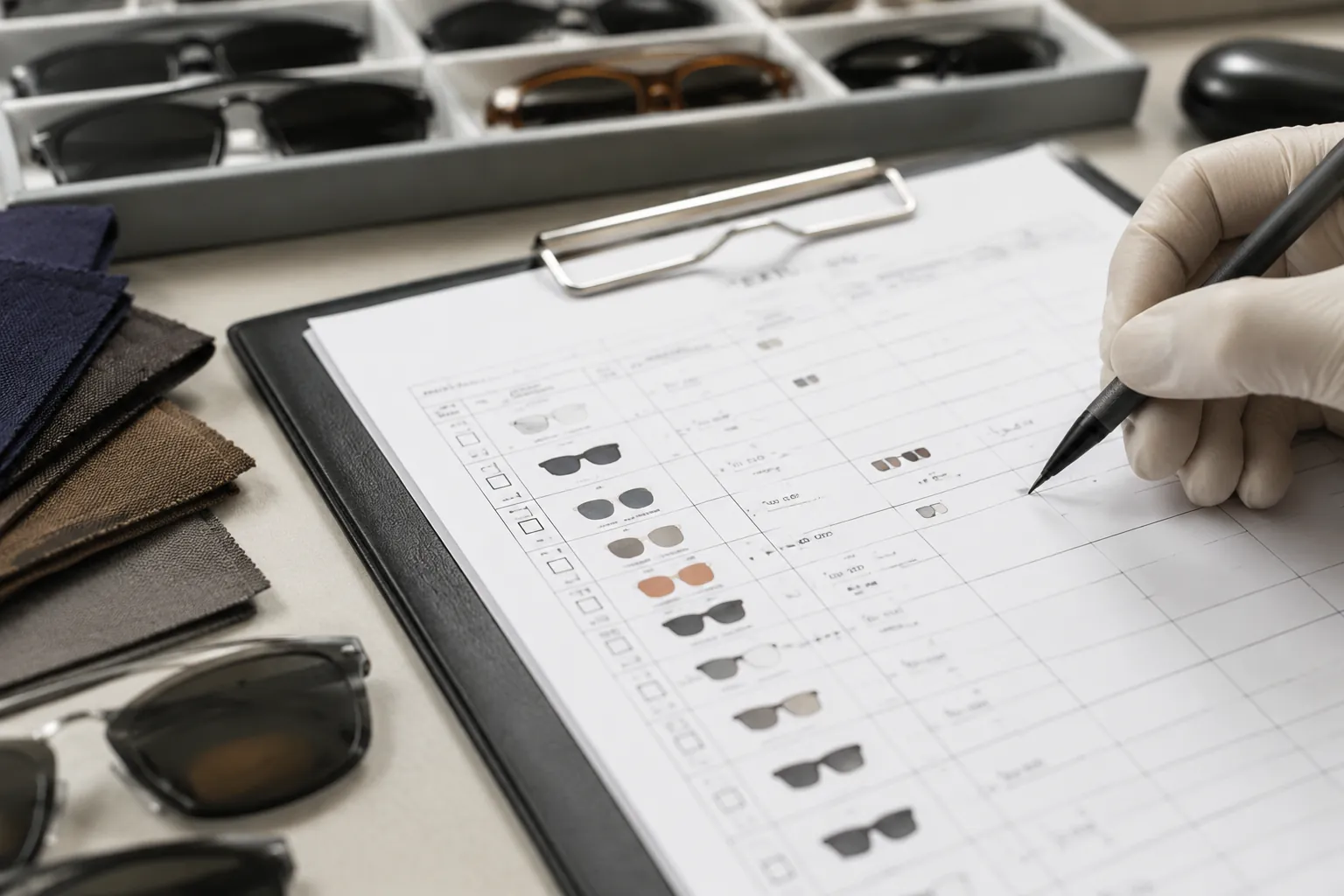
This guide helps brand owners, importers, distributors, and retailers qualify a custom sunglasses factory before sampling and price negotiation begin. The goal is simple: collect the operating details that make a quote dependable. Which steps are done in-house? Which are subcontracted? What MOQ and lead-time assumptions sit behind the price? How will decoration be controlled? Which compliance documents apply to the destination market? When a supplier answers with process facts instead of broad sales language, quote comparisons become more reliable and sourcing risk is easier to manage.
Start with process ownership before price
Many buyers ask for unit price too early. That usually produces a number that looks comparable but leaves out the variables that change cost later: tooling status, lens specification, decoration method, outsourced steps, packaging complexity, and testing requirements.
Start by asking the supplier to map the production flow for your exact product type, from material preparation to export carton. For injected sunglasses, that may include mold setup, resin drying, injection molding, trimming, polishing, hinge fitting, lens insertion, logo decoration, cleaning, packing, and final carton inspection. For acetate, the route is different: sheet cutting, CNC milling, bending, tumbling, hand polishing, wire-core insertion where applicable, hinge setting, assembly, and cosmetic inspection.
The key question is not whether the factory says it can make sunglasses. It is which steps it controls inside the same operation. If molding is in-house but lens coating, logo application, or final assembly are subcontracted, lead time control and defect responsibility get murky. Each handoff adds queue time, transport time, and another point where rework ownership can be disputed.
- Ask for a process list tied to your frame type, not a generic company profile.
- Ask which materials are processed internally, such as injected plastics, acetate, or mixed-material constructions.
- Ask which steps are outsourced, such as metal logos, mirror coating, packaging, or compliance testing.
- Ask for recent production photos or video of the actual stages relevant to your style.
If a supplier cannot explain its own process flow in sequence, treat the quote as preliminary. Simple rule. No process map, no firm comparison.
Confirm the factory can build your frame
Not every sunglasses factory is equally capable across injected plastic, acetate, and mixed-material styles. A supplier may be efficient on simple injected sport frames yet less controlled on thick acetate temples, laminated color blocks, or styles that combine plastic fronts with metal components.
Ask technical questions that reveal real manufacturing control. For injected frames, ask which dimensions are treated as critical after molding and cooling, how the factory checks for warp after conditioning, how it manages sink marks in thicker sections, and how it maintains color consistency across production batches. For acetate, ask how CNC programs are controlled, how polishing loss is managed, how lens groove dimensions are checked, and how left-right symmetry is verified after tumbling and hand polishing.
You do not need the supplier to promise a tolerance it cannot document. You do need it to identify the dimensions it measures, the inspection method used, and the point in production where the check is made. That is far more useful than a vague claim of "high precision."
| Frame Type | Main In-House Processes to Verify | Typical Risk | Technical Questions to Ask |
|---|---|---|---|
| Injected plastic | Mold development, resin drying, injection molding, trimming, polishing, assembly | Warping, sink marks, color inconsistency | Ask which molded dimensions are checked after cooling, how long parts condition before assembly, and how machine settings are recorded and reviewed. |
| Acetate | Sheet cutting, CNC milling, bending, tumbling, hand polishing, assembly | Poor edge finish, uneven lamination, groove inconsistency | Ask how CNC offsets are controlled, how groove dimensions are verified, and how material removal during polishing is monitored. |
| Mixed material | Base frame processing plus metal fitting, hinge setting, component matching | Loose joints, cosmetic mismatch, alignment drift | Ask which joining steps are internal, how fit between metal and plastic parts is checked, and how assembly strength is verified before packing. |
| Private label decorated styles | Base frame production plus engraving, pad printing, plate fitting | Logo wear, placement shift, fallout | Ask which decoration method is used for the substrate, how placement is controlled, and what internal adhesion or durability check is applied before release. |
This discussion also clarifies MOQ reality. A supplier may accept a small run on an existing frame with stock lenses and simple logo application, but that does not mean the same MOQ works for a new acetate shape, a custom mold, or a decorated mixed-material style.
Verify capacity with useful numbers
Capacity claims only matter when they connect to your order profile. A large annual output figure does not tell you whether your style will get machine time during peak months, whether decoration is a bottleneck, or whether your packaging format will slow final packing.
Ask for operational numbers that relate to your program. How many injection machines are used for eyewear parts? How many CNC stations are used for acetate? How many assembly lines or assembly workers support sunglasses production? How is logo application handled, and is that step internal or subcontracted? Ask the factory to explain how it would schedule a style similar to yours after sample approval.
Lead times should also be broken down by assumption. Ask what the quoted sample lead time includes: existing tooling or new tooling, stock lens option or custom lens, standard packaging or custom packaging, and one logo version or multiple artwork changes. Then ask what events extend bulk lead time, such as tooling development, outsourced coating, custom metal logos, packaging approval, or third-party inspection booking.
- Ask what the quoted sample lead time includes: tooling status, logo scope, lens specification, and package type.
- Ask what extends bulk lead time: new tooling, custom coatings, mixed color ratios, packaging approvals, or inspection scheduling.
- Ask how production slots are reserved during peak months and whether booking happens before or after sample approval.
- Ask how on-time delivery is measured: actual ship date against the committed ship date, not only factory-finished date.
If two suppliers quote similar lead times but one includes outsourced coating, custom packaging, and testing while the other assumes stock materials and standard packing, the numbers are not directly comparable. Compare the assumptions. Not the headline.
Understand MOQ and price logic
MOQ is not just a sales threshold. It usually reflects setup loss, machine utilization, decoration changeover, packaging preparation, and the commercial risk of custom materials that cannot easily be reused on another order.
For straightforward private label sunglasses using existing molds and standard lenses, a factory may accept a relatively small run. But that often comes with limits, such as restricted colorways, standard packaging, or one logo position only. As order volume rises, unit cost may improve because setup cost, material purchasing, and labor allocation are spread more efficiently across the run.
Ask the factory to separate the parts of the quote that you can actually control: frame, lens, decoration, packaging, tooling if any, and test cost if required. You do not need a full internal cost sheet. You do need enough visibility to understand which change requests will affect the price.
| Order Level | Typical Commercial Logic | What Often Stays Fixed | Buyer Checkpoint |
|---|---|---|---|
| 50 pairs | Entry run using stock materials or existing tooling | Setup loss, artwork preparation, and handling cost often stay high per unit | Confirm whether standard lens colors, one logo version, and simple packaging are required. |
| 300 pairs | Better labor allocation and lower material waste per unit | Custom logos, special pouches, and testing may still be charged separately | Ask whether MOQ applies per colorway, per logo version, or per shipment lot. |
| 1,000 pairs | More efficient machine scheduling and stronger material purchasing leverage | Polarized lenses, mirrored lenses, or upgraded packaging can still add cost | Ask for separate pricing by lens type and by packaging option. |
| 5,000 pairs | Best use of machine time, assembly batching, and bulk material ordering | New molds and product testing frequently remain outside the basic unit price | Check whether the lowest price assumes one color, one barcode set, and one delivery destination. |
Watch headline pricing that arrives without assumptions. A low unit price is not useful if it leaves out tooling, decoration, packaging, or the compliance work needed for the target market.
Inspect decoration like a production engineer
Decoration is where many private label programs lose margin. The frame itself may be fine, but the branding can wear off, sit crooked, or vary visibly between left and right temples.
Common methods include laser engraving, pad printing, and metal logo plates. Laser engraving can be durable when the substrate and surface finish provide clear contrast, but the visual result depends heavily on the material and finish. Pad printing is flexible and widely used for logos, but ink adhesion, curing control, and surface preparation matter. Metal logo plates can create a premium look, yet they add another fit-and-fixing process that must be controlled carefully.
Ask for measurable controls. Ask how first-piece approval is documented, whether jigs or fixtures are used to position artwork, and what internal adhesion or appearance checks are done before bulk packing. For metal plates, ask whether the recess is molded or machined, how the plate is fixed, and how the factory checks that the logo remains secure through handling and packing.
- For laser engraving, ask about line clarity, consistency on curved surfaces, and how position is checked.
- For pad printing, ask what ink system is used, how curing is controlled, and what adhesion check is applied after curing.
- For metal logo plates, ask how the plate is fixed, how the recess dimension is controlled, and how the factory checks for fallout risk.
- For combined decoration, ask the process sequence because polishing, cleaning, or heat exposure after decoration can affect appearance or adhesion.
A capable supplier should also be able to show examples of common decoration defects, such as misprint, offset placement, scratches, or loose logo plates, and explain the containment method used before packing.
Check QC depth, not just the claim
Every supplier says it has QC. That means little unless you know where checks happen, what is recorded, and what defects trigger rework or rejection.
For custom sunglasses, control should start at incoming material. Resin color, acetate sheet appearance, lens quality, metal hardware finish, and logo component dimensions all affect the final result. In-process checks should cover the features that matter for fit, function, and appearance, such as molded part dimensions, groove quality, frame alignment, hinge action, lens fit, and decoration placement. Final inspection should verify cosmetics, function, labeling, package accuracy, barcode, and carton count.
Ask how many checkpoints exist from raw material receipt to shipment. Ask what is checked on every piece and what is checked by sampling. A useful answer might describe incoming material approval, first-piece verification at machine start, in-process inspection during production, cosmetic screening before packing, and final shipment audit against an agreed standard. That level of detail is far better than a broad claim of "strict QC."
Also request the inspection standard before bulk production starts. Without agreed appearance criteria, labeling requirements, and packing requirements, buyers and factories often argue about problems that should have been defined earlier.
Match compliance documents to the market
Compliance should be addressed before sample approval and well before packaging is printed. Different markets require different product standards, labeling expectations, and chemical compliance controls, and not all documents answer the same question.
For sunglasses, buyers commonly review CE EN ISO 12312-1 for relevant European product requirements, ANSI Z80.3 for the United States, AS/NZS 1067 for Australia and New Zealand, REACH for restricted substances where applicable, and FDA registration where relevant to the product and sales channel. ISO 9001 and BSCI can support factory evaluation, but they do not replace product-specific test reports for the sunglasses being purchased.
Ask for current documents that match the actual product family as closely as possible. Check the issuing laboratory or organization, issue date, model description, lens category where applicable, and whether the tested construction still matches what will ship. If the final order changes lens tint, mirror coating, material, or labeling, earlier documents may no longer be enough for your risk review.
One practical rule is simple: never accept a management-system document as a substitute for a product test report. They serve different purposes. A factory can hold ISO 9001 or complete a BSCI audit and still need separate evidence that the sunglasses meet the relevant product and chemical requirements for the destination market.
What to ask before sampling
The best RFQ is short, technical, and hard to misread. Before paying for samples, make the factory answer the variables that drive feasibility, price, timing, and compliance risk.
- State frame material, lens requirement, colorways, target market, and required packaging format.
- Ask whether the style uses existing tooling or needs a new mold, new CNC program, or custom logo fixture.
- Confirm MOQ by colorway and by logo version, not only by total style quantity.
- Confirm sample timing and ask which assumptions are built into that timing.
- Confirm bulk timing after sample approval and ask which events would extend it.
- Request the exact compliance documents relevant to your market before final sample sign-off.
- Ask for QC checkpoints, decoration approval criteria, and packaging inspection points in writing.
The point of this checklist is not to slow sourcing down. It is to remove avoidable ambiguity before the first firm quote lands in your inbox. When a supplier answers with process steps, written assumptions, and applicable documents, you are more likely to get a quote that survives sampling and turns into a workable bulk order.
Have a custom sunglasses project in mind?
Send us your styles, target market and quantities and we will return a detailed quote with MOQ, lead time and a sample plan.
Get a QuoteWhy source this from Wenzhou with LumiShades
Wenzhou in Zhejiang Province is widely regarded as China’s eyewear manufacturing capital, producing a large share of the world’s sunglasses. That concentration matters to buyers: a deep local supply chain for acetate sheet, hinges, lens blanks, plating and packaging means shorter component lead times, easier color and material matching, and a workforce with decades of eyewear-specific skill. LumiShades has manufactured in this ecosystem since 2009, and our vertical integration — in-house injection molding, acetate cutting, CNC milling, lens tinting, decoration and quality control — means no part of your order is quietly subcontracted to a workshop you cannot audit.
For international buyers, that vertical control translates into accountability. When a single factory owns every step, defects are traced and fixed at source rather than bounced between vendors, and your specifications survive intact from first sample to bulk. For procurement review, buyers can request process records, approved samples, quality checkpoints and project-specific compliance files before placing a bulk order. Required testing and documentation are confirmed against the destination market and product specification rather than assumed from a generic certificate list. Explore our manufacturing capabilities and quality control process to see how this works in practice.
Frequently asked questions
What is the first red flag when a sunglasses factory sends a quote too quickly? The first red flag is a firm price issued before the supplier confirms the core variables: frame material, lens specification, decoration method, packaging, quantity split, tooling status, and destination market. Ask the supplier to restate these assumptions in writing. If it cannot or will not do that, treat the quote as preliminary and do not compare it directly with more detailed offers.
Is 50 pairs per design a realistic MOQ for custom sunglasses? It can be realistic for a simple private label program built on existing tooling with standard lenses, limited color options, and basic logo application. It is much less realistic when the style needs a new mold, acetate machining, custom metal logos, special packaging, or market-specific testing. Ask the supplier whether the MOQ applies per style, per colorway, per logo version, and per shipment, because those details change the commercial reality.
How should I compare suppliers on lead time? Compare lead time only after aligning the assumptions behind it. Confirm whether each quote includes approved samples, final artwork, packaging approval, deposit receipt, testing requirements, and any outsourced steps such as coating or logo plates. Ask each supplier to break lead time into sample stage, material preparation, production, inspection, and shipment readiness. That makes differences visible and easier to challenge.
Which certifications and documents matter most for export sunglasses? The answer depends on the destination market and sales channel, but buyers commonly review CE EN ISO 12312-1, ANSI Z80.3, AS/NZS 1067, REACH, and FDA registration where relevant. ISO 9001 and BSCI are useful supporting documents for factory evaluation, but they are not substitutes for product-specific test reports. Ask for documents that match the actual frame and lens combination you plan to buy, then verify the model description, date, and issuing body.
What decoration method is safest for long-term logo durability? There is no single safest method for every frame. Laser engraving is often durable when the material and finish create clear contrast. Pad printing can perform well when the correct ink system, surface preparation, and curing controls are used. Metal logo plates can be durable if the recess fit and fixing method are engineered and checked properly. The practical buying step is to ask for the exact decoration method, the factory's internal adhesion or retention check, and a production sample that uses the same substrate and finish as bulk.
Ready to start?
Explore our wayfarer sunglasses or request a quote — our sales team replies within 12 hours.
Request a Quote