
Spare Parts Planning for Sunglasses Programs
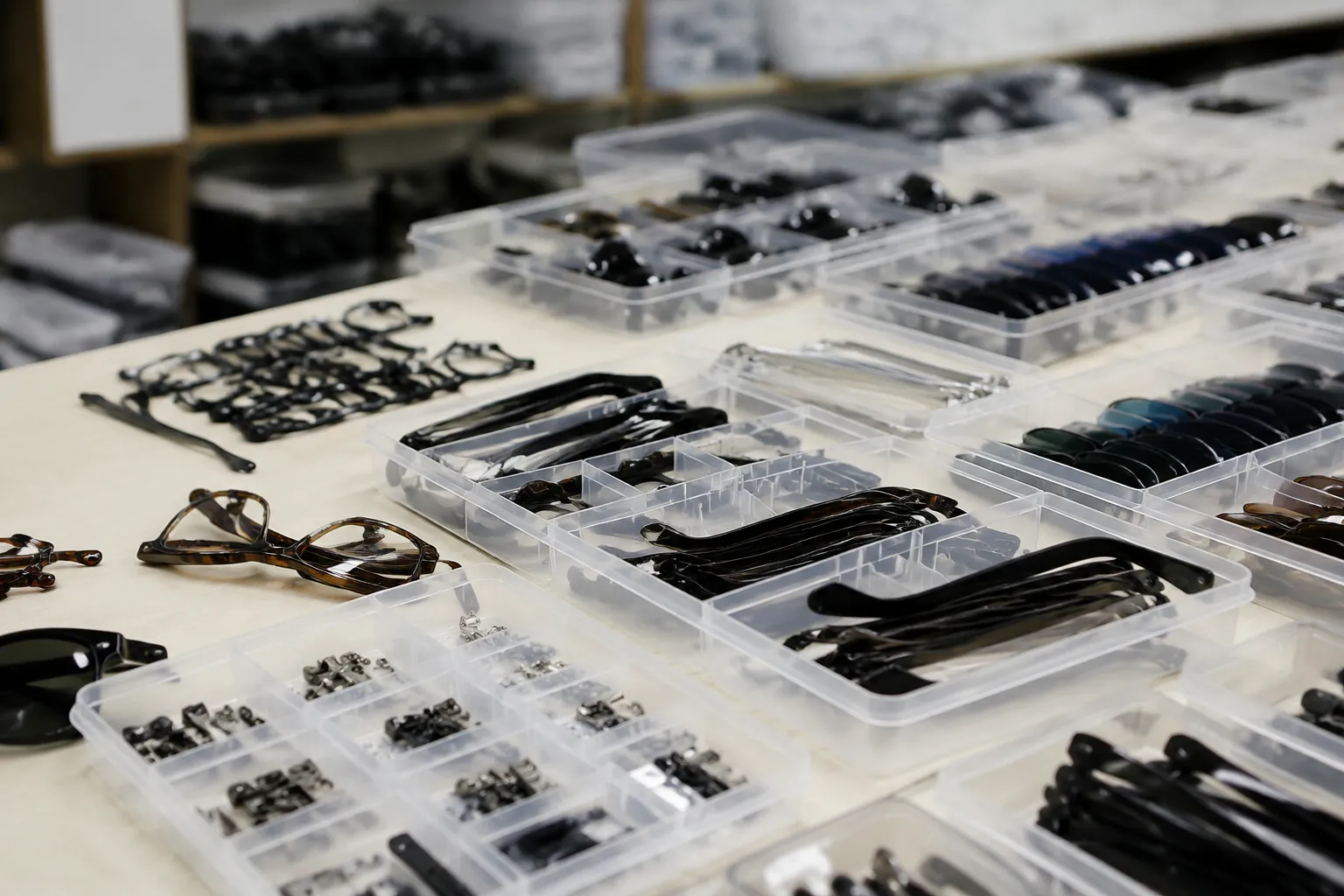
This guide is for brand owners, importers, distributors, and retailers sourcing sunglasses in volume. If a program includes only finished pairs and no planned service parts, minor failures can turn into full-pair credits, extra freight, and avoidable friction with customers. Plan the parts early. A basic spare-parts file set during sample approval and purchase-order review makes repairs faster, supports repeat styles, and improves cost control. The principle is simple: treat common service parts as planned items with codes, specifications, and storage rules, not as last-minute purchases after claims start.
Plan service parts before bulk production
Most buyers focus first on unit price, MOQ, lead time, and shipment date. Fair enough. But those points do not capture the full operating cost of a sunglasses program. After delivery, many of the most common issues are small component failures: loose screws, worn nose pads, detached trim, or lenses damaged in handling. If no spare parts were defined in advance, the service team may have only one option left: replace the whole pair.
The best time to plan service parts is before bulk production starts. At that stage, the approved sample, drawings, material selections, hinge specification, pad shape, trim details, and color references are still current. Easy to verify. Once a style is reordered, revised, or moved across material lots, matching an exact replacement gets slower and more expensive.
For private-label, importer, and distributor programs, early planning supports three practical goals. First, it creates a lower-cost repair path for common service issues. Second, it helps keep repeat styles sellable across more than one season. Third, it reduces the need for one-off remakes and urgent parcel shipments, which usually have poor unit economics.
This does not require a huge inventory. It requires control. Decide which parts are worth stocking, how they will be specified, and how they will be packed, labeled, and replenished. The first production run is usually the easiest point to make those calls because the production file is still being finalized.
Which parts usually need after-sales stock
Do not try to stock everything. Start with parts that are commonly lost, regularly handled during repair, or likely to wear in normal use. In many sunglasses programs, the main service burden comes from small hardware and fit-related parts, not complete frame breakage.
Hinges and screws usually come first. Temple screws can loosen over time, and repair becomes difficult if the exact diameter, length, head type, or finish is unknown. For spring-hinge constructions, consider stocking both screws and complete hinge assemblies where replacement is realistic. Spring mechanisms have more than one wear point.
Nose pads matter on metal frames and mixed-material constructions with adjustable pad arms. Pads can discolor, harden, tear, or fall off. Small part, big effect. Exact replacement matters because minor changes in shape, thickness, or mounting type can alter fit and comfort.
Decorative trim such as logo plates, rivet-style accents, or applied branding parts deserves attention on higher-value lines. If a visible branding part detaches, the pair may still function but no longer be fit for retail presentation.
Replacement lenses can be worth stocking for proven repeat styles, but they need tighter control than other parts. Lens shape, base curve, tint, coating, and performance must match the approved model. For that reason, lens reserves are usually best limited to top sellers or styles with steady repeat demand.
A practical starting list for most sunglasses programs is:
- Temple screws by size, length, and finish.
- Front hinge screws if different from temple screws.
- Complete hinges for acetate and metal styles.
- Nose pads by shape, size, and attachment type.
- Logo plates or trim pieces for premium styles.
- A limited lens reserve for top sellers only.
Keep the list tight. Service stock works best when it covers predictable needs, not every theoretical part for every slow-moving style.
Set part numbers and specs at sample stage
If a spare part cannot be identified fast, it will not be used well. The fix is simple: create a service-parts sheet during sample approval. Each service item should have its own part code linked to the finished style code, color code, and revision level. Keep that file with the main technical pack so sourcing, QC, and warehouse teams all work from the same record.
For screws, record diameter, length, head type, thread form, finish color, and drive type. For hinges, note material, barrel configuration, closed and open dimensions, hole spacing, and whether left and right parts differ. For nose pads, record shape, length, width, thickness, transparency level, material, and mounting type, such as push-in, screw-on, or clip-on.
Color and decoration also need traceable references. Acetate, injected components, plated trim, and printed parts can shift in shade or gloss if remade without a retained standard. Keep approved color chips, signed samples, and decoration references on file. For printed or decorated parts, attach the artwork file, color reference, and application method to the part record.
Tolerances should be clear enough for service use. No more. No less. A service-part specification does not need excess detail, but it should define the dimensions and appearance checks that determine whether a replacement part is acceptable. For example, buyers can require screw length, hole spacing, pad thickness, and visible finish to be checked against the approved reference sample and the relevant drawing.
The goal is consistency. Part codes, retained samples, and clear specifications let both the factory and the buyer verify fit and finish before parts go into service stock.
How many spare parts to buy with each order
There is no universal ratio for service stock. Do not treat any percentage as a rule. The right quantity depends on annual volume, frame construction, claim history, channel expectations, and warranty policy. A limited boutique order does not need the same reserve strategy as a national distributor program.
A better method is to estimate need by component risk and by style family. Frames with spring hinges may justify more hinge-related reserve than simple injected sport styles. Metal frames with adjustable pads usually justify more pad reserve than full-plastic constructions. Premium styles with applied trim may justify a small trim reserve if the branded component will be hard to remake later.
| Part type | Suggested starter ratio | Best use case | Notes |
|---|---|---|---|
| Temple screws | 1.5% to 3% of pair qty | All styles | Low cost, easy to store, include extra for spring hinges |
| Complete hinges | 0.5% to 1% | Acetate and metal styles with higher stress | Stock left and right separately if the design is asymmetric |
| Nose pads | 2% to 4% | Metal frames and adjustable-pad styles | Useful where pad wear, discoloration, or loss is a known service issue |
| Logo plates or trim | 0.3% to 0.8% | Premium branded styles | Best for parts that are difficult to remake consistently later |
| Replacement lenses | 0.5% to 1.5% | Top-volume repeaters | Confirm lens performance, tint, base curve, and coating match before stocking |
These ratios are starting points only. Validate them against actual returns data. On small orders, parts may be packed as loose service stock rather than held as formal inventory. On larger runs, adding a controlled reserve during the same production cycle is often easier than arranging a later remake because the materials and production references are already active.
One more check matters: compare the cost of carrying each spare-part category with the landed cost of a full-pair replacement and the service expectations of the sales channel. That gives procurement teams a better basis for decision than a fixed percentage alone.
Build the parts plan into cost, MOQ, and lead time
After-sales parts get expensive when they are treated as exception orders. Avoid that. Quote them alongside the finished style and include them in the purchase-order structure. Once part codes, quantities, and packing rules appear in the commercial file, the supplier can plan materials, production time, and packing in a controlled way.
Buyers should ask suppliers to present service parts in one of three formats:
- Included in total style cost as a defined service reserve.
- Quoted as a separate line item by part code and quantity.
- Packed as a standard spare-part kit per carton or per style.
For most procurement teams, the separate line-item method is easiest to audit and replenish because it ties usage directly to style codes and warranty cost. It also makes repeat-order comparisons clearer.
Discuss lead time at the same moment. Spare parts confirmed during sample approval can usually be checked and packed with bulk production. If they are requested only after delivery, the supplier may need to reconfirm fit, finish, available material, and minimum practical production quantity. That adds time. It also adds cost.
When evaluating suppliers, buyers can also request supporting process controls such as Management-system documents available for project reviews or BSCI social compliance documentation where relevant to supplier qualification. Those certifications do not replace technical verification of the parts themselves, but they can help indicate whether documentation and process discipline are likely to be maintained.
Do not ignore compliance and fit risks
Spare parts are small, but the risk is not. Lenses are the clearest example. If a lens is replaced, the new part should still meet the applicable standard for the approved model, such as CE EN ISO 12312-1, ANSI Z80.3, or AS/NZS 1067, depending on market and product claim. A lens that looks similar but performs differently can create a real product-claim issue.
Material chemistry matters too. Nose pads, coatings, paints, and adhesives used in trim should stay aligned with the chemical requirements already cleared for the product, including REACH where applicable. Do not assume a visually similar replacement from another source is equivalent without documentation and fit testing.
For importer qualification files, some buyers also request FDA registration details from suppliers as part of general vendor documentation. Where that forms part of the buyer's internal process, spare-parts documentation should be managed with the same discipline as the main product file: part identification, material declaration where required, and traceability to the approved style.
Mechanical fit matters just as much. Incorrect screw hardness, inaccurate hinge hole spacing, poorly matched trim dimensions, or lens shape variation can create repeat failures during repair. QC on spare parts should therefore check, at minimum, dimensional fit, finish match, and functional assembly against a retained reference sample. For lenses and decorated parts, add visual inspection under consistent lighting and a basic assembly check on the intended frame.
Pack, label, and track service stock properly
Good planning still fails if warehouse control is weak. Service parts are small, easy to mix, and expensive to sort once they are blended. The simplest safeguard is full traceability from each service unit back to the style and revision that produced it.
Each bag or box should be labeled with the style code, part code, color, quantity, production date, and purchase-order reference. Add left-right orientation where relevant. For screws, include size, thread, and finish. For nose pads, include shape, material, and attachment type. For lenses, include lens color and any side-specific identification if the geometry is not symmetrical. If the part is plated, printed, or otherwise decorated, record the finish or decoration reference used for approval.
Distributors should also decide in advance where service stock will be held. A single central service location gives stronger stock control. Regional kits may shorten response time to key accounts. The right model depends on claim volume, shipping cost, and customer-service commitments, but the choice should be made before returns begin.
A simple operating method works well:
- Reserve a small portion of each bulk shipment as service stock on arrival.
- Store service stock separately from saleable finished goods.
- Issue parts by claim reason so failure patterns can be tracked.
- Review usage every quarter and adjust reserve ratios on the next PO.
This turns service stock into operating data. Over time, buyers can see which parts are genuinely useful, which materials drive recurring complaints, and which styles do not justify ongoing spare-part support.
Use after-sales data to improve the next run
A spare-parts plan should do more than support repairs. It should show where the product or process needs work. If one style uses an unusual number of screws, review hinge fit, torque control, and hardware specification. If pad complaints are frequent, review material selection, mounting method, and storage conditions. If trim keeps detaching, review the mechanical design, recess geometry, or bonding method. If replacement lenses are often rejected, compare shape, tint, base curve, and coating consistency against the retained approved sample.
For buyers, the value is direct: better service data supports cleaner reorders, clearer supplier discussions, and more realistic decisions about which styles deserve long-term support. A style that needs constant special handling may not be as profitable as its sales volume suggests.
Simple rule: if a style is important enough to reorder, it is important enough to have a spare-parts file.
That is the point. Turn after-sales activity into a controlled process instead of a reactive cost center. Better repairs matter, but better buying decisions matter more.
Have a custom sunglasses project in mind?
Send us your styles, target market and quantities and we will return a detailed quote with MOQ, lead time and a sample plan.
Get a QuoteWhy source this from Wenzhou with LumiShades
Wenzhou in Zhejiang Province is widely regarded as China’s eyewear manufacturing capital, producing a large share of the world’s sunglasses. That concentration matters to buyers: a deep local supply chain for acetate sheet, hinges, lens blanks, plating and packaging means shorter component lead times, easier color and material matching, and a workforce with decades of eyewear-specific skill. LumiShades has manufactured in this ecosystem since 2009, and our vertical integration — in-house injection molding, acetate cutting, CNC milling, lens tinting, decoration and quality control — means no part of your order is quietly subcontracted to a workshop you cannot audit.
For international buyers, that vertical control translates into accountability. When a single factory owns every step, defects are traced and fixed at source rather than bounced between vendors, and your specifications survive intact from first sample to bulk. For procurement review, buyers can request process records, approved samples, quality checkpoints and project-specific compliance files before placing a bulk order. Required testing and documentation are confirmed against the destination market and product specification rather than assumed from a generic certificate list. Explore our manufacturing capabilities and quality control process to see how this works in practice.
Frequently asked questions
Should I buy spare parts for every sunglasses style? No. Prioritize styles likely to repeat, styles with higher retail value, and constructions with common service points such as spring hinges, adjustable nose pads, or applied trim. Start with past claim data by style family, then assign service stock only where repair is commercially justified. For slower-moving designs, ask the supplier to retain drawings, approved samples, and part specifications even if you do not hold physical stock.
What is the best time to confirm spare parts with the factory? Confirm them during sample approval and before bulk PO release. At that point, the approved sample, material references, hinge details, pad type, trim finish, and lens specification are still current. Ask the supplier to issue a service-parts sheet with part codes, descriptions, quantities, labeling rules, and any fit-critical notes, then attach that sheet to the main PO file.
Can replacement lenses be sourced later from a different supplier? Yes, but treat it as a technical requalification task, not a simple replacement purchase. The new lens must match the approved lens shape, base curve, tint, coating, and the relevant performance standard for the model, such as CE EN ISO 12312-1, ANSI Z80.3, or AS/NZS 1067 where applicable. Before buying, request drawings, material details, test documentation where required, and a physical fit check on the original frame.
How should spare parts be packed for distributor use? Pack them in labeled bags or boxes by style code and part code, then add color, quantity, production date, and PO reference for traceability. Include left-right identification for asymmetric parts, and add technical identifiers that matter in service use, such as screw size and finish, pad mounting type, or lens color. Keep service stock physically separate from saleable finished goods and record every issue by claim reason.
Do spare parts usually have the same MOQ as finished sunglasses? Not always. Small components are often easier to add to the main production run in practical quantities than to reorder later as standalone items. Ask the supplier for the minimum efficient quantity for each part category, whether parts can be packed as a service kit with the bulk order, and whether replenishment pricing changes once the original materials or setup are no longer active.
Ready to start?
Explore our aviator sunglasses or request a quote — our sales team replies within 12 hours.
Request a Quote