
Low-MOQ Custom Sunglasses for Event Merch Buyers
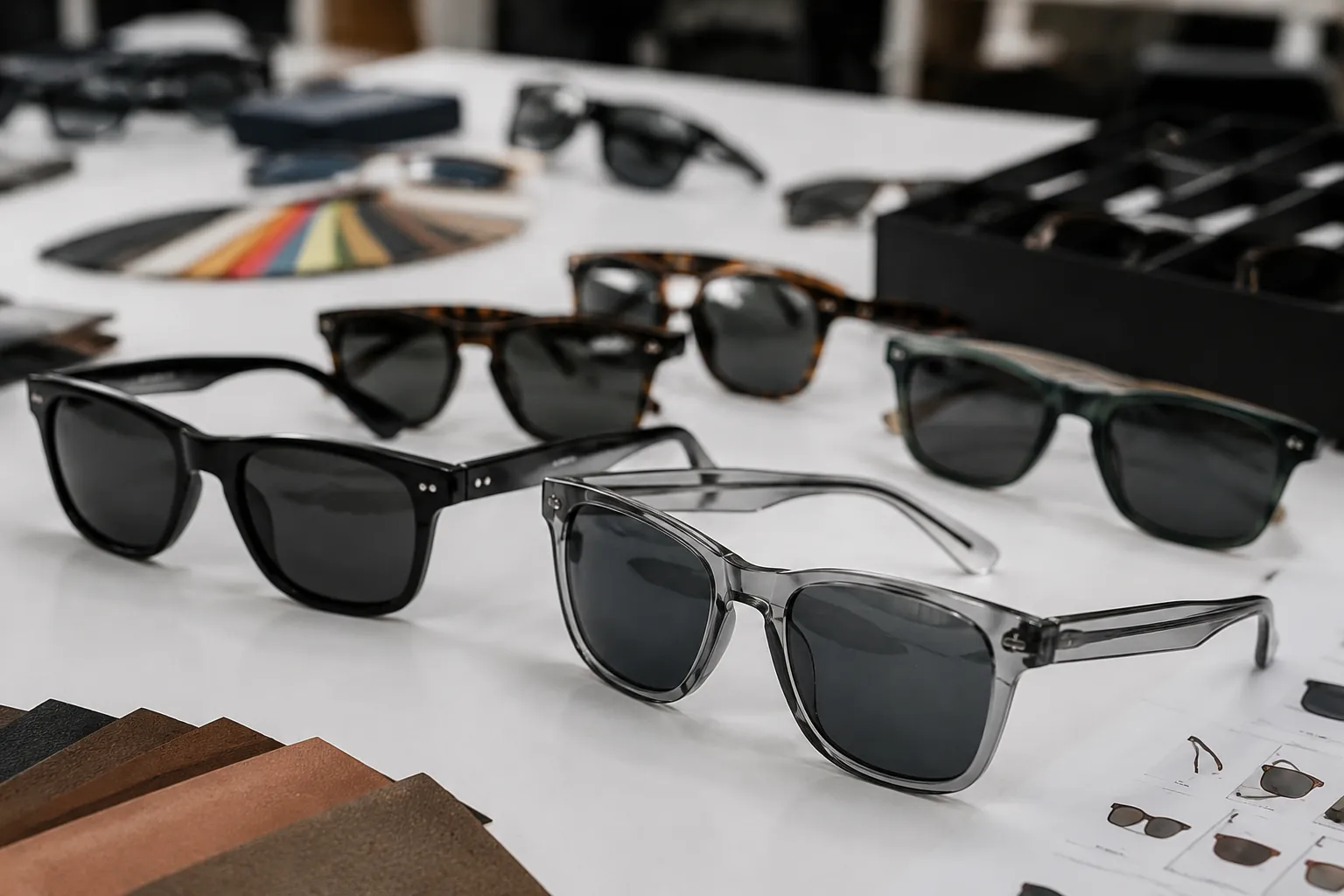
This guide is for buyers sourcing custom sunglasses for an event, campaign, retail test, or short seasonal run without committing to a large volume. In the 50 to 300 pair range, the issue is usually not whether a supplier will take the order. It is whether the spec is clear, simple, and realistic enough to quote, sample, approve, and deliver on time. At low volume, setup work, manual handling, and approval rounds have a bigger effect on unit cost and timeline than many first-time buyers expect. The goal is simple: launch fast with a product that looks deliberate, fits the use case, and meets the rules of the destination market.
Why 50 to 300 pairs is a different sourcing job
Small-batch custom sunglasses sit between two very different buying models: off-the-shelf promo eyewear and full private-label production. At 50 to 300 pairs, most buyers are working from existing frame platforms and standard decoration methods, not developing new molds or changing frame structure.
The reason is simple. Fixed setup tasks still apply on a small run. Artwork prep, print setup, sample making, packaging confirmation, and final QC all take time whether the order is 80 pairs or 8,000. With fewer units to spread that work across, each extra step shows up quickly in both price and schedule.
That is why the easiest low-volume orders usually stick to one proven frame, one lens tint, one main logo position, and one packaging format. More variation is possible. It just costs more time.
For event merch, speed usually comes from reducing variables, not chasing the lowest stated MOQ. A supplier may accept a small order, but the project can still drag if the brief is incomplete or the spec keeps changing during sampling.
Start with the right product architecture
Before asking for a firm quote, lock the product architecture: frame material, lens type, decoration method, and packaging. If those points are still open, most suppliers can only give a rough estimate.
For speed and cost control, injection-molded frames are often the practical choice at 50 to 300 pairs. They are widely used, generally consistent, and easier to decorate at low volume than more labor-heavy materials. Acetate can look more premium, but it usually involves more handwork and inspection. Ask whether that upgrade is really needed for the intended price point or brand position.
Keep lenses simple unless the concept clearly requires otherwise. Standard tints such as smoke, brown, green, or blue are usually easier to source, match, and approve than less common fashion colors. If the destination market requires a specific lens category or labeling approach, confirm the exact lens spec. Do not rely on appearance alone.
- Fastest route: existing injection frame, standard PC lens, one-color pad print, microfiber pouch or polybag.
- Best low-volume premium option: acetate frame, standard tinted lens, laser engraving or a small logo detail only if the supplier confirms suitability.
- Best for tight budgets: one frame color, one lens tint, one logo location, stock carton format.
- Highest delay risk: multiple color splits on a small order, custom hardware, lens changes after sample approval, or repeated artwork revisions.
Stock components and proven processes move faster. That trade-off is usually worth it on a deadline-driven event order.
Where the money moves on a small run
At low MOQ, price is shaped by more than frame and lens material cost. Setup time, labor, yield risk, and the number of production steps matter just as much. A product that looks only slightly more complex to the end customer can cost noticeably more if it needs extra decoration, added cleaning, special inserts, or more manual checking.
So compare prices against the exact build being quoted. Do not benchmark a 100-pair event order against high-volume pricing from a different program. The better question is this: which spec gives the strongest branded result without adding avoidable handling and setup cost?
| Order Size | Typical Use Case | Cost Behavior | Most Efficient Spec |
|---|---|---|---|
| 50 pairs | VIP event, influencer seeding, limited promo | Highest unit cost because setup and QC are spread across very few units | Stock frame, one logo position, stock pouch or polybag |
| 100-150 pairs | Event merch, launch gift, small campaign | Better balance of branding and cost, but still sensitive to complexity | One frame color, one lens tint, simple print or engraving |
| 200-300 pairs | Retail test, multi-city event, small reseller program | More room to absorb selected upgrades if the margin supports them | Consider better packaging or one additional branding touch only if necessary |
| 1000+ pairs | Reorder program, national promotion | Setup cost is less dominant and more customization may become economical | Review broader color options, trims, and packaging upgrades |
Decoration method is one of the clearest cost levers. Pad printing is usually the most economical option for simple logos. Laser engraving can be more durable or more understated, depending on the frame material and surface. Metal logo plates can create a stronger retail look, but they also add component sourcing, alignment checks, and assembly work.
If budget is tight, spend on what people actually notice: frame shape, lens tint, and clean logo placement. Hidden complexity rarely adds much value to event merch.
Branding methods that make sense at low MOQ
Small orders do not need lots of branding elements. They need one branding element that is visible, suitable for the frame, and repeatable in production. In most cases, the outer temple is the best primary branding position because it is easy to see when worn and easy to inspect during QC.
Pad printing is common on low-volume branded sunglasses because setup is relatively simple and the method works well for straightforward temple logos. But the artwork still has to fit the process. Fine lines, tiny reversed details, or logos placed across a strongly curved surface may not reproduce cleanly. Laser engraving can work well for subtle branding on compatible materials. Metal logo plates can look more premium, but on small runs they create more approval points around size, position, and attachment quality.
Keep expectations realistic. Low-volume production can be consistent, but placement tolerance still needs to be agreed in advance. Review the logo on the actual frame, not just in artwork. A logo that looks balanced in a PDF can sit too high, too low, or too close to the hinge on the finished product.
- Choose one primary branding location, usually the outer temple.
- Keep artwork line weight appropriate for the selected decoration method and surface texture.
- Approve logo size and position on the real frame, not only on a screen.
- Confirm ink color or engraving appearance early, especially for white, metallic, or brand-matched finishes.
- Ask the supplier to check print adhesion or engraving consistency during sampling.
On a low-MOQ event order, one clean logo usually works better than several weak details.
Compliance is not optional
Promotional sunglasses are still sunglasses. If the product is being distributed as eyewear in a destination market, compliance needs to be part of the brief from day one. Lens category, product markings, and supporting documents should match the exact product configuration being shipped.
Depending on the market and the program, buyers may need to discuss standards or documentation such as CE EN ISO 12312-1, ANSI Z80.3, AS/NZS 1067, REACH, FDA registration, ISO 9001, and BSCI. Use these terms carefully. Product standards and material-regulation references are not the same as factory management certifications or social-audit frameworks, and not every document applies to every order.
For Europe, buyers often ask about CE EN ISO 12312-1 and REACH where relevant. For the US, buyers commonly ask about ANSI Z80.3 and may request clarification on FDA registration status where relevant to the supplier or product category. For Australia and New Zealand, AS/NZS 1067 is a common reference. Confirm with the supplier which documents apply to the exact frame-and-lens combination being ordered for the intended market.
Late changes create risk here. If you change lens tint, lens material, mirror coating, or another key spec after sample approval, the compliance position may need to be checked again. Lock the lens spec early. Record it clearly. Keep bulk production aligned to that approved build.
A realistic launch timeline and how buyers lose days
Low-MOQ sunglass projects usually move through four stages: quotation, sample development, bulk production, and pre-shipment QC. Timing varies by supplier, season, complexity, and approval speed. Still, small orders move fastest when the brief is complete and feedback is quick.
| Stage | Typical Time | What Must Be Locked | Most Common Delay |
|---|---|---|---|
| Quotation | 1-3 days | Frame reference, quantity, logo method, destination market | Incomplete brief or unclear compliance target |
| Sample | Varies by supplier and complexity | Artwork, frame color, lens spec, packaging direction | Repeated artwork edits or color changes |
| Bulk Production | Varies by supplier and complexity | Approved sample, deposit, final packing standard | Late sign-off, changed materials, or split-color requests |
| Pre-shipment QC | Final days before dispatch | Carton marks, assortment, inserts, shipping details | Last-minute label or carton revision |
Most delays start on the buyer side. Missing vector logo files, no agreed color reference, packaging left undecided until after sampling, or internal sign-off on logo before frame color is final can all stop production or force rework.
If the event date is fixed, build in non-factory time too. Freight booking, customs clearance, domestic delivery, and final venue distribution all affect the real arrival date. Work backward from the in-hand date, not the factory finish date.
What to check in sampling and QC
Sample approval needs discipline, especially on a 50 to 300 pair order where inconsistency is easier to spot. Do not approve a sample based only on the logo. Check the full product against the agreed spec, including cosmetics, assembly, lens consistency, and packing.
- Frame finish: check for sink marks, flow lines, rough parting lines, polishing quality, color uniformity, and visible scratches.
- Lens review: confirm tint consistency, left-right color match, cosmetic cleanliness, and scratch visibility under angled light.
- Decoration: inspect logo placement, edge sharpness, ink density, engraving clarity, and left-right alignment.
- Assembly: open and close both temples repeatedly to assess hinge tension, symmetry, and basic wearing balance.
- Packing: verify pouch or polybag type, barcode labels, carton marks, inner-pack quantity, and assortment breakdown.
Keep one clean approval file set with approved sample photos, final artwork, color references, packaging layout, and shipping marks. That reduces confusion once bulk production starts.
Minor variation matters more at low volume because each pair represents a larger share of the order. A visible logo shift, uneven print density, or mismatched lens appearance stands out fast. Careful sample review is not overkill. It is basic risk control.
How to brief the factory so the order stays simple
The fastest low-MOQ projects usually come from the clearest briefs. A good brief gives the supplier enough information to quote and sample right away without burying them in unresolved options.
Include the frame reference, total quantity, quantity by color if relevant, lens tint, decoration method, artwork format, packaging type, destination market, and required compliance references. Also state the use case, such as giveaway, retail sale, VIP gift, or reseller test. That helps the supplier judge where the budget should go and what finish level makes sense.
A strong brief might read like this: 150 pairs total, one existing injection frame, black frame, smoke lens, white pad print on both outer temples, CE EN ISO 12312-1 and REACH documentation requested for EU sale, microfiber pouch, individual polybag, export carton marks by event code. Clear. Priceable. Actionable. A weak brief says only: need custom sunglasses fast, maybe black or clear, maybe pouch, logo attached.
If this is a first run for a new brand or campaign, use the order to collect real feedback: sell-through, social visibility, response to fit, and whether the packaging matched the target price point. The second order is usually easier because the frame, artwork, and packing decisions are no longer being made from scratch.
For event merch, the best small order is rarely the most complex one. It is the one that arrives on time, looks consistent across the batch, and gives the buyer a repeatable spec for the next run.
Have a custom sunglasses project in mind?
Send us your styles, target market and quantities and we will return a detailed quote with MOQ, lead time and a sample plan.
Get a QuoteWhy source this from Wenzhou with LumiShades
Wenzhou in Zhejiang Province is widely regarded as China’s eyewear manufacturing capital, producing a large share of the world’s sunglasses. That concentration matters to buyers: a deep local supply chain for acetate sheet, hinges, lens blanks, plating and packaging means shorter component lead times, easier color and material matching, and a workforce with decades of eyewear-specific skill. LumiShades has manufactured in this ecosystem since 2009, and our vertical integration — in-house injection molding, acetate cutting, CNC milling, lens tinting, decoration and quality control — means no part of your order is quietly subcontracted to a workshop you cannot audit.
For international buyers, that vertical control translates into accountability. When a single factory owns every step, defects are traced and fixed at source rather than bounced between vendors, and your specifications survive intact from first sample to bulk. For procurement review, buyers can request process records, approved samples, quality checkpoints and project-specific compliance files before placing a bulk order. Required testing and documentation are confirmed against the destination market and product specification rather than assumed from a generic certificate list. Explore our manufacturing capabilities and quality control process to see how this works in practice.
Frequently asked questions
Can I split 50 pairs across multiple frame colors? Possibly, but assume a split-color 50-pair order will be slower to quote, harder to pack, and often more expensive per pair than a single-color run. Before approving that structure, ask four direct questions: whether each color is already available on the same frame platform, whether any color has a different MOQ, whether the split affects sample or production timing, and how the assortment will be packed and labeled. If speed and cost control matter most, keep a 50-pair order to one frame color.
What is the best logo method for a low-cost event order? For most low-cost event programs, start with one-color pad printing on the outer temple. It is usually the best balance of visibility, setup efficiency, and production simplicity at 50 to 300 pairs. To make it work, send vector artwork, avoid very fine details, confirm the maximum print area on the actual frame, and ask the supplier to show logo position on the sample before bulk approval.
Do I need compliance documents for promotional giveaway sunglasses? Yes. If the product is being distributed as sunglasses, confirm the relevant compliance position for the destination market before bulk production. Ask the supplier which product standard or documentation applies to the exact frame-and-lens configuration being ordered, such as CE EN ISO 12312-1, ANSI Z80.3, AS/NZS 1067, and REACH where relevant. Also ask whether any planned change to lens tint, coating, or material would require the compliance file to be reviewed again.
How fast can I move from artwork approval to shipped bulk order? There is no fixed timeline that applies to every supplier or every build. The reliable approach is to ask for a written production schedule tied to your exact spec: sample lead time, sample approval cutoff, bulk production window, pre-shipment QC timing, and dispatch date. When comparing suppliers, ask what could extend the schedule, especially artwork revisions, packaging changes, split colors, or lens substitutions. Then add time for freight, customs, and final delivery before committing to an event date.
Is acetate worth it for a 100-pair event order? It can be, but only if the program needs a more premium retail presentation and the margin can support a more labor-intensive product. Compare acetate and injection options on four points: target selling price or gifting value, visual brand fit, lead-time tolerance, and acceptable unit cost. If the order is mainly for fast event distribution rather than premium retail presentation, an existing injection-molded frame is usually the safer choice.
Ready to start?
Explore our wayfarer sunglasses or request a quote — our sales team replies within 12 hours.
Request a Quote