
Questions Before a Sunglasses Pilot Run
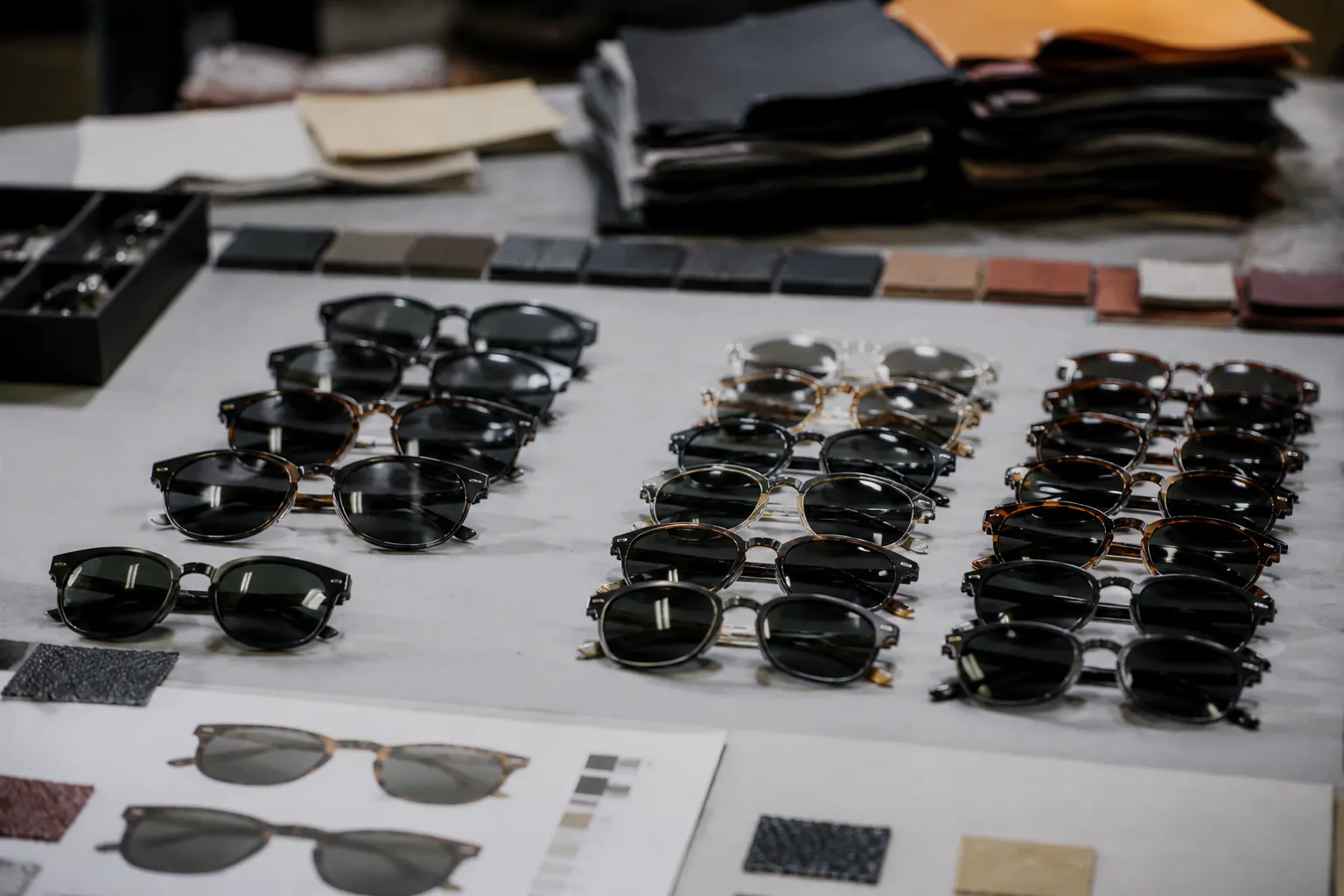
This guide is for buyers who have already approved a sunglasses sample and now need to decide whether the factory is ready for a pilot run. That step sits between a good-looking sample and a real production commitment. It is also where repeatability problems often show up first: lens shade variation, hinge inconsistency, logo drift, packaging errors, and missing compliance or labeling details. A pilot run is not just a small order. It is a controlled production test that shows whether the factory can reproduce the approved standard under normal conditions before you commit to bulk volume.
Why the pilot run matters
An approved sample proves that the factory can make one acceptable piece. It does not prove the same result can be repeated across a pilot quantity using production tooling, normal operators, standard inspection points, and materials pulled from real supply lots.
That gap matters in custom eyewear. A lot can change when work moves from the sample room to the production line. Frame dimensions can drift if molding or machining settings are not held consistently. Acetate can look different from one sheet lot to another. Lens tint or mirror finish can shift from batch to batch if the process is loose. Logos that look fine on early pieces can start to wander or fail later in the run if decoration is unstable.
The pilot run is a test of repeatability, not design intent. That is the point. The question is no longer whether the sample looks right. The question is whether the factory can hold dimensions, decoration, lens appearance, and pack-out consistency when the line runs under normal production conditions.
For that reason, the pilot should reflect the real factory flow: frame production, finishing, lens production, assembly, decoration, cleaning, packing, and final QC. If a key step is still being improvised or outsourced without disclosure, the pilot is not giving you a reliable production signal.
First question: is the pilot built under bulk conditions?
Ask this directly: Is the pilot run made under the same conditions planned for bulk production? If the answer is vague, keep going until the factory names the materials, tooling, processes, and inspection method it will use for the main order.
You need confirmation that the pilot uses the same frame material, lens material, hinge specification, decoration process, packaging components, and QC method planned for bulk. If the approved sample was hand-corrected by a senior technician, that is not automatically a problem. The problem is approving a pilot that does not reflect what routine production will actually deliver.
- Confirm whether the tooling used for the pilot is the final production tooling.
- Ask whether the frame components are made using the same production settings planned for bulk.
- Check whether acetate parts come from the same sourcing approach planned for the order, rather than from specially selected sheets.
- Verify that lenses come from the same production process intended for bulk, not from individually adjusted lab pieces.
- Confirm the logo uses the real production method: pad printing, laser engraving, hot stamping, or a metal logo plate.
- Require final packaging components in the pilot: pouch, box, barcode label, warning label, carton mark, and shipper pack-out.
A meaningful pilot should also expose the real operator handoff points. If temple alignment is adjusted after hinge assembly, who handles that in standard production and how is the result checked? If lens insertion requires heating, what control prevents frame distortion or lens damage? These are basic production questions. The factory should answer them clearly.
If you skip this step, the pilot can turn into a cosmetic exercise. A hand-tuned pilot may pass while the bulk run later fails on fit, finish, labeling, or assembly consistency.
What to measure, not just what to look at
Many buyers review pilot pieces visually and miss the main issue: measured consistency. A pilot should be checked against a concise written specification sheet, even for a style-led program.
Start with the dimensions and features that matter commercially and functionally: front width, temple length, bridge size, lens opening, finished weight, lens appearance, logo position, hinge feel, and packaging accuracy. The tolerances should come from the approved specification for that model, not from a generic template. If the factory does not have a written tolerance sheet, require one before bulk approval.
Color and lens appearance need the same discipline. Lens shade should be checked against an approved master under controlled lighting, not by casual comparison in an office. If the style includes mirrored lenses, review visual uniformity after edging, cleaning, and assembly, because some problems only show up after handling.
| Checkpoint | What to ask | Typical control point | Why it matters |
|---|---|---|---|
| Frame dimensions | What tolerances apply to front width, temple length, bridge size, and lens opening? | Approved drawing or signed spec sheet | Dimensional drift affects fit, symmetry, and retail consistency. |
| Lens color | How is tint checked batch to batch against the approved sample? | Approved master under controlled light, including left-right pairing | Customers notice lens mismatch immediately. |
| Hinges | How is hinge feel checked, and is the result verified after repeated opening and closing? | Defined functional check against the approved standard | A pair can feel acceptable at first and loosen later. |
| Decoration | How is print, engraving, or logo-plate position checked against the approved artwork? | Approved artwork, placement drawing, and visual standard | Branding errors are highly visible and hard to rework cleanly. |
| Weight | What finished-weight range is accepted for this model? | Approved product specification | Unexpected weight changes can indicate material or hardware differences. |
Keep the control list short enough to enforce. A short set of measurable checkpoints beats a long document that no one follows on the line.
Where process drift usually appears
Good pilot-run questions are specific. Ask the factory where it expects the highest defect risk on this model, and ask for the answer by process step. A capable factory should be able to explain the risk points, not just offer general reassurance.
Each material and construction has its own failure pattern. Injection-molded styles may show sink marks, warpage, or trimming inconsistency if the process is unstable. Acetate styles may vary in pattern balance, edge finish, or symmetry after machining and polishing. Lens-related issues can include shade inconsistency, edge chipping, coating damage, or scratches introduced during assembly and cleaning.
Decoration creates another control point. Pad printing can fail if surface preparation or curing is weak. Laser engraving quality can shift if settings are not fixed. Hot stamping can lose sharpness on curved parts if pressure or positioning varies. Metal logo plates can move if pocket fit or adhesive application is not controlled.
- Ask which process step has the highest reject risk on this model.
- Ask which defects are considered reworkable and which require remaking the part.
- Ask how pilot findings will be turned into updated work instructions, process settings, or inspection points before bulk.
- Ask who approves those changes and how they are documented.
The answer tells you whether the team really understands the build. If a factory cannot identify likely failure points, confidence should go down, not up.
Compliance and labeling checks before volume
The pilot run is the right stage to verify that the production version still matches the compliance and labeling requirements for your market. Do not wait until bulk packing starts to ask for reports, declarations, or packaging proof.
For sunglasses, the file may include CE EN ISO 12312-1, ANSI Z80.3, AS/NZS 1067, REACH-related declarations, and FDA registration details where applicable to your market and business model. The key issue is not just collecting documents. The documents must match the exact product configuration being produced, including lens category, lens material, coating, frame material, and any construction change made after sampling.
This is where buyers make expensive assumptions. A report or declaration tied to one configuration may not automatically cover a revised one. If you changed the lens material, changed the tint category, added a mirror coating, or changed the frame material, ask the supplier exactly which documents still apply and which must be updated or reconfirmed.
- Confirm the compliance file matches the actual pilot materials and final lens specification.
- Check all market-required warnings, importer details, country-of-origin marking, and packaging claims before printing.
- Verify REACH-related declarations if your market or customer requires them.
- Require the pilot pack-out to include the final instruction sheet, warning insert, or both, if applicable.
System certifications such as ISO 9001 or BSCI can show how a factory manages operations, but they do not replace product-level compliance. Useful signals, yes. Proof, no.
Pilot economics: unit cost versus risk cost
Some buyers hesitate because the unit cost of a pilot run is higher than the unit cost quoted for bulk. That is the wrong comparison. A pilot is not low-cost inventory. It is a risk-control step.
The real question is simple: is the pilot cost lower than the cost of finding the same problem after a full order is produced, packed, or shipped? Packaging mistakes, labeling errors, unstable decoration, inconsistent lenses, and avoidable rework can all cost far more to fix at bulk stage than during a controlled pilot.
MOQ also affects how useful the pilot will be. A very small quantity may confirm appearance, but it may not expose repeatability problems across colorways, decoration steps, or packaging variations. The pilot quantity should be large enough to test the production risks that matter for your program.
| Stage | Typical quantity | Typical timing | What you learn |
|---|---|---|---|
| Sample | 1-5 pieces | Before pilot approval | Design approval, appearance, basic fit, logo look |
| Pilot run | Factory-defined trial quantity | After sample approval, before full PO release | Process stability, packaging accuracy, and real defect patterns |
| Bulk order | Order MOQ and above | After pilot sign-off | Commercial execution at scale |
| Rework or remake | Varies | Adds extra production and logistics time | The cost of weak pilot control |
When you review pilot economics, compare the pilot cost against the likely cost of repacking, relabeling, replacement production, shipment delay, or customer claims if the same issue slips into bulk.
A practical sign-off checklist for buyers
Before releasing a full bulk PO, require a written pilot-run sign-off. Keep it short. Keep it specific. Make it hard to reinterpret later.
- Approved reference: one sealed golden sample, dated and identified by both sides.
- Pilot quantity: state exactly how many pairs were produced, inspected, and accepted.
- Measured results: record the actual dimensions, weight, lens appearance result, hinge check result, and logo placement outcome against the approved specification.
- Packaging confirmation: approve pouch, box, barcode, warning label, carton mark, and pack-out method.
- Inspection standard: define the defect classification and acceptance method that will be used for bulk.
- Compliance file: list the reports and declarations that apply to this exact style and lens build.
- Corrective actions: document every pilot issue and the action taken before bulk release.
- Bulk lock: confirm that no material, hardware, logo, lens, or packaging change is allowed without written approval.
This document helps prevent a common dispute later: the supplier says bulk matched the sample, while the buyer says bulk matched a different version of the sample. Without a locked reference and written pilot summary, both sides end up arguing from memory.
Proceed, fix, or stop: the pilot decision
At the end of the pilot, the buyer needs a clear decision. Not a vague sense of comfort.
Proceed if the pilot meets the approved specification, packaging is correct, the compliance file matches the finished product, and the factory can explain its control points clearly. Fix and repeat if the defects are limited, the root causes are understood, and the correction does not materially change the approved product. Stop if the pilot shows unstable dimensions, recurring decoration failure, inconsistent lenses without a clear root cause, or weak compliance support.
One final question is especially useful: What changed between the approved sample and the pilot? Any capable factory should be able to answer that directly. Changes in material source, decoration process, lens specification, hardware, or packaging can all affect bulk consistency, even when they look minor at first.
The pilot run is the cheapest stage at which to find expensive production problems.
Treat it as a production-control gate, not a formality. That gives you a firmer basis for deciding whether the factory is ready for the main order.
Have a custom sunglasses project in mind?
Send us your styles, target market and quantities and we will return a detailed quote with MOQ, lead time and a sample plan.
Get a QuoteWhy source this from Wenzhou with LumiShades
Wenzhou in Zhejiang Province is widely regarded as China’s eyewear manufacturing capital, producing a large share of the world’s sunglasses. That concentration matters to buyers: a deep local supply chain for acetate sheet, hinges, lens blanks, plating and packaging means shorter component lead times, easier color and material matching, and a workforce with decades of eyewear-specific skill. LumiShades has manufactured in this ecosystem since 2009, and our vertical integration — in-house injection molding, acetate cutting, CNC milling, lens tinting, decoration and quality control — means no part of your order is quietly subcontracted to a workshop you cannot audit.
For international buyers, that vertical control translates into accountability. When a single factory owns every step, defects are traced and fixed at source rather than bounced between vendors, and your specifications survive intact from first sample to bulk. We back this with 15+ years of experience, shipments to 60+ countries, more than 5 million pairs produced per year and a 98.5% on-time delivery rate. Our certifications — CE EN ISO 12312-1, FDA registration, ANSI Z80.3, AS/NZS 1067, REACH, ISO 9001 and BSCI audit — mean the compliance documentation your market requires already exists. Explore our manufacturing capabilities and quality control process to see how this works in practice.
Frequently asked questions
How many pairs should a pilot run include for custom sunglasses? There is no universal number, so ask the factory to propose a pilot quantity based on model complexity, number of colorways, decoration steps, and packaging variations. Your job is to confirm that the quantity is large enough to test repeatability under normal production conditions. If the quantity is too small to include real line setup, in-process inspection, and final pack-out, it will not give you a reliable production read.
Should the pilot run use final packaging and labels? Yes. Require the pilot to include the actual pouch, box, barcode label, warning label, carton mark, and final pack-out method intended for bulk shipment. Then check every printed and applied element against your approved artwork and market requirements, including importer details, country-of-origin marking, and any required warnings. Packaging errors are much easier to fix at pilot stage than after bulk packing starts.
Can I rely on an approved pre-production sample instead of a pilot run? Not if your goal is to verify production stability. A pre-production sample shows the target appearance. A pilot run shows whether the factory can reproduce that target using routine production materials, normal operators, standard tooling, and actual packing conditions. If the style is simple and the supplier has strong documented controls, you may decide to move directly to bulk, but that decision should be based on evidence, not assumption.
What compliance documents should I check before approving bulk? Check only the documents relevant to your market and product configuration. Common references include CE EN ISO 12312-1, ANSI Z80.3, AS/NZS 1067, REACH-related declarations, and FDA registration details where applicable. Then verify that the documents match the exact pilot configuration: lens category, lens material, coating, frame material, and any design or construction changes made after sample approval. If anything changed, ask the supplier in writing whether the existing file still applies.
What is the biggest warning sign during a pilot run review? A weak or unclear explanation from the factory. If the team cannot state what changed from sample to pilot, identify the highest-risk process step, explain how key specifications are checked, or show which compliance and labeling documents apply to the exact build, you do not yet have enough control for a safe bulk release. In that case, pause approval, ask for a written corrective-action plan, and require a repeat review on corrected pilot output.
Ready to start?
Explore our square sunglasses or request a quote — our sales team replies within 12 hours.
Request a Quote