
OEM vs ODM Sunglasses: Margin, MOQ, and Lead Time
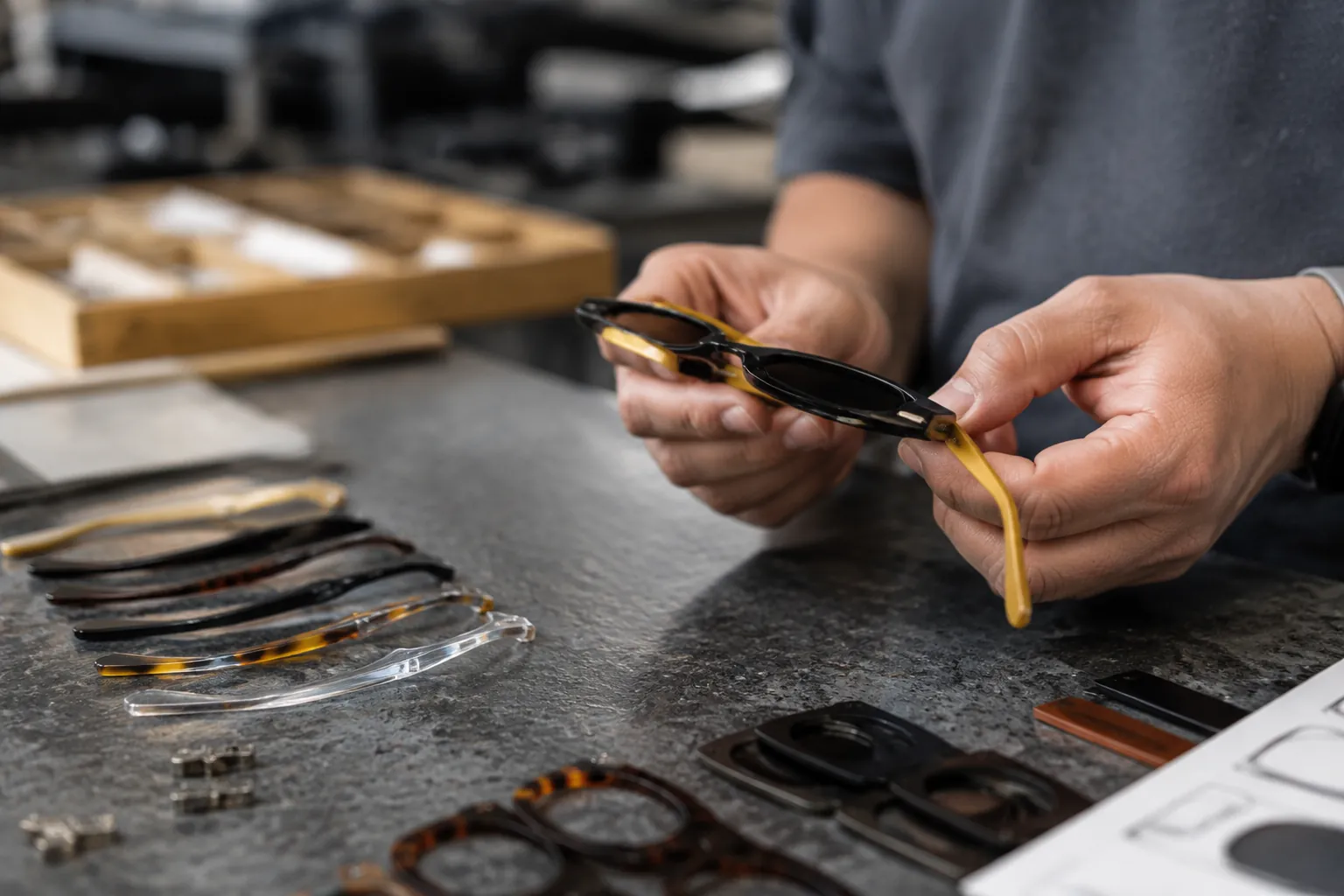
This guide is for brand owners, importers, distributors, and retail buyers sourcing sunglasses in volume. It compares OEM and ODM using the variables that directly affect a purchase order: development cost, sample timing, MOQ, unit cost at planned volume, revision risk, compliance alignment, and reorder stability. The goal is simple. Protect margin, hit the launch window, and make the second order easier than the first. If you are choosing between a fully developed frame and a factory platform with selected changes, start here.
Start with the buying model, not the sketch
Most buyers start with looks. That is usually the wrong first step. Start with the buying model.
An OEM program develops a frame to your specification. An ODM program starts with an existing factory design and applies selected changes. That choice affects cost, speed, MOQ, compliance work, and reorder control before the first carton ships.
If the product story depends on frame architecture, fit, dimensions, hinge construction, or a distinct silhouette, OEM is often the right path. If your advantage is speed, branding, packaging, price point, or channel timing, ODM is usually the better commercial choice.
- Choose OEM when shape, dimensions, hinge construction, or lens geometry are central to the product.
- Choose ODM when you need a proven base frame, lower first-order risk, and faster launch timing.
- Use both if you manage a portfolio: ODM for trend styles, OEM for repeatable core sellers.
Head-to-head: cost, speed, and control
| Factor | OEM | ODM |
|---|---|---|
| Starting point | New frame developed from a sketch, reference sample, or tech pack | Existing factory frame platform with selected changes |
| MOQ logic | Usually higher when custom molds, logo hardware, or non-standard parts are required | Often lower because the base mold and construction already exist |
| Sample timeline | Typically longer because the first prototype may require revisions before approval | Usually shorter when the base frame and materials are already active |
| Bulk lead time | Can extend if custom parts, tooling correction, or repeated approvals are needed | Usually more predictable when the style uses proven components |
| Development cost | Higher due to engineering work, prototype revisions, and possible tooling expense | Lower because the base frame has already been developed |
| Customization depth | Highest: front shape, eye size, bridge, temple profile, hardware, lens base curve, branding | Moderate: color, finish, lens tint, logo method, trim, packaging, limited component changes |
| Reorder risk | Lower when tools, bill of materials, and approved samples are controlled tightly | Low if the base style remains active and components stay standardized |
| Margin profile | Can improve over time if the style becomes a protected repeat SKU | Often stronger early because it preserves cash and reduces sunk development cost |
The trade-off is direct. OEM buys control. ODM buys speed.
Neither model is always cheaper over the life of a product. OEM can pay off if the style becomes a durable repeat seller. ODM usually makes more sense at the start because it limits development spend while you test real demand.
What OEM actually changes in your cost structure
OEM does not just raise the quoted unit price. It changes the cost structure around the order.
You may need engineering time, prototype revisions, tooling work, custom hardware, and separate approvals for fit, construction, logo placement, and packaging. None of that is unusual. But it adds time and non-recurring cost before bulk production starts.
This matters because development cost has to be absorbed somewhere. If projected repeat volume is strong, the math can work. If volume is still uncertain, OEM can put pressure on margin before the style proves itself.
Ask a simple question: will this frame still be reordered after the first sales cycle? If the answer is unclear, ODM is often the safer starting point.
Where ODM saves money and where it does not
ODM usually lowers first-order risk because the base frame, mold, and construction already exist. Sample timing is shorter. MOQ is often easier. The factory may already know the common failure points for that style. That helps.
But ODM is not automatically cheap. Costs can rise if you request too many changes to an existing platform. New metal trims, unusual lens colors, special finishes, custom packaging, or low-volume color splits can push the project back toward OEM economics.
That is the trap. Buyers choose ODM for speed, then over-customize the first order and lose the speed advantage.
Use ODM for what it does well: quick validation, lower exposure, and cleaner execution on a tight retail calendar.
Sample timing is rarely one round
Many sourcing plans assume one sample, one approval, then production. Real projects are usually messier.
OEM samples often move through several rounds because shape, fit, hinge tension, lens alignment, branding position, or finish details need correction. ODM projects are faster, but they can still slow down if you change color combinations, logo methods, or packaging late in the process.
Build time for revisions into the purchase plan. Be blunt about critical dates. If the launch window is fixed, leave less open to interpretation.
A practical rule helps here: the more variables you change at once, the more sample rounds you should expect.
Compliance and specification control must match the market
Sunglasses are not only a design purchase. They are also a specification purchase. Lens performance, material declarations, labeling, and test requirements have to match the destination market and the product claim.
OEM gives you more control over technical choices, but it also puts more responsibility on the buyer to define them clearly. ODM can reduce development work if the factory already has a proven specification package for a similar style, but you still need to confirm that it matches your market, labeling plan, and documentation needs.
Do not assume an existing platform automatically fits every market. Confirm the standard, the test scope, and the exact approved construction before bulk approval.
Reorders depend on control, not memory
The first order gets attention. The second order tests the system.
Stable reorders depend on documented control: approved samples, color standards, lens references, packaging files, bill of materials, logo artwork, and clear tolerances. OEM programs usually justify this discipline because more is custom. ODM programs need it too, especially if the factory runs many variations of the same base frame.
If reorder consistency matters, lock the specification early and record what was actually approved. Memory is not a control system.
This is where margin is protected over time. Fewer surprises mean fewer claims, less rework, and less dead stock.
A practical way to choose between OEM and ODM
Use the business case, not preference.
Choose OEM if the frame itself creates the advantage, repeat volume is likely, and you can support a longer development cycle. Choose ODM if speed matters more, demand is still being tested, or the line needs a lower-risk launch.
For many buyers, the strongest approach is mixed. Use ODM to fill seasonal, trend-led, or channel-specific needs. Reserve OEM for core styles that can justify development cost through repeat orders and tighter brand ownership.
That is usually the cleanest way to protect cash early without giving up long-term control where it counts.
Have a custom sunglasses project in mind?
Send us your styles, target market and quantities and we will return a detailed quote with MOQ, lead time and a sample plan.
Get a QuoteWhy source this from Wenzhou with LumiShades
Wenzhou in Zhejiang Province is widely regarded as China’s eyewear manufacturing capital, producing a large share of the world’s sunglasses. That concentration matters to buyers: a deep local supply chain for acetate sheet, hinges, lens blanks, plating and packaging means shorter component lead times, easier color and material matching, and a workforce with decades of eyewear-specific skill. LumiShades has manufactured in this ecosystem since 2009, and our vertical integration — in-house injection molding, acetate cutting, CNC milling, lens tinting, decoration and quality control — means no part of your order is quietly subcontracted to a workshop you cannot audit.
For international buyers, that vertical control translates into accountability. When a single factory owns every step, defects are traced and fixed at source rather than bounced between vendors, and your specifications survive intact from first sample to bulk. We back this with 15+ years of experience, shipments to 60+ countries, more than 5 million pairs produced per year and a 98.5% on-time delivery rate. Our certifications — CE EN ISO 12312-1, FDA registration, ANSI Z80.3, AS/NZS 1067, REACH, ISO 9001 and BSCI audit — mean the compliance documentation your market requires already exists. Explore our manufacturing capabilities and quality control process to see how this works in practice.
Frequently asked questions
What is the main difference between OEM and ODM sunglasses? OEM sunglasses are developed to your specification, while ODM sunglasses start from an existing factory design with selected modifications. OEM gives more control over shape, fit, and construction. ODM usually reduces development time and first-order risk.
Is OEM always more expensive than ODM? Usually at the start, yes, because OEM often includes engineering work, prototype revisions, and possible tooling cost. Over time, OEM can make financial sense if the style becomes a strong repeat seller and the development cost is spread across larger reorder volume.
Which model is better for a first bulk order? ODM is often the better fit for a first bulk order if demand is still unproven. It usually offers faster samples, lower MOQ pressure, and less upfront cost. OEM is more suitable when the frame design itself is central to the brand and repeat volume is likely.
Can an ODM frame still be customized? Yes, but within limits. Common ODM changes include color, finish, lens tint, logo application, trim, and packaging. If requested changes affect the frame structure, hardware, or non-standard components, the project can become slower and more expensive.
How should buyers think about compliance in OEM and ODM projects? Buyers should confirm that lens performance, labeling, material declarations, and required testing match the destination market. OEM provides more control over technical specification, but it also requires clearer direction from the buyer. ODM can simplify the process if the base style already has a suitable specification package, but it still must be checked carefully.
Ready to start?
Explore our aviator sunglasses or request a quote — our sales team replies within 12 hours.
Request a Quote