
How to Vet a Sunglasses Factory for Scale
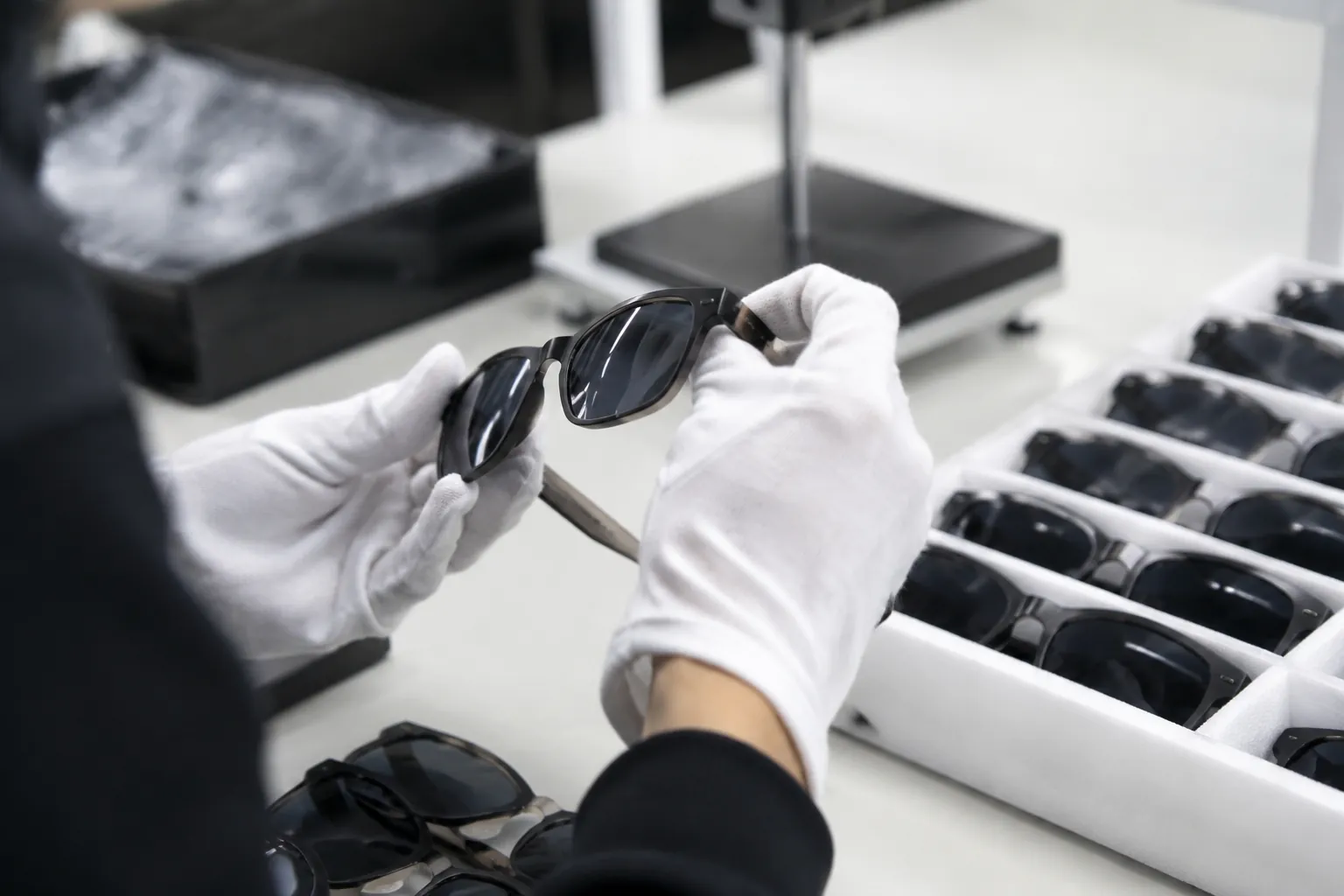
This guide is for importers, brand owners, distributors, and retail buyers who need to start small without getting trapped by a factory that fails once volume rises. The test is not whether a supplier can make attractive samples or deliver one acceptable pilot order. The test is repeatability at higher volume: frame fit, lens shade, logo position, compliance paperwork, and ship date. Use this framework to screen a sunglasses factory before your next launch turns into rework, chargebacks, missed delivery windows, or weak replenishment.
Start with the scale question, not the sample
Most factories look good at sample stage. Samples move slower, get closer supervision, and often receive extra attention from engineering and sales staff. Bulk production is different.
So start with one question: what changes inside the factory as volume moves from pilot to repeat to program level?
For sunglasses, those jumps often look like this:
- 300 to 1,000 pairs: the factory must prove first-run control: frame color consistency, lens shade matching, logo placement, and packing accuracy.
- 1,000 to 5,000 pairs: the factory must raise throughput without letting scrap, rework, or cosmetic variation climb.
- 5,000 to 50,000 pairs: the problem shifts to material planning, line scheduling, component supply, and stable QC across repeat lots and multiple SKUs.
Ask for process evidence, not confident claims. A serious supplier should be able to explain what changes between 500, 5,000, and 20,000 pairs: mold loading, acetate sheet planning, lens tint batch control, pad-print fixture count, hinge supply planning, in-line QC frequency, and packing-line staffing.
If a factory says it can scale, push for detail. How is eyewear production organized by process? Which steps are in-house and which are outsourced? How is decoration capacity planned? How are rework units separated?
You are not looking for perfect metrics. You are looking for operational literacy, internal consistency, and a clear account of how output increases without weaker control.
A low MOQ does not prove weak capability. It may simply mean the supplier is willing to support launch testing. The real issue is whether that same factory can explain how process, scheduling, inspection, and material planning change as order size rises.
Four capacity checks that predict whether scale will hold
- Core manufacturing control. Injection and acetate are not the same process. Injection frames depend on mold condition, resin drying, melt stability, cooling control, and post-mold warpage management. Acetate frames depend on sheet quality, cutting yield, CNC accuracy, tumbling, polishing, and conditioning before lens fitting. Ask which dimensions are checked on critical parts and how bridge and temple symmetry are verified.
- Lens process stability. Lens tinting looks simple until bulk exposes shade drift. On dark solid tints and fashion gradients, common failures are carton-to-carton variation and poor left-right matching. Ask how tint batches are controlled, how color is approved, whether an approved reference sample is kept, and how UV400, polarization, or mirror-coating claims are supported if those features apply.
- Decoration throughput. Laser engraving, pad printing, hot stamping, and metal logo attachment can all become bottlenecks. A sample can be decorated carefully by one skilled operator. Large runs need fixture repeatability, curing discipline where needed, and routine adhesion or appearance checks. Ask how logo position is controlled, what shift tolerance is allowed, and whether decoration sits on the main line or in a separate queue.
- Final QC discipline. Scale breaks down when inspection happens only at the end. Better factories inspect after molding or CNC, after polishing, after lens tinting, during decoration, after hinge assembly, and again at final packing. Ask which defects are screened at each stage and how rework is isolated so approved goods are not mixed with repair stock.
These checks matter because most bulk failures start upstream. By the time defects appear in final inspection, schedule recovery is already hard. Material waste is already sunk.
What changes from 300 to 50,000 pairs
| Volume band | Main buyer goal | Typical factory stress point | What to verify |
|---|---|---|---|
| 300-1,000 pairs | Launch quickly with low cash exposure | Setup time, logo fixture accuracy, carton mix-ups | Sample-to-bulk match, approval sign-off flow, barcode and assortment control |
| 1,000-5,000 pairs | Reduce unit cost without quality drop | Material batching, lens tint consistency, rising rework | Batch coding, in-line QC records, defect segregation method |
| 5,000-20,000 pairs | Stable replenishment | Line balancing, component shortage, decoration queueing | Production plan by process, component availability, capacity by shift |
| 20,000-50,000 pairs | Program reliability across multiple SKUs | Tool loading, packaging throughput, shipment scheduling | Multi-line allocation, final AQL method, export document accuracy and booking discipline |
Scaling is not one problem. It is a different problem at each stage.
At 300 pairs, the risk is usually setup inefficiency and preventable packing mistakes. At higher volumes, the risk shifts to planning failure: decoration parts arriving late, lenses produced in split lots without tight shade control, or packaging becoming the last bottleneck.
A useful buyer question is simple: Where does your line slow down first when this order moves from 1,000 to 10,000 pairs? Good factories answer with specifics. Weak factories answer with generalities.
Price breaks are easy to quote. Ask what makes them real
Factories often quote lower prices at higher order quantities. That is normal. The useful question is what operating change makes each price break credible.
At low MOQ, setup costs are spread over fewer pairs: mold or color changeover, acetate sheet selection, lens tint setup, print plate preparation, QC file creation, and carton labeling. As volume rises, setup-cost dilution may improve, material purchasing may get more efficient, and labor productivity may increase because operators repeat the same task longer with fewer interruptions.
But not every style scales in cost at the same rate. Push quote logic back to the bill of materials and the process route:
- Injected frame: often shows a stronger cost-down profile once tooling, resin color, and lens specification are fixed.
- Acetate frame: usually carries more labor in cutting, CNC milling, tumbling, polishing, and fitting.
- Decoration-heavy style: often shows a weaker price break because logo application and cosmetic checks remain labor-intensive.
- Packaging-heavy program: custom boxes, pouches, barcode labels, and inserts can offset part of the unit-cost gain from production scale.
Request a quote ladder tied to assumptions: frame material, lens material, hinge type, logo method, packaging, inspection level, and order split by colorway. If the supplier gives one low number without build logic, treat it as provisional.
Lead time says more than price
A scalable factory should explain lead time by stage, not just with one headline number. A single total can hide risk if approvals are still open, decoration is handled by a separate supplier, or packaging materials are not yet confirmed.
A typical custom order may include these stages:
- Artwork and construction confirmation
- Pre-production sample or counter-sample approval
- Material preparation: resin, acetate sheets, lenses, hinges, logo parts, packaging
- Frame production: injection or acetate cutting/CNC
- Finishing and polishing
- Lens production or tinting, then fitting
- Decoration: engraving, pad printing, hot stamping, or logo attachment
- Assembly, alignment, and final adjustments
- In-line and final QC
- Packing and export carton preparation
Ask which of these steps are in-house and which are outsourced. In practice, delays usually come from three places: slow approval of frame or lens color, late arrival of logo hardware or packaging, and rework after cosmetic defects are found too late.
Also ask what must be locked before bulk starts. A disciplined answer should include approved frame color, approved lens reference, logo position standard, barcode file, carton marks, packing ratio, and destination-market compliance requirements. If those items are still open, lead time is not under control.
Quality failures that show up only after you scale
Small runs can hide instability. The factory can inspect heavily and correct issues by hand. Larger runs expose weak controls fast.
Common bulk failure modes include:
- Lens shade variation across cartons. Often caused by weak tint batch control or mixing stock from different production lots.
- Temple logo drift. Common in pad printing or metal plate application when fixtures wear, shift, or are changed mid-run.
- Frame warpage. Often linked to weak cooling control in injection or poor conditioning of acetate before fitting and assembly.
- Left-right alignment problems. Easy to hide on samples; expensive in bulk when hinge fitting and temple adjustment are rushed.
- Surface finish inconsistency. Especially on acetate polishing, sprayed coatings, or rubberized finishes.
- Packing errors. Wrong barcode, mixed colorway counts, incorrect inserts, or mislabeled cartons.
Ask the factory which inspection points exist before final packing. A stronger control plan includes visual checks after molding or CNC, lens shade confirmation before fitting, logo position checks during decoration, opening-closing and alignment checks after assembly, and random final inspection before carton seal.
ISO 9001 and BSCI can be useful signals for management and social compliance. They are not substitutes for a real production control plan. Ask to see the workflow: who checks, at what stage, against which standard, and what happens to failed units.
Compliance is not one box. Match the order to the market
For sunglasses, compliance needs to be built into the sourcing brief early. Wait until after sample approval and you may need to change lens performance, markings, or packaging and restart part of the process.
Buyers should turn certification or documentation labels into order-level questions. The point is not whether a factory can name a standard. The point is whether the exact style, lens construction, labeling, and destination market are covered.
| Requirement | Why buyer cares | Factory question to ask |
|---|---|---|
| CE EN ISO 12312-1 | Relevant benchmark for sunglasses sold into applicable markets | Which lens category, markings, warnings, and test reports apply to this exact style? |
| ANSI Z80.3 | Common reference for U.S. non-prescription sunglasses | Has this lens construction and tint been evaluated against the standard, and can supporting documentation be provided? |
| AS/NZS 1067 | Important for Australia and New Zealand requirements | What lens performance and labeling are prepared for that destination? |
| REACH | Chemical compliance for materials, coatings, inks, and components | Which components are covered by current declarations or test data, and what is the document date? |
| FDA registration | Documentation point sometimes requested in U.S. import files | What records can be provided if requested by the importer or customs broker? |
Keep instructions plain and early: tell the factory where the goods will be sold, what lens category is required, whether polarization or mirror coating is involved, and what packaging or warning-label rules apply. Then make those points part of the approved pre-production file, not an afterthought.
A practical screening checklist before the next order
Use this checklist during quotation and sampling. It is faster to screen discipline now than to discover weak control after deposit payment.
- Ask for MOQ, but also ask what changes in process at 300, 1,000, and 5,000 pairs.
- Confirm whether frame production, lens tinting, decoration, and QC are in-house or outsourced.
- Request a quote ladder tied to material, lens type, hinge type, logo method, packaging, and inspection assumptions.
- Ask for sample and bulk lead time by stage, not only one total number.
- Check which standards matter for your destination market: CE EN ISO 12312-1, ANSI Z80.3, AS/NZS 1067, REACH, and any FDA registration paperwork needed.
- Approve a pre-production standard that covers frame color, lens shade, logo location, barcode, carton marks, packing ratio, and labeling requirements.
- Define inspection checkpoints before final packing, especially for lens consistency, alignment, and decoration adhesion or placement.
- For repeat programs, ask how the factory controls batch-to-batch consistency on color, logo placement, and material sourcing.
If a supplier answers these points clearly and consistently, scaling from a test order to a larger program is more likely to work. If answers stay vague during quoting, expect the same once production starts.
Have a custom sunglasses project in mind?
Send us your styles, target market and quantities and we will return a detailed quote with MOQ, lead time and a sample plan.
Get a QuoteWhy source this from Wenzhou with LumiShades
Wenzhou in Zhejiang Province is widely regarded as China’s eyewear manufacturing capital, producing a large share of the world’s sunglasses. That concentration matters to buyers: a deep local supply chain for acetate sheet, hinges, lens blanks, plating and packaging means shorter component lead times, easier color and material matching, and a workforce with decades of eyewear-specific skill. LumiShades has manufactured in this ecosystem since 2009, and our vertical integration — in-house injection molding, acetate cutting, CNC milling, lens tinting, decoration and quality control — means no part of your order is quietly subcontracted to a workshop you cannot audit.
For international buyers, that vertical control translates into accountability. When a single factory owns every step, defects are traced and fixed at source rather than bounced between vendors, and your specifications survive intact from first sample to bulk. We back this with 15+ years of experience, shipments to 60+ countries, more than 5 million pairs produced per year and a 98.5% on-time delivery rate. Our certifications — CE EN ISO 12312-1, FDA registration, ANSI Z80.3, AS/NZS 1067, REACH, ISO 9001 and BSCI audit — mean the compliance documentation your market requires already exists. Explore our manufacturing capabilities and quality control process to see how this works in practice.
Frequently asked questions
Can a factory with a 50-pair MOQ still be suitable for 10,000-pair orders? Yes, but MOQ alone tells you almost nothing about scalability. Check whether the factory can explain how it will handle tooling or fixture allocation, material planning, tint batch control, decoration capacity, and QC staffing as volume rises. Ask for one recent example of a repeat or higher-volume order and which steps were in-house versus outsourced. Base the decision on process control, not entry MOQ.
What is the first sign that a sunglasses supplier will struggle at scale? A common warning sign is vague process-control language. If the supplier cannot explain how it keeps lens tint, frame color, logo position, and packing accuracy consistent across multiple lots, larger orders are more likely to create variation, rework, and delay. Ask to see the approval standard, the in-line inspection points, and the method used to separate failed units from approved stock.
How should I evaluate a bulk lead time quoted by a supplier? Break lead time into stages: sample approval, material preparation, frame production, lens production or tinting, decoration, assembly, QC, and packing. Then ask which steps depend on outside suppliers and what must be approved before bulk starts. A lead time is more credible when the supplier can name dependencies clearly, explain likely delay points, and confirm which documents or approvals release production.
Which compliance points should I raise before sample approval? Start with the destination market, then confirm which standards or documents apply to that exact style. For many programs, that means discussing CE EN ISO 12312-1, ANSI Z80.3, AS/NZS 1067, REACH, and any FDA registration documents your importer or broker may request. Also confirm lens category, required markings, warning language, packaging labels, and whether polarization, mirror coating, or other lens claims need supporting test data. Put those points into the pre-production file before bulk planning starts.
Is the lowest per-pair price at a higher quantity always the best buying decision? No. A lower quoted unit cost can be offset by slower sell-through, higher inventory exposure, or more rework if the supplier is stretched. Compare the price break against demand certainty, style complexity, and the factory's ability to hold quality at that volume. In many cases, buyers reduce risk by validating demand and factory performance with a smaller run first, then moving to repeat orders after quality, compliance, and replenishment reliability are proven.
Ready to start?
Explore our sport wrap sunglasses or request a quote — our sales team replies within 12 hours.
Request a Quote