
Bulk Sunglasses That People Actually Keep
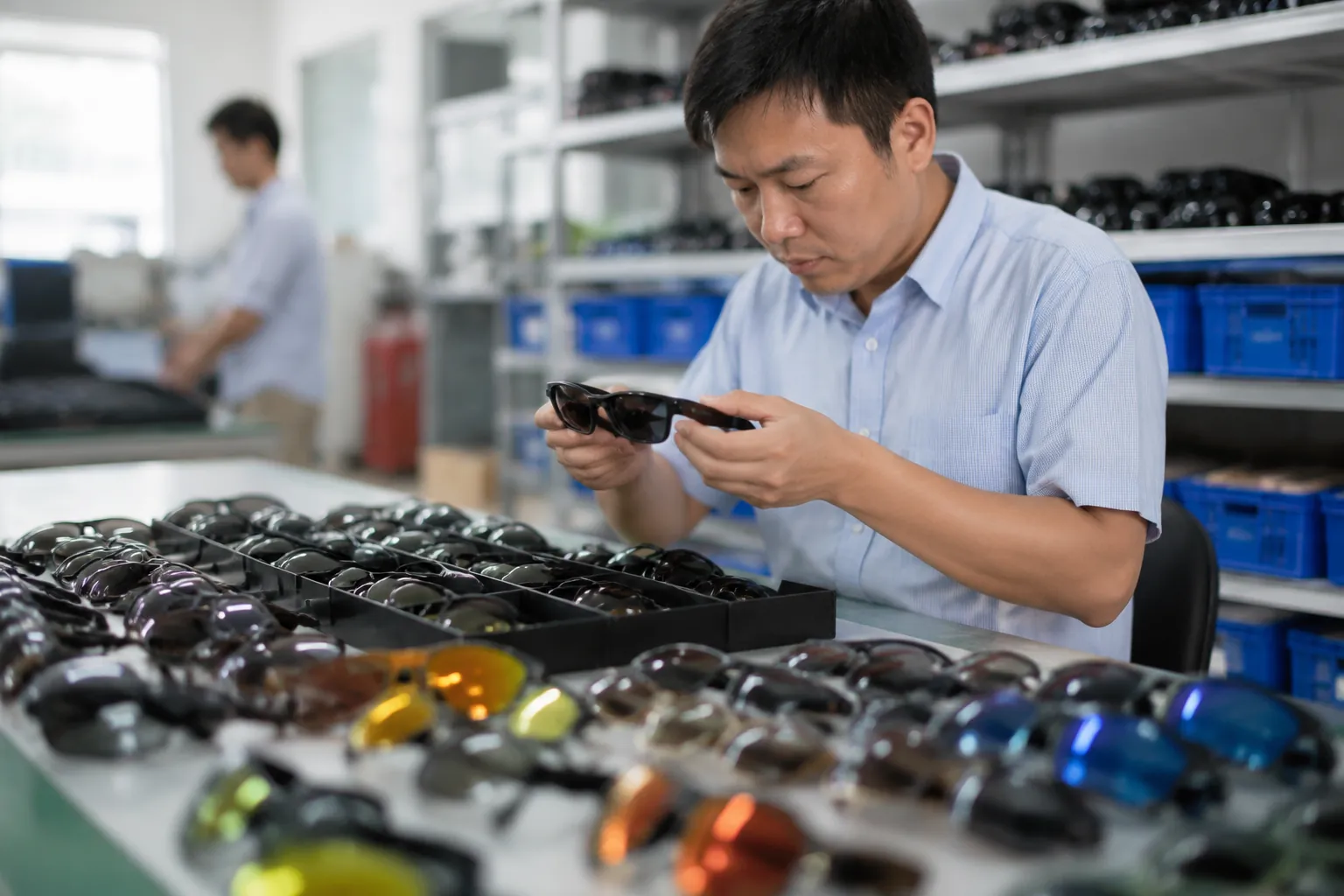
This guide is for buyers sourcing sunglasses for promotions, events, staff kits, retail tie-ins, and corporate campaigns. The goal is not to buy the cheapest pair. It is to choose a frame, lens, branding method, packaging format, and compliance path that people will actually use, while still meeting budget and delivery targets. In bulk eyewear, "giftable" usually comes down to a few practical details: stable fit, a wearable lens tint, branding that does not make the product look disposable, and production controls that keep approved samples aligned with bulk output.
Start With the Use Case, Not the Logo
Many weak promotional sunglasses programs go off course before sampling even starts. The buyer begins with a large logo placement, then tries to force the product spec around it. That usually leads to avoidable cost, weaker wearability, and a product that shows the brand but does not feel worth keeping.
Start with the actual use case instead. A one-day festival giveaway, a university orientation pack, a resort pool program, a field-staff issue item, and a premium distributor gift do not need the same build. They should not get the same build. Durability, packaging, decoration, and testing all change with the job the product needs to do.
Before requesting quotations, define these points clearly:
- Recipient type: general public, employees, VIP guests, retail customers, or channel partners.
- Expected wear period: one event, one season, or repeat daily use.
- Landed unit budget: product, packaging, freight, duty, and any testing cost.
- Branding priority: high visibility, understated wearability, or a balance of both.
- Destination market: Europe, the US, Australia/New Zealand, or mixed markets with different regulatory requirements.
This short brief changes the sourcing conversation. It helps the supplier recommend whether an injection-molded frame is enough, whether a more premium material is justified, which branding method fits the expected use life, and what compliance work may be required for the destination market.
If the project has a fixed event date, simplify early. Fewer frame colors, fewer artwork versions, and fewer packaging variations usually mean a more reliable schedule.
Choose Frames People Will Wear Again
If the frame feels weak in the hand, the sunglasses stop feeling like a gift. They start feeling like throwaway event merchandise. Wearability starts with fit, balance, and how the material behaves in normal handling. For many promotional programs, an injection-molded plastic frame in a proven unisex shape is the safest place to start because it supports repeatable production and controlled cost.
For broad campaigns, classic square, wayfarer-style, and rounded unisex silhouettes usually perform better than narrow fashion shapes. They suit more face types and reduce fit complaints. Buyers should pay attention to the details that shape perceived quality:
- Temple tension: too loose and the frame slides forward; too tight and it becomes uncomfortable fast.
- Bridge shape: smoother, more forgiving bridge profiles usually work better for mixed-user campaigns.
- Front thickness: very thin fronts can feel weak and may deform more easily in handling or shipment.
- Hinge support: the area around the hinge and screw seat needs enough material to resist cracking during repeated opening and closing.
- Pair weight: frames that are too light can feel insubstantial, while front-heavy pairs can become uncomfortable in longer wear.
Material choice affects both feel and production behavior. Injection-molded frames are common in high-volume promotional orders because they are cost-efficient and repeatable. Acetate can deliver richer color depth and a heavier hand feel, but it costs more and usually makes more sense for retail-oriented or premium gifting programs. CNC-finished details can improve edge definition, but they usually belong in a higher price tier.
For most buyers, the low-risk formula is simple: one proven frame shape, limited color variation, and a construction level matched to the expected wear period. The frame does not need to chase fashion. It needs to feel stable, comfortable, and deliberate enough to keep.
Get the Lens Right First
Recipients notice the lens before they notice the logo. Buyers often spend too much time on frame color and too little time checking tint consistency, visual comfort, and scratch resistance. That is where cheap projects often fail. Uneven tint, obvious left-right variation, or lenses that mark easily during packing can make an otherwise acceptable frame feel poor right away.
For many promotional and corporate-use programs, the safest lens choice is a standard smoke, grey, or brown tint. These colors are easier to wear, easier to approve, and easier to align with conservative brand programs. Mirror coatings can work for sports, music, or youth campaigns, but they add process complexity and show surface damage more easily if handling is poor. Gradient tints can look more premium, but they require tighter control to keep the fade uniform across the run.
Do not approve lenses under office lighting alone. Review them outdoors in daylight. Check three things: whether left and right lens color match, whether the view is clean and free from obvious distortion, and whether ordinary handling leaves visible marks.
| Lens option | Best use | Main advantage | Main trade-off |
|---|---|---|---|
| Standard smoke or grey tint | Corporate campaigns, broad giveaways | Safe unisex look, easiest color acceptance | Lower display impact than fashion lenses |
| Brown or tea tint | Travel, hospitality, lifestyle programs | Warmer visual feel, softer aesthetic | May not align with every brand palette |
| Mirror-coated lens | Sports events, youth promotions | High visual impact | Higher cost and greater risk of visible coating damage |
| Gradient tint | Fashion-led retail tie-ins | More premium appearance | Harder to keep uniform in large runs |
If the sunglasses will be sold or distributed in regulated markets, define compliance at quotation stage. Not later. Confirm which standard applies by destination, such as CE EN ISO 12312-1, ANSI Z80.3, or AS/NZS 1067. If chemical compliance matters, confirm REACH requirements as well. For products entering the US, buyers may also need to confirm whether the supplier is FDA registered where applicable. Waiting until after deposit to sort out testing or documentation often leads to delay, rework, or unusable stock.
Use Branding That Still Looks Wearable
Large branding does not automatically add promotional value. In many campaigns, oversized logos reduce wearability because recipients feel like they are wearing an ad. The better question is where decoration stays visible without making the sunglasses look disposable.
For bulk sunglasses, three decoration methods cover most needs. Pad printing is usually the standard starting point because it is efficient for temple branding and works across many volume programs. Laser engraving can produce a cleaner, more understated result on compatible materials and often resists surface wear better than basic print. Metal logo plates can increase perceived value, but they also add components, assembly steps, and cost.
The branding method should match the expected use life. For a short activation, pad printing may be fully appropriate. For a staff issue item or a higher-end gift, a more durable and less intrusive method may make more sense. Ask the supplier to show examples of each decoration method on the actual frame material under consideration, not just on generic samples.
A practical placement strategy is straightforward:
- Outer temple: primary brand mark, kept controlled in size.
- Inner temple: website, campaign line, SKU, or compliance text where required.
- Pouch or box: secondary branding surface if the frame itself should remain clean.
If post-event wear matters, restrained branding usually performs better. The more normal the pair looks, the more often it gets used.
Treat Packaging as Part of the Product
Packaging shapes perception before the sunglasses are even tried on. A simple polybag may be fine for a basic handout, but it can weaken a premium campaign, a media mailer, or an executive welcome kit. Packaging should be chosen for handling conditions, presentation needs, and freight practicality, not just unit cost.
Packaging also affects damage rates. A low-cost frame packed badly can arrive scratched, which can make the total program cost worse than a slightly better-protected product. The best packaging choice usually balances presentation, lens protection, packing speed, and shipping efficiency.
| Packaging type | Typical use | Cost effect | Operational note |
|---|---|---|---|
| Individual polybag | Mass giveaways, one-day events | Lowest | Fast packing, minimal presentation, limited scratch protection |
| Microfiber pouch | Corporate kits, retail support, staff issue | Low to moderate | Adds utility because it can also be used for lens cleaning |
| Printed paper box | Gift sets, retail tie-ins, premium campaigns | Moderate | Improves presentation but adds approval steps and packing volume |
| Hard case | Travel programs, premium staff issue | Highest | Best protection, but increases freight cube materially |
For many B2B buyers, the microfiber pouch is the strongest middle-ground choice. It provides basic lens protection in distribution, adds utility for the recipient, creates another branding surface, and avoids the bulk of rigid packaging.
If the order will ship to multiple event locations, confirm fulfillment details early: carton pack count, inner-box quantity, SKU labeling, destination labeling, and whether color variants are separated clearly at carton level. Small details here prevent avoidable mistakes later.
Plan MOQ, Lead Times, and Compliance Early
Bulk sunglass pricing is shaped less by the base frame alone than by variation and process complexity. Multiple frame colors, different logo versions, and market-specific packaging all add handling time, setup work, and inspection risk.
Factories also define MOQ differently. Ask for the supplier's actual minimum order quantity by frame color, lens option, logo version, and packaging type. A quoted MOQ "per design" can be misleading if the order is split across several variants. For a first order, it is usually smarter to reduce variables and build volume into one stable spec.
Lead time should be discussed in operating terms, not just as a headline number. A workable quotation should separate:
- Sample time: how long the supplier needs once artwork, colors, and branding positions are confirmed.
- Bulk production time: counted from final sample approval and deposit, if applicable.
- Packaging time: whether custom boxes, inserts, or pouches extend the schedule.
- Testing time: whether compliance testing is already covered by an existing approved construction or must be completed for the new specification.
- Freight and customs buffer: especially important for fixed event dates and multi-country distribution.
If the campaign serves more than one destination market, align compliance requirements at the start. Confirm which standards apply, whether the same build can satisfy all destinations, and what documents the supplier can provide. Buyers may also want to ask whether the supplier operates under ISO 9001 quality management and whether social compliance programs such as BSCI are relevant to the brand's sourcing policy.
For event-driven orders, the safest path is usually one frame, one lens, one branding method, and one packaging format. Keep it simple.
QC Checks That Prevent Expensive Surprises
Giftable sunglasses do not need luxury-level construction. They do need consistency. One polished sample means very little if bulk production cannot hold the same fit, print placement, and lens appearance across the run. Focus less on one perfect prototype and more on whether the supplier has a repeatable control process.
The most common quality failures in promotional eyewear are predictable: logo drift on curved temples, left-right lens color mismatch, scratches introduced during final packing, loose hinges, and mixed components in split-color orders. These are usually process-control issues, not design issues.
Buyers should ask for the inspection plan in practical terms. At minimum, confirm:
- What incoming materials are checked before production starts.
- What in-process checks are carried out during molding, lens fitting, and decoration.
- How branding position is controlled on curved temple surfaces.
- How finished lenses are protected before final packing.
- How final random inspection is documented before shipment.
It is also worth asking how nonconforming units are handled, whether replacement units are produced, and how mixed-SKU orders are verified before carton sealing. For time-sensitive event programs, a small agreed overage can be useful insurance against transit damage, counting discrepancies, or on-site loss.
Good QC is not only about rejecting bad units. It is about building enough control into the process that the shipment is ready to deploy with minimal surprises.
A Low-Risk Spec for a Strong First Order
If a buyer wants a dependable starting point, the spec is usually straightforward: an injection-molded unisex frame in a commercially safe color, grey tinted lenses, controlled outer-temple branding by pad print or laser marking where suitable, and a microfiber pouch. That combination usually keeps cost, wearability, and presentation in balance for a broad audience.
For a more premium campaign, upgrade one variable at a time. Not everything at once. Move to acetate if hand feel and appearance justify the cost. Add a metal logo plate if branding permanence matters. Add a printed paper box if the sunglasses will be presented as a formal gift rather than dropped into a kit. This step-by-step approach makes cost movement easier to judge and keeps the project commercially disciplined.
Buyer shortcut: If recipients are expected to wear the sunglasses after the event, keep branding restrained, lens tint practical, and packaging useful. If the product only needs short-term visual impact, bolder color and logo choices may be acceptable, but comfort, basic durability, and compliance still need to be specified properly.
The best promotional sunglasses are rarely the cheapest item on the quote sheet. They are the pair that ends up in a car, tote bag, pool bag, or office drawer and gets used again. That is what makes bulk sunglasses truly giftable: repeat wear, acceptable quality, and a spec that can be reordered without starting from zero.
Have a custom sunglasses project in mind?
Send us your styles, target market and quantities and we will return a detailed quote with MOQ, lead time and a sample plan.
Get a QuoteWhy source this from Wenzhou with LumiShades
Wenzhou in Zhejiang Province is widely regarded as China’s eyewear manufacturing capital, producing a large share of the world’s sunglasses. That concentration matters to buyers: a deep local supply chain for acetate sheet, hinges, lens blanks, plating and packaging means shorter component lead times, easier color and material matching, and a workforce with decades of eyewear-specific skill. LumiShades has manufactured in this ecosystem since 2009, and our vertical integration — in-house injection molding, acetate cutting, CNC milling, lens tinting, decoration and quality control — means no part of your order is quietly subcontracted to a workshop you cannot audit.
For international buyers, that vertical control translates into accountability. When a single factory owns every step, defects are traced and fixed at source rather than bounced between vendors, and your specifications survive intact from first sample to bulk. We back this with 15+ years of experience, shipments to 60+ countries, more than 5 million pairs produced per year and a 98.5% on-time delivery rate. Our certifications — CE EN ISO 12312-1, FDA registration, ANSI Z80.3, AS/NZS 1067, REACH, ISO 9001 and BSCI audit — mean the compliance documentation your market requires already exists. Explore our manufacturing capabilities and quality control process to see how this works in practice.
Frequently asked questions
What is the best MOQ for a first promotional sunglasses order? For a first order, ask the supplier for MOQ in four separate ways: per frame style, per frame color, per logo version, and per packaging type. This matters because a quoted MOQ per design can become impractical once the order is split into variants. If you are only testing concept approval, a small pilot run may be enough. If you want usable pricing and fewer setup costs per unit, concentrate volume into one specification first. A practical approach is to start with one frame, one lens tint, one logo, and one packaging format, then expand only after the program proves itself.
How long should I allow before an event date? Build the timeline backward from the required in-hand date, not from the factory's minimum quoted production time. Leave time for sample approval, any compliance testing or document review, bulk production, packaging, freight booking, customs clearance, and delivery to the final venue or warehouse. Ask the supplier to break lead time into sample time, production time, and packaging time, then add your own logistics buffer. If the event date is fixed, reduce spec changes early and avoid adding multiple colorways or custom packaging late in the process.
Which branding method lasts longest on bulk sunglasses? It depends on the frame material and finish, so ask the supplier to compare methods on the exact frame you plan to buy. In general, laser engraving can resist rubbing better than basic surface pad printing when the material is suitable. Metal logo plates can also hold up well, but they add cost and assembly complexity. Pad printing remains a practical choice for many short-life promotional programs. To decide properly, request a rub-test comparison or handling sample for each method under consideration and review how visible wear appears after repeated use.
Do promotional sunglasses still need compliance testing? Yes, if they are sold or distributed in regulated markets. Confirm the required standard by destination before placing the order: CE EN ISO 12312-1 for relevant European market use, ANSI Z80.3 for the US market, and AS/NZS 1067 for Australia and New Zealand. If chemical compliance applies, confirm REACH requirements as well. For US-bound product, also ask whether FDA registration is relevant to the supplier's category and documentation. Do not assume an existing test report covers your order; verify that the report applies to the same construction, lens type, and market requirement.
What packaging gives the best balance of cost and perceived value? For many B2B campaigns, a microfiber pouch is the most practical middle option. It adds basic protection during distribution, gives the recipient a useful accessory, provides another branding surface, and usually creates less freight volume than rigid packaging. Choose a polybag only when presentation and protection are secondary to speed and cost. Choose a printed box or hard case only when the program needs stronger presentation or protection and the added packing volume is acceptable. Before approving packaging, ask for packed dimensions, carton counts, and photos showing how the sunglasses are protected inside the final pack.
Ready to start?
Explore our cat-eye sunglasses or request a quote — our sales team replies within 12 hours.
Request a Quote