
How Many SKUs Should a New Sunglasses Line Launch With?
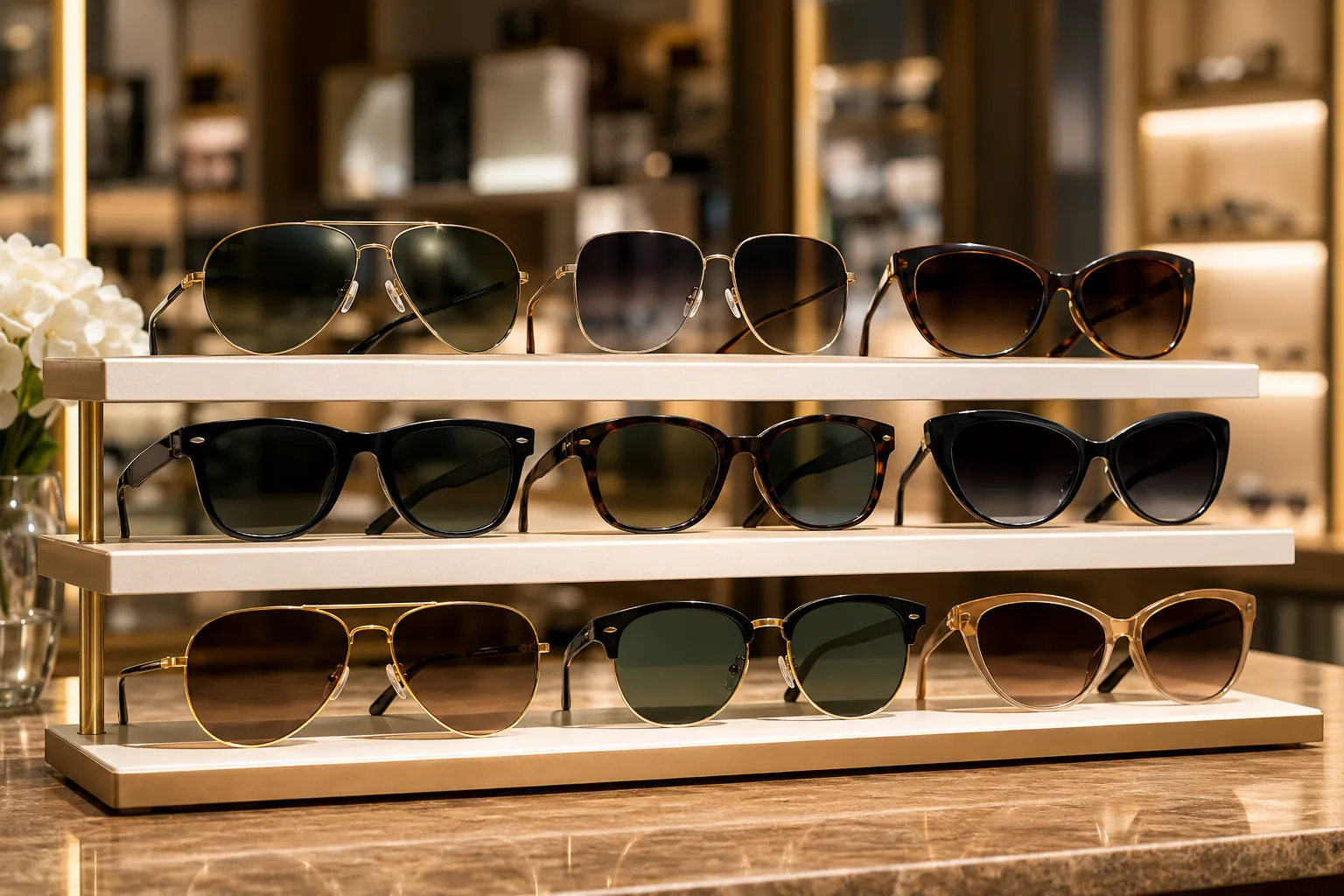
This guide is for brands, importers, distributors, and retailers planning a new sunglasses collection. The goal is to avoid two common mistakes: launching too many weak SKUs or too few to read demand properly. The right launch size is not driven by creative energy. It is set by channel risk, MOQ structure, unit depth per SKU, compliance workload, and how fast a supplier can repeat winning styles. If sampling is quick and replenishment lead time is workable, you can launch a tighter range and add proven styles later. That is the point. Build a first assortment large enough to generate usable sales feedback, but small enough to protect cash flow, simplify compliance, and avoid slow-moving stock.
Start with channel risk, not design excitement
Assortments get too big when teams start with mood boards instead of sell-through risk. That is backwards. A sunglasses line should be sized around where it will sell, how many listings or accounts will carry it, and how much inventory error the business can absorb. SKU count is not mainly a branding decision. It is an inventory and execution decision first.
If you sell DTC through your own site, marketplaces, or social channels, a smaller range is usually easier to manage. Feedback comes faster. You see clicks, conversion, returns, and color preference early. If you sell through wholesale accounts or distributors, you may need more breadth to cover different shape profiles, price points, and customer types. Even then, breadth only helps if each SKU has a clear commercial role.
- Low-risk launch: 3-5 SKUs. Usually right for new brands, online-first sellers, or first orders with a new supplier.
- Moderate-risk launch: 5-7 SKUs. Often workable for mixed channels, showroom selling, or distributors serving different account types.
- Higher-complexity launch: 8-10 SKUs. Better for buyers with prior category data, stronger replenishment control, or a clear segmentation plan.
- High-fragmentation danger zone: 10+ SKUs on a first drop. This often reduces stock depth per style and muddies the demand signal.
Give every proposed SKU a job before you approve it. One may cover classic everyday wear. Another may cover sport styling. Another may carry the premium material story. If two SKUs chase the same buyer without a clear difference in price, fit, or material, cut one. In a first launch, clarity beats variety.
Use MOQ, unit depth, and reorder speed to set the ceiling
In custom sunglasses, the real cap on SKU count is how thinly the opening order gets spread. A supplier may offer MOQs from 50 pairs per design, but MOQ flexibility is not the same thing as good planning. More SKUs mean fewer pairs per design. Fewer pairs mean weaker data.
For most first launches, work backward from the minimum quantity needed to judge a style with confidence in your own channel. If opening depth is too low, early account changes, returns, or timing noise can distort the result. The exact number depends on your model. The rule does not: depth per SKU matters as much as total order size.
Lead time changes the math. If sampling, approvals, and repeat production move on a practical schedule, you do not need to fund every idea in the first PO. Test a tighter range. Watch early sales. Reorder the styles that are actually working.
| Total Opening Order | Launch SKU Count | Pairs per SKU | Typical Result |
|---|---|---|---|
| 300 pairs | 3 SKUs | 100 pairs | Lean test with enough depth to compare early performance |
| 600 pairs | 6 SKUs | 100 pairs | Balanced opening for mixed DTC and wholesale |
| 1,000 pairs | 5 SKUs | 200 pairs | Deeper stock for repeat sellers and account replenishment |
| 1,000 pairs | 10 SKUs | 100 pairs | Usually only sensible when demand is partly validated |
| 1,200 pairs | 12 SKUs | 100 pairs | Broad on paper, but often harder to manage operationally |
Do not look at SKU count in isolation. Look at units per SKU relative to reorder speed. A line can fail quietly when every style is understocked and the buyer cannot tell whether a sellout reflects real demand or just a shallow opening quantity.
Build the assortment around three commercial roles
A practical first-season collection usually needs only three SKU roles: volume drivers, margin drivers, and image drivers. This keeps decisions commercial. It also stops the line from turning into a pile of disconnected design ideas.
- Volume drivers: broad-appeal shapes such as classic square, soft round, slim rectangle, or clean navigator.
- Margin drivers: styles with stronger perceived value, such as acetate fronts, metal temples, polarized lenses, or more premium detailing.
- Image drivers: directional styles that define the line visually but are not expected to carry the opening order financially.
Material choice matters here. Injection-molded frames are often the safest base for volume SKUs because they support repeatability and cost control at scale. Acetate can offer a more premium hand feel and stronger visual depth, but it is less forgiving when quantities are spread too thin. Color consistency, polishing, and fitting control often need more attention. CNC-milled details can create a sharper premium finish, but they add process time and should be reserved for SKUs where the selling price supports the extra cost.
For first launches, standardize the technical base and vary the style surface. Keep one hinge family across several SKUs if possible. Limit lens constructions. Reserve polarized lenses or heavier decoration for a small number of styles. That makes replacement parts, QC setup, and second-order repeatability easier to manage.
Budget math: too many SKUs get expensive fast
Many buyers compare only the quoted unit price. That is a mistake. The real launch cost sits in fragmentation. Every added SKU can create separate approvals for color, lens tint, logo position, packaging labels, carton breakdown, and QC records. Even if the supplier accepts low MOQs, the buyer's internal handling cost usually rises with each variation.
Price breaks matter too, but they vary by supplier, construction, and order structure. Do not assume the lowest MOQ gives the best overall economics. In many eyewear programs, deeper quantities across fewer styles improve unit cost, reduce packaging complexity, and simplify freight planning. A fragmented first order can keep the business stuck in a less efficient cost band even when nominal MOQ is met.
Consider the hidden cost stack behind each extra SKU:
- Sampling cost: more prototypes, more color or lens approvals, and more revision cycles.
- Packaging cost: more barcode files, artwork versions, stickers, and carton labels.
- QC cost: more inspection points for logo placement, lens matching, and assembly finish.
- Inventory cost: more slow-moving tails that take warehouse space and tie up cash.
- Reorder cost: more partial repeats that may not qualify for the best production efficiency.
Packaging is a common leak. If every SKU gets a different printed box, care card, pouch, and carton label, small runs get inefficient fast. A better first-drop structure is often one master carton specification, one generic care insert, one pouch material, and only essential SKU-level differences such as the barcode sticker and frame-color label. Standardization protects margin early.
Let compliance, tolerances, and material behavior narrow the range
Not every design idea deserves production. Before approving a first assortment, run it through compliance workload and manufacturing behavior. Overseas buyers are not sourcing only a fashion item. They are sourcing a regulated consumer product that has to survive freight, handling, retail display, and customer use.
For many export programs, standards and regulatory requirements such as CE EN ISO 12312-1, ANSI Z80.3, AS/NZS 1067, REACH, and FDA registration may affect planning, depending on target market and product scope. The practical takeaway is simple: do not create unnecessary combinations of lens category, coating, frame material, and decoration in the first PO if each combination adds documentation, test review, or approval complexity. Confirm with the supplier which tests, declarations, and technical files apply to the destination market before you lock the assortment.
Tolerances matter too. In bulk eyewear production, buyers should define acceptance criteria for visible dimensions and cosmetic consistency, not just overall style approval. Lens tint consistency, left-right color matching, temple alignment, hinge feel, logo placement, and surface finish all need clear standards. Decorative processes such as pad printing, laser marking, hot stamping, and metal logo plates each add their own control points. Mirrored and gradient lenses need closer appearance checks because mismatch shows easily under retail lighting.
Material behavior should reduce SKU count, not expand it. Acetate can deliver a richer premium look, but batch variation, polishing time, and fitting work often make it better suited to selected premium SKUs than to a full unproven launch. Injection frames are generally easier to repeat consistently at volume. Polarized lenses can support stronger pricing, but spreading them across too many styles increases both cost and compliance review. Keep decorative and material complexity concentrated in a small number of SKUs.
A practical launch framework for different buyer types
Different buyers should not use the same SKU formula. Their replenishment rhythm and sales visibility are different. An online-first brand can read weekly conversion data quickly. A distributor may need account feedback across multiple territories before reordering. A retail chain cares more about store allocation and replenishment discipline by shape and color.
| Buyer Type | Recommended First Launch | Why | Reorder Trigger |
|---|---|---|---|
| Online-first brand | 3-5 SKUs | Faster feedback, simpler content planning, and lower inventory risk | Reorder when core styles show sustained sales velocity and inventory cover becomes too short for the supplier lead time |
| Distributor | 6-8 SKUs | Needs enough breadth for different accounts, regions, and price points | Reorder when multiple accounts repeat the same styles or when sample conversion shows clear concentration on specific SKUs |
| Retail chain or multi-store retailer | 5-7 core SKUs plus limited color extensions | Store allocation works better with consistent shapes and simpler replenishment | Reorder from store sell-through by shape and color, adjusted for current stock cover and inbound timing |
| Established brand entering a new segment | 6-10 SKUs | Can test several style and price positions using an existing audience | Reorder after ranking styles by revenue, margin, and sales velocity rather than by sellout alone |
If you are not sure which category you fit, default smaller. It is easier to add two validated SKUs on the second order than to clear several weak ones through markdown later. In launch planning, restraint is often more profitable than ambition.
Use a hard pre-PO checklist before locking SKU count
Before placing the PO, score every proposed SKU against a hard checklist. Be strict. If a design fails two or more items, it usually does not belong in the first drop. This is far more reliable than approving styles just because they look good in a sample review.
- Channel fit: Does this style match a defined sales channel, customer segment, or account type?
- Unit depth: Can you buy enough pairs for the result to be commercially meaningful in your channel?
- Price logic: Does it still hit the target landed margin after freight, duty, packaging, and expected markdown risk?
- Compliance path: Does it fit the required market standards and documentation without creating avoidable testing complexity?
- Production fit: Are the frame material, lens family, and decoration method realistic for a controlled first run?
- Repeatability: If it wins, can the supplier repeat it with consistent fit, finish, and timing?
Repeatability is the question buyers often miss. A launch assortment should be built for replenishment, not just presentation. If the supplier controls more key processes consistently, operates under a documented quality system such as ISO 9001, and can provide relevant compliance records, the buyer usually has a stronger basis for a lean assortment strategy. Supplier social compliance programs such as BSCI may also matter for some retailers, but verify them directly. Do not assume. The commercial goal is simple: fewer speculative SKUs now, cleaner demand signals, and an easier second PO.
The safest first-season formula
For many overseas buyers, the safest first-season collection is 4-6 SKUs with clear role separation, moderate color variation, and enough depth to reorder winners. A practical structure is two volume shapes, one slightly premium style, one directional style, and one or two color extensions only where the shape is already commercially strong. That keeps the line readable for the customer and manageable for the buying team.
Keep technical variation tight. Do not launch every frame in a different material, hinge, lens treatment, and logo method. Standardize hinge types where possible, keep lens families narrow, and reserve premium decoration for selected styles. This reduces approval rounds, shortens QC setup, and lowers the risk of drift between samples and bulk production.
The first collection is not a display of everything the factory can make. It is a controlled market test with real cash exposure. If your supplier can sample, approve, and replenish on a practical timeline, use that speed to learn instead of overcomplicating the opening order. More options are not better by default. Better data is better. The best first launch is the one that generates clear demand signals, protects cash, and makes the second PO easier to place.
Good first launch: fewer SKUs, deeper stock per style, controlled materials, clearer demand signals, and a defined reorder plan. Bad first launch: too many designs, shallow quantities, unnecessary lens and decoration variation, unclear performance data, and leftover stock that reduces budget flexibility.
Have a custom sunglasses project in mind?
Send us your styles, target market and quantities and we will return a detailed quote with MOQ, lead time and a sample plan.
Get a QuoteWhy source this from Wenzhou with LumiShades
Wenzhou in Zhejiang Province is widely regarded as China’s eyewear manufacturing capital, producing a large share of the world’s sunglasses. That concentration matters to buyers: a deep local supply chain for acetate sheet, hinges, lens blanks, plating and packaging means shorter component lead times, easier color and material matching, and a workforce with decades of eyewear-specific skill. LumiShades has manufactured in this ecosystem since 2009, and our vertical integration — in-house injection molding, acetate cutting, CNC milling, lens tinting, decoration and quality control — means no part of your order is quietly subcontracted to a workshop you cannot audit.
For international buyers, that vertical control translates into accountability. When a single factory owns every step, defects are traced and fixed at source rather than bounced between vendors, and your specifications survive intact from first sample to bulk. We back this with 15+ years of experience, shipments to 60+ countries, more than 5 million pairs produced per year and a 98.5% on-time delivery rate. Our certifications — CE EN ISO 12312-1, FDA registration, ANSI Z80.3, AS/NZS 1067, REACH, ISO 9001 and BSCI audit — mean the compliance documentation your market requires already exists. Explore our manufacturing capabilities and quality control process to see how this works in practice.
Frequently asked questions
What is the best SKU count for a new private label sunglasses brand? For most new brands, 3-5 SKUs is a practical starting range. That is usually enough to compare shape, price, and color preference without spreading inventory too thin. To set the exact number, check three things first: your opening budget, the minimum workable quantity per SKU, and your supplier's repeat lead time. If you cannot afford meaningful depth on five styles, launch three stronger ones instead.
Should I use the 50-pair MOQ on every design? Usually not. A 50-pair MOQ can make sense for one controlled test style, a niche account request, or a sample-market trial, but using the minimum across the whole assortment often creates weak data and more operational complexity. Ask one blunt question before approving any SKU at MOQ level: if this style sells out or stalls, will the quantity be large enough to teach you something useful? If not, cut the SKU or increase the depth.
How many colors should each frame have at launch? Start with 1-2 colors per core shape. A reliable opening structure is one commercial color and one hero color. Add more only if you already have category data showing clear color demand by channel or region. More color options increase packaging, stock allocation, and replenishment complexity, so each added color needs a clear selling reason.
Does faster production mean I can launch fewer SKUs? Yes, often. If your supplier can sample quickly, confirm approvals efficiently, and repeat bulk production within your selling window, you can launch a tighter range and reorder winners instead of funding broad speculative inventory. Compare supplier lead time against your weekly sell-through visibility. If you can spot a winning style early enough to reorder before the season moves on, a smaller launch is usually the safer choice.
How do compliance requirements affect SKU planning? Every added lens type, coating, frame material, or decoration method can increase the amount of compliance review and documentation required. Before finalizing the SKU plan, confirm which market requirements apply to your shipment, such as CE EN ISO 12312-1, ANSI Z80.3, AS/NZS 1067, REACH, or FDA registration. Then simplify the first launch by cutting avoidable combinations. A practical checklist is: confirm destination-market requirements, request current test reports or declarations from the supplier, match those documents to the exact product construction, and avoid adding extra materials or lens treatments unless there is a clear commercial reason.
Ready to start?
Explore our sport wrap sunglasses or request a quote — our sales team replies within 12 hours.
Request a Quote