
What Makes a Sunglasses OEM Quote Low or Incomplete
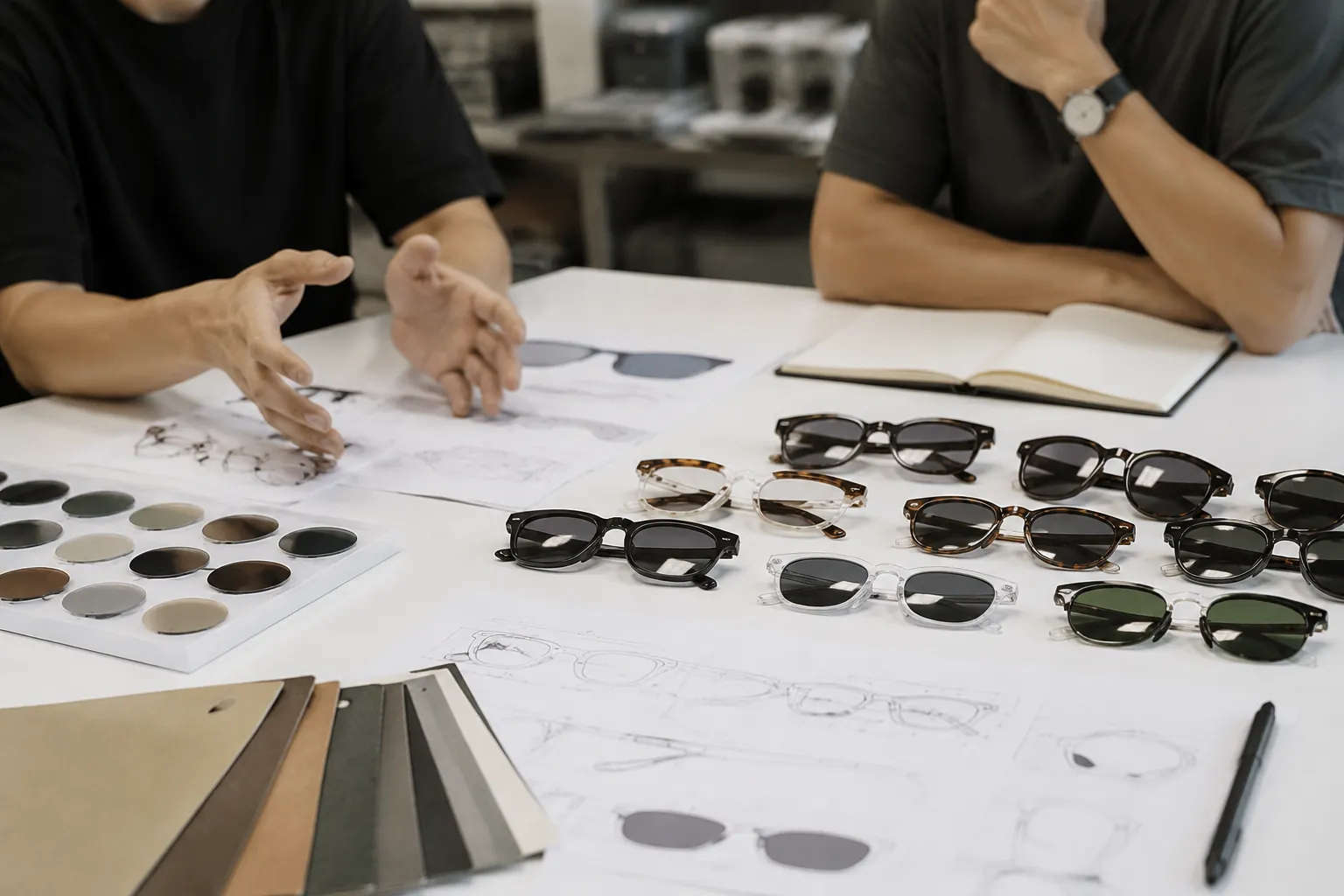
This article is for brands, importers, distributors, and retailers buying custom sunglasses at volume. A low quote only matters if you know what it includes and what it leaves out. Compare tooling, materials, decoration, testing, packaging, and freight on the same basis. Miss one item, and the "cheap" bid can become the expensive one.
Start With Unit Price, Then Break It Down
A sunglasses quote is not a single number standing alone. It reflects a set of choices: frame material, lens type, decoration, packaging, carton method, testing scope, and how much setup work the factory must absorb.
A quote around $2.10 per pair at high volume can be realistic only when the order is simple and the factory can spread fixed costs across enough units. At MOQ 50 pairs per design, the same frame usually costs more because setup is spread over far fewer pieces. That is normal.
What is not normal is a "low" quote that later adds tooling, plate fees, special inks, or compliance testing. Ask the first question plainly: does the unit price include all recurring production costs, or only the base frame and assembly? If that is unclear, the quote is incomplete.
The Big Cost Drivers Buyers Miss
These are the common places where a quote looks cheap on paper and grows later.
- Tooling and mold work: Injection frames may require mold fabrication or mold modification. If the design is new, front-end cost is real even if the per-pair price looks attractive.
- Frame material: Injection, acetate, and metal do not cost the same. Acetate needs cutting, tumbling, polishing, and more handwork. Metal needs CNC work, soldering, plating, and tighter alignment control.
- Lens specification: Plain tinted lenses are not the same as polarized lenses, mirrored finishes, gradient tints, or specialty coatings. Each adds material and process cost.
- Decoration: Laser engraving, pad printing, and metal logo plates can carry setup charges and yield risk. A logo on the temple is not free.
- Packaging: A polybag and bulk carton are inexpensive. A custom box, cleaning cloth, insert card, barcode label, and retail hang tag are separate items and should be quoted clearly.
- Compliance testing: CE EN ISO 12312-1, ANSI Z80.3, AS/NZS 1067, REACH, FDA registration, ISO 9001, and BSCI each affect what the factory can claim, document, or support. They are not interchangeable, and not all are product certifications.
- Freight and cartons: Export carton size, weight, destination, and shipping term can change landed cost more than buyers expect.
The point is simple: if a supplier does not say what is included, you are comparing assumptions, not offers.
A Clean Quote Breaks Costs Into Buckets
The easiest way to compare suppliers is to force each bid into the same buckets. Use this structure and ask every factory to fill it in. If they cannot, the quote is not ready for approval.
| Cost bucket | What should be included | Common omission | Buyer risk |
|---|---|---|---|
| Tooling / setup | Mold cost, mold modification, screen or plate setup, color master matching | Tooling billed later | Margin loss after PO is placed |
| Unit production | Frame, lens, hinges, screws, labor, normal assembly | Packaging or logo work excluded | Quote looks lower than reality |
| Decoration | Pad print, laser engraving, metal logo plate, color fill | One-time plate charge hidden | Unexpected NRE fee |
| Testing / compliance | Test reports, pre-production checks, paperwork for the stated standard | Only "can pass" claimed, not included | Delay at customs or market entry risk |
| Packing / export | Inner pack, master carton, labels, cartons, palletization if needed | Retail-ready packing not quoted | More handling cost at destination |
Some suppliers bundle more than others. That is fine. But the bundle must be explicit. A low quote with no line-item clarity is often just a postponed invoice.
Why MOQ Changes the Real Price
MOQ is not just a factory rule. It changes the cost structure. At 50 pairs per design, the factory is carrying setup time, color matching, sample approval, and quality checks across a tiny run. Per-pair cost stays high. At 300, 1,000, and 5,000+ pairs, the fixed cost gets spread out and the quote begins to behave like a production price.
That is why a price ladder matters. If a supplier shows the same price at 50 and 5,000 pairs, something is off. Either the 50-pair quote is subsidized, or the 5,000-pair quote is padded. Neither helps you plan.
For overseas buyers, the practical question is not "what is the cheapest unit price?" It is "what is the true landed cost at my target quantity, with my packaging, my decoration, and my compliance requirements?" That answer is usually more useful than the headline number from a casual inquiry.
Testing and Compliance Are Not Afterthoughts
Eyewear is a product category where compliance can decide whether a shipment moves smoothly. For a serious buyer, the question is not whether the factory says it can pass. The question is what proof exists, for which market, and under which standard.
Keep the standards straight. CE EN ISO 12312-1 is the relevant sunglasses standard for the EU. ANSI Z80.3 is a common U.S. eyewear safety reference. AS/NZS 1067 applies to Australia and New Zealand. REACH addresses chemical compliance concerns in the EU market and can affect materials, coatings, and some decorative finishes. FDA registration is a regulatory status, not the same thing as product certification. ISO 9001 and BSCI relate to management systems and social compliance processes, not sunglasses performance testing.
Testing also affects lead time. A quote that omits sample testing, pre-production checks, or document preparation may be cheaper only because it assumes the buyer will solve compliance later. That creates avoidable risk. Confirm the standard and documentation before production starts.
Materials and Decoration Change the Risk Profile
Two quotes can look similar and still behave very differently in production. The reason is usually material behavior and decoration risk.
Injection frames are efficient for volume, but they depend on stable molds and consistent resin flow. Acetate has a premium hand feel, but it also brings more processing steps: cutting, shaping, polishing, and tighter visual inspection. Metal frames can look slim and clean, but CNC milling, wire forming, and logo placement need better dimensional control. Poor tolerance control shows up as crooked temples, uneven lens seating, or loose hinges.
Decoration is where shortcuts get expensive. Laser engraving needs accurate positioning and consistent surface finish. Pad printing is efficient only when the artwork is stable and the setup is approved. Metal logo plates add material and labor. If the supplier is not spelling out these details, the quote is incomplete.
For example, a factory that handles injection molding, acetate cutting, CNC milling, lens tinting, decoration, and QC in-house reduces handoff points. That does not remove risk. It does reduce the chance that outside vendors quietly add cost or delay.
Packaging, Freight, and Landed Cost
Some buyers negotiate hard on unit price and then lose the margin in logistics. That is a common mistake.
Packaging decisions change both cost and freight. A small retail box adds carton volume. A hard case adds weight. Insert cards, cloths, and polybags may be inexpensive individually, but they add up across thousands of pairs. Even the way the factory packs master cartons changes how many pairs fit per CBM.
Freight also changes the meaning of a quote. EXW, FOB, and DDP are not interchangeable. If one supplier quotes factory price and another quotes delivered price, the lower number is often not comparable. Ask for the same term, the same packing specification, and the same destination basis before comparing.
- Confirm unit price at your target quantity.
- Confirm whether tooling, decoration, and packaging are included or listed separately.
- Confirm the applicable test standard and document set.
- Confirm carton count, carton size, and shipment term.
- Convert everything to landed cost per pair.
That is the comparison that matters.
What a Serious Buyer Should Ask Before Saying Yes
Use this checklist before you approve any OEM quote.
- What exactly is included in the unit price?
- Is tooling included, amortized, or billed separately?
- What are the sample lead time and bulk lead time?
- Which compliance standard applies to my market?
- What decoration methods are included, and what are their setup fees?
- What is the packaging specification, and who pays for custom packing items?
- What is the price at 300, 1,000, and 5,000+ pairs?
- What freight term is being used, and what are the estimated carton dimensions and weight?
A good supplier answers these quickly and clearly. A weak one avoids the details. That usually tells you enough.
Have a custom sunglasses project in mind?
Send us your styles, target market and quantities and we will return a detailed quote with MOQ, lead time and a sample plan.
Get a QuoteWhy source this from Wenzhou with LumiShades
Wenzhou in Zhejiang Province is widely regarded as China’s eyewear manufacturing capital, producing a large share of the world’s sunglasses. That concentration matters to buyers: a deep local supply chain for acetate sheet, hinges, lens blanks, plating and packaging means shorter component lead times, easier color and material matching, and a workforce with decades of eyewear-specific skill. LumiShades has manufactured in this ecosystem since 2009, and our vertical integration — in-house injection molding, acetate cutting, CNC milling, lens tinting, decoration and quality control — means no part of your order is quietly subcontracted to a workshop you cannot audit.
For international buyers, that vertical control translates into accountability. When a single factory owns every step, defects are traced and fixed at source rather than bounced between vendors, and your specifications survive intact from first sample to bulk. We back this with 15+ years of experience, shipments to 60+ countries, more than 5 million pairs produced per year and a 98.5% on-time delivery rate. Our certifications — CE EN ISO 12312-1, FDA registration, ANSI Z80.3, AS/NZS 1067, REACH, ISO 9001 and BSCI audit — mean the compliance documentation your market requires already exists. Explore our manufacturing capabilities and quality control process to see how this works in practice.
Frequently asked questions
Why does a low sunglasses quote often turn expensive later? Because the first number may exclude tooling, decoration setup, testing, custom packaging, or freight. Once those items are added, the landed cost can be much higher than the headline unit price. To avoid surprises, ask for a quote that shows what is included and what is excluded, then compare on the same trade term and quantity.
What should I ask for to compare two OEM quotes fairly? Use the same quantity, frame material, lens type, decoration method, packaging specification, and trade term such as FOB or EXW. Ask each supplier to state tooling, unit production, packaging, and compliance separately if possible. Then compare landed cost per pair, not just factory price.
Is MOQ 50 pairs/design realistic for custom sunglasses? Yes, but the per-pair price is usually higher because setup costs are spread over a small run. MOQ 50 can work for testing a design, market sampling, or a small launch. If you need a commercial run, ask the supplier for price breaks at 300, 1,000, and 5,000+ pairs so you can plan the real cost curve.
Which compliance documents matter for sunglasses exports? Start by matching the market to the standard: CE EN ISO 12312-1 for the EU, ANSI Z80.3 for the U.S., and AS/NZS 1067 for Australia and New Zealand. Ask for the specific test report or evidence the supplier can provide, and confirm whether REACH-related material compliance is needed for your product. Also note that FDA registration is a regulatory status, not a product performance certificate.
How long should samples and bulk production take? Lead times depend on design complexity, materials, decoration, and whether approvals are smooth. Ask the factory to separate sample lead time from bulk production lead time and to state when timing starts, such as after artwork approval or deposit receipt. For planning, use the supplier's written schedule rather than an informal estimate, and build in extra time if tooling, compliance checks, or packaging development are involved.
What makes acetate, injection, and metal quotes different? Injection is usually more efficient at scale because the process is designed for repeated molding. Acetate needs cutting, shaping, polishing, and careful visual inspection. Metal often needs CNC work, forming, plating, and tighter assembly control. The process steps, scrap risk, and finishing labor are different, so the prices should not be the same. Ask the supplier to quote each material on the same packaging and compliance basis before comparing.
Ready to start?
Explore our round sunglasses or request a quote — our sales team replies within 12 hours.
Request a Quote