
What Sunglasses Factories Make In-House vs Outsource
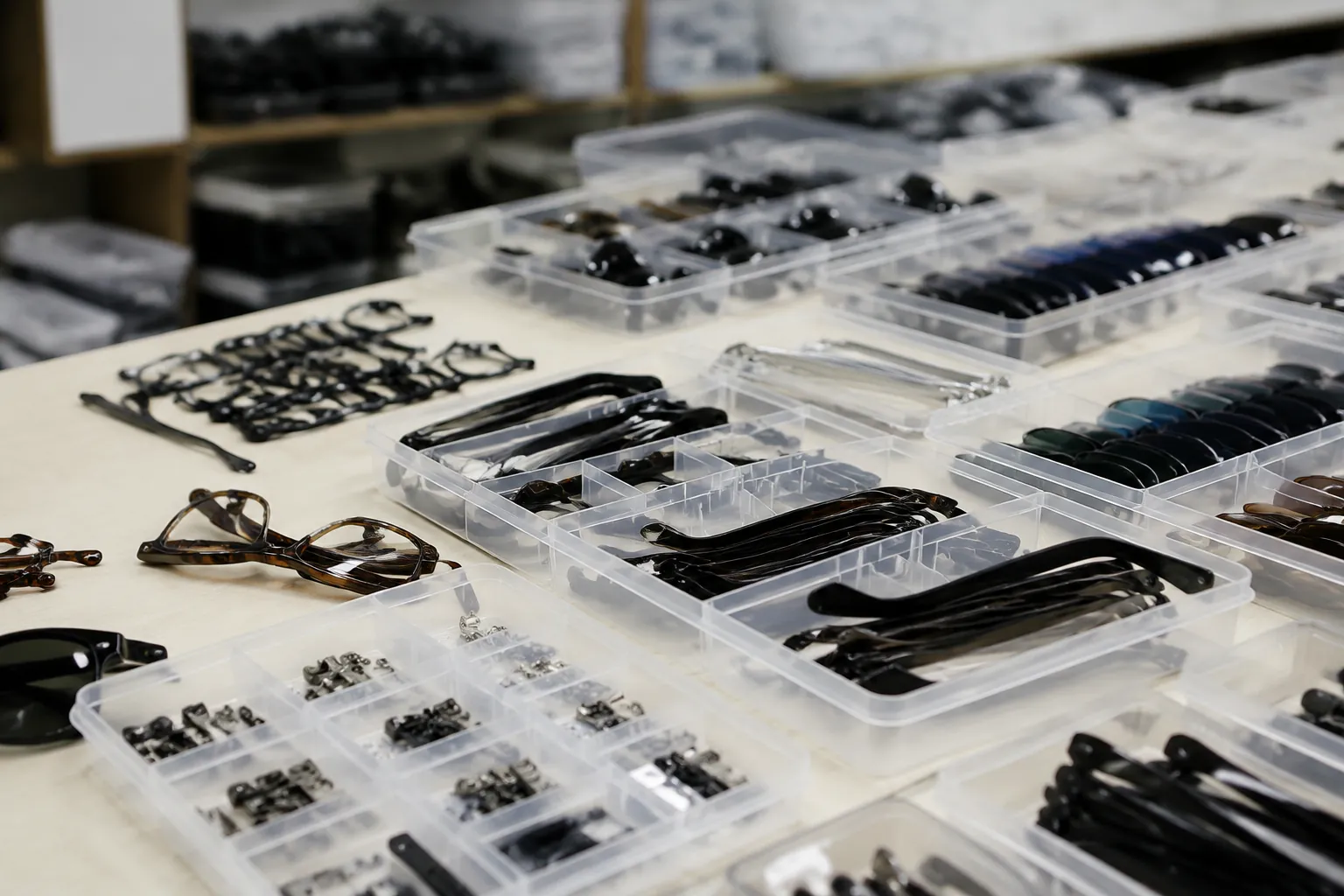
If you buy custom sunglasses for a brand, chain, or distribution business, you need to know exactly where each component is made and where work is handed off. That split affects fit tolerance, color consistency, defect rate, compliance exposure, lead time, and landed cost. This guide explains which sunglass processes are usually best kept in-house, which are commonly outsourced, and what that means in practical sourcing terms. Use it to judge a supplier before you place volume orders.
Start with one question: what is really made under one roof?
Many suppliers say they "make sunglasses," but that can mean anything from full production to final assembly of purchased parts. For a buyer, the useful question is narrower: which steps are actually controlled inside the factory, and which are handed to other plants?
That distinction matters. Sunglasses are a multi-step product. A frame may be molded or cut in one place, a lens tinted somewhere else, logo decoration handled by a subcontractor, and final packing done back at the main site. Every handoff adds queue time. It also adds room for error.
Color drifts. Fit shifts. Packaging gets mixed up. It happens.
A credible factory should be able to map the full flow clearly: raw material intake, frame forming, trimming, lens work, decoration, assembly, QC, and shipment. If a supplier cannot explain where each step happens, assume the process is fragmented. Fragmented production is not always bad, but it should be intentional and documented.
Do not rely on brochure language. Ask for a process map, a machine list, and sample records from the last production run. If the answer is vague, the supplier is likely more assembler than manufacturer.
The processes that should usually stay inside the factory
Some operations are worth keeping under one roof because they directly affect appearance, function, and repeatability. If a supplier says these are in-house, ask for machine photos, operator headcount, and a real walk-through.
- Injection molding for TR90, PC, or similar frame parts. Clamp pressure, melt temperature, mold cooling, and cycle time affect warpage, sink marks, and flash. A good factory should hold key dimensions to the limits on your drawing or approved sample.
- Acetate cutting and shaping. Acetate behaves differently from injection plastics. Moisture content, cutting speed, and sanding finish affect edge smoothness and temple symmetry. If the cut is off, hinge alignment and front balance can suffer.
- CNC milling. This is common on thicker acetate or mixed-material designs. CNC gives repeatability for bridge detail, bevels, and custom contours, especially when the buyer wants tight cosmetic consistency across multiple SKUs.
- Lens tinting. Color consistency is hard to manage if tinting is split across suppliers. A controlled process should define dye bath concentration, temperature, dwell time, rinse sequence, and color inspection under standard light. On repeat orders, buyers should expect documented color matching against an approved standard, not "close enough by eye."
- Decoration. Laser engraving, pad printing, hot stamping, and metal logo plates all have different failure modes. Pad print misregistration, poor ink cure, and weak adhesion are common causes of rejects. Placement should be checked against the approved artwork and sample.
- Final QC and packing. This should never be an afterthought. A real QC station checks lens fit, temple opening force, symmetry, surface scratches, coating defects, and carton counts before ship-out. For private label programs, this is also where barcode and carton accuracy must be confirmed.
In-house control does not mean perfection. It usually means faster correction. If a lens tint is too dark, a temple is warped, or the logo is misaligned, the factory can isolate the problem and fix the next batch without waiting for an outside vendor to respond.
What is commonly outsourced, and why that is not always bad
Not every process belongs inside one factory. Some steps are subcontracted because they need specialized equipment, a separate environmental setup, or volume that does not justify in-house investment.
| Process | Commonly in-house? | Often outsourced? | What to verify if outsourced |
|---|---|---|---|
| Basic frame molding | Yes, in larger factories | Yes, in assembly-only factories | Who owns the mold, where it is stored, and whether cavities are maintained and polished |
| Special lenses or coatings | Sometimes | Yes | UV/AR/polarized specification, coating durability, haze, and whether test reports match the exact lens build |
| Packaging printing | Sometimes | Yes | Artwork version control, carton dimensions, barcode accuracy, and color match on print |
| Metal hardware finishing | Sometimes | Yes | Plating thickness, corrosion resistance, color consistency, and nickel-release or REACH risk |
Outsourcing is not automatically a problem. A factory may subcontract a process because the work is specialized, seasonal, or too capital-intensive to do in-house. For example, a lens coating vendor may have better vacuum equipment than the frame plant, or a packaging printer may be more efficient for short runs with frequent artwork changes.
The issue is control. Managed outsourcing can work if the main factory defines specifications, inspects incoming parts, keeps lot traceability, and owns the final sign-off. Risk rises when the supplier cannot tell you which vendor did the work, what standard was used, or how defects are corrected before shipment. Blind outsourcing makes it hard to answer simple buyer questions such as, "Why did this batch shift in tint?" or "Why did the logo rub off after testing?"
Use one simple rule: if a subcontracted step can change optics, fit, safety, or brand appearance, the main factory should have a documented inspection gate before the product moves forward.
How in-house control changes lead time, MOQ, and price
Lead time is not just a shipping estimate. It is the sum of material readiness, queue time, processing time, inspection, rework, and packing. The more processes the same factory controls, the easier it is to build a predictable schedule.
For a controlled factory, sample lead time is often shorter because the team can move from tool prep to molding or cutting, then into tinting, logo application, and QC without waiting on outside suppliers. Bulk lead time still depends on order size, SKU count, and whether new molds or custom lens colors are needed. If subcontracted printing or special lens work is involved, add buffer time for handoffs and re-inspection.
MOQ and price follow the same logic. A small pilot run is expensive per unit because setup, tool cleaning, and color matching are spread over very few pairs. As volume rises, the factory can stabilize settings and reduce waste. At higher volumes, unit cost usually improves because changeovers are amortized and materials can be purchased in better lots.
Here is the basic economics:
- Low MOQ, high customization: more hand setup, more inspection, higher scrap risk, and slower response when changes are needed.
- Mid-volume replenishment: the factory can lock process settings and repeat the same color and finish with less waste.
- High volume: labor efficiency improves, material waste drops, and the factory can negotiate better resin, acetate, lens, and carton costs.
The point is simple. More in-house control usually improves schedule predictability and makes cost scaling easier to explain. If every critical step depends on another company, delays become harder to forecast and cost changes become harder to justify.
Material behavior and tolerances buyers should ask about
Eyewear problems often start with material behavior, not with the final assembly step. Buyers who know a few details can ask better questions during supplier review.
TR90 and PC: These materials are light and flexible, but they can warp if processing temperature or cooling is uneven. Frame fronts should stay symmetrical, and lens openings should not pinch the lens. If a factory cannot keep repeatable dimensions on a molded frame, the temples may open unevenly or the lens may not seat correctly.
Acetate: Acetate is attractive because it polishes well and takes deep color, but it is more sensitive to moisture, heat, and cutting quality. After cutting, it often needs resting or stabilization to reduce later movement. Poor sanding can create edge haze or visible tool marks.
Lenses: Standard tinted lenses should be checked for color uniformity, haze, and optical clarity. Polarized lenses add another layer of risk because the film alignment must be correct and the laminate must not delaminate at the edges. If the coating is outsourced, ask whether the subcontractor measures transmission and haze on every lot or only on a sample.
For custom programs, ask for practical tolerance targets on your own spec sheet. Reasonable examples to discuss include front width, temple length, lens fit, and logo position. The exact tolerance should be written against the product design and approved sample, not guessed informally.
Also ask how the factory handles rework. If an acetate temple is slightly twisted, can it be heat-adjusted on site? If a pad print is faint, can the factory strip and reprint without damaging the surface? The answer tells you whether the plant is equipped for real production control or only for final assembly.
What a buyer should verify on the factory floor
Do not stop at certificates on a PDF. A factory audit should confirm that the claimed capability is real and that the plant can support your order pattern.
- Tooling ownership: confirm who owns the molds, who maintains them, and whether they are stored on site or at a partner facility.
- Machine list: injection molding machines, CNC equipment, cutting stations, polishing tools, tinting tanks, printing or engraving machines, and QC gauges should all be visible.
- QC checkpoints: ask where inspection happens, what defects are rejected, and how often batches are sampled. For higher-risk orders, sampling should happen at incoming, in-process, and final stages.
- Material traceability: frame resin, acetate sheets, lenses, screws, and plating lots should be identifiable by batch.
- Color control method: ask how the factory matches frame color and lens tint from pre-production sample to bulk, and whether it uses a standard light booth or a visual-only check.
- Rework handling: if a logo is off by 1 mm or a temple is warped, what happens next, and who approves the fix?
It also helps to ask for production records from the last two or three comparable orders: order quantity, defect rate, rework percentage, and on-time shipment rate. A good factory should be able to speak in practical terms, not just promises.
Bluntly, if the supplier cannot show where the work happens, it may be relying heavily on outside processors or acting as a trading-house style operation. That does not automatically disqualify it, but it changes how you manage risk.
Compliance is part of manufacturing, not a side note
For overseas buyers, compliance should be treated as part of the process flow, not as a box-ticking exercise after production is done. The certifications and registrations you mention should be tied to the exact product and market you are buying for.
The most relevant credentials for many sunglass programs are:
- CE EN ISO 12312-1
- ANSI Z80.3
- AS/NZS 1067
- REACH
- FDA registration
- ISO 9001
- BSCI
These matter because they connect to different parts of manufacturing and supply. CE EN ISO 12312-1, ANSI Z80.3, and AS/NZS 1067 are tied to sunglass performance and testing expectations in their respective markets. REACH affects restricted substances in coatings, inks, adhesives, and some metal finishing. ISO 9001 matters because it reflects process control, document discipline, and corrective-action behavior. BSCI speaks to social compliance, which is increasingly relevant for retail buyers and brand audits. FDA registration is relevant in the United States market context, but buyers should still confirm whether the product itself needs additional documentation or testing based on intended use and claims.
If decoration is done in-house, the factory should know exactly which inks, primers, and adhesives are used and whether they are traceable to compliant batches. If lens tinting or plating is outsourced, verify that the subcontractor's materials still fit the destination market requirements. A good supplier will provide test reports tied to the exact frame and lens combination you are buying, not just a similar model.
Ask whether the certification scope covers the product family you want, whether reports are current, and whether the test lab references the same SKU code. Compliance claims only matter when they line up with the real production route.
How to separate a real factory from a parts assembler
There are three practical signs that tell you whether you are dealing with a serious production site.
- Process continuity: parts move from molding or cutting to decoration to QC without leaving the site, or the supplier can clearly document each external step.
- Failure ownership: the same factory answers for fit, color, logo placement, lens issues, and packing errors.
- Production history: the plant can discuss annual output, line balance, and on-time delivery, not just say "we can do it."
High output alone does not prove manufacturing strength. Process control does. A factory that can explain its workflow, show records, and prove traceability is easier to manage than one that relies on general claims.
If the supplier is mostly assembling purchased parts, you may still get a workable order, especially for simple private label programs. But expect slower sample turns, weaker correction speed, and more batch-to-batch variation. That is why the best buying decision is not just about price. It is about matching the factory structure to your order type.
Practical rule: if your program depends on repeatability, speed, and brand consistency, prioritize in-house molding, tinting, decoration, and QC over broad catalog claims. A factory that does fewer things well is often safer than one that claims everything and controls little.
Have a custom sunglasses project in mind?
Send us your styles, target market and quantities and we will return a detailed quote with MOQ, lead time and a sample plan.
Get a QuoteWhy source this from Wenzhou with LumiShades
Wenzhou in Zhejiang Province is widely regarded as China’s eyewear manufacturing capital, producing a large share of the world’s sunglasses. That concentration matters to buyers: a deep local supply chain for acetate sheet, hinges, lens blanks, plating and packaging means shorter component lead times, easier color and material matching, and a workforce with decades of eyewear-specific skill. LumiShades has manufactured in this ecosystem since 2009, and our vertical integration — in-house injection molding, acetate cutting, CNC milling, lens tinting, decoration and quality control — means no part of your order is quietly subcontracted to a workshop you cannot audit.
For international buyers, that vertical control translates into accountability. When a single factory owns every step, defects are traced and fixed at source rather than bounced between vendors, and your specifications survive intact from first sample to bulk. We back this with 15+ years of experience, shipments to 60+ countries, more than 5 million pairs produced per year and a 98.5% on-time delivery rate. Our certifications — CE EN ISO 12312-1, FDA registration, ANSI Z80.3, AS/NZS 1067, REACH, ISO 9001 and BSCI audit — mean the compliance documentation your market requires already exists. Explore our manufacturing capabilities and quality control process to see how this works in practice.
Frequently asked questions
Which sunglasses processes should I insist are in-house? Verify the steps that most directly affect product consistency: injection molding, acetate cutting and shaping, CNC milling when used for the design, lens tinting, decoration, and final QC. Ask the factory to show where each step happens, who owns the equipment, and how each step is checked before shipment.
Is outsourcing lens tinting always a problem? No. It can be acceptable if the factory controls incoming inspection, batch traceability, and final QC, and if the subcontractor's output matches the required color and transmission specification. It becomes a risk when the supplier cannot identify the vendor, show the test basis, or explain how out-of-spec lots are rejected.
How does in-house production affect lead time? It usually makes lead time more predictable because fewer handoffs mean fewer queue delays and less re-inspection. To evaluate a quote, ask for sample lead time, bulk lead time, the number of production steps done on site, and whether any outsourced process adds extra days for transfer and verification.
What tolerances should I ask about during a factory audit? Ask the factory to state the tolerances it can hold on the exact design you are buying, not just general capability. Good audit questions include front width, temple length, lens fit, symmetry, and logo placement, plus how those measurements are checked and recorded. Require the tolerances to be written on the approved spec or sample sheet.
Which certifications are relevant for custom sunglasses? For many sunglass programs, the key credentials to verify are CE EN ISO 12312-1, ANSI Z80.3, AS/NZS 1067, REACH, FDA registration, ISO 9001, and BSCI. Confirm that the documentation is current, that the scope covers the exact product family, and that any test report references the same SKU or build you plan to order.
When does a higher MOQ make sense? A higher MOQ makes sense when you want lower unit cost and more stable output. As volume rises, setup time, color matching, and scrap are spread across more pairs, which usually improves pricing. Before agreeing to a larger MOQ, ask the factory to confirm material availability, whether the mold or tooling is ready, and what happens if the first production run does not match the approved sample.
Ready to start?
Explore our square sunglasses or request a quote — our sales team replies within 12 hours.
Request a Quote