
What an OEM Sunglasses Sample Must Prove Before Bulk
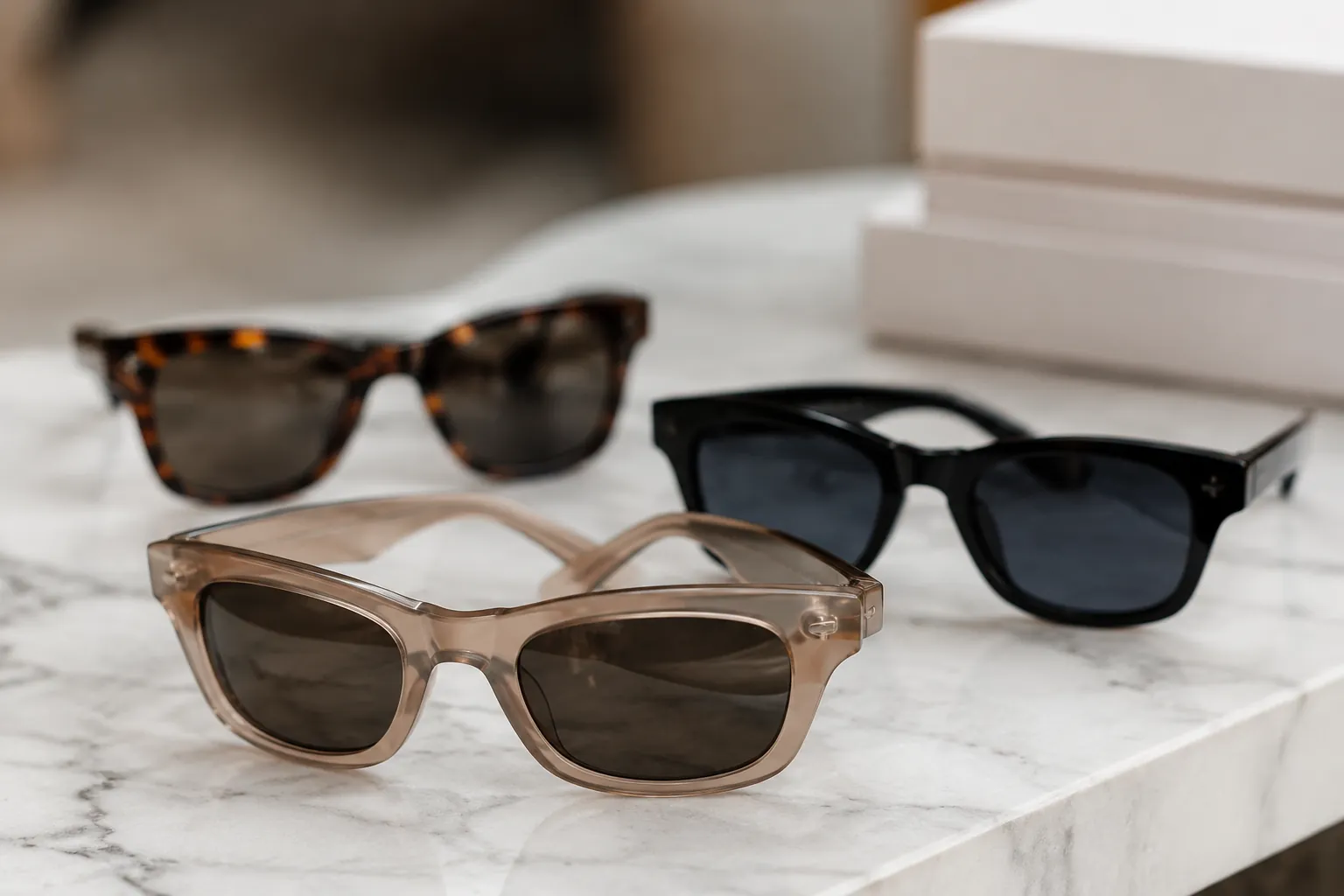
This guide is for brand owners, importers, distributors, and retailers buying custom sunglasses in volume. A sample must do more than look good in a photo or fit one person once. Before you release bulk production, it should show that the factory can hold dimensions, match lens appearance, assemble hinges consistently, place decoration correctly, and pack the product without creating damage risk. Many bulk disputes start when sample approval is based on appearance alone instead of documented production control.
Treat the sample as a production test
Many buyers treat the first sample as design approval only. That is too limited. For OEM sunglasses, the sample should be a small production test: can the factory make the frame, lenses, decoration, assembly, and packaging in a repeatable way using the intended process and materials?
If you approve only shape, color, and logo position, bulk can still fail on lens shade mismatch, loose temples, crooked decoration, scratched lenses, or packaging that damages corners in transit. Those are not random problems. They usually mean the sample never proved process control.
Ask for a sample pack, not one hero piece. A useful approval set usually includes:
- 1 wearable sample for style and fit review
- 2 to 3 additional pieces from the same trial run to check repeatability
- Lens specification with material, base curve, thickness, tint or coating description, and polarization status if applicable
- Measurement sheet against the approved drawing
- Decoration artwork reference and logo position drawing
- Packaging mockup or actual unit pack components
- Compliance documents or a market-specific testing plan
One hand-finished piece proves very little. Multiple pieces from one setup can reveal lens variation, hinge inconsistency, print drift, or packaging fit problems. Fast sample lead time helps only if the sample includes enough technical evidence to support a bulk decision.
Dimensions need numbers, not guesses
Frames can look similar on screen and still fit differently in real use. A size line such as 52-20-145 is shorthand. It does not control the full geometry that affects fit, visual balance, and assembly. Ask for measured values against the drawing, not nominal size alone.
For sunglasses, the sample record should normally confirm eye size, bridge, temple length, front width, lens width, lens height, endpiece width, and logo position. If the design requires it, the factory should also confirm angles or curvature defined in the technical drawing.
Useful sample checks include:
- Measure key dimensions on the submitted pieces and compare them with the approved drawing
- Compare left-right symmetry at the bridge, endpieces, and temple alignment
- Confirm that logos or ornaments are placed from a defined datum point, not by visual judgment only
- Ask the supplier to state its internal tolerance standard for the model and material
- Keep the measured sample as the signed reference for pre-shipment inspection
Material and process affect what is realistic. Injection-molded plastic can move if molding conditions are not stable. Acetate can change slightly after tumbling and polishing. CNC machining can hold programmed geometry well, but final polishing can still alter edges and widths. So "looks fine" is not enough.
If the supplier cannot provide a basic dimensional report at sample stage, it becomes much harder to enforce the same control points during production and final inspection.
Lens consistency matters more than one good pair
Lens approval is where many fashion sunglasses programs become expensive. One sample can look acceptable under office lighting and still trigger claims in bulk because the real issue is not the color of one pair. It is consistency across the run.
The sample file should state lens material and process clearly: PC, TAC polarized, nylon, CR-39, or other agreed material; base curve; thickness; tint method; mirror or flash coating if any; and intended market requirement. If polarization is claimed, the supplier should confirm that the sample uses polarized lenses rather than a non-polarized visual substitute.
On the physical sample, check left-right lens matching first. View the frame over white paper and again in daylight. If a gradient is used, confirm the fade is even and reaches the same depth on both lenses. If a mirror or flash coating is used, compare the hue at multiple angles because coating variation often shows during movement, not straight on.
Also check for defects that are easy to miss in photos: stress marks near the edge, waviness, haze, visible inclusions, poor polishing, and uneven edge thickness after cutting or edging.
| Lens type | Typical OEM advantage | What to verify on sample | Common bulk risk |
|---|---|---|---|
| PC non-polarized | Cost efficiency, impact resistance, broad use in fashion programs | Shade match, clarity, edge stress marks, surface quality | Waviness, tint variation, weak hard-coat performance |
| TAC polarized | Polarization option for fashion and mid-range programs | Polarization confirmation, lamination quality, left-right consistency, coating appearance | Delamination, left-right mismatch, edge peel |
| Nylon | Good optical quality, flexibility, premium feel | Clarity, curve accuracy, coating adhesion, cosmetic consistency | Higher cost, coating inconsistency if process control is weak |
| CR-39 | Good optical quality, used in some premium lines | Tint depth, thickness, cosmetic finish, scratch-resistance expectation | Breakage risk in rough handling, longer sourcing or processing time |
For compliance, ask which standard the product is intended to meet for your market: CE EN ISO 12312-1, ANSI Z80.3, or AS/NZS 1067. If chemical restrictions apply, ask how REACH is managed for frame materials, paints, coatings, inks, and pouches. FDA registration may appear in importer or facility paperwork for the US, but it is not a substitute for sunglass lens performance compliance.
Hinge feel must be tested, not described
"Premium hinge feel" is vague. The factory needs a practical target and a defined construction. On the sample, confirm whether the design uses a standard hinge, spring hinge, or another specified structure, and check that the submitted sample matches the approved construction.
Then test the sample the way a customer will use it. Open and close each temple repeatedly. A good sample should not loosen suddenly, squeak excessively, or show obvious screw movement. Place the frame on a flat surface and compare left and right opening angles. Fold the temples and check whether the tips land evenly without crossing or twisting the front.
Check also for:
- Screw loosening after repeated opening and closing
- Gap between hinge parts and frame insert
- Temple wobble at full open position
- Stress whitening or cracking around embedded hinges in plastic frames
- Glue failure around ornaments or logo plates near the hinge zone
Mixed-material designs need extra scrutiny. A sample can survive brief handling and still fail in use if the hinge insert was forced, the screw was over-tightened, or nearby decoration interferes with movement. Ask whether assembly relies mainly on manual fitting or controlled fixtures. Manual assembly is not automatically a problem, but the supplier should explain how it keeps alignment consistent from sample to bulk.
Decoration needs adhesion, position, and repeatability checks
Decoration often looks strongest on the sample and becomes one of the weakest-controlled parts in bulk. A single perfect logo may simply mean the operator spent extra time on that piece. It does not prove repeatability.
| Decoration method | What to verify on the sample | Typical bulk risk if not checked |
|---|---|---|
| Pad printing | Logo position, ink coverage, edge sharpness, rub resistance | Off-center print, blurred fine text, weak adhesion |
| Laser engraving | Depth consistency, readability on curve, heat marks | Uneven tone, poor visibility, material scorching |
| Metal logo plate | Alignment, fixing strength, edge finishing, no lift | Crooked placement, sharp edges, plate detachment |
| Hot foil or color fill | Coverage in recesses, color match, abrasion resistance | Patchy fill, color drift, early wear |
Ask for a decoration control note that includes artwork size, color reference, and location from a fixed datum point such as hinge center or temple tip. For small logos, ask the supplier to confirm that the artwork suits the actual surface and finish being used. Matte plastic, polished acetate, coated rubber effects, and metal inserts do not behave the same during printing or filling.
A basic dry-rub check is useful at sample stage. Rub the logo area firmly with a clean cloth to see whether ink, foil, or fill shows obvious weakness. This is not a replacement for formal testing, but it can expose poor adhesion before bulk starts. Most important, compare several pieces from the same setup. Repeatability is the approval target.
Packaging fit is part of product quality
A frame can pass final QC and still arrive unsellable because the pouch sheds lint, the case presses on the temples, the zipper rubs the lenses, or the retail box is too tight and workers force it closed. Packaging should be reviewed with the sample, not after bulk starts.
Your sample pack should include the real or mock unit packaging: pouch, cloth, case if used, retail box or mailer, barcode label, warning labels, and any leaflet or insert. Then test fit and packing sequence.
- Does the folded frame enter the pouch without forcing the hinge area?
- Does the case protect lenses from contact with zipper teeth, snaps, or hardware?
- Can the frame, insert, and leaflet fit the retail box without corner crush?
- Can workers complete packing without re-folding or twisting temples unnaturally?
- Is the barcode visible for warehouse scanning without reopening the unit pack?
Ask for outer carton assumptions early: units per carton, estimated carton dimensions, and gross weight. Packaging decisions affect freight cost, storage efficiency, and damage risk. At sample stage, ask the factory to pack one unit exactly as intended for bulk and perform simple handling checks. You are not replacing transport testing. You are checking for obvious mechanical problems before they scale into a shipment issue.
Paper proof must freeze what was approved
A usable OEM approval set includes both the physical sample and the supporting documents. If you approve from photos and one courier piece only, later disputes become difficult because no one can prove exactly what was frozen.
The sample file should include:
- Final specification sheet with dimensions, materials, colors, lens type, and decoration method
- Measurement record for the submitted sample or sample set
- Packing specification with unit pack components and carton assumptions
- Artwork file reference and logo position drawing
- Compliance document set or a clear testing plan by destination market
- Lead-time definition showing when the bulk clock starts
Keep compliance language precise. CE EN ISO 12312-1, ANSI Z80.3, and AS/NZS 1067 relate to sunglass performance requirements by market. REACH relates to chemical restrictions. FDA registration may be relevant in US supply-chain documentation but does not replace sunglass standard compliance. ISO 9001 refers to a quality management system. BSCI refers to social compliance auditing. They are not interchangeable, and none should be described as broader proof than it is.
Also lock timing in writing. Confirm whether the bulk lead time starts from deposit, artwork approval, sample sign-off, packaging confirmation, or another trigger. If the trigger is not written down, the schedule is not fully agreed.
Release bulk in stages, not with one vague yes
The safest way to buy custom sunglasses is to approve in stages instead of giving one broad final yes. That separates design approval from manufacturing control and reduces ambiguity.
| Approval stage | What you review | What should be frozen |
|---|---|---|
| Design sample | Shape, fit intent, material direction, styling | Core geometry and visual concept |
| Pre-production sample | Lens specification, measurements, decoration, hinge feel, assembly | Manufacturing specification and artwork position |
| Packing sample | Pouch, case, retail box, barcode, carton assumptions | Unit packing method and labeling | Bulk confirmation | Signed sample set plus documents | Production release criteria and QC standard |
For very small programs, some steps may be combined, but the logic should not be skipped. If the order is commercially important, a true pre-production sample is worth the time because it reflects actual materials, decoration method, and assembly approach.
The practical rule is simple: if a supplier resists measurement records, avoids lens specification detail, cannot explain decoration control, or has not checked packaging fit, the sample is not ready for bulk approval. It may still be attractive. That is not the same as production-ready.
Have a custom sunglasses project in mind?
Send us your styles, target market and quantities and we will return a detailed quote with MOQ, lead time and a sample plan.
Get a QuoteWhy source this from Wenzhou with LumiShades
Wenzhou in Zhejiang Province is widely regarded as China’s eyewear manufacturing capital, producing a large share of the world’s sunglasses. That concentration matters to buyers: a deep local supply chain for acetate sheet, hinges, lens blanks, plating and packaging means shorter component lead times, easier color and material matching, and a workforce with decades of eyewear-specific skill. LumiShades has manufactured in this ecosystem since 2009, and our vertical integration — in-house injection molding, acetate cutting, CNC milling, lens tinting, decoration and quality control — means no part of your order is quietly subcontracted to a workshop you cannot audit.
For international buyers, that vertical control translates into accountability. When a single factory owns every step, defects are traced and fixed at source rather than bounced between vendors, and your specifications survive intact from first sample to bulk. We back this with 15+ years of experience, shipments to 60+ countries, more than 5 million pairs produced per year and a 98.5% on-time delivery rate. Our certifications — CE EN ISO 12312-1, FDA registration, ANSI Z80.3, AS/NZS 1067, REACH, ISO 9001 and BSCI audit — mean the compliance documentation your market requires already exists. Explore our manufacturing capabilities and quality control process to see how this works in practice.
Frequently asked questions
How many sample pieces should I ask for before bulk approval? For a new model, new colorway, new lens treatment, or new decoration method, ask for at least 2 to 3 pieces from the same sample run. That lets you compare repeatability in lens appearance, logo position, temple alignment, and hinge feel. For a repeat order with no material or process change, one confirmation piece may be enough if you already have a signed reference sample and stable production history. In either case, ask the supplier to identify whether the pieces were hand-finished prototypes or made using the intended production method.
What sample-stage issue most often causes bulk claims later? Lens inconsistency is one of the most common causes: left-right shade mismatch, mirror variation, stress marks, waviness, or optical defects that were not checked carefully on the sample. Packaging fit is another frequent issue because many buyers approve the product first and review the real pack too late. To reduce risk, inspect the sample in daylight, compare more than one piece, and review the complete packed unit before authorizing bulk.
Should I request compliance reports before placing bulk production? Yes. Before releasing bulk, ask for either the relevant reports already available for the product or a written testing plan that states which standard will be used for your market: CE EN ISO 12312-1, ANSI Z80.3, or AS/NZS 1067. If chemical compliance matters, ask how REACH is controlled for frame materials, coatings, inks, and accessories. Also separate product compliance from factory credentials such as ISO 9001 or BSCI. A practical buyer action is to list required documents in the purchase order and state when they must be submitted: before production, before shipment, or both.
Are sample dimensions really necessary if the sample already fits well? Yes. Fit by feel is subjective and can vary from person to person. A measurement sheet creates objective control points for pre-production approval, in-line checks, and pre-shipment inspection. It also reduces disputes about what changed between sample and bulk. At minimum, ask for key dimensions from the approved drawing and keep the signed sample as the physical reference.
How do MOQ and pricing affect sample approval risk? The core issue is not a fixed quantity threshold but how much risk you carry if the sample is weak. On a small order, the factory may have less room for sorting, rework, or packaging adjustment, so unclear specs can quickly affect a meaningful share of the order. On a larger order, the process may be more stable, but the financial impact of approving the wrong sample is much higher because the same defect can scale across many more units. The buyer action is the same at any MOQ: freeze the sample with measurements, lens specification, decoration reference, packaging method, and compliance plan before deposit-driven bulk starts.
Ready to start?
Explore our round sunglasses or request a quote — our sales team replies within 12 hours.
Request a Quote