
What a 7-10 Day Sunglasses Sample Must Include
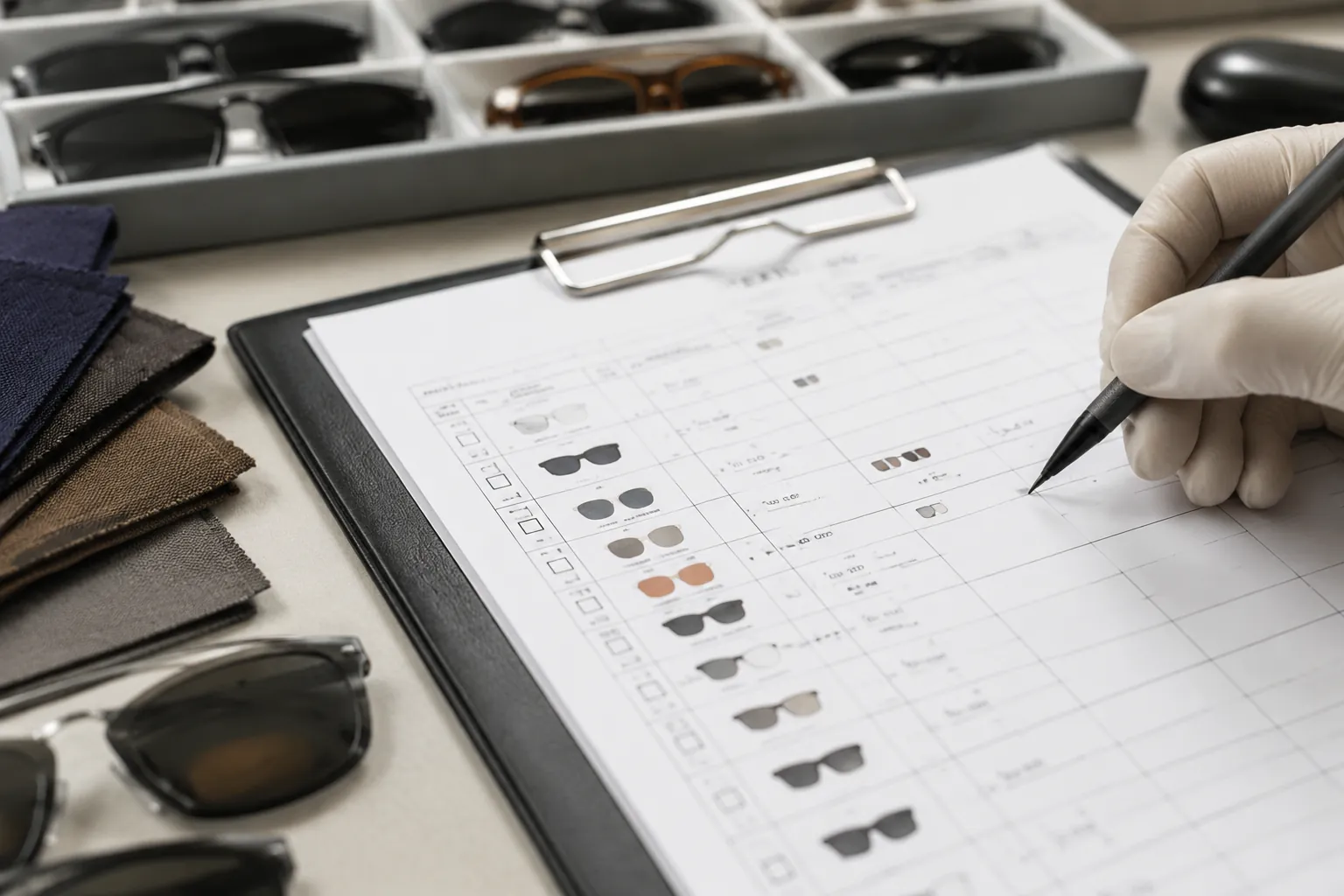
This guide is for brand owners, importers, distributors, and retail buyers sourcing custom sunglasses from overseas factories. A 7-10 day sample promise matters only if you know what should be delivered, what must be approved in writing, and what still remains unverified before bulk production. In eyewear, a fast sample is useful only if it becomes a manufacturing reference, not a display piece. The checkpoints below help you tell the difference between a supplier with production discipline and one that is simply making a good-looking prototype.
A real 7-10 day sample cycle is not one sample
Buyers hear sample in 7-10 days and often assume a finished, production-ready pair will arrive by day 10. Usually, that is not what the factory means. A real sample cycle includes document confirmation, material selection, decoration proofing, fit review, assembly checks, and at least one written approval before shipment.
For custom sunglasses, the factory should state which sample type it is making:
- Look sample: used to confirm styling, color direction, and logo visibility. It may not reflect final mass-production construction.
- Pre-production sample: built to the intended bulk specification, including material, hinge, decoration method, and lens specification.
- Compliance-ready sample: built to the target lens and construction specification so test planning and paperwork can move forward.
If the supplier does not define the sample type, the 7-10 day promise is vague. That is the problem. The buyer may think final production is being approved, while the factory may only want appearance approval.
In a realistic in-house program, 7-10 days can be enough for CAD review, frame shaping from an existing platform, lens tinting, logo application, assembly, adjustment, and internal QC. But only if the technical scope is already clear. If the front curve, hinge type, logo size, lens category, or compliance path is still unsettled, speed means very little.
A short sample cycle should produce three outputs: the physical sample, a written specification confirmation, and a list of unresolved items. Without all three, the buyer is approving a concept. Not a production reference.
What the factory should confirm before making anything
Fast sample programs depend on disciplined buyer input. A mood board, two competitor photos, and a logo file are not enough. Before any frame material is cut or prepared, the factory should issue a pre-sample confirmation pack.
- Frame construction summary: material (for example injection plastic, TR90, acetate, metal, or combination construction), hinge type, lens base curve if relevant, core wire use if applicable, finish, and target weight if requested.
- Size sheet: lens width, bridge, temple length, lens height, front width, and other key dimensions, all in millimeters.
- Tolerance notes: acceptable production variance for critical dimensions and logo placement.
- Color callouts: Pantone references where possible, or approved physical color chips for frame, temple tips, lenses, and logos.
- Artwork proof: logo method, placement, orientation, and dimensions in millimeters.
- Compliance target: intended market and lens path, such as CE EN ISO 12312-1, ANSI Z80.3, AS/NZS 1067, REACH-related material control, and FDA registration context for U.S. import handling.
These are not paperwork extras. Small dimensional changes affect fit, comfort, visual proportion, and brand presentation. A logo can look off even if the shift is slight. A bridge shape that changes between CAD and sample can change wearability and perceived quality.
If basic construction points are left as to be confirmed later, the sample can still look acceptable and fail as a production reference. That is how one version gets approved and another shows up in bulk.
The exact deliverables a serious sample program should include
A serious supplier should send more than polished photos and a tracking number. The sample package should show what was built, how it compares with the approved specification, and which points are still provisional.
| Deliverable | What it should show | Why it matters for bulk |
|---|---|---|
| Physical sample pair | Actual frame, lenses, hardware, decoration, opening and closing feel, and finish quality | Confirms fit, balance, comfort, visual proportion, and tactile quality before PO release |
| Spec sheet | Key dimensions in mm, material callouts, hinge type, lens details, weight if relevant, and color references | Prevents bulk drift from the approved sample |
| Logo proof | Method, exact location, size, and orientation on the real substrate | Avoids rework caused by artwork-only approval |
| QC photo set | Front, side, top, folded view, underside, and close-ups of hinge, bridge, logo, and lens tint | Creates a visual reference even if the courier sample is delayed or damaged |
| Open-issue list | Items still provisional, such as lens darkness, trim finish, or surface texture | Stops hidden changes between sample approval and mass production |
On the physical sample itself, check the basics:
- Temple opening resistance should feel even from left to right, without one side noticeably looser.
- The frame should sit level unless intentional asymmetry is part of the design.
- Lenses should be seated cleanly, without visible stress marks, edge damage, or uneven fit.
- Pad print edges should be crisp. Laser marks should be consistent. Metal logo plates should sit flush, with no visible adhesive overflow.
- Polish and finishing should be even around the bridge, end pieces, and temple tips, where rushed work often shows first.
If the supplier sends only glamour photos and asks for approval, push back. That is a sales shortcut, not a complete sample package.
Approval checkpoints from day 1 to day 10
The goal of a sample cycle is not speed alone. It is controlled speed. Stage approvals reduce the risk that a small misunderstanding turns into tooling changes, logo rework, or a delayed bulk run.
- Day 1-2: spec lock. Confirm dimensions, target weight if relevant, material, hinge, lens type, logo method, packaging assumptions, and expected volume. The factory should also confirm whether the sample method matches the intended production method.
- Day 2-4: frame body review. Ask for raw or unfinished frame photos if the shape is new. This is where you catch temple thickness, front angle, bridge cut, bevel depth, or oversized end pieces before decoration is applied.
- Day 4-6: decoration and lens review. Approve actual logo placement and lens tint. Ask for both indoor and daylight photos. Lens appearance can shift a lot under different lighting.
- Day 6-8: assembly and QC review. Review open and folded views, hinge alignment, lens seating, polish quality, and left-right symmetry. Ask for measured dimensions, not CAD values alone.
- Day 8-10: shipment and sample record. The shipped pair should be tied to a final sample record showing style code, revision, dimensions, materials, lens target, and any unresolved issues excluded from approval.
Working tolerances should be discussed here, not after approval. Exact tolerance depends on material, construction method, and the buyer's quality standard. The key point is simple: tolerances must be written and agreed. If they are not documented, the approved sample cannot control production well.
Bulk timing also needs a clear trigger. Ask the factory whether production lead time starts from sample approval, deposit receipt, packaging approval, or all of them together. A generic calendar promise is not enough.
How materials, decoration, and volume affect what the sample proves
Not all materials behave the same. Not all sample methods scale well into production. Judge a 7-10 day sample against the actual bulk plan.
| Material/process | What samples prove well | What still needs caution | Typical volume logic |
|---|---|---|---|
| Injection molded plastic | Repeatable shape, texture direction, assembly logic, and a scalable manufacturing path when tooling and process are finalized | Color can shift between resin lots; surface appearance can change with mold condition and processing control | Often used when the program is intended for repeatable volume production |
| Acetate cut and polished | Premium look, bevel detail, lamination effect, and richer hand feel | Pattern distribution in tortoise or marble sheets will vary pair to pair; hand finishing affects consistency | Common in premium programs where appearance and material feel matter more than maximum throughput |
| CNC-milled components | Precise shaping for development, low-volume customization, and geometry review | Machining marks and edge finishing need close review; the sample may not represent the most efficient bulk method | Useful in development or lower-volume custom work |
| Mixed-material frame with metal trims | Branding detail, higher perceived value, and stronger visual differentiation | Trim attachment, plating consistency, and adhesive cleanliness require tighter QC | Feasible, but assembly complexity increases quality-control demands |
Decoration choice matters too. Pad print is flexible and common, but durability depends on surface preparation, ink system, and curing control. Laser engraving is more permanent on suitable surfaces, but contrast may be subtle. Metal logo plates can look premium, but they add assembly steps and attachment risk.
Volume changes process logic. A factory may sample a small project using a more manual route, while a larger program should be judged against a repeatable production method. Tell the supplier your expected volume early. Then ask directly whether the sample reflects the intended bulk process or only a development method.
Compliance and paperwork: what can really be checked at sample stage
A sample cycle should not end with a casual statement like can pass test. At sample stage, a factory may not run every formal certification test on every prototype. It should still define the intended compliance route and confirm whether the construction aligns with it.
- CE EN ISO 12312-1: confirm lens category target, UV protection target, labeling approach, and whether the sample lens specification matches the intended bulk lens specification.
- ANSI Z80.3: confirm the intended U.S. sunglasses compliance path and whether optical and transmittance targets are being sampled correctly.
- AS/NZS 1067: relevant for Australia and New Zealand, where category and labeling alignment should be considered early.
- REACH: ask which materials are covered, especially paints, coatings, plastics, nose pads, and metal trims.
- FDA registration: useful in U.S. import context, but not a substitute for product-performance compliance.
- ISO 9001 and BSCI: useful indicators of management systems and social compliance structure, but not proof that a specific sunglass style meets optical or UV requirements.
At sample stage, a capable supplier should be able to state the target lens category, whether polarization is planned, whether any mirror coating is cosmetic or functional within the final specification, and whether the sample uses the same lens substrate intended for production. A dark-looking lens proves very little on its own.
Also ask which compliance documents will exist at bulk stage: test reports, declarations, labeling files, or technical documentation. The exact set depends on market and product specification. Define that path before placing the order, not after the goods are finished.
Red flags and the final buyer checklist before bulk approval
Weak sample programs usually show themselves through small failures in discipline, not dramatic mistakes. Watch for these signs:
- No version control: sample photos, drawing, and shipped product do not carry the same style code or revision.
- No tolerance language: dimensions are listed, but acceptable production variance is not.
- Decoration approved from artwork only: no real close-up proof on the actual substrate.
- Lens spec missing: nobody can state lens category, UV target, polarization plan, or substrate.
- Substitute materials: the sample is made in one material while bulk will use another, without written disclosure.
- Date promised before engineering review: this often signals sales pressure rather than technical planning.
- No written open-issue list: unresolved points remain hidden inside a broad approval.
Before placing bulk, use this final gate:
- Do the physical sample, spec sheet, and QC photo file all show the same style code and revision?
- Are all key frame dimensions confirmed in millimeters with written tolerances?
- Is the sample made in the same material planned for mass production?
- Are lens color, target category, UV requirement, and any polarization requirement written clearly?
- Is the logo method fixed: pad print, laser engraving, or metal logo plate?
- Have you seen close-up decoration photos on the actual sample, not only digital artwork?
- Are unresolved points listed in writing before PO issue?
- Has the factory defined when bulk lead time starts and what approvals or documents are still pending?
- Does the process choice match your real volume plan?
If those boxes are checked, the sample cycle has done its job. It will not remove every production risk. It will give you a controlled manufacturing reference instead of a hopeful guess.
Have a custom sunglasses project in mind?
Send us your styles, target market and quantities and we will return a detailed quote with MOQ, lead time and a sample plan.
Get a QuoteWhy source this from Wenzhou with LumiShades
Wenzhou in Zhejiang Province is widely regarded as China’s eyewear manufacturing capital, producing a large share of the world’s sunglasses. That concentration matters to buyers: a deep local supply chain for acetate sheet, hinges, lens blanks, plating and packaging means shorter component lead times, easier color and material matching, and a workforce with decades of eyewear-specific skill. LumiShades has manufactured in this ecosystem since 2009, and our vertical integration — in-house injection molding, acetate cutting, CNC milling, lens tinting, decoration and quality control — means no part of your order is quietly subcontracted to a workshop you cannot audit.
For international buyers, that vertical control translates into accountability. When a single factory owns every step, defects are traced and fixed at source rather than bounced between vendors, and your specifications survive intact from first sample to bulk. We back this with 15+ years of experience, shipments to 60+ countries, more than 5 million pairs produced per year and a 98.5% on-time delivery rate. Our certifications — CE EN ISO 12312-1, FDA registration, ANSI Z80.3, AS/NZS 1067, REACH, ISO 9001 and BSCI audit — mean the compliance documentation your market requires already exists. Explore our manufacturing capabilities and quality control process to see how this works in practice.
Frequently asked questions
Is a 7-10 day sample enough time for a fully custom sunglasses style? Sometimes, but only if the technical scope is already clear. For custom logo, color, lens tint, and an existing frame platform, 7-10 days can be realistic. For a new shape, new tooling, hinge changes, or an undefined compliance target, that timeline is more likely to produce a look sample than a final production reference. Ask the factory to state in writing whether the sample is a look sample, pre-production sample, or compliance-ready sample, and what still remains unconfirmed.
What is the biggest mistake buyers make during sample approval? Approving appearance without locking the written specification. A good-looking sample is not enough if dimensions, materials, lens specification, decoration method, tolerances, and revision status are still vague. Before approval, require a spec sheet, QC photos, and an open-issue list. If any feature is provisional, mark it clearly so it cannot be treated as approved in bulk.
Should I pay for more than one sample round? Often yes. One round may be enough for a simple private-label program built on an existing platform, but a second round is common when you adjust fit, logo position, lens category, color, hardware, or finishing details. A simple rule works here: if a change affects construction, dimensions, decoration placement, or a compliance-related lens specification, ask for another confirmed sample or at least revised evidence tied to the same style code and revision.
Can a sample prove compliance with CE EN ISO 12312-1 or ANSI Z80.3 by itself? No. A sample can show whether the planned lens and frame construction appear aligned with the target standard, but formal compliance depends on the final product specification and the supporting documentation or test results. At sample stage, ask the supplier to define the target standard, lens category, substrate, UV performance target, labeling plan, and what documents will be available before shipment or at bulk stage.
How do MOQ and target volume affect the sample stage? They affect process choice and how representative the sample is of bulk production. A supplier may make a low-volume sample with more handwork, while a larger-volume order may require a more repeatable method. Tell the factory your expected launch volume and repeat-order plan early. Then ask a direct question: does this sample reflect the intended bulk process, materials, and assembly method, or is it only a development sample? That answer should be written into the sample record.
Ready to start?
Explore our round sunglasses or request a quote — our sales team replies within 12 hours.
Request a Quote