
ODM vs OEM Sunglasses: Which Sourcing Path Fits?
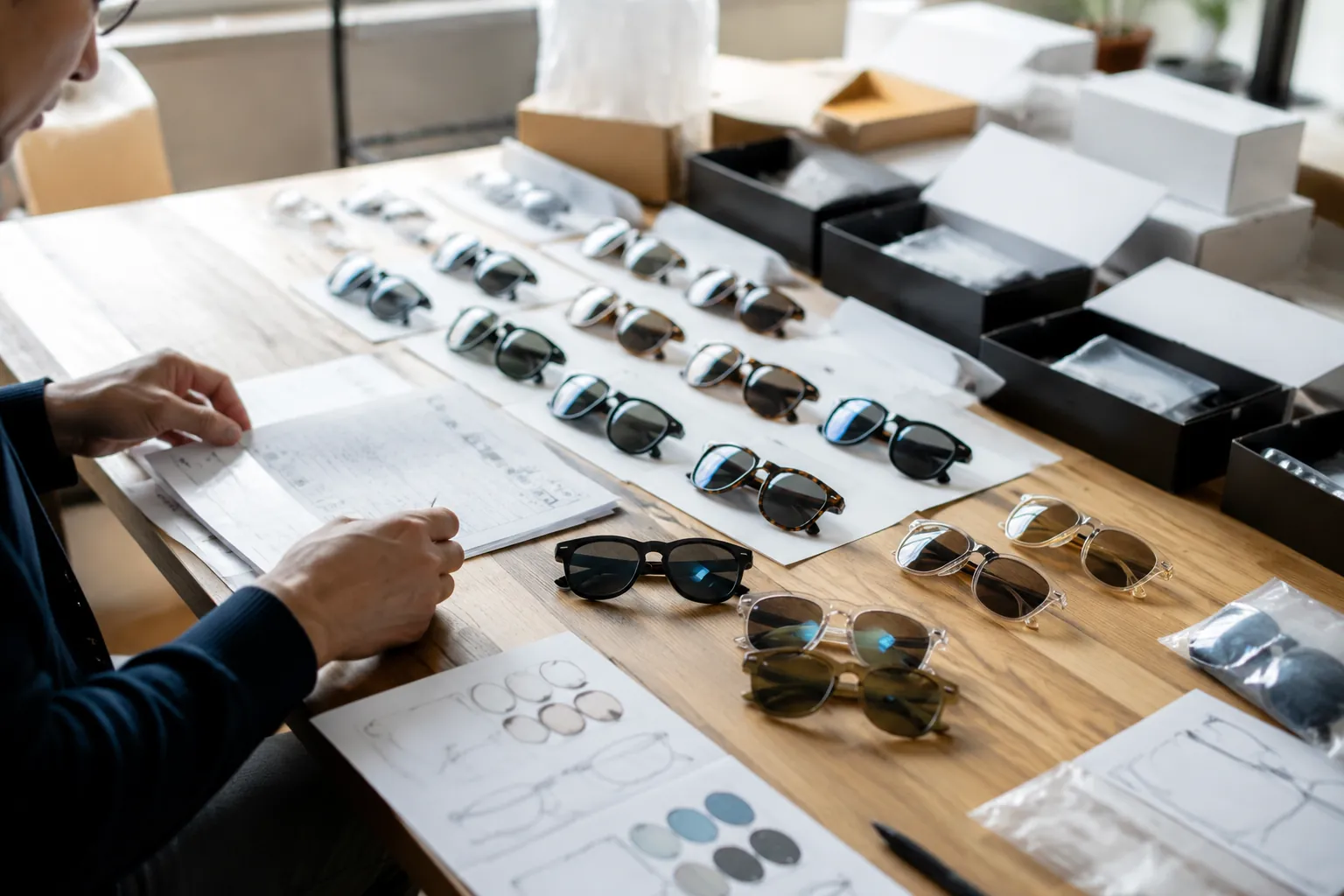
This guide is for brand owners, importers, distributors, and retailers sourcing sunglasses in volume. If you are choosing between adapting an existing frame and developing your own, the wrong call can delay launch, absorb cash, and create reorder problems later. The goal is simple: pick the path that fits your budget, timeline, exclusivity needs, compliance demands, and likely repeat volume. This is not only a design decision. It is a decision about risk, control, and how reliably you can reproduce the same product on the next PO.
Start with the decision that matters
Buyers often frame ODM versus OEM as a design choice. In production, it is really a choice about risk, speed, and control.
ODM means you start from a frame the factory already makes. The buyer usually changes brand-facing elements such as lens color, frame color, logo application, temple print, packaging, barcode labels, pouch, or cleaning cloth. Some factories also allow limited cosmetic changes, such as trim details or surface finish, as long as those changes do not require new tooling.
OEM means the buyer develops a new frame or requests structural changes large enough to require new drawings, new tooling, or a fresh engineering review. That may affect dimensions, fit, mold geometry, hinge position, decoration areas, or material construction.
For a first order, ODM is often the safer path. The factory already knows the frame, the tooling exists, and the assembly steps are familiar. That usually makes output quality and sample-to-bulk consistency easier to predict. OEM makes more sense when the frame itself is part of the product advantage and a stock structure cannot deliver the required shape, fit, or branded details.
- Choose ODM if speed matters more than frame exclusivity.
- Choose ODM if the first order is a market test and volume is still uncertain.
- Choose OEM if you expect repeat volume and want a frame structure that competitors cannot easily copy.
- Choose OEM if your product depends on custom fit, dimensions, comfort, or a signature silhouette that catalog styles cannot provide.
A simple rule helps: if small dimensional changes would materially affect comfort, appearance, or brand identity, the project probably belongs in OEM. If not, ODM is usually enough.
Use four filters before technical debate
Start with four filters: budget, launch window, exclusivity, and reorder plan. In many cases, those four questions make the right path obvious before detailed technical discussion begins.
| Buyer factor | ODM starting point | OEM starting point |
|---|---|---|
| Budget | Lower development spend; often better suited to first runs and market testing | Higher upfront spend; easier to justify when repeat volume is expected across multiple POs |
| Typical MOQ | Often lower because existing tooling is already in use; exact MOQ depends on frame, lens, packaging, and decoration requirements | Usually higher in practical terms because development, sampling, and tooling costs must be recovered over volume |
| Lead time | Usually shorter when changes are limited to color, logo, lens, and packaging and materials are available | Usually longer because drawing review, tooling, trial production, corrections, approvals, and possible retesting add steps |
| Exclusivity | Limited unless the supplier gives written style protection or mold restriction | Higher because custom development makes direct duplication more difficult, especially when tooling ownership and exclusivity terms are documented |
| Reorder stability | Often strong when the factory has an established process for the style | Can be strong after development is locked, but only if drawings, tolerances, color standards, and QC limits are documented clearly |
| Technical freedom | Constrained by existing mold geometry, lens groove, wall thickness, and hinge location | Higher because fit, dimensions, balance, decoration areas, and structural details can be defined for the program |
If your target order is close to a supplier's minimum for existing styles, ODM is usually the practical starting point. If you already expect the style to become a repeat item over several seasons, OEM may be worth the added cost because that expense can be spread across future orders.
Ask a harder question than first-order price. Ask this instead: if the style sells, do you want to reorder the same frame with consistent results for the next one to two years? If the answer is yes, OEM deserves a serious look.
Where ODM wins
ODM usually wins on speed, lower complexity, and lower cash exposure. That is the point.
On an established ODM style, the factory generally already knows how the frame behaves in production, which assembly points need attention, and which cosmetic changes are safe without tooling changes. That does not remove defect risk. It does reduce development uncertainty.
Process maturity matters more than catalog size. A supplier that controls key steps in-house, such as molding or machining, lens fitting, decoration, assembly, and QC, can often move faster because fewer outside parties are involved. Routine changes like logo placement, temple print size, lens tint, or packaging details are usually easier to manage in that setup.
ODM is especially useful in four common cases:
- Market testing: You want to launch several shapes quickly and see what actually sells before paying for custom tooling.
- Private label retail programs: You need branded sunglasses for stores, e-commerce, resorts, or promotional channels where speed and repeatability matter more than proprietary frame engineering.
- Trend-driven styles: You want current shapes without carrying development cost for a design with a short selling window.
- Shorter approval loops: When the change is mainly color, lens, logo, and packaging, sampling is usually simpler than a full custom program.
The hidden advantage is lower technical exposure. Existing styles have already seen production use, so the factory is less likely to discover basic assembly problems during your order. For many first runs, ODM is the right answer.
Where OEM pays off
OEM is slower because you are paying for control. Sometimes that is exactly the right trade.
A custom frame can solve product requirements that ODM cannot handle cleanly. Examples include a different bridge fit, a custom lens groove specification, a temple shape built for a certain logo treatment, a distinctive acetate construction, or dimensions that are not available in open-catalog styles.
OEM only makes economic sense if you look past the first PO. The first run often includes drawing review, prototype approval, tooling, trial production, fit correction, decoration confirmation, and pre-production approval. If the style becomes a repeat program, those upfront costs become easier to justify because the same tooling and specification support future orders.
Typical OEM risk points include:
- Dimensional revisions after tooling: Changes to eye size, bridge, groove position, or temple geometry can affect comfort, assembly, and lens retention.
- Decoration conflict: A logo plate, pad print, or foil area that looks fine on artwork may fail on the real curve or wall thickness of the frame.
- Material behavior: Acetate, TR90, and injected plastics differ in processing, finishing, color appearance, and structural feel.
- Approval delay: Late changes to dimensions, color, hinge type, lens specification, or temple shape often trigger extra review rounds.
OEM is usually the better route when you need real shape exclusivity, repeat orders across multiple seasons, engineered logo zones, or a fit profile that stock dimensions do not support well. One caution is blunt but important: do not pay for OEM development if the end result is basically an ODM frame with a new logo, lens color, or surface finish.
Compare total cost, not just unit price
FOB unit price alone will not tell you which path is better. It is too narrow.
A useful comparison includes development cost, time cost, and reorder risk. Start with quantity. Many suppliers can support lower MOQs on selected existing styles than on custom-developed styles, but actual minimums still depend on frame construction, lens specification, packaging, and decoration method. Unit pricing usually improves with volume, but the real question is whether the total program cost matches the sales opportunity.
Then look at the costs buyers often underestimate:
- Sampling rounds: ODM usually needs fewer approvals because the base frame already exists. OEM often needs several rounds before dimensions, finishing, and assembly details are locked.
- Tooling and setup: Frame molds, logo hardware, print plates, laser files, custom inserts, and cartons can all add cost beyond the unit price.
- Time cost: A delayed launch can cost more than a slightly higher unit price if the product misses a key selling window.
- Defect risk: New tooling and unproven assembly steps usually require tighter process control than an established production style.
- Reorder risk: If drawings, Pantone references, lens category, approved samples, and QC standards are not clearly documented, later orders may not match the original shipment closely enough.
A practical cost review has three layers: first-order cash out, cost per saleable unit shipped on time, and cost per consistent reorder. For a small first run, limiting exposure and dead-stock risk often matters more than maximum originality. For a long-running core SKU, stronger control over the frame can protect margin better than saving a small amount on the first batch.
Compliance, materials, and decoration can change the answer
ODM versus OEM cannot be judged in isolation. Compliance, materials, and decoration often decide what is actually workable.
For sunglasses sold internationally, buyers often review requirements against CE EN ISO 12312-1, ANSI Z80.3, or AS/NZS 1067, depending on the target market. Chemical compliance matters too, which is why REACH is often relevant for EU business. In the US, buyers may also ask about FDA registration status where it affects their import or market-access process. Factory credentials such as ISO 9001 and BSCI can help with supplier assessment, but they do not replace product testing or market-specific compliance review.
Material choice affects both appearance and production behavior:
- Injection-molded plastic: Often used for scalable programs where repeatability and cost control are priorities.
- Acetate: Common in premium-looking styles because it supports layered color effects and detailed finishing, but it usually requires more processing steps and tighter finishing control.
- TR90 or similar lightweight materials: Often chosen for comfort-focused products, but decoration options and surface appearance may differ from standard injected plastics.
- Lens tinting and coating: Smoke, brown, green, mirror, or gradient finishes should be checked for batch consistency, not only on one approval sample.
Decoration method matters as well. Pad printing is flexible, but curved surfaces can distort artwork. Laser engraving is durable on suitable surfaces, but the visual result depends on color and texture. Metal logo plates can add a premium look, but they need enough temple thickness and a reliable attachment method.
If the main selling point is lens category, color consistency, or finish, compliance review and lens process control should start early. If the selling point is frame silhouette, fit, or structure, OEM becomes more compelling. Leave compliance until the end and delays become very likely.
What the development path looks like
Whichever route you choose, disciplined approvals prevent expensive surprises later. That is not paperwork for its own sake. It is process control.
- Lock the commercial target: confirm quantity, target FOB, destination market, packaging scope, and launch date.
- Choose the frame path: existing architecture with limited modifications, or new/custom development.
- Freeze key specifications: eye size, bridge, temple length, front width, lens color, logo method, case, pouch, and carton markings.
- Approve a physical sample: not only photos. Check fit, hinge feel, lens alignment, temple closing symmetry, logo position, finish quality, and tint under suitable lighting.
- Confirm the compliance plan: decide which product standard and document set apply before bulk production starts.
- Review the pre-production sample: especially if there has been any material, color, lens, or decoration change after the first approval.
- Set QC checkpoints: define incoming material checks, in-line inspections, and final random inspection requirements before shipment.
For ODM, the path is usually shorter because the frame already exists and the engineering variables are narrower. For OEM, reserve more time for drawing review, tooling, trial production, fit correction, and final approval. A common buyer mistake is treating a dimensional change after tooling as minor. In eyewear, even a small revision can affect comfort, assembly, decoration placement, or lens fit.
Better approval discipline leads to more predictable reorders. Simple as that.
A blunt checklist for choosing
Choose ODM if most of these statements are true:
- You need to launch quickly and cannot absorb a long development cycle.
- Your first order is relatively small and you want to limit upfront exposure.
- You are testing demand rather than building a long-term hero frame.
- You can accept an existing frame architecture with your own colors, lenses, packaging, and branding.
- You want fewer development steps and simpler approvals.
Choose OEM if most of these statements are true:
- You expect repeat orders and want stronger frame-level differentiation.
- You need custom fit, custom geometry, or structural logo placement.
- You can absorb a longer development timeline before bulk shipment.
- You want a frame platform that is not available from the supplier's general catalog.
- You are prepared to manage drawings, tolerances, approved samples, and QC standards carefully.
If you are still undecided, use a staged sourcing model. Start with ODM to test shape acceptance, target pricing, and sell-through. If one style performs well, use that evidence to assess an OEM version for the next season. For many buyers, that is the most practical balance: faster launch now, stronger exclusivity later.
Have a custom sunglasses project in mind?
Send us your styles, target market and quantities and we will return a detailed quote with MOQ, lead time and a sample plan.
Get a QuoteWhy source this from Wenzhou with LumiShades
Wenzhou in Zhejiang Province is widely regarded as China’s eyewear manufacturing capital, producing a large share of the world’s sunglasses. That concentration matters to buyers: a deep local supply chain for acetate sheet, hinges, lens blanks, plating and packaging means shorter component lead times, easier color and material matching, and a workforce with decades of eyewear-specific skill. LumiShades has manufactured in this ecosystem since 2009, and our vertical integration — in-house injection molding, acetate cutting, CNC milling, lens tinting, decoration and quality control — means no part of your order is quietly subcontracted to a workshop you cannot audit.
For international buyers, that vertical control translates into accountability. When a single factory owns every step, defects are traced and fixed at source rather than bounced between vendors, and your specifications survive intact from first sample to bulk. We back this with 15+ years of experience, shipments to 60+ countries, more than 5 million pairs produced per year and a 98.5% on-time delivery rate. Our certifications — CE EN ISO 12312-1, FDA registration, ANSI Z80.3, AS/NZS 1067, REACH, ISO 9001 and BSCI audit — mean the compliance documentation your market requires already exists. Explore our manufacturing capabilities and quality control process to see how this works in practice.
Frequently asked questions
Can I make an ODM frame exclusive just by adding my logo? No. Your logo and packaging may be unique, but the underlying frame can still be sold to other buyers unless exclusivity is agreed in writing. Ask whether the style is open catalog, customer-restricted, or linked to a specific tooling ownership arrangement. Before placing the order, get written confirmation covering the exact frame reference, the markets or channels included, the time period, and whether the restriction applies to the mold itself or only to your branding.
At what order volume does OEM usually start to make more sense? There is no fixed threshold because the answer depends on tooling cost, material choice, complexity, and expected reorder frequency. In practice, OEM becomes easier to justify when you have solid reason to expect repeat business rather than a one-time test order. Ask the supplier to quote both options: an ODM version and an OEM version, including sampling cost, tooling cost, lead time, and projected reorder terms. Then compare total cost across the first order and at least one realistic repeat order.
How much faster is ODM than OEM in real factory terms? ODM is usually faster because it removes part of the engineering and tooling cycle, but the gap depends on the changes requested and the supplier's workload. Ask for a dated timeline that separates sample preparation, approval, bulk production, and shipment. For OEM, make sure the timeline also shows drawing review, tooling, trial production, correction rounds, and pre-production sample approval so the likely delay points are clear.
What should I approve on the sample besides appearance? Approve the sample against a written checklist, not just visual impression. Check frame dimensions, bridge comfort, temple closing alignment, hinge tension, lens seating, logo position, color reference, surface finish, packaging details, and any barcode or carton marks. If the order must meet a market requirement such as CE EN ISO 12312-1, ANSI Z80.3, or AS/NZS 1067, confirm which sample or production stage will be used for testing and keep the approved physical sample as the reorder reference.
Does ISO 9001 or BSCI mean the sunglasses are compliant for sale? No. ISO 9001 and BSCI are useful for supplier assessment, but they do not prove that a finished pair of sunglasses meets product requirements for sale in a target market. Product compliance still needs to be reviewed against the relevant standard and any chemical requirements such as REACH. Ask which test reports are available for the product category, whether those reports match your actual lens and frame specification, and whether new testing is needed after any material, lens, or coating change.
Ready to start?
Explore our rimless sunglasses or request a quote — our sales team replies within 12 hours.
Request a Quote