
Cost a Custom Sunglasses Program From Margin Backward
This guide is for buyers who need a custom sunglasses program to hit a margin target, not just match a look. If you know your target retail price, wholesale sell-in price, or distributor price, you can work backward into a factory-ready sourcing brief before requesting quotes. That approach cuts wasted sampling, exposes packaging and freight costs early, and helps prevent a common sourcing mistake: approving a specification that cannot support the required margin. Start with the cost ceiling. Then build the product around it.
Start with the number that controls the program
Many sourcing mistakes start at the wrong end. A buyer approves a frame concept, asks for acetate, adds mirrored lenses, upgrades to a rigid case, and only then requests pricing. By then, the commercial result is already boxed in. Start instead with the maximum landed cost per pair and build the product around that ceiling.
Use a simple margin chain. Selling price minus channel margin, operating overhead, and target profit leaves the maximum landed cost. Landed cost should include ex-factory price, packaging, freight, duty where applicable, local inbound handling, and any testing or inspection cost allocated to the order. Leave one item out and the quote can look fine while still missing the margin target.
If your target sell-in price is fixed, calculate the maximum spend per pair after planned gross margin is protected. Then strip out non-product costs first. Freight, duty, receiving, and compliance work can take a real share of the budget. What remains for ex-factory cost may be far lower than the design team expects. That ex-factory ceiling should guide decisions on frame material, lens treatment, branding method, and packaging format.
At factory level, small spec changes matter. A basic custom program can stay commercially efficient if the specification is disciplined. The same program can go out of range fast once it adds premium materials, complex decoration, and bulky retail packaging. Margin problems usually do not come from one big error. They come from several small upgrades that were never costed together.
Use a hard rule: once you set the allowed ex-factory cost, every upgrade must displace spend somewhere else. There is no hidden budget in the frame. If the market supports only a limited ex-factory cost, premium material, premium branding, and premium packaging usually cannot all stay.
Build the cost stack before the frame
Break cost into clear buckets and require suppliers to quote that way. If product, decoration, packaging, and logistics are rolled into one number, buyers lose control of trade-offs.
- Product cost: frame material, lens material, hinge, screws, assembly, and standard inner packing.
- Decoration cost: pad print, screen print, laser marking, hot foil, metal logo plate, custom paint, and inside-temple branding.
- Packaging cost: pouch, cleaning cloth, care card, barcode label, rigid case, folding box, and carton inserts.
- Compliance and QC cost: testing allocation, pre-production checks, inline inspection, final AQL inspection, and labeling review.
- Logistics cost: master carton size, carton density, freight mode, duty, local handling, and warehouse receiving.
First-time buyers often underestimate packaging and logistics more than frame cost. A simple temple print may add little. A rigid case plus retail box adds direct packaging cost first, then can raise freight cost again by reducing carton efficiency. That second hit is often missed.
Ask the supplier how many pairs fit into the export carton under each packaging option. A pouch-packed program usually ships more efficiently than a rigid-box presentation set. If pack-out changes because of bulkier retail packaging, landed cost per pair rises even if ex-factory product price does not.
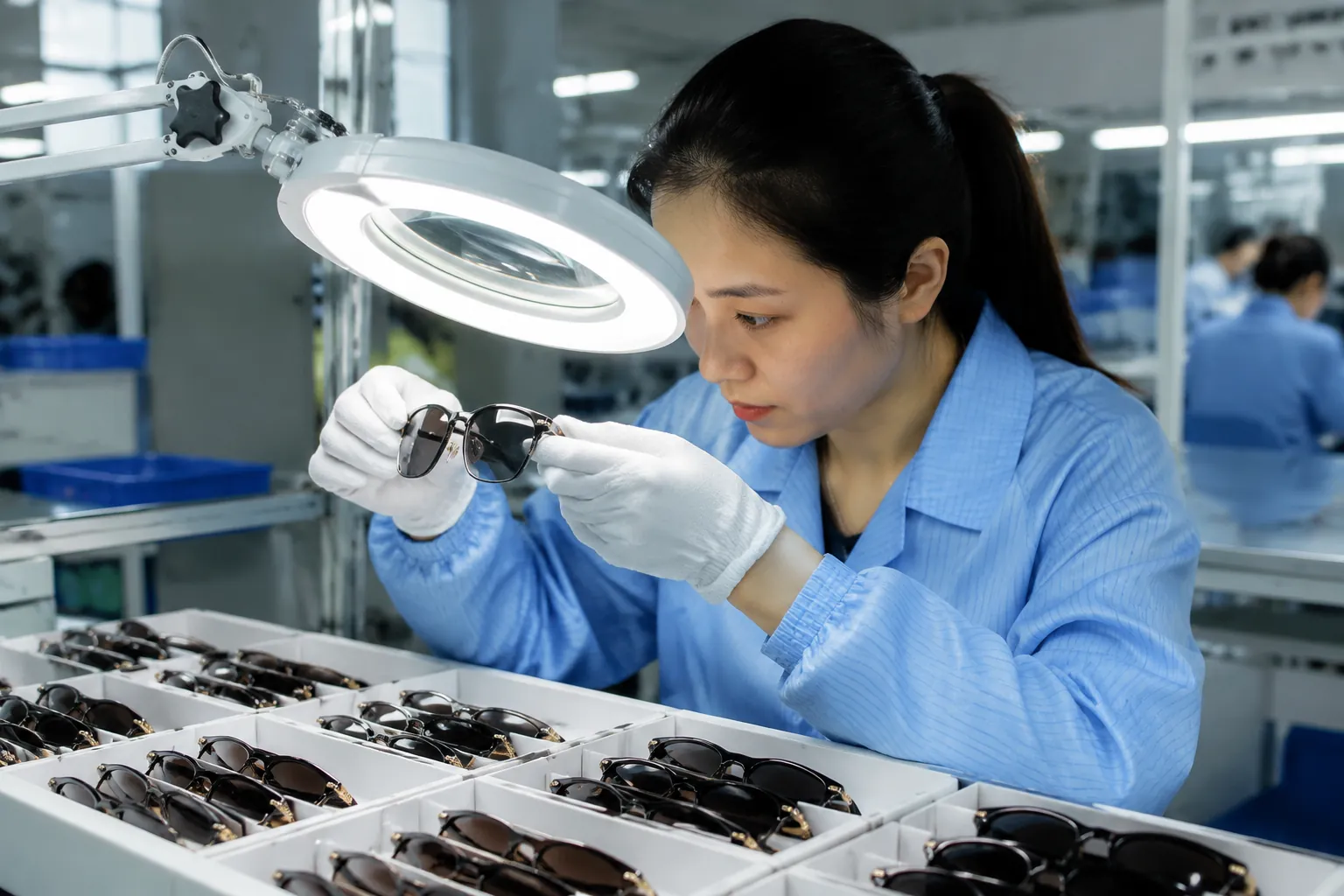
Process structure matters too. A factory with in-house control over molding, lens processing, decoration, assembly, and QC can usually give earlier and more reliable feedback on whether a target cost is realistic. Ask which operations are done internally and which are subcontracted. Every handoff can add variation, approval time, and coordination risk.
How spec choices change cost, lead time, and yield
| Spec choice | Typical cost effect | Lead-time effect | Process detail and buyer trade-off |
|---|---|---|---|
| Injection-molded frame | Usually the most cost-efficient frame route for volume programs | Generally more repeatable once tooling and color are approved | Stable dimensions and good production consistency; often the safest choice for cost-controlled repeat orders |
| Acetate frame | Higher material and labor cost than basic injection programs | Longer because of cutting, polishing, fitting, and finishing steps | Offers a more premium hand feel and visual depth, but adds labor content and more process variation |
| Standard tinted lens | Usually the base-cost lens option | Minimal added complexity when standard colors are used | Good commercial choice for broad programs because color control is typically simpler |
| Mirror or gradient lens | Adds processing and approval complexity | May require more sampling and tighter appearance control | Can improve shelf appeal, but also raises the risk of rejection for finish or color inconsistency |
| Pad-printed logo | Generally one of the lowest-cost branding methods | Minimal impact when artwork is production-ready | Flexible for lower MOQs, but adhesion and placement consistency should be approved against a standard |
| Metal logo plate | Higher part cost and more assembly work | Adds fitting, sampling, and approval steps | Creates a premium look, but requires separate components, fixtures, and more process control |
| Soft pouch | Usually lower packaging cost | Minimal operational impact | Supports freight efficiency and is often the better value choice for commercial programs |
| Rigid case plus retail box | Raises packaging cost and can increase freight cost | Adds more packing steps and more approval points | Improves presentation, but can pressure margin faster than many buyers expect |
Material behavior matters. Injection frames are efficient, consistent, and easier to repeat once the tool, resin choice, and color standard are fixed. They are often the best fit for price-sensitive private-label or promotional programs. Acetate gives a stronger premium signal, but it also brings more manual work in cutting, beveling, tumbling, polishing, hinge fitting, and adjustment.
Decoration choice affects yield as well as appearance. Pad printing is economical and flexible, but buyers should ask how print adhesion is checked and how logo position is controlled. Metal plates can make branding look stronger, yet they require separate parts and added assembly steps. On low-MOQ runs, that extra cost does not always create equal customer value.
Reverse-build the program in four steps
- Set the sales model. Confirm whether the program is for direct retail, wholesale, promotional use, or distribution. Each route has a different margin structure, and distributor models usually leave less room for ex-factory cost.
- Fix the landed-cost ceiling. Write one target number per pair and treat it as a hard commercial limit. If the number stays flexible, the specification usually drifts upward.
- Rank cost priorities. Decide where the budget should create value: frame material, lens appearance, branding method, or packaging. Pick the few features that matter most to the buyer or end customer.
- Match MOQ to complexity. If the specification includes custom hardware, special lens effects, multilingual inserts, and retail packaging, a small MOQ may still be possible, but it should be treated as a development run rather than an optimized production price.
A useful brief must be commercially specific. State the target landed cost, target ex-factory ceiling, MOQ by color, total color count, frame construction, lens requirement, branding method, packaging format, destination market, and freight assumption. That gives the supplier enough information to quote the program you actually intend to buy.
If the quote comes back high, reduce complexity in the order that hurts customer perception least. Packaging is often the first place to review, then decoration, then lens treatment, and finally frame material or construction. Many buyers cut the frame first and save less than expected because the real cost pressure came from packaging or process complexity.
Ask suppliers to quote upgrades separately. Do not ask only for one price on a premium version. Request a base quote plus adders for mirrored lenses, metal logo plates, rigid cases, or printed retail boxes. That makes trade-offs visible. It also tightens negotiation discipline.
Use MOQ, breakpoints, and production logic correctly
Price is not linear. A small order does not scale neatly into a larger one because setup cost, material purchasing, process efficiency, wastage, and packaging procurement all move differently at each volume level. Ask for pricing at multiple quantity breaks. Do not assume a straight-line cost drop.
Low-MOQ orders are often best treated as pilot runs, sales samples, or market tests. They can still support useful customization, but each added process step has a bigger effect on unit cost because fixed setup and approval effort are spread across fewer pairs. As volume rises, simple custom programs usually become more efficient, especially when they use repeatable constructions, standard lens colors, and uncomplicated branding.
Do not confuse total quantity with real production efficiency if the order is fragmented. A moderate order split across many colors, barcode versions, packaging assortments, or language inserts can behave like several small runs instead of one efficient run. Complexity eats savings.
Lead time follows the same logic. Sample development depends on artwork readiness, material availability, logo method, and packaging complexity. Bulk production timing depends on approval discipline as much as factory capacity. If logo artwork, lens standard, packaging layout, and carton pack-out change after approval, part of the sourcing and packing cycle may need to be repeated.
Ask which inputs are long lead-time items. Standard hinges, common lens tints, and stock pouches usually move faster than custom hardware, plated logo parts, or fully printed rigid boxes. Know that early. It helps you decide where customization adds value and where it only adds schedule risk.
Put compliance and QC into the cost model on day one
Sunglasses compliance is not an afterthought. It affects design, labeling, documentation, timing, and cost. If the goods will be sold in more than one market, say that before sampling starts. Lens category, visible light transmission, labeling format, and test planning need to match the destination market from the start.
- CE EN ISO 12312-1: relevant framework for sunglasses sold in markets that require conformity to this standard for performance, labeling, and safety.
- ANSI Z80.3: common reference standard for non-prescription sunglasses in the US market.
- AS/NZS 1067: relevant for sunglasses intended for Australia or New Zealand.
- REACH: important where chemical substance compliance applies to frame materials, coatings, inks, and components.
- FDA registration: may appear in US supplier documentation discussions, but it does not replace product performance testing to the relevant sunglass standard.
Also separate product standards from management or social compliance systems. ISO 9001 relates to quality management systems, and BSCI is commonly used in social compliance auditing. Both can help when assessing supplier capability, but neither replaces product-level testing or market-specific compliance for sunglasses.
QC should be defined and costed, not assumed. Ask how the factory checks lens appearance, hinge function, frame symmetry, logo position, and carton accuracy during inline and final inspection. A credible supplier should be able to explain how standards are approved, how defects are classified, and how final goods are compared against the signed sample or approved master.
Force tolerance discussions early. Logo position, left-right alignment, color matching, labeling content, and packaging accuracy should all be approved against documented references, not judged informally during production. Late compliance or labeling corrections are expensive. They can trigger relabeling, repacking, retesting, or shipment delay.
Where programs lose margin
Most margin failures are predictable. Many happen outside the frame front.
- Over-packaging: the product is commercially viable, but the presentation set absorbs too much of the available budget.
- Too many SKUs: colors, barcodes, languages, or pack formats are split so shallowly that no version runs efficiently.
- Spec drift after approval: a late logo revision, lens change, or packaging update consumes the planned margin.
- Wrong freight assumption: the costing model assumes one transport mode, but the launch date forces a more expensive option.
- Testing too late: avoidable rework appears after production is already underway or capacity is already booked.
The fix is simple. Freeze the commercial target before creative complexity expands. If the channel supports only a certain landed cost, every upgrade must replace another cost. Margin usually disappears through a string of small, individually reasonable decisions that were never evaluated together.
A good supplier should challenge an unrealistic brief early. If the cost lane clearly points to injection construction and printed branding, but the brief asks for acetate, mirrored lenses, fitted metal logos, and rigid retail packaging at a low MOQ, early pushback is useful. It saves time. It also stops non-viable samples from absorbing development effort.
The best RFQs are commercial as well as visual. Send the reference image, but also state the destination market, target ex-factory ceiling, MOQ by color, compliance basis, sample timeline, quality expectations, and which features should be quoted as optional upgrades. Then ask for the same design quoted at several quantity breaks with packaging broken out separately. That comparison often shows whether margin improves more through higher volume, simpler packaging, or a different construction route.
Have a custom sunglasses project in mind?
Send us your styles, target market and quantities and we will return a detailed quote with MOQ, lead time and a sample plan.
Get a QuoteWhy source this from Wenzhou with LumiShades
Wenzhou in Zhejiang Province is widely regarded as China’s eyewear manufacturing capital, producing a large share of the world’s sunglasses. That concentration matters to buyers: a deep local supply chain for acetate sheet, hinges, lens blanks, plating and packaging means shorter component lead times, easier color and material matching, and a workforce with decades of eyewear-specific skill. LumiShades has manufactured in this ecosystem since 2009, and our vertical integration — in-house injection molding, acetate cutting, CNC milling, lens tinting, decoration and quality control — means no part of your order is quietly subcontracted to a workshop you cannot audit.
For international buyers, that vertical control translates into accountability. When a single factory owns every step, defects are traced and fixed at source rather than bounced between vendors, and your specifications survive intact from first sample to bulk. We back this with 15+ years of experience, shipments to 60+ countries, more than 5 million pairs produced per year and a 98.5% on-time delivery rate. Our certifications — CE EN ISO 12312-1, FDA registration, ANSI Z80.3, AS/NZS 1067, REACH, ISO 9001 and BSCI audit — mean the compliance documentation your market requires already exists. Explore our manufacturing capabilities and quality control process to see how this works in practice.
Frequently asked questions
How do I know whether my target ex-factory cost is realistic? Start with the maximum landed cost your business can support, then deduct all non-factory elements you already know or can estimate: freight mode, duty if applicable, local inbound handling, inspection, testing allocation, and packaging sourced through the factory. The remainder is your ex-factory ceiling. Then compare that ceiling with the actual specification. If the spec includes premium material, multiple lens effects, custom hardware, and bulky retail packaging, ask the supplier to quote the same design in a simplified base version and in the requested premium version. That side-by-side quote is one of the fastest ways to test whether the target is commercially realistic.
Is 50 pairs a useful MOQ for a real branded program? Yes, if you use it for the right purpose. A 50-pair MOQ is most useful for market testing, internal sales samples, buyer presentations, influencer seeding, or a controlled pilot launch. It is less useful for margin optimization because setup effort, artwork handling, and packaging approvals are spread over very few units. If you proceed at that volume, keep the specification simple: standard lens color, print branding, and efficient packaging. Also ask the supplier whether the 50-pair run is being treated as a true production order or as a custom sample batch, because that affects both pricing logic and lead time.
What should I ask the factory to break out in the quote? Ask for separate line items for ex-factory product cost, decoration, packaging, sample charge, testing allocation if any, and any inspection cost billed through the factory. Request the quote at multiple quantity breaks using the same specification so you can see where efficiency changes. Also ask for separate adders for mirrored or gradient lenses, metal logo plates, rigid cases, printed retail boxes, and any other optional feature. Finally, ask for carton pack-out by packaging option, because freight efficiency can materially change landed cost even when unit ex-factory price changes only slightly.
How much does packaging affect landed cost? Often more than buyers expect, because packaging affects both direct cost and shipping efficiency. A pouch, care card, and barcode label usually keep both costs under better control. A rigid case and retail box add material and packing labor first, then can reduce the number of pairs per export carton, which raises freight cost per pair. To evaluate packaging accurately, ask for three things together: unit packaging cost, master carton dimensions, and the number of pairs packed per carton. Without all three, you do not have a reliable landed-cost comparison.
When should compliance be discussed? Before sampling starts. Tell the supplier where the sunglasses will be sold and ask which standard will govern the program: CE EN ISO 12312-1, ANSI Z80.3, or AS/NZS 1067 as applicable. Also confirm whether REACH-related material declarations are required for the market and whether the supplier can support the documentation you need. If a supplier mentions FDA registration, treat it as a documentation point only, not proof that the sunglasses meet the relevant performance standard. The practical step is to align market, lens category, labeling, packaging text, and test plan before artwork and samples are approved.
Ready to start?
Explore our shield & oversized sunglasses or request a quote — our sales team replies within 12 hours.
Request a Quote