
UV400 Alone Fails: Lens Specs Buyers Must Verify
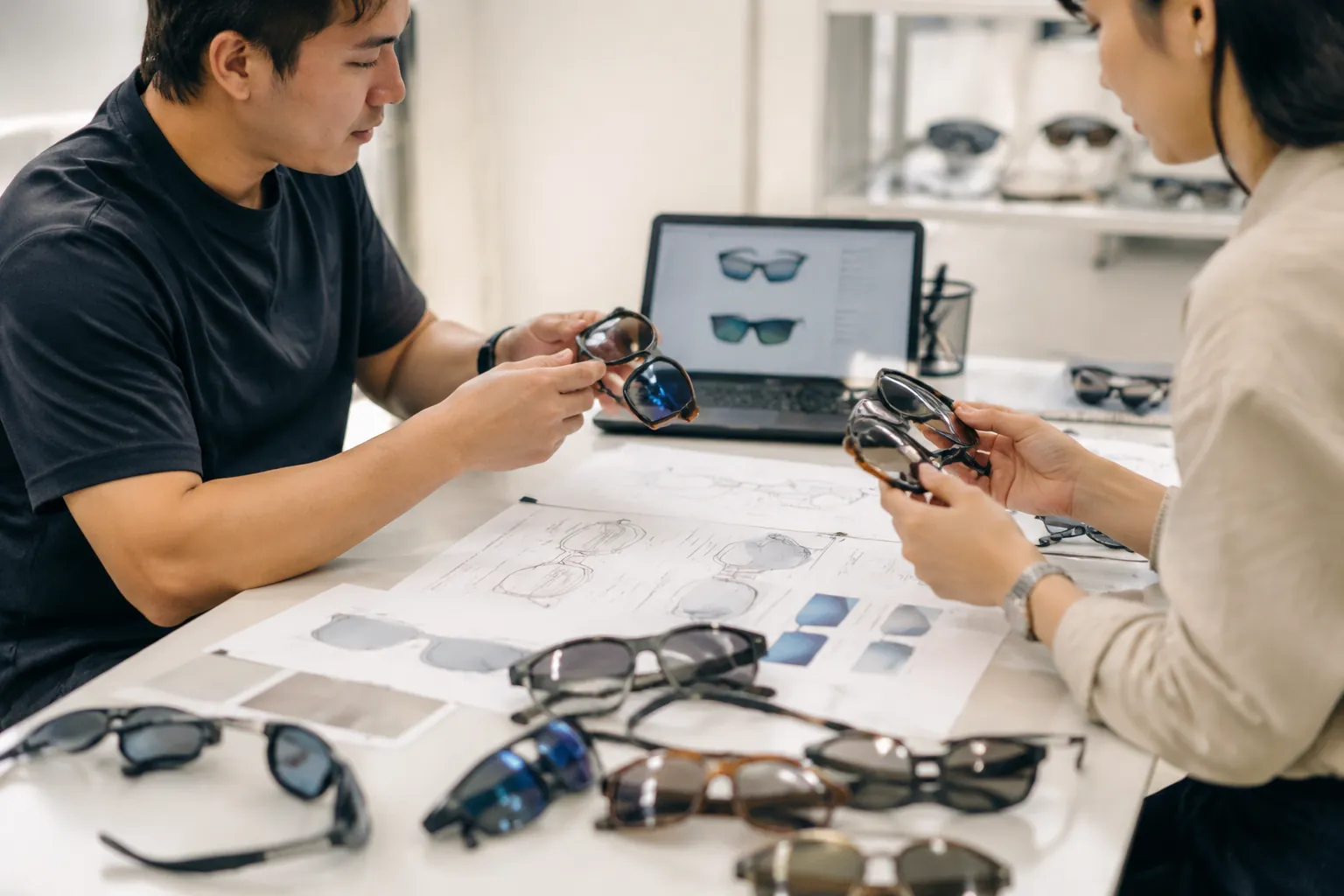
This guide is for brand owners, importers, distributors, and retailers buying custom sunglasses in volume. A UV400 claim alone does not tell you how dark the lens looks, whether left and right lenses match, how coatings hold up in packing and transit, or whether a later batch will match the approved sample. If you source private-label or OEM eyewear, lock these lens details into the spec sheet before you release bulk production.
Start with the spec sheet, not the UV400 sticker
Buyers often approve the frame, confirm the logo, and treat the lens as a generic part. That is a mistake. UV400 only states ultraviolet protection up to 400 nm. It says nothing about visible light transmission, optical consistency, coating durability, polarization quality, or color tolerance.
For procurement, the lens specification should be fixed before sample approval. At minimum, document lens material, base curve, nominal thickness, visible light transmission target, lens color reference, coating stack, polarization requirement, and the compliance standard for the destination market. If the supplier cannot confirm these points in writing, the order is still under-specified.
A usable spec might read like this: grey polycarbonate lens, stated center thickness, minimum edge thickness after edging, VLT target with tolerance, hard coat required, mirror optional, left-right color match against approved master, and no visible cosmetic defects under agreed inspection conditions. Exact values will vary by product and market. The rule does not. Make the lens measurable.
- Material: PC, TAC polarized assembly, CR-39, nylon, or acrylic
- Transmission target: defined as a VLT value with an agreed tolerance
- Color standard: smoke grey, G-15 style green, brown, gradient, or approved custom reference
- Surface treatments: hard coat, mirror, backside anti-reflective coating, hydrophobic topcoat if required
- Compliance target: CE EN ISO 12312-1, ANSI Z80.3, AS/NZS 1067, or other destination-specific requirements
VLT decides how dark the lens really is
Two lenses can both claim UV400 and still look and perform very differently. The practical buying metric is visible light transmission, or VLT. It is the percentage of visible light that passes through the lens. It affects comfort, appearance, and intended use.
A common sourcing mistake is approving a lens by eye alone. Bad idea. Visual judgment changes with lighting, and mirror or gradient lenses can mislead in photos. Specify a VLT target, an acceptable tolerance, and the measurement method. The right VLT depends on the style, function, and market position of the product.
Also ask how the factory controls tint consistency. Tint can vary with material, dye process, production conditions, and coating. Good practice is to compare finished lenses against an approved master under controlled lighting and to verify transmittance by instrument, not by visual check alone.
Left-right matching matters too. If the pair differs in darkness or color, complaints start fast even if UV protection is fine. The purchase order should state how matching will be checked and what variation is acceptable.
| Lens option | Typical use case | What to verify | Common procurement risk |
|---|---|---|---|
| Solid tint PC | Entry to mid-price sunglasses | VLT range, color match, hard-coat adhesion | Shade drift between batches |
| TAC polarized | Polarized lifestyle and driving styles | VLT, polarization efficiency, glue-line appearance | Delamination or stress marks |
| Gradient tint | Fashion collections | Top-to-bottom transition, left-right symmetry, gradient height tolerance | Uneven fade line or mismatched pair height |
| Mirror-coated lens | Sport and trend styles | Base tint under mirror, scratch resistance, color uniformity | Rub marks after packing |
Material choice affects impact, optics, and durability
Lens material is not just a cost decision. It affects impact resistance, weight, optical quality, tint behavior, and coating compatibility. Polycarbonate is common in sunglasses because it is light and impact-resistant. TAC polarized lenses are widely used when polarization is needed at moderate cost, but bonding quality matters because they are laminated. CR-39 is known for good optical clarity, though it is less impact-resistant than polycarbonate. Acrylic appears in lower-cost programs, but scratch resistance and long-term durability are weaker.
Ask for the actual thickness plan and edge specification. A sample can look fine and still crack, warp, or fit poorly if the edge profile does not suit the frame groove or base curve. For wrap shapes, shields, and oversized fronts, review lens thickness, edge finish, and frame fit together. Not as separate items.
Material behavior also changes production risk. Polycarbonate can show stress if molding, edging, or insertion is poorly controlled. TAC constructions can develop appearance defects if lamination is weak or if the lenses see excess heat. CR-39 machines well, but it is not the first choice where higher impact resistance is required. The sourcing takeaway is simple: choose the material for the use case, then write the related dimensional and appearance requirements into the PO.
Plain rule: the lower the target price, the more tightly the minimum lens performance should be defined. Budget programs fail most often when the lens spec is left open.
Polarization needs proof, not a checkbox
Many purchase orders say only polarized lens. That is not enough. A polarized lens can still vary in efficiency, cosmetic quality, and visual uniformity. Buyers should confirm the lens construction, ask how the factory checks polarization direction after assembly, and review appearance standards for laminated lenses.
Common failure modes include lamination defects, internal haze, edge bubbles, and stress patterns visible at certain angles. Frame assembly can also create stress marks in mounted polarized lenses, especially on wrapped fronts or tight grooves. In weak processes, left and right lenses may not perform consistently.
For sampling, request at least these checks:
- Confirm the polarization effect with a visual test and, if available, an instrument-based check.
- Inspect lenses under strong light for glue-line defects, haze, and edge bubbles.
- Check the mounted frame for stress marks after lens insertion.
- Review the lens with screens and reflective surfaces if the product is intended for driving or outdoor use.
- Ask the supplier what acceptance criteria it uses for polarization performance and appearance.
Polarization adds cost and process complexity. Use it when glare reduction supports the product promise. Do not add it casually to a price-sensitive fashion program without confirming that the construction is stable enough for bulk production.
Coatings cause many appearance claims
Mirror, flash, backside anti-reflective, and hard-coat layers can improve the product, but they also cause claims if handling and packing do not match the coating. Buyers may approve a mirror sample that looks good in development, then receive bulk goods with rubbing marks or uneven appearance.
Hard coat is especially important on polycarbonate lenses because it helps reduce scratching during edging, assembly, bagging, and retail handling. If hard coat is required, state it clearly. Do not assume it. Inspection should cover both pre-assembly and post-assembly condition.
Mirror coatings need tighter visual control than many buyers expect. Define both the base lens tint and the mirror shade, because the same mirror can look different over different base colors. If brand color matters, keep an approved master sample and inspect under agreed lighting conditions. Phone photos are not final approval tools.
Backside anti-reflective coating can improve comfort on darker lenses, but it adds another process layer and should be checked for haze, streaks, and adhesion-related defects. Hydrophobic top layers can improve wipe performance, but they also need compatibility checks with sleeves, polybags, and packing materials.
- Hard coat: reduces handling scratches; specify it clearly if required
- Mirror/flash: verify color consistency, reflectivity, and packing protection
- Backside AR: inspect for coating defects under angled light
- Logo print on lens: verify abrasion resistance, print position, and appearance after handling
Compliance is market-specific, and the lens drives much of it
For export orders, the compliance file should match the destination market and the exact lens configuration being sold. Depending on the market and product, relevant documents may involve CE EN ISO 12312-1, ANSI Z80.3, AS/NZS 1067, REACH, and FDA registration. ISO 9001 and BSCI may help with supplier assessment, but they are not sunglasses performance standards.
The practical point is direct: compliance applies to the actual product configuration, not to a general concept. If the lens material, tint category, coating stack, or polarization construction changes, confirm whether the available test documents still match the SKU being shipped.
When reviewing supplier documents, verify the test sample description instead of relying on the title page. Check whether the report identifies the lens type, tint condition, and relevant standard clearly enough to support your order. A report for one configuration does not automatically cover another color, coating, or construction.
For organized sourcing, keep these details linked to each SKU: lens material, lens color, VLT, polarization yes or no, coating stack, and destination market. That makes it much easier to confirm whether the documentation matches the goods in production.
Set QC gates before you release bulk
Effective lens QC is not one final inspection. It should include checkpoints at incoming material, tinting or coating, edging, assembly, and packing. If defects are found only at finished-goods stage, options are limited and delays get expensive.
Define acceptance criteria in writing. That includes VLT target and tolerance, color reference, polarization requirement, logo position, cosmetic standard, coating appearance, and packing method. Inspection conditions should also be stated where possible, including lighting and viewing distance for cosmetic checks.
If timing is tight, request a pre-production sample and then a top-of-production confirmation once bulk begins. This is especially useful for custom tints, gradients, and mirror effects. Photos can help catch obvious drift, but physical approval samples are still more reliable for exact color and surface appearance.
A practical sourcing rhythm looks like this:
- Approve frame and lens spec sheet.
- Approve color chip or master lens reference.
- Review pre-production sample made with actual materials and decoration methods.
- Confirm packing method for coated or printed lenses.
- Run in-line QC during tinting, assembly, and final packing.
The key is simple. Define the QC gate before production starts. If lens darkness, mirror shade, or coating quality is still open to interpretation midway through bulk, the shipment schedule is already at risk.
Use order size to negotiate control, not just price
MOQ and order size should influence lens strategy, but not replace it. Small trial runs can help test market response, though they may limit process options for custom colors, multilayer coatings, or specialized constructions. Larger runs usually allow better process stability and more consistent matching because production can be controlled over a longer, more uniform batch.
That does not mean every high-volume order is safer. It means buyers should use volume to negotiate the right controls: approved masters, retained samples, batch-matching procedures, and clearer QC checkpoints. If the supplier offers a lower price by relaxing lens consistency, that is not a real saving once claims and replacements are counted.
At lower price points, simpler lens constructions are often more repeatable. A solid-tint lens with stable VLT control and an appropriate hard coat is usually easier to manage than a low-cost combination of polarization, mirror, backside AR, and decorative printing. The more processes stacked onto an aggressive target price, the more closely you need to review risk.
Serious buyers ask a better question than what is cheapest? They ask: which lens construction is most repeatable at my price point, in my market, with acceptable claim risk? That question leads to better procurement decisions than a UV400 sticker ever will.
Have a custom sunglasses project in mind?
Send us your styles, target market and quantities and we will return a detailed quote with MOQ, lead time and a sample plan.
Get a QuoteWhy source this from Wenzhou with LumiShades
Wenzhou in Zhejiang Province is widely regarded as China’s eyewear manufacturing capital, producing a large share of the world’s sunglasses. That concentration matters to buyers: a deep local supply chain for acetate sheet, hinges, lens blanks, plating and packaging means shorter component lead times, easier color and material matching, and a workforce with decades of eyewear-specific skill. LumiShades has manufactured in this ecosystem since 2009, and our vertical integration — in-house injection molding, acetate cutting, CNC milling, lens tinting, decoration and quality control — means no part of your order is quietly subcontracted to a workshop you cannot audit.
For international buyers, that vertical control translates into accountability. When a single factory owns every step, defects are traced and fixed at source rather than bounced between vendors, and your specifications survive intact from first sample to bulk. We back this with 15+ years of experience, shipments to 60+ countries, more than 5 million pairs produced per year and a 98.5% on-time delivery rate. Our certifications — CE EN ISO 12312-1, FDA registration, ANSI Z80.3, AS/NZS 1067, REACH, ISO 9001 and BSCI audit — mean the compliance documentation your market requires already exists. Explore our manufacturing capabilities and quality control process to see how this works in practice.
Frequently asked questions
If a supplier says the lens is UV400, what should I ask next? Ask for the full lens specification: material, VLT target and tolerance, lens color reference, coating stack, polarization yes or no, and the compliance standard for your destination market. Then ask for supporting documents or test reports where applicable, and confirm that those documents match the actual lens configuration you are buying.
What is the most common lens problem in bulk sunglasses orders? One of the most common problems is inconsistency between the approved sample and bulk production, especially in tint shade, mirror appearance, left-right matching, and surface defects. To reduce risk, approve a master sample, define measurable acceptance criteria in the PO, and require in-line checks before final packing.
Do polarized lenses always justify the higher cost? No. Polarization is useful when glare reduction is part of the product promise, such as for driving, fishing, or outdoor use. For a low-price fashion program, a well-made non-polarized lens may be the better choice if it offers more stable production quality and lower claim risk. Decide based on end use, retail positioning, and the supplier's proven control of polarized lens quality.
How can I reduce claim risk on mirror-coated lenses? Approve the base tint and mirror color together, not separately. Keep a retained master sample, inspect under consistent lighting, specify the cosmetic standard required, and confirm the packing method before bulk starts. Also ask the supplier to check post-packing appearance, because mirror issues often show up after bagging and carton transit rather than at the coating stage alone.
At what stage should I approve lens color? Approve lens color before bulk production using a physical master sample or an agreed color reference viewed under controlled lighting. For gradients, mirrors, and custom tints, do not rely on phone photos alone. If the program is sensitive, request a top-of-production sample or first-run confirmation to verify that bulk output still matches the approved standard.
Ready to start?
Explore our sport wrap sunglasses or request a quote — our sales team replies within 12 hours.
Request a Quote