
Reserve Sunglasses Factory Capacity Before Peak Season
This guide is for brands, importers, distributors, and retailers that buy custom sunglasses in repeat volumes but do not want to commit too early to finished inventory. It explains how to reserve factory capacity before final quantities are fixed, what a manufacturer needs before it can plan, and where flexibility ends once materials, tooling, decoration, packaging, or compliance work begins. The aim is practical: protect launch dates, limit cash exposure, avoid peak-season bottlenecks, and turn a sales forecast into a production plan a factory can schedule.
The Capacity Problem Buyers Notice Too Late
Sunglasses production is seasonal. Factory capacity is not. Injection machines, acetate cutting tables, CNC milling stations, tumbling and polishing lines, lens tinting, decoration fixtures, assembly benches, packaging workers, and final QC teams all have daily limits. A supplier may accept a purchase order in March, but if many buyers need April or May shipment, the real question is simple: is there still line time?
Capacity reservation is the buying tool for that problem. Instead of placing a full bulk order months before demand is clear, the buyer blocks a defined production window based on agreed assumptions: frame model, material, estimated quantity band, tooling status, lens type, decoration method, packaging level, inspection requirement, compliance market, and target shipment date. The factory can then plan labor, equipment time, components, and QC resources around that window.
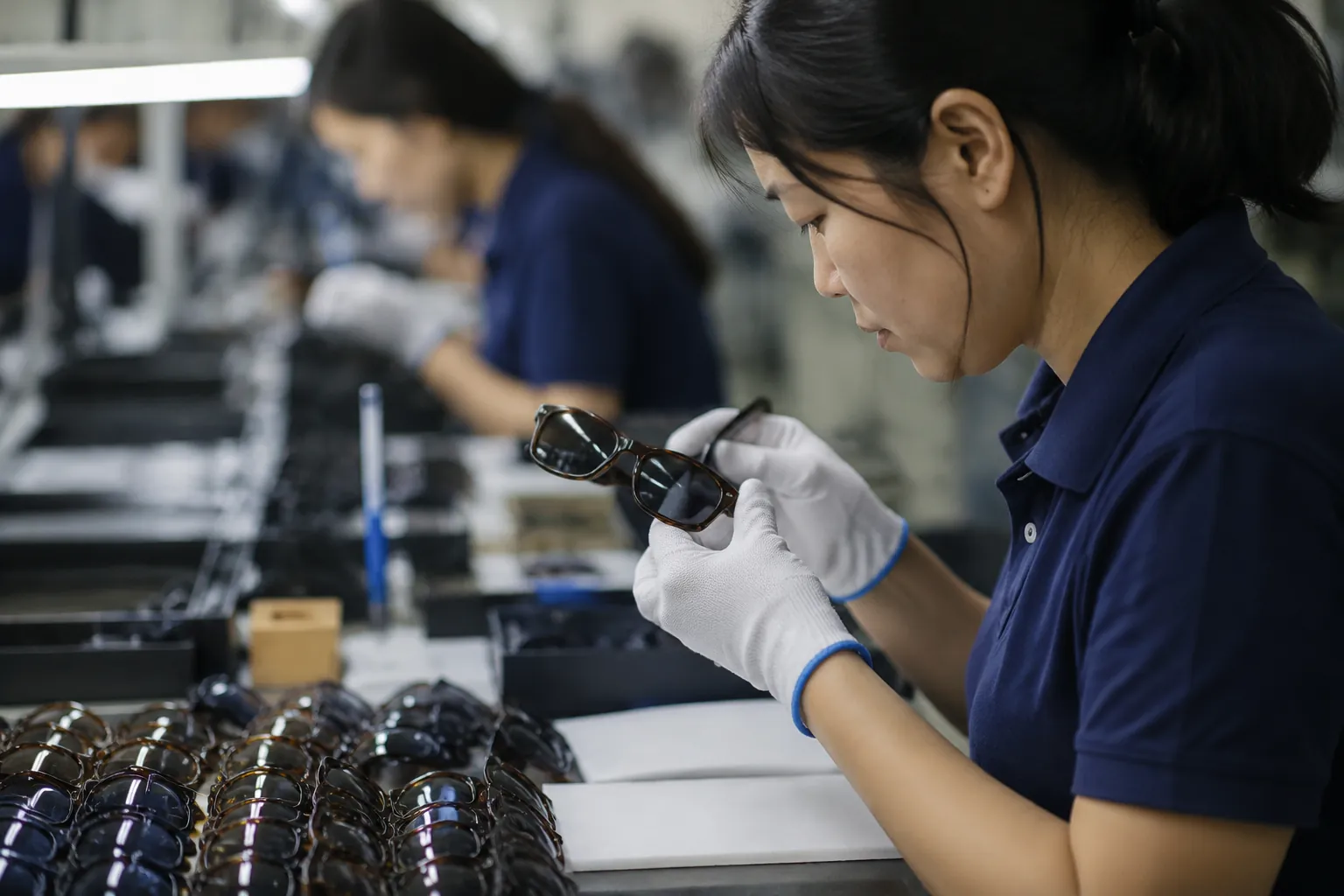
For a Wenzhou sunglasses manufacturer such as LumiShades, capacity planning is not just a sales promise. It affects molding or frame forming, lens preparation, decoration, assembly, packaging, and inspection. A small validation run may fit between larger jobs if materials and tooling are ready. A retail promotion with multiple colors, polarized lenses, logo decoration, barcode labels, printed pouches, and carton marks needs protected calendar space and earlier file approval.
The mistake is treating all sunglasses as equal units. They are not. A standard PC injection frame with smoke lenses and a one-color temple print is easier to schedule than a laminated acetate frame with custom sheet color, metal logo plate, polarized TAC lenses, and printed retail packaging. The second program has more approval points, longer material preparation, and more ways to slip.
Four Ways to Hold a Production Slot
Buyers usually reserve capacity in one of four ways. The right method depends on forecast confidence, customization level, tooling status, and how much risk each side will accept. A loose email saying "please keep capacity for us" does not hold much weight once the factory starts filling peak-season schedules with confirmed orders.
| Reservation Method | Best For | Buyer Commitment | Factory Protection | Main Risk |
|---|---|---|---|---|
| Forecast hold | Repeat programs using existing molds or previous SKUs | Rolling forecast, style mix estimate, target ship month | Low; the factory may only pencil in the window | Slot can be released if no PO, deposit, or approval follows |
| Deposit-backed slot | Seasonal launches, retail drops, distributor pre-orders | Deposit tied to quantity band, production window, and spec freeze dates | Medium to high; the factory can assign line time and start approved purchasing | Late spec changes can still move the schedule |
| Blanket PO with releases | Large repeat orders shipped in monthly or quarterly batches | Total seasonal or annual quantity with release dates | High; the factory can level-load production and materials | Buyer may overcommit if sell-through slows |
| Material-first reservation | Custom acetate, special lens colors, exclusive packaging, metal trims | Buyer funds long-lead or custom components before final assembly quantity | High for materials; moderate for final assembly capacity | Unused custom material may become buyer-owned inventory |
For many overseas buyers, the safest structure is a deposit-backed slot with release rules. It gives the factory a commercial reason to protect capacity while leaving the buyer room to adjust color ratios, shipment splits, or final quantities before the freeze date. Keep it specific: reserve a quantity band, commit to a minimum release, define the latest release date, and state what happens to deposits and custom materials if the final order lands below forecast.
What the Factory Needs Before It Can Plan
A factory cannot reserve capacity accurately from a mood board or style name. It needs enough technical and commercial detail to estimate machine hours, material lead time, decoration setup, packaging labor, inspection workload, and compliance requirements. Without those inputs, any delivery date is only a rough planning estimate.
- Frame material: PC, TR90, acetate, metal, or mixed material. PC injection is efficient for volume. TR90 needs suitable process control. Acetate requires cutting, forming, tumbling, polishing, and more handwork.
- Tooling status: existing mold, modified mold, or new mold. Existing molds support faster planning. Mold modification or new tooling should be scheduled separately from bulk production.
- Quantity band: give a real range such as 300, 1,000, 5,000, or 20,000 pairs. "Large volume" is not schedulable. A 50-pair validation run and a 5,000-pair order use different planning assumptions.
- Lens specification: lens category, tint color, gradient, mirror coating, polarized or non-polarized, UV400 requirement, base curve, thickness, and destination market.
- Decoration method: pad printing, laser engraving, hot stamping, metal logo plate, temple printing, lens logo, or embedded badge. Each method has different fixtures, curing time, tolerance, and approval samples.
- Packaging scope: polybag, microfiber pouch, EVA case, paper box, barcode, hangtag, warning card, carton mark, inner box, and distributor label rules.
- Compliance market: CE EN ISO 12312-1 for Europe, ANSI Z80.3 for the United States, AS/NZS 1067 for Australia and New Zealand, REACH where materials or accessories may contain restricted substances, and FDA registration where relevant to U.S. handling requirements.
Price and scheduling improve when orders move from sample-level quantities to efficient production tiers. A 50-pair run can be useful for validation, content creation, influencer seeding, or niche SKUs. At higher quantities, setup time, material purchasing, decoration fixtures, and packaging labor spread across more units. Do not expect high-volume pricing while reserving only low-MOQ capacity.
A Realistic Reservation Timeline
Work backward from the in-warehouse date, not just the factory shipment date. Ocean freight, customs clearance, inland trucking, distributor receiving, retailer allocation, and e-commerce launch preparation all take time. If the retail set date is fixed, late production can put the program at risk even if the factory eventually ships acceptable goods.
For existing tooling and standard materials, many buyers should start capacity discussions about 10 to 14 weeks before the required factory shipment. If the project includes new molds, custom acetate sheets, exclusive lens colors, polarized lenses, or printed retail packaging, start earlier. Development, sampling, material purchasing, and approval cycles add time. The final timeline should come from the factory after it reviews the full specification.
- 10 to 14 weeks before shipment: send forecast, style brief, target markets, lens requirement, packaging level, and quantity band. Ask the factory to flag mold, material, capacity, and compliance constraints.
- 8 to 10 weeks before shipment: approve sample direction or request corrections. Ready tooling may allow faster sampling than new tooling, but rework, artwork changes, or material substitutions add another cycle.
- 6 to 8 weeks before shipment: lock the reservation with deposit, preliminary PO, or blanket PO. Confirm whether the slot includes frame molding or cutting, lens tinting, decoration, assembly, packaging, QC, and document review.
- 4 to 6 weeks before shipment: freeze technical specs: lens category, logo artwork, frame colors, packaging artwork, barcode data, warning text, and carton marks.
- 25 to 35 days before shipment: complete bulk production for many ready-tooling private-label programs, provided materials, samples, artwork, and payments are already approved. Confirm the actual lead time by SKU and process.
- Final week: conduct final inspection, review test or compliance documents, confirm carton count and gross weight, book freight, and release balance payment according to agreed terms.
Do not confuse sample approval with production readiness. A handmade acetate sample or pilot injection sample can look right while barcode files, lens markings, pouch artwork, carton labels, destination warnings, or compliance documents are still unfinished. Those details can still block shipment.
Where Flexibility Ends: Materials and Decoration
The point of capacity reservation is not to push buyers into unnecessary inventory. It is to protect factory time while demand becomes clearer. Strong agreements separate capacity, materials, and finished goods because each one becomes fixed at a different point.
Standard black or tortoise PC frames are relatively flexible when resin, pigment, and molds are common. Custom acetate is different. Once acetate sheets are ordered, the color, pattern, sheet thickness, and supplier minimums are effectively locked. After cutting starts, yield loss and leftover sheet pieces become part of the cost. A buyer may reduce the finished order, but the custom material exposure remains.
Lens decisions also affect flexibility. Smoke or brown non-polarized lenses are usually easier to source than private tint, gradient, mirror coating, or polarized TAC lenses. Polarized lenses require correct axis orientation and should be checked for visual clarity, stress, haze, delamination, and color consistency. If the buyer changes from non-polarized to polarized after the reservation is locked, the factory may need different lens blanks, extra checks, revised pricing, and more time.
Decoration has its own cutoff points. Pad printing needs a plate, pad, ink test, and position sample. Laser engraving depends on the substrate and coating. Metal logo plates may require stamping or casting, plating, adhesive or mechanical fixing, and position control. Write down practical logo tolerance, such as temple logo position within an approved millimeter range, lens logo inside the approved visual zone, and color matched to a Pantone reference or approved master sample. A phone photo is not a color standard.
Blunt rule: reserve capacity early, but freeze custom materials before the factory spends labor and cash. Flexibility disappears step by step, not all at once.
Deposit, MOQ, and Price Logic
A reservation deposit is not automatically a penalty. It should match real exposure. The factory may hold machine time, schedule workers, buy lenses, prepare decoration fixtures, print packaging, or decline another confirmed order. If the buyer cancels late, the factory may not be able to refill that exact slot with a matching job.
Ask exactly what the deposit applies to before paying it. A clear agreement states whether the deposit is credited to the bulk invoice, used partly for material purchase, refundable before a cutoff date, non-refundable after a stated milestone, or converted into buyer-owned components if the project stops. Vague terms cause disputes, especially when custom materials have already been purchased.
| Cost Item | When It Becomes Hard to Change | Buyer Control Point | Typical Planning Note |
|---|---|---|---|
| Existing mold production time | After the factory line schedule is issued | Confirm model list and quantity band before deposit | Best for repeat programs where style and tooling are already approved |
| New mold or mold modification | After tooling work starts | Approve 2D or 3D drawings, dimensions, hinge structure, and fit requirements first | Schedule tooling separately from bulk production |
| Custom acetate sheets | After sheets are purchased or cut | Freeze color code, lamination, pattern, and thickness | Unused sheets may become buyer-owned material |
| Lens tinting and polarization | After lens blanks are allocated, tinted, coated, or assembled | Confirm category, tint, coating, polarization, and destination standard | Private tint and polarized lenses reduce flexibility |
| Logo decoration | After plates, pads, screens, molds, or fixtures are made | Approve artwork size, position, color, and tolerance sample | Allow time for fixture testing and color matching |
| Retail packaging | After print files are approved or sent to press | Check barcode, warnings, country labeling, and carton marks | Packaging errors can delay otherwise finished goods |
MOQ and price should be discussed plainly. LumiShades can support low-MOQ development or validation orders, but small runs carry more setup cost per unit. As quantity increases, material buying, decoration setup, packaging preparation, and QC planning usually become more efficient. The exact price depends on frame material, lens specification, finish, packaging, decoration, inspection requirement, and payment terms. Holding capacity for a low quantity while demanding high-volume pricing is not realistic.
Build QC and Compliance Into the Slot
Capacity is not only assembly time. It also includes inspection, testing coordination, correction, repacking, and document review. Sunglasses that pass a basic visual check can still fail optical, labeling, or restricted-substance requirements. For overseas buyers, that can become a customs issue, retailer chargeback, or recall risk.
For Europe, buyers should specify CE EN ISO 12312-1 requirements, including lens category, UV protection, warnings, and user information. For the United States, ANSI Z80.3 is relevant for non-prescription sunglasses, and FDA registration may be relevant to the manufacturer, importer, or product handling route. For Australia and New Zealand, AS/NZS 1067 applies. REACH matters for restricted substances in frames, coatings, inks, metal parts, pouches, cases, and other accessories. ISO 9001 and BSCI may also be requested when buyers need evidence of quality management or social compliance systems.
QC checkpoints should match the order specification. Typical checks include frame alignment, hinge tension, screw tightness, lens fit, cosmetic defects, logo position, tint consistency, polarization effect, packaging, barcode labels, carton marks, and AQL inspection points before shipment. Agree practical tolerances before bulk starts. Examples include temple opening symmetry, visible scratch limits, gap between lens and rim, hinge resistance, lens color matched against a master sample, and logo placement within the approved tolerance. Hinge feel is subjective unless the buyer approves a golden sample.
Reserve time for QC. A rushed final inspection after cartons are sealed is poor planning. If an order has mixed colors, polarized lenses, retail packaging, and multiple destination labels, inspection needs more time than a plain polybag order. The reservation should include at least one clear final inspection point before balance payment and freight release.
What to Put in the Reservation Agreement
A good capacity reservation agreement is short but specific. It should tell both sides what is protected, what can still change, and what happens if dates move. This is not about legal bulk. It is about operational clarity.
- Reserved window: production start range, planned completion date, and whether the slot covers assembly only or also molding, cutting, lens tinting, decoration, packaging, QC, and document review.
- Quantity band: minimum committed quantity, maximum protected quantity, and last date for final release.
- SKU scope: frame models, colors, lenses, decorations, packaging versions, and destination markets included in the hold.
- Deposit treatment: credit to bulk order, material allocation, refund conditions, cancellation cutoff, and ownership of unused custom components.
- Spec freeze dates: separate deadlines for frame color, lens spec, logo artwork, packaging artwork, barcode data, warning text, and shipping marks.
- Compliance documents: required standards such as CE EN ISO 12312-1, ANSI Z80.3, AS/NZS 1067, REACH, FDA registration where relevant, ISO 9001, and BSCI where the buyer requires factory-system evidence.
- Delay rules: what happens if buyer approvals are late, the factory misses production start, material suppliers slip, inspection fails, or freight booking changes.
- Status rhythm: weekly updates before production, then milestone updates for material ready, production started, decoration completed, final QC scheduled, and shipment released.
Daily chasing does not make acetate polishing faster, lens tinting more stable, or a failed inspection pass faster. Clear checkpoints do. The strongest reservation plans give the factory enough commitment to protect capacity and give the buyer enough flexibility to avoid unnecessary finished inventory.
Have a custom sunglasses project in mind?
Send us your styles, target market and quantities and we will return a detailed quote with MOQ, lead time and a sample plan.
Get a QuoteWhy source this from Wenzhou with LumiShades
Wenzhou in Zhejiang Province is widely regarded as China’s eyewear manufacturing capital, producing a large share of the world’s sunglasses. That concentration matters to buyers: a deep local supply chain for acetate sheet, hinges, lens blanks, plating and packaging means shorter component lead times, easier color and material matching, and a workforce with decades of eyewear-specific skill. LumiShades has manufactured in this ecosystem since 2009, and our vertical integration — in-house injection molding, acetate cutting, CNC milling, lens tinting, decoration and quality control — means no part of your order is quietly subcontracted to a workshop you cannot audit.
For international buyers, that vertical control translates into accountability. When a single factory owns every step, defects are traced and fixed at source rather than bounced between vendors, and your specifications survive intact from first sample to bulk. For procurement review, buyers can request process records, approved samples, quality checkpoints and project-specific compliance files before placing a bulk order. Required testing and documentation are confirmed against the destination market and product specification rather than assumed from a generic certificate list. Explore our manufacturing capabilities and quality control process to see how this works in practice.
Frequently asked questions
How early should we reserve sunglasses factory capacity for a summer launch? For standard styles using existing tooling and common materials, start capacity discussions about 10 to 14 weeks before the required factory shipment. Work backward from the in-warehouse date, then add time for ocean freight, customs, inland transport, retailer receiving, and launch preparation. If the project uses new molds, custom acetate, special lens colors, polarized lenses, metal trims, or printed retail packaging, start earlier and ask the factory to separate tooling, sampling, material purchase, bulk production, QC, and shipment dates in writing.
Can we reserve capacity before final colors and quantities are known? Yes, but the reservation must define a quantity band, a minimum committed quantity, the maximum protected quantity, and the final release date. Keep only genuinely flexible items open. Once pigment is mixed, acetate is purchased or cut, lens blanks are tinted or coated, logo fixtures are made, or packaging files are approved for print, changes usually create cost, delay, or leftover buyer-owned material.
What is a reasonable MOQ for testing a new sunglasses design? A low-MOQ order can work for fit checks, market testing, influencer seeding, or a small launch, but it should not be priced like a bulk order. Ask the factory to quote clear tiers, such as validation quantity, first commercial quantity, and repeat-order quantity. Compare not only unit price but also sample fees, tooling cost, decoration setup, packaging MOQ, inspection cost, and whether the same approved materials can be used again for the bulk order.
Does a deposit guarantee on-time delivery? No. A deposit should protect the agreed production window, but on-time delivery also depends on sample approval, artwork accuracy, material readiness, compliance requirements, inspection results, payment timing, and freight booking. The agreement should state that buyer-side delays move the schedule and should define what happens if the factory misses the confirmed production start or completion date after all buyer approvals are received.
Which compliance standards should we mention in the reservation brief? State the destination market first, then list the required standards and documents. Common references include CE EN ISO 12312-1 for Europe, ANSI Z80.3 for the United States, AS/NZS 1067 for Australia and New Zealand, REACH for restricted substances, and FDA registration where relevant to U.S. handling requirements. If your retailer requires factory-system evidence, also ask whether ISO 9001 or BSCI documentation is available and current.
How do we avoid paying for inventory we may not need? Use a minimum release plus upside reservation. Commit only to the quantity you can reasonably absorb, reserve extra capacity for forecast upside, and set a deadline for final release. For custom acetate, private lens colors, branded packaging, or metal trims, state who owns and pays for unused components if the final order is lower than forecast. This protects capacity without forcing all forecast volume into finished goods too early.
Ready to start?
Explore our cat-eye sunglasses or request a quote — our sales team replies within 12 hours.
Request a Quote