
Rush vs Standard Sunglasses Orders: What Can Safely Move Faster
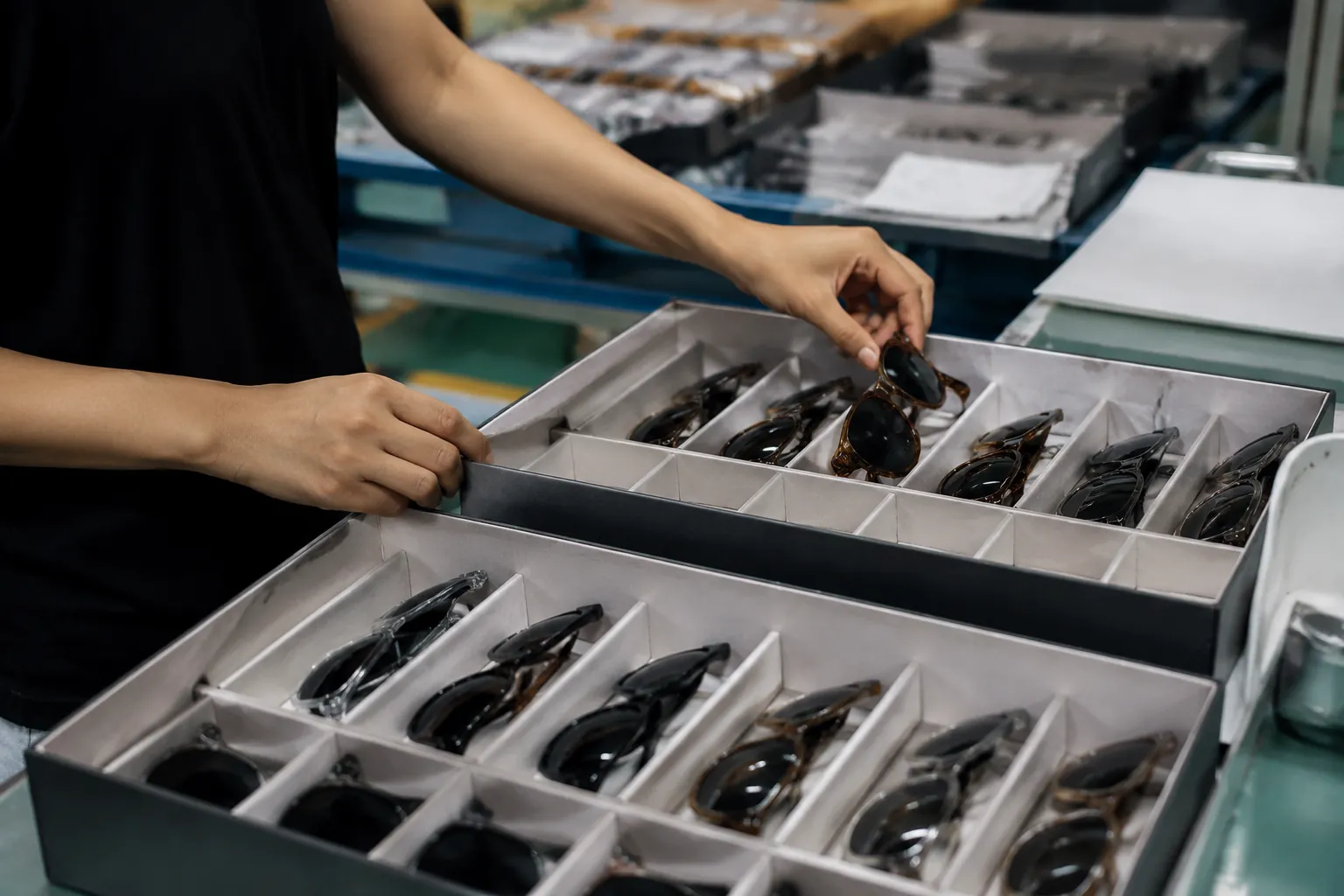
This guide is for brand owners, importers, distributors, and retail buyers ordering custom sunglasses in volume. It explains where lead time can be shortened without adding hidden quality risk, and where rushing usually creates rework, scrap, failed inspections, or missed ship dates. In custom eyewear, the safest way to hit a launch date is not to squeeze every step equally. It is to lock the highest-impact decisions early, use proven constructions where possible, and protect the process steps with real manufacturing, testing, and compliance limits.
What a rush order actually changes
Many buyers treat a rush order as if the whole schedule can simply be compressed from start to finish. In eyewear production, that is rarely true. A realistic rush plan does not remove technical steps. It cuts waiting time between steps, shortens approval loops, and secures production capacity earlier.
For custom sunglasses, total lead time depends on product structure, material availability, decoration method, packaging scope, and approval speed. A repeat order on an existing frame platform can move much faster than a new style that needs fresh tooling, new lens development, and custom retail packaging. Packaging can also become the critical path if barcode data, warning text, shipping marks, or box structure are confirmed late.
Some stages have hard limits. Injection-molded parts need stable settings to control shrinkage, warpage, and fit. Acetate parts need enough machining, polishing, and conditioning time to reduce later distortion. Lens tinting, mirror coating, and hard coating need controlled application and consistency checks. Pad printing, laser marking, and metal logo application each need setup and, in some cases, curing or adhesion checks. Incoming material checks, in-line QC, and final inspection are not admin work. They stop defects from reaching packed cartons.
This is why supplier structure matters. If molding, machining, lens processing, decoration, assembly, and QC are handled in-house, handoff time is usually shorter and corrections are faster. If those steps are spread across several subcontractors, even a small issue like logo placement variance or lens color mismatch can add transport time, repeated approvals, and unclear accountability.
Before sampling starts, a serious rush review should answer three questions: is the frame design already proven, are the required materials available or on a confirmed replenishment schedule, and can the buyer return approvals quickly through one clear decision maker? If any answer is no, the project may still move ahead. But it is not low risk.
When compression is low risk and when it is not
Not every sunglasses program should be accelerated in the same way. The safest projects to speed up are repeat orders or limited updates on an existing frame platform. The riskiest are projects that combine new tooling, new lens development, and new packaging in one schedule.
| Order type | Typical sample time | Bulk lead time after approval | Compression potential | Main risk |
|---|---|---|---|---|
| Repeat order, same frame, same lens, same pack | Short confirmation cycle if materials remain unchanged | Usually the shortest and most predictable | High | Material shortage or packaging delay |
| Existing frame with new logo or color | Moderate, depending on color and decoration approval | Usually manageable if the base frame is stable | Medium to high | Color approval loop, logo position variance, decoration durability |
| Existing frame with new lens tint, mirror, or polarization | Moderate to longer because lens approval is critical | Often longer than a logo-only change | Medium | Visible light transmission drift, coating adhesion, left-right lens mismatch |
| New injection mold or new acetate shape | Longer because fit and cosmetic corrections are common | Less predictable until the sample is validated | Low | Fit correction, shrinkage adjustment, polishing or assembly rework |
| Mixed-material fashion frame with multiple trims | Longer because more components must align | Often the least stable under time pressure | Low | Tolerance stack-up, cosmetic reject rate, assembly instability |
An existing frame platform moves faster because its behavior is already known. The supplier already understands hinge fit, lens groove depth, temple opening force, front curvature, and the most common cosmetic defect points. That history removes some engineering uncertainty. With a new mold, the first sample may reveal front warpage, lens seating stress, or temple angle imbalance that must be corrected before bulk starts.
The highest-risk rush orders usually stack three changes at once: a new frame, a custom lens specification, and custom retail packaging. Each change has its own approval path. The schedule is then controlled by the slowest unresolved element, not by the requested ship date.
Decisions that must be frozen early
If the goal is a shorter schedule without quality drift, several specifications must be fixed before the first sample starts. Late changes here do not affect just one component. They can force rework across sourcing, tooling, decoration, packaging, testing, and compliance review.
- Frame material: TR90, polycarbonate, acetate, metal, or mixed construction. A material change affects tooling method, finishing time, assembly approach, and cosmetic expectations.
- Lens specification: base curve, thickness, tint, polarization, mirror, and hard coating. Lens construction affects fit, appearance, and performance review against the target market standard.
- Branding method: pad print, laser engraving, silk screen, hot foil, or metal plate. Each method needs different artwork preparation, fixtures, and durability checks.
- Color standard: digital references help, but signed physical samples are more reliable for acetate patterns, transparent injections, painted finishes, and lens tints.
- Packaging set: box structure, pouch material, cloth print, barcode layout, warning text, master carton quantity, and shipping mark format.
- Compliance target: CE EN ISO 12312-1, ANSI Z80.3, AS/NZS 1067, REACH-related material control, and any FDA registration planning that applies to the importer or route to market.
A common mistake is approving frame shape while leaving lens details open. That can trigger avoidable rework because lens curve and thickness affect insertion force, edge stress, and final appearance. Too tight, and the front can be stressed. Too loose, and the lens can rattle or fail fit checks. Another mistake is approving artwork before the branding method is fixed. A logo file prepared for pad printing may not transfer cleanly to a small laser mark or a shaped metal plate.
MOQ strategy matters too. Low MOQs can help with market testing, but low volume leaves less room to absorb instability from color development, setup-heavy decoration, or packaging corrections. If the buyer wants both a rush schedule and a low MOQ, the safest path is usually a proven frame platform with simple specifications.
Where time can be saved safely
There are legitimate ways to shorten lead time. Most come from better planning, not more pressure on the factory floor.
- Use a proven frame platform: changing color, temple print, or approved lens options is usually safer than opening new tooling.
- Nominate one approver: a single decision owner cuts contradictory comments and prevents multi-team approval loops.
- Release production-ready artwork: vector files, exact logo size, placement dimensions, and finish callouts reduce decoration delays.
- Bundle approvals: review frame color, lens appearance, logo placement, and packaging details together instead of across several rounds.
- Reserve capacity early: realistic forecasts help secure molding, milling, lens processing, decoration, and packing slots before the schedule fills.
- Use simpler packaging where possible: standard protective packaging or export cartons can remove a packaging bottleneck if the sales channel allows it.
In many projects, the biggest non-technical delay is buyer response time. The sample is ready, but production cannot move because approvals on logo position, lens shade, or packaging text are still circulating internally. That is not a factory speed problem. It is an approval problem.
Another safe way to move faster is to separate what must ship together from what does not. If the sunglasses are approved but printed retail boxes are late, some buyers choose a first shipment in compliant protective packaging and move retail presentation packaging to a later shipment. That only works if the sales channel, customer, and labeling rules allow it. But it can protect the launch date without changing the product itself.
Suppliers can also work in parallel. While the buyer reviews the sample, the factory can verify material availability, prepare decoration fixtures, and tentatively reserve production capacity. This only works when the major specifications are already frozen and unlikely to change.
Shortcuts that usually backfire
Some shortcuts look efficient on paper. They usually create more delay later.
Skipping pre-production confirmation. If bulk starts before the final sample, golden sample, or pre-production sample is clearly approved, preventable variation becomes much harder to control. Typical problems include inconsistent logo position, lens shade mismatch, or visible differences between sample and bulk.
Changing packaging after bulk starts. Barcode labels, warning statements, carton marks, and quantity per master carton are often treated as minor details. They are not. A finished order can stall at packing or shipping because printed information is incomplete or wrong.
Rushing color matching on acetate or transparent injection frames. These materials can look different under different lighting conditions. A screen image or unsupervised digital approval is weak protection when visual consistency matters.
Adding too many cosmetic steps at once. Mirror lens, inside print, outside logo, foil detail, metal trim, and painted edges may all be feasible. Each extra step adds handling, setup, and reject risk. On a compressed schedule, that complexity often becomes the main source of delay.
Leaving compliance to the end. If the product must align with CE EN ISO 12312-1, ANSI Z80.3, or AS/NZS 1067, then lens category, labeling, and performance expectations should be built into the program from the start. REACH-related material control should also begin during material selection, not after assembly.
The pattern is consistent. Teams try to save time in development, then lose more time in correction, re-approval, sorting, or shipment holds. That is not acceleration. It is avoidable schedule risk.
Compliance and QC steps you should not compress
There is a clear line between fast production and reckless production. Experienced buyers move quickly on approvals but protect the control points that safeguard consistency and market access.
First is lens performance and labeling alignment. Depending on the destination market, sunglasses may need testing or documentation aligned with CE EN ISO 12312-1, ANSI Z80.3, or AS/NZS 1067. If the buyer changes tint target, coating, or lens construction late in the project, the product may need to be reviewed again against the applicable standard. This matters most when visible light transmission is close to a category threshold.
Second is restricted substance and material control. REACH-related expectations do not apply only to the front frame. Coatings, inks, nose pads, temple tips, adhesives, and decorative parts also need controlled sourcing and traceability. If a rush project substitutes materials without proper records, a short-term schedule gain can create a much larger compliance problem later.
Third is process QC. In eyewear, this means more than checking appearance. A useful in-line and final control routine includes hinge function, screw security, lens seating, logo position, surface defects, color consistency, opening and closing feel, and carton accuracy. On acetate and mixed-material frames, dimensional drift matters because small changes affect comfort and lens fit. On molded styles, unstable settings can show up as temple imbalance, front twist, or warpage.
Many capable factories operate with documented systems such as ISO 9001 and may also complete social compliance audits such as BSCI, but buyers should still confirm the exact QC checkpoints for the project. A rush order still needs measurable control points, signed references, and traceable approvals. Speed helps only if those controls stay intact.
How MOQ, price breaks, and lead time interact
Buyers often assume smaller orders always move faster because there are fewer pieces. Sometimes that is true. Often it is not. Small quantity does not remove setup work.
For example, a low-MOQ order can be practical when it uses a stock frame platform, an already approved lens option, and simple branding. But if the same small order requires a custom metal logo, a new lens tint, and printed retail packaging, the setup burden stays high relative to the quantity. Unit cost often rises because artwork preparation, fixture setup, packaging development, and QC overhead are spread across fewer pieces.
Price breaks and capacity planning vary widely by supplier, style, material, and decoration complexity. Buyers should not rely on generic market claims or assumed price thresholds. They should request quotations based on a fixed specification and compare the cost impact of quantity, packaging, and decoration choices directly.
Lead time follows the same logic. A complicated small order can be less practical than a larger order built on an existing frame with simpler packaging. More units do not automatically mean a slower schedule. Stable production flow matters more than absolute piece count.
If the launch date is fixed, buyers should ask for two quotations: the fastest low-risk plan and the lowest-cost plan. Those are often different scenarios. Comparing both before the purchase order is issued is far more effective than trying to redesign the schedule after development starts.
A practical timeline buyers can use
Good rush management starts at the front end. The buyer who sends complete specifications at the start usually moves faster than the buyer who starts pushing for speed while key decisions are still open.
- Project kickoff: confirm frame reference, material, lens specification, branding method, compliance target, packaging set, quantity, destination market, and required ship date.
- Approval setup: send vector artwork, placement dimensions, barcode data, warning text, carton marks, and the name of one approval contact with authority to sign off.
- Sample stage: allow the supplier to build and review the sample against the fixed specification. If the project uses new tooling or mixed materials, expect a longer and less predictable sample cycle than for a proven platform.
- Sample feedback: return one consolidated decision promptly: approve, reject with a single correction list, or approve with exact changes. Avoid serial comments from separate teams.
- Pre-production release: confirm the final reference sample or golden sample before bulk starts, then release the deposit and any missing packaging data without delay.
- Bulk monitoring: track material arrival, production progress, decoration status, packaging readiness, and QC findings in parallel rather than waiting until the end.
- Pre-shipment check: verify packing accuracy, shipping marks, barcode labels, and inspection release before booking freight.
The rule is simple: compress waiting time, not control steps. If speed matters most, simplify the design, freeze the high-impact specifications early, and respond quickly to samples. If differentiation matters most, accept a more standard timeline and protect the final result.
Have a custom sunglasses project in mind?
Send us your styles, target market and quantities and we will return a detailed quote with MOQ, lead time and a sample plan.
Get a QuoteWhy source this from Wenzhou with LumiShades
Wenzhou in Zhejiang Province is widely regarded as China’s eyewear manufacturing capital, producing a large share of the world’s sunglasses. That concentration matters to buyers: a deep local supply chain for acetate sheet, hinges, lens blanks, plating and packaging means shorter component lead times, easier color and material matching, and a workforce with decades of eyewear-specific skill. LumiShades has manufactured in this ecosystem since 2009, and our vertical integration — in-house injection molding, acetate cutting, CNC milling, lens tinting, decoration and quality control — means no part of your order is quietly subcontracted to a workshop you cannot audit.
For international buyers, that vertical control translates into accountability. When a single factory owns every step, defects are traced and fixed at source rather than bounced between vendors, and your specifications survive intact from first sample to bulk. For procurement review, buyers can request process records, approved samples, quality checkpoints and project-specific compliance files before placing a bulk order. Required testing and documentation are confirmed against the destination market and product specification rather than assumed from a generic certificate list. Explore our manufacturing capabilities and quality control process to see how this works in practice.
Frequently asked questions
Can a new custom sunglasses design realistically be rushed into bulk in under 25 days? Only in limited cases, and not as a default expectation. First ask whether the project uses an existing frame platform, whether the lens specifications are already proven, whether packaging is standard or custom, and whether all approvals can be returned immediately. If the project needs new tooling, new lens development, or custom packaging, ask the supplier for a written critical path showing which step controls the schedule. That will show quickly whether the target timing is realistic or simply risky.
What is the first thing I should freeze if my launch date is tight? Freeze the frame platform and lens specification first. Confirm the material, front shape reference, lens curve, lens construction, tint direction, and any coating requirements before artwork or packaging discussions begin. Then ask the supplier to confirm that the chosen frame-lens combination fits the target compliance standard and production method. If these basics stay open, the rest of the program stays unstable.
Does a lower MOQ always mean faster delivery? No. A lower MOQ can reduce total production volume, but it does not remove setup, color approval, decoration preparation, packaging development, or compliance review. To judge speed properly, ask the supplier to separate fixed setup work from piece-count production time. Then compare two scenarios: a low-volume custom order and a slightly larger order with simpler specifications. That comparison is usually more useful than MOQ alone.
Which approvals cause the most avoidable delay? The most common delay points are packaging details, logo placement, and lens appearance. To avoid repeated loops, prepare one approval pack that includes artwork, exact placement dimensions, barcode data, warning text, carton marks, and a physical or clearly defined color reference. Assign one final approver and require all internal comments to be consolidated before feedback goes to the factory. That is one of the safest ways to cut schedule loss.
Which compliance items should never be left until the end? Do not postpone decisions tied to CE EN ISO 12312-1, ANSI Z80.3, or AS/NZS 1067, and do not treat REACH-related material control as a final-stage paperwork task. Confirm early which market the sunglasses will enter, which standard applies, how the product will be labeled, and which materials or components need sourcing records. If U.S. route-to-market planning involves FDA registration responsibilities on the importer side, clarify that early as well. The practical step is to request a compliance checklist from the supplier before bulk starts and match it to the destination market.
Ready to start?
Explore our sport wrap sunglasses or request a quote — our sales team replies within 12 hours.
Request a Quote