
Spring Hinge Sunglasses: Smart Upgrade or Extra Risk?
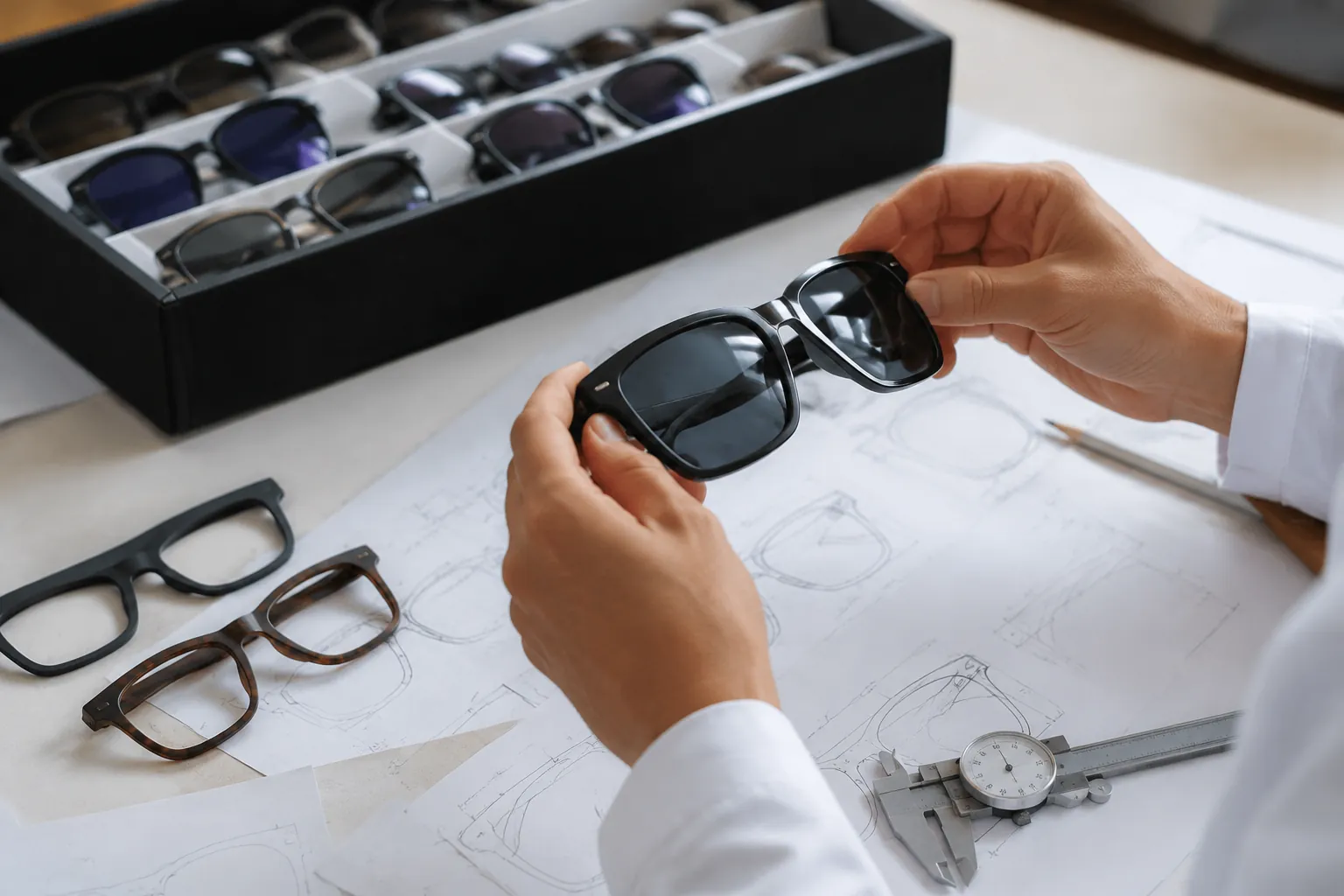
This guide is for brand owners, importers, distributors, and retail buyers deciding whether spring hinges belong in a sunglass program. The short answer: sometimes yes, often no. The right call depends on selling channel, fit range, frame material, target retail, and whether the supplier can control hinge quality in production. Keep it practical. Specify spring hinges only when they solve a real fit problem, support the selling channel, and justify the added cost and QC burden.
Start with the selling channel, not the hinge
Many buyers treat spring hinges as an automatic upgrade. That is poor sourcing logic. A hinge adds value only if it fixes a real problem in how the product is sold and worn.
Spring hinges are most useful when one frame has to fit a wide range of adult head widths and the customer has little chance to compare sizes before purchase. That often includes travel retail, gift shops, pharmacy chains, general merchandise, and some online programs with limited fit guidance. In those channels, extra temple flexibility can reduce complaints such as too tight at the head, pinches at the temples, or feels narrow out of the box.
They are less useful in optical shops, fashion boutiques, and better-run online brands that already manage fit with clearer size data, more size options, or more disciplined frame development. If the customer can choose by front width, lens width, bridge, and temple length, a spring hinge may add cost without fixing the real issue.
For promo, event, and low-price seasonal sunglasses, spring hinges are usually the wrong trade-off. Those programs are bought on landing cost, speed, and simple construction. A hidden comfort feature is hard to monetize when retail is low and the product is expected to be used hard or for one season.
- Good fit for spring hinges: one-size adult programs, travel retail, broad demographic assortments, some readers-sunglasses hybrids, and online styles with limited sizing choice.
- Weak fit: youth programs, narrow fashion silhouettes, beach promo, festival sunglasses, and low-retail programs under heavy cost pressure.
- Often unnecessary: acetate or TR/PC styles already engineered with more forgiving temple spread, a wider front, or balanced wrap.
Ask a better question: Which complaint will this solve, in which channel, and for which customer? If the supplier cannot answer clearly, the hinge is probably being offered as a perceived upgrade, not a functional need.
What a spring hinge actually changes in fit
A standard hinge opens to a fixed stop angle set by the frame design and hinge build. A spring hinge allows controlled outward travel beyond that point. In simple terms, it lets the temples flex outward during wear and removal, so the frame feels more forgiving across a wider range of head widths.
That helps when the base frame is slightly narrow for part of the intended audience. It does not fix the wrong bridge shape, weak nose support, cheek contact caused by lens position, too much wrap, or a temple that is too short.
Material matters:
- Injected PC: the frame already has some flexibility, so the comfort gain may be noticeable but limited. Check how securely the hinge assembly is anchored in the material.
- TR or similar flexible plastics: the base material often gives significant passive flex already, so the added value of a spring hinge may be smaller than buyers expect.
- Acetate: a well-developed acetate temple with proper core wire design can already provide comfortable spread. Spring hinges may be redundant unless the style fits narrow or the selling channel benefits from extra forgiveness.
- Metal: the comfort gain is often easier to justify because the temple itself usually has less passive flex than many plastic constructions.
So review the full fit package, not just the hardware. Look at front width, hinge placement, temple length, temple curve, wrap, and balance. In many projects, a small geometry change improves comfort with less cost and less failure risk than changing the hinge system.
The real trade-off: comfort gain versus failure points
Spring hinges add parts, assembly steps, and stress points. More parts mean more to inspect, more ways left and right temples can vary, and more ways the product can fail in use.
A standard sunglass hinge is relatively simple. A spring hinge adds an internal mechanism under repeated movement. That mechanism can fail if hinge quality is weak, assembly is inconsistent, the frame is over-opened in use, or the hardware is not well protected against corrosion.
The most common failure modes are predictable:
- Loss of spring performance: one side no longer returns properly or opens with the same feel as the other side.
- Screw loosening: repeated movement can expose weak screw control or poor thread retention.
- Housing movement or pull-out: especially in lower-rigidity plastic constructions if the hinge anchoring is weak.
- Alignment drift: the left and right temples open with different resistance or sit unevenly, which customers quickly read as poor quality.
This is why spring-hinge sunglasses need tighter process control than standard-hinge styles. A capable supplier should have defined checks for hinge seating, symmetry, screw security, and function before packing. Ask what the factory actually checks during incoming hardware control, assembly, and final QC. Do not assume the hinge will stay stable just because the approval sample looked fine.
That leads to the commercial question. Does the added comfort reduce enough fit complaints or returns to offset the higher unit cost and extra defect exposure? If current complaints are mainly about bridge fit, style, or lens performance, the answer is probably no.
Cost, MOQ, and lead-time impact by frame type
The unit increase can look small. At scale, it is not. And unit cost is only part of the picture. A spring hinge can affect sampling, hardware sourcing, temple construction, assembly time, and final inspection requirements.
| Frame type | Typical added unit cost | Lead-time impact | Typical process changes | Best use case | Risk level |
|---|---|---|---|---|---|
| Injected PC sunglasses | Usually increases hardware and assembly cost; exact cost depends on hinge type and construction | May increase if temple insert structure or tooling details need revision | Insert design review, added assembly control, hinge pull and function checks | Mass retail adult comfort-fit programs | Medium |
| Acetate sunglasses | Usually higher impact than basic hinges because of fitting and finishing complexity | Development may take longer if hinge pocket milling or fitting needs adjustment | CNC or milling adjustment, hinge pocket fitting, polishing recheck | Mid- to higher-retail programs where comfort supports the product story | Medium to high |
| Metal sunglasses | Usually a moderate added cost depending on hinge specification | Can affect assembly timing, though often with less tooling disruption than some plastic constructions | Extra assembly control, plating review, screw retention check | Adult unisex styles with a broad fit target | Medium |
| Low-price promo sunglasses | Often hard to justify commercially even when the hardware premium looks small | Any added delay can hurt seasonal or event timing | More QC burden than the price point can usually support | Rarely worth it | High |
For low-MOQ development, the cost impact is often magnified because setup, hardware handling, and extra assembly attention are spread across very few units. For bulk orders, compare the cost of spring hinges against upgrades the customer is more likely to notice, such as lens consistency, logo durability, packaging quality, or tighter final QC.
Lead time should be discussed early. If spring hinges require a different temple construction, extra fitting work, or separate hardware sourcing, the usual sample and bulk schedule may no longer apply. Get the revised critical path in writing.
Retail price point determines whether the benefit is noticed
Spring hinges are easiest to justify when the retail price leaves room for comfort-focused features and the buyer expects lower tolerance for fit complaints.
At lower price bands, customers usually judge sunglasses on appearance, lens tint, UV claim, and whether the frame survives basic use. In that segment, most buyers should prioritize stable assembly, lens consistency, logo adhesion, and screw control before adding more complex hinge hardware.
In mid-tier private label, spring hinges can support a comfort claim when the frame targets a broad adult audience and sells across mixed channels. Travel stores, airport retail, and general accessories programs are common examples because a single SKU often needs to accommodate many face shapes reasonably well.
At higher retail, the decision is still not automatic. Customers notice temple feel, yes. They also notice looseness, asymmetry, rough rebound, or poor finishing around the hinge area. Fast. A poor spring hinge damages a premium frame faster than a good standard hinge. If you use spring hinges in a higher-retail product, the supplier should be able to show clean execution, consistent left-right feel, and stable assembly over repeated handling.
Higher retail does not justify spring hinges by itself. It only raises the execution standard.
How to spec spring hinges without creating QC trouble
If you decide to use spring hinges, write the requirement properly into the tech pack. Do not just write spring hinge. That leaves too much room for inconsistent samples and unstable bulk output.
- State frame material and construction: injected PC, TR, acetate, metal, or mixed. Hinge anchoring and risk points vary by material.
- Define opening feel: light, medium, or firm, and require left-right consistency.
- Specify the intended fit function: for example, broader adult fit tolerance or easier on-off comfort for a one-size program.
- Set screw retention expectations: require post-assembly tightening and a defined check in final QC.
- Call out corrosion expectations: especially for beach, driving, or high-sweat use, where hardware quality matters more.
- Request alignment and function checks: the frame should open evenly, sit symmetrically, and show no visible hinge instability before packing.
The supplier process matters as much as the written spec. Ask whether hinge fitting, assembly, polishing, and final inspection are controlled in-house or outsourced, and who signs off if a hinge issue appears during production. If the product story depends more on visible brand presentation than hidden comfort hardware, the budget may work harder in better finishing and decoration instead.
Compliance remains separate from hinge choice. The hinge does not replace the requirement for the finished sunglass to meet the target market standard. Depending on market and channel, buyers commonly review conformity against CE EN ISO 12312-1, ANSI Z80.3, or AS/NZS 1067, and may also check chemical requirements such as REACH. If the program involves medical or reading-related distribution in the United States, buyers may also need to confirm whether FDA registration is relevant to the product category and importer setup. Factory system credentials such as ISO 9001 or social compliance audits such as BSCI can support supplier evaluation, but they do not replace product-level approval.
A simple decision framework before sample approval
Use this checklist before locking the hinge specification:
- Name the complaint you are trying to solve. If the issue is temple pressure or a narrow feel, spring hinges may help. If the issue is bridge fit, cheek contact, lens coverage, or style mismatch, they probably will not.
- Review the audience spread. If one SKU must cover a broad adult head-size range, spring hinges are more defensible.
- Check unit economics. On tight-margin programs, remove anything the customer is unlikely to notice or value.
- Compare geometry first. A small front-width adjustment, softer temple bend, or longer temple may solve the problem more simply.
- Ask for two development samples. Review one with a spring hinge and one with a standard hinge for comfort, handling feel, symmetry, and visual quality.
- Estimate failure cost, not just hardware cost. The right question is whether the hinge improves the commercial result after factoring in QC burden, defect exposure, and customer perception.
Blunt rule: If you cannot name the exact complaint spring hinges will solve in your channel, do not add them.
Where do they usually make sense? Adult unisex sunglasses for chain retail, one-size online programs, comfort-led travel or driving styles, and some metal frames aimed at a broad adult audience. Where do they usually not make sense? Kids sunglasses, narrow fashion silhouettes, very low-price promo, acetate styles already tuned for fit, and short-life seasonal drops.
Often, the best sourcing decision is the least dramatic one: standard hinges, correct size specs, compliant lenses, stable assembly, and on-time delivery. Hardware earns its place only if it changes the commercial outcome.
Have a custom sunglasses project in mind?
Send us your styles, target market and quantities and we will return a detailed quote with MOQ, lead time and a sample plan.
Get a QuoteWhy source this from Wenzhou with LumiShades
Wenzhou in Zhejiang Province is widely regarded as China’s eyewear manufacturing capital, producing a large share of the world’s sunglasses. That concentration matters to buyers: a deep local supply chain for acetate sheet, hinges, lens blanks, plating and packaging means shorter component lead times, easier color and material matching, and a workforce with decades of eyewear-specific skill. LumiShades has manufactured in this ecosystem since 2009, and our vertical integration — in-house injection molding, acetate cutting, CNC milling, lens tinting, decoration and quality control — means no part of your order is quietly subcontracted to a workshop you cannot audit.
For international buyers, that vertical control translates into accountability. When a single factory owns every step, defects are traced and fixed at source rather than bounced between vendors, and your specifications survive intact from first sample to bulk. We back this with 15+ years of experience, shipments to 60+ countries, more than 5 million pairs produced per year and a 98.5% on-time delivery rate. Our certifications — CE EN ISO 12312-1, FDA registration, ANSI Z80.3, AS/NZS 1067, REACH, ISO 9001 and BSCI audit — mean the compliance documentation your market requires already exists. Explore our manufacturing capabilities and quality control process to see how this works in practice.
Frequently asked questions
Do spring hinges reduce returns on online sunglass orders? Sometimes, but only when returns are mainly caused by temple pressure or a frame feeling too narrow. They do not reliably solve bridge fit, cheek contact, lens coverage, or style-related returns. Before approving them, ask for a standard-hinge sample and a spring-hinge sample in the same frame, then compare fit on multiple wearers and review your actual return reasons by SKU.
Are spring hinges a premium feature for all acetate sunglasses? No. In acetate, comfort often depends more on front width, temple shape, core wire design, and overall frame balance than on hinge type alone. Buyers should request side-by-side samples and inspect hinge pocket finishing, temple alignment, and opening feel carefully. If the acetate frame already fits well with a standard hinge, adding a spring hinge may only add cost and fitting complexity.
Do spring hinges affect compliance testing like CE EN ISO 12312-1 or ANSI Z80.3? Not in the same way that lens category, transmittance, and UV performance do. However, the hinge is still part of the finished product, so overall construction quality matters in product approval and in customer use. Keep compliance review and hinge approval as separate checkpoints: confirm the product meets the required market standard, then separately approve hinge function, alignment, and assembly consistency.
At what order volume does the cost question become important? At every volume. At low MOQ, the issue is often sample cost, development time, and whether the supplier can execute the hardware consistently. At higher volume, the issue becomes total landed cost, defect exposure, and whether the feature improves sell-through or reduces returns enough to justify itself. Buyers should calculate the total incremental cost across the order, not just the added cost per pair.
What should I ask for in a spring hinge sample review? Ask for a direct comparison against the same frame with a standard hinge. Check left-right opening feel, visible symmetry, screw security, temple alignment, rebound consistency, finishing around the hinge area, and whether the comfort improvement is actually noticeable in wear. Also ask the factory how the hinge is anchored, what final QC checks are applied, and whether any change in sample or bulk lead time is expected because of the hinge specification.
Ready to start?
Explore our cat-eye sunglasses or request a quote — our sales team replies within 12 hours.
Request a Quote