
Injection-Molded vs Acetate Sunglasses: Buyer Guide
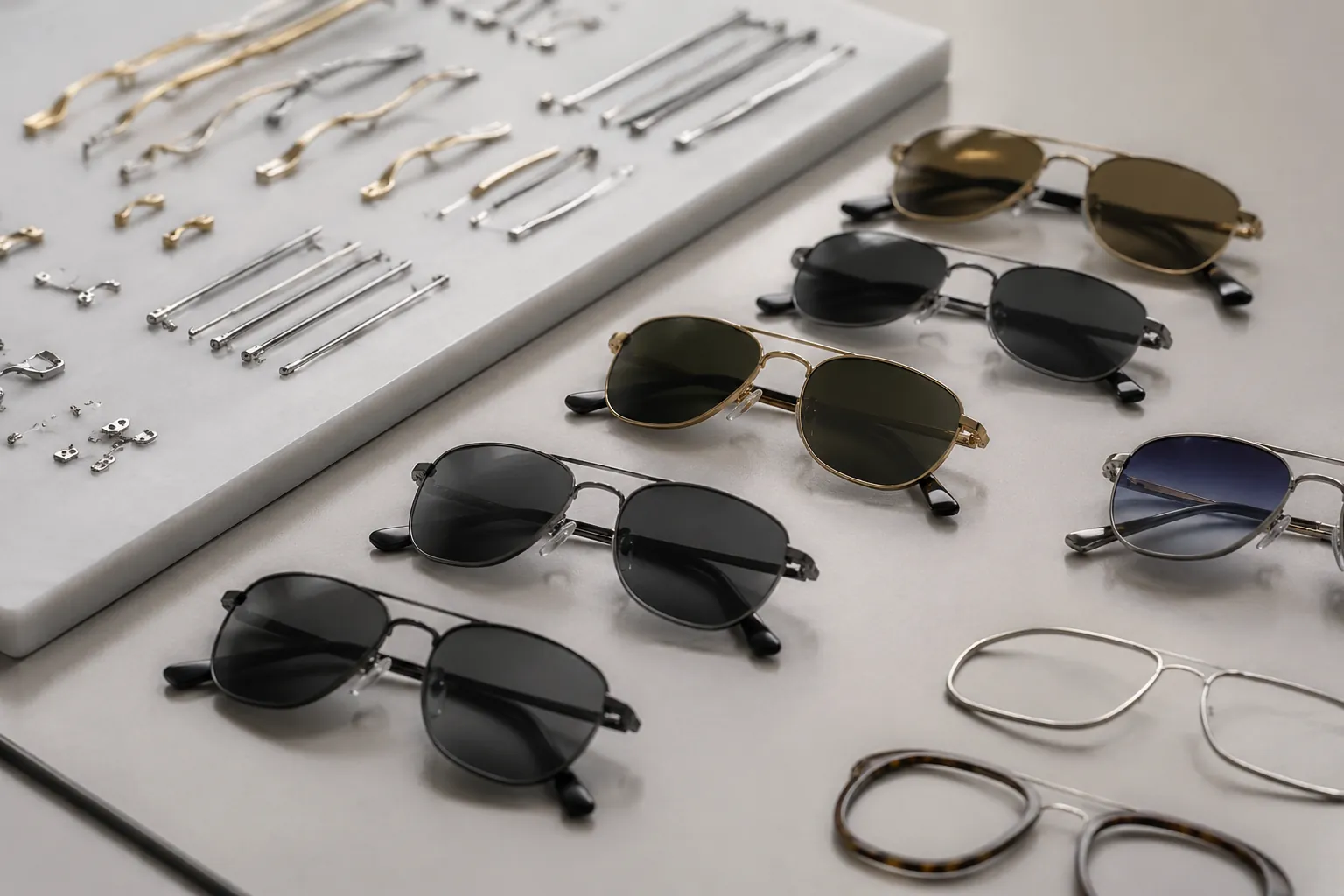
This guide is for brand owners, importers, distributors, and retailers comparing injection-molded sunglasses with acetate sunglasses for private-label or custom production. The question is simple: which route fits your target retail price, margin, finish standard, lead-time window, compliance needs, and reorder plan? Start there. Not with assumptions about what sounds premium. A frame can look strong in a prototype and still fail commercially if the manufacturing route does not support repeatability, cost control, or replenishment. Use this guide to connect material choice to sourcing risk, process control, and real retail conditions before you approve samples or place bulk orders.
Start with retail price, not material
Many buying mistakes start with aesthetics. A buyer likes the weight of acetate, or a team assumes injection-molded means low-end. Wrong order. Start with target retail price, then required margin, then landed-cost ceiling. Only after that should you choose the production route.
Injection-molded sunglasses often make sense when the program needs cost control, consistent output, and efficient replenishment. Acetate makes more sense when the frame material itself supports the selling story and the customer is expected to notice polished edges, layered color, or a heavier hand-feel.
Think past the first order. A style that looks good as a sample but becomes hard to control in cost, finish, or lead time at scale is not a strong program. Injection-molded frames usually offer better consistency across repeat runs. Acetate can scale too, but it typically involves more manual finishing and, with that, more cosmetic variation between batches.
| Decision factor | Injection-molded sunglasses | Hand-finished acetate sunglasses |
|---|---|---|
| Typical retail fit | Often suited to value-driven and commercial programs where cost discipline and repeatability matter | Often suited to mid-tier and premium programs where frame material supports the selling story |
| Unit cost at scale | Usually more efficient once tooling is approved and repeat volume is planned | Usually higher because cutting, shaping, polishing, and inspection involve more labor |
| Surface character | Clean, even gloss or matte with a more uniform appearance | Greater visual depth, layered effects, and richer edge finish |
| Dimensional consistency | Typically strong after tooling and process settings are validated | Can be good, but depends more on heat forming and hand-finishing control |
| Reorder speed | Usually easier to repeat quickly once the program is locked | Can be slower if sheet availability or finishing capacity becomes the constraint |
If your cost model is tight, your product is promotional, or early success will require replenishment, injection-molded sunglasses deserve serious consideration. If your buyer is paying for material character as well as shape, acetate is easier to justify.
Use this five-point decision framework
Before asking for a final quote, score the project across five areas. This avoids a common sourcing mistake: approving a design in one material and only later discovering that the cost structure, lead time, or finish standard does not fit the market.
- Target retail price and gross margin: Work backward from shelf price and wholesale requirements. If the program needs strict ex-factory cost control, injection molding is often easier to manage. If the frame itself must support higher perceived value, acetate may justify the extra cost.
- Styling requirement: If the concept depends on visible material depth, laminated color effects, thicker polished rims, or a more fashion-led hand-feel, acetate usually has the advantage. If the design relies on clean geometry, sports styling, or straightforward commercial fashion, injection is often enough.
- Time to market: Do not ask only about sample timing. Ask about approval timing, tooling timing if needed, and realistic bulk timing after artwork and packaging are confirmed. Injection programs are often easier to schedule once the process is stable. Acetate can move well too, but extra hand-finishing stages create more capacity pressure.
- Finish expectation: If the customer will closely inspect polish depth, bevel quality, edge sharpness, and material richness, acetate may be the better choice. If the buying decision is driven more by shape, lens appearance, fit, and branding, injection may deliver the right result with fewer variables.
- Repeatability and reorder risk: If you expect refill orders across markets, seasons, or accounts, ask which route will reproduce shape, color, and finish more reliably. Injection usually brings lower run-to-run variation once tooling is fixed. Acetate demands tighter process oversight to keep appearance consistent from batch to batch.
Score each point from 1 to 5. If cost discipline, scheduling, and repeatability score highest, injection is often the better route. If material character and premium presentation matter most, acetate is more likely to earn its keep.
Where injection molding wins
Injection-molded sunglasses are not just a lower-cost option. In many commercial programs, they are the lower-risk option too. Once tooling and process settings are stable, the factory can usually reproduce larger runs with fewer manual variables than an acetate program.
- Dimensional repeatability: Front shape, bridge form, and temple geometry are usually easier to repeat under controlled molding conditions.
- Lens-fit stability: Consistent rim and groove formation helps reduce lens-fit problems during assembly.
- Hinge alignment: More consistent molded parts can make hinge insertion and final assembly easier to standardize.
- Decoration efficiency: Pad printing, laser engraving, hot stamping, and metal logo application are easier to control when the underlying surface and geometry are uniform.
- Lower labor exposure: Injection still requires assembly and inspection, but it generally involves less manual polishing and edge correction than acetate.
Process control still matters. A typical injection route includes tooling approval where applicable, sample review, molding, trimming or de-gating, hardware fitting, lens fitting, branding, assembly, adjustment, and final quality control. Buyers should ask how the supplier checks warpage, symmetry, lens retention, hinge function, and cosmetic finish.
If the factory cannot explain those controls clearly, that is a warning sign. It usually means the supplier is relying too much on end-of-line sorting instead of stable production. For programs that depend on replenishment, account consistency, or multi-market rollout, injection-molded sunglasses often provide the stronger operating base.
Where acetate earns the extra cost
Acetate remains a strong choice when the frame material itself helps justify the retail price. It can offer visual depth, layered color effects, richer transparency, and polished edge quality that many buyers associate with a more premium presentation. On thicker silhouettes, acetate can also deliver the denser hand-feel that fashion and optical-adjacent programs often want.
That result comes from a longer and more variable process. A typical acetate route includes sheet selection, cutting, CNC shaping, beveling, tumbling, heat forming, polishing, hinge insertion, lens fitting, adjustment, and cosmetic inspection. Every step can improve appearance. Every step also adds labor and increases the need for control.
Risk usually shows up in predictable places. High-gloss dark colors can reveal polishing marks or edge inconsistency more clearly than lighter patterns. Thick temples and bold bevels can look excellent, but they take more time to finish well. Laminated color effects can add real shelf value, but they should be reviewed under consistent lighting because variation is easier to spot.
The rule is practical: choose acetate when material character helps sell the product. If the customer is expected to notice polish depth, layered color, edge definition, and weight, the added process cost may be justified. If the customer mainly wants a clean shape at the right price, acetate may add complexity without enough return.
| Process area | Injection-molded route | Acetate route |
|---|---|---|
| Base material behavior | Resin formed in a mold under controlled process conditions | Sheet material cut and shaped through multiple machining and finishing steps |
| Main finish labor | Generally lower manual polishing demand | Generally higher because shaping and surface finish depend more on manual operations |
| Cosmetic risk points | Possible molding defects, surface inconsistency, or visible gate and flow issues if process control is weak | Possible scratches, over-buffed edges, polish inconsistency, or visible lamination variation |
| Best use case | Commercial volume, replenishment, promotional programs, and operationally consistent rollouts | Premium fashion, thicker silhouettes, and material-led styling stories |
Process details buyers should ask about
The real sourcing difference is not only material. It is process control. Two suppliers can quote the same style in the same material and still deliver very different results because their checkpoints, tolerances, records, and corrective actions are different.
For injection-molded sunglasses, ask how the supplier controls tooling validation where applicable, part cooling, trimming quality, hinge insertion, and lens groove consistency. Front warpage after molding is not a minor detail. If the part is unstable before assembly, later heating and adjustment may improve appearance without removing internal stress or repeatability risk. Ask which measurements are controlled on approved samples and how those points are checked during production.
For acetate, ask how many polishing stages are used, how the supplier protects bevel definition, and how hinge channels are checked after machining and insertion. More of the surface result depends on handling. A strong supplier should be able to explain how appearance is standardized between operators and between batches, not only how defects are repaired at final inspection.
Ask about decoration methods too. Pad printing is common for efficient logo application. Laser engraving can provide durable marking on suitable surfaces. Hot stamping can create a metallic effect. Metal logo plates can improve presentation, but they also add component sourcing, alignment checks, and assembly steps. Each method changes cost, lead time, and defect risk.
- Frame symmetry check: ask how left and right temples are compared after assembly and how nonconforming pieces are handled
- Lens fitting standard: ask how secure seating, lens stress, and lens cosmetic condition are checked before packing
- Hinge performance: ask whether hinge movement, screw security, and alignment are checked during production and at final inspection
- Color control: ask how frame color and tinted lenses are matched from batch to batch under standard lighting conditions
- Decoration inspection: ask how print adhesion, engraving position, or logo-plate alignment is verified against the approved sample
Specific answers matter. They tell you whether the quotation reflects a controlled process or just a target price.
Lead time, MOQ, tooling, and cost in real buying terms
MOQ tells you whether a supplier will run the style. It does not tell you whether the program is efficient. Buyers should separate minimum order acceptance from economical order quantity. A supplier may accept a small trial order, but the unit cost, setup burden, and approval overhead can still be high.
A better way to judge the offer is to ask how pricing, lead time, and production risk change by quantity band. Do not rely on headline MOQ alone. Request quantity breaks, sample timing, tooling timing if relevant, and bulk timing based on frozen specifications. Injection programs often become more attractive as repeat volume rises because tooling and setup are spread across more units. Acetate programs can improve with scale too, but the cost benefit is usually limited by ongoing finishing labor.
Lead time works the same way. A sample may be produced quickly, but production timing depends on whether the shape, lens color, branding method, packaging, carton marks, and compliance requirements are already fixed. Programs slow down when buyers approve the frame shape first and then reopen branding, packaging, or lens details later.
Tooling logic matters as well. Injection commonly involves a clearer upfront tooling decision for custom parts or molds, which makes sense when reorder volume is expected. Acetate generally offers more design flexibility for lower-volume variation because the route depends more on cutting and machining than dedicated molding, but per-unit processing remains more labor-intensive.
Common buyer mistake: approving the frame shape, then revising lens tint, logo method, temple artwork, and packaging after sample sign-off. That usually causes delay, approval confusion, and mismatch between sample, bulk production, and compliance documents.
If your launch date is fixed, freeze these items early: frame color, lens specification, logo method, packaging specification, barcode language, carton marks, and destination-market compliance requirements.
Compliance is not a side note
Material choice affects margin and finish. Compliance determines whether the product can be imported, labeled, and sold in the target market. Serious buyers separate factory credentials from product-level requirements because they are not the same thing.
| Requirement | Why it matters | What the buyer should confirm |
|---|---|---|
| CE EN ISO 12312-1 | Key sunglass standard used for many markets that require product performance and labeling compliance | The report and labeling apply to the actual finished product specification being ordered, including lens category and markings |
| ANSI Z80.3 | Important reference standard for non-prescription sunglasses in the US market | Test documentation matches the final lens and frame configuration, not only a similar sample |
| AS/NZS 1067 | Relevant standard for Australia and New Zealand programs | Lens classification, coverage, and claims fit the destination-market requirements |
| REACH | Chemical compliance requirement relevant to materials and components in applicable markets | Coverage extends to relevant frame materials, coatings, inks, soft components, and metal decorations where used |
| FDA registration | Often discussed in US import and supplier-screening contexts | The supplier can explain what registration it holds and provide current supporting records if requested |
ISO 9001 and BSCI can be useful indicators of management systems and social compliance review, but they do not replace product-level sunglass testing. Never assume a factory certificate automatically covers a new frame, new lens, or new decoration combination.
Keep the tested product configuration aligned with the bulk order. If the approved sample, tested sample, and production sample differ in lens, marking, coating, or decoration chemistry, retesting, relabeling, or shipment delay may follow.
A practical choice by buyer scenario
The best decision usually becomes obvious once the product is tied to its actual sales environment.
- Retail chain program: choose injection-molded when fill rate, cost discipline, and reorder consistency matter more than handcrafted material character.
- Fashion brand capsule: choose acetate when the frame itself must communicate value through polish, layered color, or heavier tactile presence.
- Distributor testing several markets: compare both routes based on total landed cost, approval speed, compliance path, and likely reorder structure before scaling up.
- Tourism, event, or promotional merchandise: choose injection when cost, branding efficiency, and schedule reliability are the main priorities.
- Optical-adjacent premium line: consider acetate when thicker silhouettes, stronger hand-feel, and boutique presentation are commercially important.
If you are still split between the two routes, ask for comparable prototypes of the same shape in both materials where feasible. Then compare four things side by side: quoted cost under the same Incoterm, finish quality under store lighting, hinge and lens-fit consistency after handling, and the supplier's plan for repeat orders.
That usually ends the debate. Most buyers do not need the most romantic material story. They need the production route that protects margin, supports repeatability, and fits the market. That is why injection-molded sunglasses often make more sense for commercial programs, while acetate keeps its place where material character is part of what the customer is paying for.
Have a custom sunglasses project in mind?
Send us your styles, target market and quantities and we will return a detailed quote with MOQ, lead time and a sample plan.
Get a QuoteWhy source this from Wenzhou with LumiShades
Wenzhou in Zhejiang Province is widely regarded as China’s eyewear manufacturing capital, producing a large share of the world’s sunglasses. That concentration matters to buyers: a deep local supply chain for acetate sheet, hinges, lens blanks, plating and packaging means shorter component lead times, easier color and material matching, and a workforce with decades of eyewear-specific skill. LumiShades has manufactured in this ecosystem since 2009, and our vertical integration — in-house injection molding, acetate cutting, CNC milling, lens tinting, decoration and quality control — means no part of your order is quietly subcontracted to a workshop you cannot audit.
For international buyers, that vertical control translates into accountability. When a single factory owns every step, defects are traced and fixed at source rather than bounced between vendors, and your specifications survive intact from first sample to bulk. We back this with 15+ years of experience, shipments to 60+ countries, more than 5 million pairs produced per year and a 98.5% on-time delivery rate. Our certifications — CE EN ISO 12312-1, FDA registration, ANSI Z80.3, AS/NZS 1067, REACH, ISO 9001 and BSCI audit — mean the compliance documentation your market requires already exists. Explore our manufacturing capabilities and quality control process to see how this works in practice.
Frequently asked questions
At what order quantity does injection molding usually become the better commercial choice? There is no universal break point because the answer depends on tooling, frame complexity, decoration, packaging, and the supplier's process. Ask for a price matrix by quantity, confirm whether tooling is required, and compare the total delivered cost against the same style in acetate. Also ask which quantity the supplier considers operationally efficient for repeat production, not just the minimum it will accept for a first order.
Can injection-molded sunglasses still look premium? Yes. Premium appearance can come from overall design, surface finish, lens quality, color control, and branding execution. Review actual production samples under retail lighting, not only studio photos. Compare gloss or matte consistency, visible parting or gate marks, logo accuracy, and how the frame feels after normal handling. If the premium story depends mainly on layered material depth or hand-polished edge character, acetate may still be the better fit.
What should I freeze before bulk production starts? Freeze the approved frame shape, frame color, lens specification, logo method and position, packaging specification, barcode language, carton marks, destination market, and compliance documents required for that market. Put those points into a signed approval record or purchase specification sheet. If any of them change after sign-off, ask the supplier to confirm in writing how the change affects sample approval status, lead time, price, and testing.
How fast can a supplier move from sample to bulk? Timing varies by construction, tooling, workload, and how complete the buyer's specification is. Do not settle for one headline lead time. Ask for a dated timeline covering sample development, revisions, test sample preparation if needed, production booking, bulk manufacturing, inspection, and shipment readiness. Then confirm which milestones depend on buyer approvals. That gives you a more reliable schedule than a single sample-to-bulk promise.
Which certifications and tests should matter most for sunglasses buyers? Start with the requirements of the destination market and the actual product you are buying. Common checkpoints include CE EN ISO 12312-1, ANSI Z80.3, AS/NZS 1067, REACH, and FDA registration where relevant to your import process. Also review ISO 9001 and BSCI as factory-level credentials, but do not treat them as substitutes for product testing. Ask for reports or records that match the final frame-lens configuration, and make sure labeling and documentation align with the bulk SKU you will ship.
Ready to start?
Explore our square sunglasses or request a quote — our sales team replies within 12 hours.
Request a Quote