
How to Keep Sample and Bulk Sunglasses Consistent
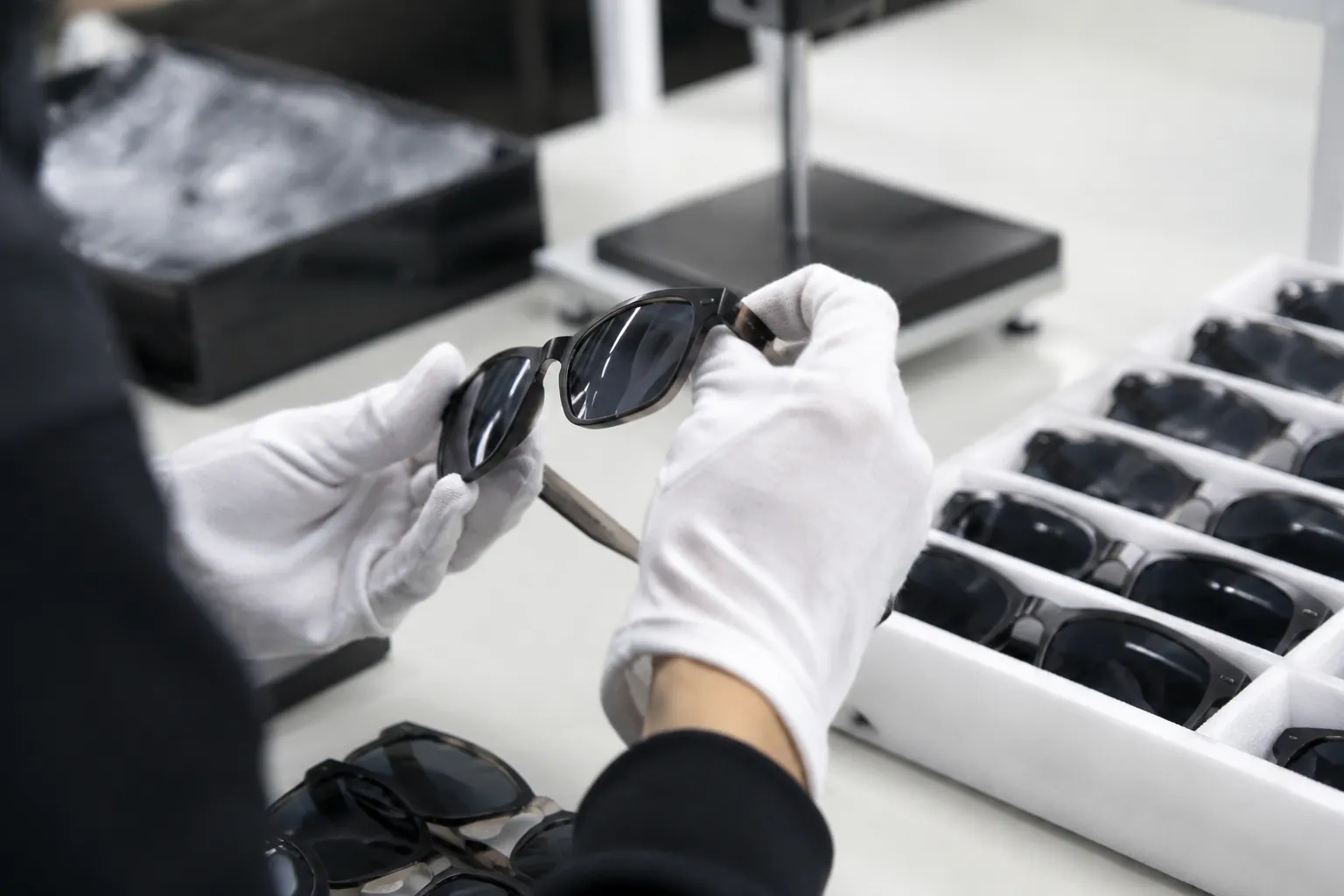
This article is for brand owners, importers, distributors, and retail buyers who need bulk sunglasses to match the approved sample, not just look similar. The business case is straightforward: fewer disputes, fewer rejects, less rework, and clearer shipment release decisions. In custom eyewear, consistency does not happen by habit or experience alone. It comes from turning the approved sample into a documented production standard before bulk materials are ordered and assembly starts.
Why approved samples still fail in bulk
Most sample-to-bulk failures in sunglasses come from one basic mistake: the approved sample is treated as a visual reference, while mass production needs measurable controls. A development or pre-production sample can be adjusted by a skilled technician. Bulk output depends on repeatable molding conditions, stable materials, polishing consistency, assembly alignment, lens fitting, decoration settings, and packing control across the full order.
That gap is where problems start. Small process changes can create visible differences. On injected frames, a change in resin lot, pigment dispersion, molding temperature, or cooling can shift color and gloss. On acetate styles, sheet variation can change transparency, pattern density, and tone. During assembly, drift in temple opening, hinge alignment, or temple bend can change how the frame sits and feels. On decorated styles, pad printing, laser engraving, or metal logo application can look different from the approved sample if the process is not fixed.
Buyers usually spot mismatches first in three areas: color, fit, and finish. Frame fronts may look glossier or duller. Lens tint may look darker or lighter. Temples may open tighter or looser than the approved sample. Cosmetic defects such as burrs, scratches, polish inconsistency, paint overflow, or logo misplacement also stand out fast when units are checked side by side.
The cost rises quickly once the sample has already been approved internally or by a retail customer. If the shipment arrives darker, tighter, glossier, or less refined than the approved sample, the supplier may say the bulk is close enough while the buyer disagrees. Then the dispute turns subjective. That is avoidable. The fix is to convert the approved sample into a production specification that the factory, QC team, and buyer all use.
Turn sample approval into a production specification
An approved sample should never stand alone. It needs a signed specification sheet that the factory, QC team, and buyer all work from. Without that document, the risk of mismatch stays high.
For custom sunglasses, the specification should define measurable controls for appearance, construction, packaging, and compliance. Record the frame material, lens material, base curve where relevant, finish level, logo method, dimensions, weight target, hardware, packaging, and required market standards. If the frame is TR90, polycarbonate, CP, metal, or acetate, state that clearly. If the lens is TAC polarized, nylon, polycarbonate, or CR-39, lock that detail before bulk approval.
- Record core dimensions such as eye size, bridge, temple length, front width, lens height, and inside temple opening.
- Set tolerances for each critical point instead of listing only nominal size.
- Freeze target weight with an agreed tolerance appropriate to the construction.
- State the exact decoration method: pad print, screen print, laser engraving, hot foil, or metal logo plate.
- Define cosmetic defect limits for scratches, burrs, swirl marks, sink marks, color variation, and logo position.
- List packaging details down to pouch, polybag, barcode, carton mark, and pack-out method.
If a supplier offers in-house molding, acetate processing, lens production, or decoration, that may improve control. It does not replace written standards. Process capability helps only when the buyer has clearly defined what must stay consistent from sample to bulk.
Control color before it becomes a dispute
Color is one of the most common reasons buyers reject bulk sunglasses. Many approvals still rely on vague terms such as darker, cleaner, warmer, or more transparent. That is not enough once production starts. Color needs a physical reference, a decision rule, and a defined inspection condition.
Start with the material. Injected plastics and acetate do not behave the same way. Injected color can shift with resin lot, pigment dispersion, masterbatch ratio, and molding conditions. Acetate can vary from one sheet batch to another, especially in transparent, translucent, smoke, champagne, or tortoise patterns. Lens tint can also drift if process control is weak. On gradient lenses, a small shift in the tinting process can move the fade position enough to create a visible mismatch within the same order.
A practical method is to approve one sealed master sample at the factory and keep one counter-sample with the buyer. Then define where color matters most: frame front, temples, lens, logo fill, pouch, and packaging print. If the style uses polarized, mirrored, or gradient lenses, specify whether tint density, mirror appearance, and fade position are part of the approval standard.
| Risk area | Typical cause | What buyer should specify | What QC should check |
|---|---|---|---|
| Injected frame color | Resin lot, pigment ratio, or molding variation | Approved master sample, finish level, and no material substitution without written approval | Visual match under fixed lighting, batch comparison, and left-right consistency |
| Acetate pattern | Sheet-to-sheet variation in tone and density | Acceptable range for pattern contrast, transparency, and dominant tone | Panel comparison before cutting and spot checks after polishing |
| Solid lens tint | Process variation during tinting or coating | Approved tint reference and no left-right mismatch | Shade consistency within each pair and across sampled units |
| Gradient lens | Variation in fade position or tint uniformity | Fade position, top-edge darkness, and bottom clarity level | Top-to-bottom consistency and pair-to-pair fade alignment |
If color is brand-critical, treat it as a controlled component, not a general impression. This matters most on transparent injected frames, patterned acetate, gradient lenses, and logo paint fill. Small shifts show up fast and are hard to fix after packing.
Fit drift starts with loose tolerances
A sample can fit well while bulk production slowly drifts out of shape. This happens in both injected and acetate frames because molding behavior, polishing, hinge setting, temple heating, and final forming all affect fit. If tolerances are loose, or checks happen only at final inspection, the problem is often found too late.
The size printed on the temple is not enough. Two frames with the same marked size can fit differently if front curvature, bridge shape, temple spread, pantoscopic angle, or temple bend changes. For sunglasses, useful control points include front width, lens width, bridge opening, inside temple opening, temple bend start point, lens seating stability, and left-right symmetry. Hinge alignment matters too. One uneven temple can cause rocking on a flat surface and crooked wear on the face.
Buyers should define which dimensions are fit-critical and set measurable tolerances for those points in the specification. They should also state which defects are unacceptable, such as visibly loose lenses, unstable assembly, sharp edges, or obvious left-right asymmetry. Weight control can also help flag unintended material or lens changes when used with dimensional checks.
Check these points at more than one stage: after molding or cutting, after polishing, and after final assembly. For repeat orders, keep a golden sample from the first successful bulk run as well as the original approved sample. That matters. A bulk-approved golden sample reflects actual tooling, materials, and production finishing better than a hand-adjusted prototype.
Finish standards need defect limits
Terms like good finishing or export quality are not standards. They are placeholders. A sample may look clean because it was checked one piece at a time. Bulk production is judged across many units, by different inspectors, often under time pressure. Without clear defect definitions, the same mark can be called acceptable by one party and rejectable by another.
Set acceptance rules under a defined viewing condition, such as normal white light at a consistent inspection distance. Then separate critical, major, and minor defects. Critical defects may include sharp burrs, cracked lenses, broken hinges, wrong labeling, or nonconformity with the agreed compliance requirement. Major defects may include obvious scratches in the main visual area, severe color mismatch, visible frame deformation, rocking, loose lenses, or missing logos. Minor defects may include small marks outside the main visual zone if they stay within the approved standard.
Common cosmetic checkpoints include scratches on lenses, edge burrs, swirl marks, sink marks near thick sections, paint overflow, weak pad print adhesion, uneven laser engraving, and off-center metal logo plates. Decoration method matters here. Pad printing, laser engraving, and metal logo application each produce different visual and durability results, so the final method should be approved before bulk production starts.
- Define inspection lighting and viewing distance before QC begins.
- Separate critical defects from major and minor cosmetic issues.
- State whether inner-temple defects are judged differently from front-facing defects.
- Require left-right logo position consistency with an agreed tolerance.
- Require lens cleanliness and correct accessories at packing, not only at assembly.
If the decoration method changes after sample approval, the product has changed. Buyers should confirm the final logo process before sign-off because a process switch can affect appearance, durability, cost, and lead time.
Link compliance, cost, and lead time
Compliance failures can also create sample-to-bulk mismatch. A sample may use one lens or material combination, while bulk production uses another to meet a lower target cost or a shorter schedule. That can change performance, labeling, and regulatory status. Buyers selling into multiple markets should write exact requirements into the purchase order, sample approval file, and final specification sheet.
Relevant standards and systems may include CE EN ISO 12312-1, ANSI Z80.3, AS/NZS 1067, REACH, FDA registration where applicable, ISO 9001, and BSCI. These are not interchangeable. Product standards such as CE EN ISO 12312-1, ANSI Z80.3, and AS/NZS 1067 relate to sunglass performance and labeling requirements in their respective markets. REACH relates to chemical compliance for applicable materials. FDA registration may matter depending on product classification and market entry requirements. ISO 9001 and BSCI are factory management and audit frameworks, not substitutes for product compliance testing.
Lead time discipline matters too. If color, packaging, logo method, or lens specification is still changing after materials are ordered, delay and mismatch risk rise. Small MOQ programs can work well for market tests, but they often leave less room for process variation and rework than larger, more stable programs. If a buyer is pushing cost down, the non-negotiable product requirements should be stated clearly so they are not changed without approval.
| Order size | Typical use case | Process risk | Buyer focus |
|---|---|---|---|
| Low MOQ pilot order | Market test, limited launch, or seeding program | Higher variation risk if materials or setup are fragmented | Freeze specifications tightly and limit avoidable complexity |
| Small commercial run | Early retail placement or regional test | More stable than a pilot, still sensitive to color and decoration drift | Confirm materials, packaging, and first-batch QC records |
| Core retail order | Planned commercial volume | Better repeatability if BOM and process stay fixed | Use staged approval and pre-shipment inspection |
| Scale program | Chain retail or repeat program | High exposure if standards are weak because more units are affected | Lock BOM, compliance route, and release criteria before deposit |
If the goal is to repeat the approved sample at volume, freeze the bill of materials before bulk starts. That includes frame material, lens construction, hinge, decoration process, and packaging components. No substitutions without written approval.
Use staged approvals before full production
Experienced buyers do not move straight from sample approval to packed cartons. They add checkpoints. It is cheaper to catch drift early than to sort it out after the full order is made. This matters even more on custom programs with multiple SKUs, where one colorway may run well while another shifts in appearance or decoration.
A practical approval flow starts with the development sample, which confirms style direction, rough fit intent, and branding layout. The next step is a pre-production sample made with the intended bulk material, lens, hardware, decoration method, and packaging. Only after that sample is signed should bulk production be released. Before assembly ramps up, the buyer should also confirm carton marks, barcode content, and pack-out details, because packaging errors can delay shipment even when the sunglasses themselves are acceptable.
Once production begins, ask for in-line photos, measurements, or first-batch QC data from the initial run. That information should tie back to the specification and may include key dimensions, weight, logo position, and visual color comparison against the master sample. A final pre-shipment inspection using the agreed defect criteria and sampling method should then determine release. For repeat orders, buyers should confirm whether the same mold, acetate source, hinge, lens construction, and decoration method will be used. Repeatability depends on repeat inputs.
At factory level, each process step—molding or cutting, polishing, lens fitting, decoration, cleaning, and packing—should be checked against the same approved standard. If one stage is controlled and the next is not, the sample still will not match the bulk.
What to lock before paying the deposit
The safest orders usually look simple on paper because the hard decisions were made early. Before deposit payment, the buyer should know exactly what is frozen and what is still open. Any unresolved point can turn into a production dispute later.
- Approved master sample identified by date, code, or photo record
- Signed specification sheet with dimensions, weight target, and tolerances
- Material definition for frame, lens, hardware, coatings, and accessories
- Color reference for frame, lens, pouch, and printed packaging
- Decoration method, artwork size, and logo position approval
- Required compliance standards and documents for the destination market
- Packaging pack-out, barcode, carton mark, and assortment details
- Inspection method, defect criteria, and shipment release rule
Once those points are fixed, price and lead time discussions become more realistic. More importantly, the buyer is no longer purchasing a promise. The buyer is purchasing a controlled result. That is the difference between a sample that wins approval and a bulk order that arrives looking like the same product.
Have a custom sunglasses project in mind?
Send us your styles, target market and quantities and we will return a detailed quote with MOQ, lead time and a sample plan.
Get a QuoteWhy source this from Wenzhou with LumiShades
Wenzhou in Zhejiang Province is widely regarded as China’s eyewear manufacturing capital, producing a large share of the world’s sunglasses. That concentration matters to buyers: a deep local supply chain for acetate sheet, hinges, lens blanks, plating and packaging means shorter component lead times, easier color and material matching, and a workforce with decades of eyewear-specific skill. LumiShades has manufactured in this ecosystem since 2009, and our vertical integration — in-house injection molding, acetate cutting, CNC milling, lens tinting, decoration and quality control — means no part of your order is quietly subcontracted to a workshop you cannot audit.
For international buyers, that vertical control translates into accountability. When a single factory owns every step, defects are traced and fixed at source rather than bounced between vendors, and your specifications survive intact from first sample to bulk. For procurement review, buyers can request process records, approved samples, quality checkpoints and project-specific compliance files before placing a bulk order. Required testing and documentation are confirmed against the destination market and product specification rather than assumed from a generic certificate list. Explore our manufacturing capabilities and quality control process to see how this works in practice.
Frequently asked questions
How many samples should a buyer keep after approval? Keep at least two approved references: one sealed master sample at the factory and one retained counter-sample with the buyer. For important programs, keep one sample from the first approved bulk run as well. Label each sample with the style code, color, approval date, and revision status. If packaging is customized, keep approved packaging references with the product sample so QC can check the full sellable unit against the same standard.
What is the biggest cause of color mismatch in bulk sunglasses? The most common cause is uncontrolled variation in materials or processing after sample approval. Injected frames can shift with resin lot, pigment ratio, and molding conditions. Acetate can vary by sheet batch. Lens appearance can change with tinting or coating variation. To reduce risk, require a sealed master sample, define the exact material and color reference in the specification, inspect under fixed lighting, and prohibit substitutions without written approval.
Can a factory meet low MOQ and still keep consistency? Yes, but the buyer usually needs tighter controls because smaller runs can be more sensitive to setup variation and fragmented materials. Ask the factory to confirm whether the bulk order will use the same material, mold, decoration process, and packaging as the approved sample. Request a pre-production sample made with actual bulk components and review first-batch QC results before authorizing full release.
Which certifications and standards should be written into the PO? List the exact requirements for the destination market and separate product compliance from factory system claims. For sunglasses, that may include CE EN ISO 12312-1, ANSI Z80.3, AS/NZS 1067, REACH, and FDA registration where applicable. If the supplier refers to ISO 9001 or BSCI, treat those as evidence of management or audit status, not as proof that the product itself is compliant. The PO should also state what test reports, declarations, labels, and markings are required before shipment.
Should buyers approve packaging separately from the sunglasses? Yes. Packaging should be approved as a separate controlled item because barcode errors, carton mark mistakes, wrong pouch material, or incorrect pack-out can block shipment even when the sunglasses pass inspection. Approve the pouch, box if used, barcode content, carton mark format, assortment method, and packing instructions, then include those details in the same order specification and final release checklist.
Ready to start?
Explore our round sunglasses or request a quote — our sales team replies within 12 hours.
Request a Quote