
Retail-Ready Sunglasses Packing That Cuts Chargebacks
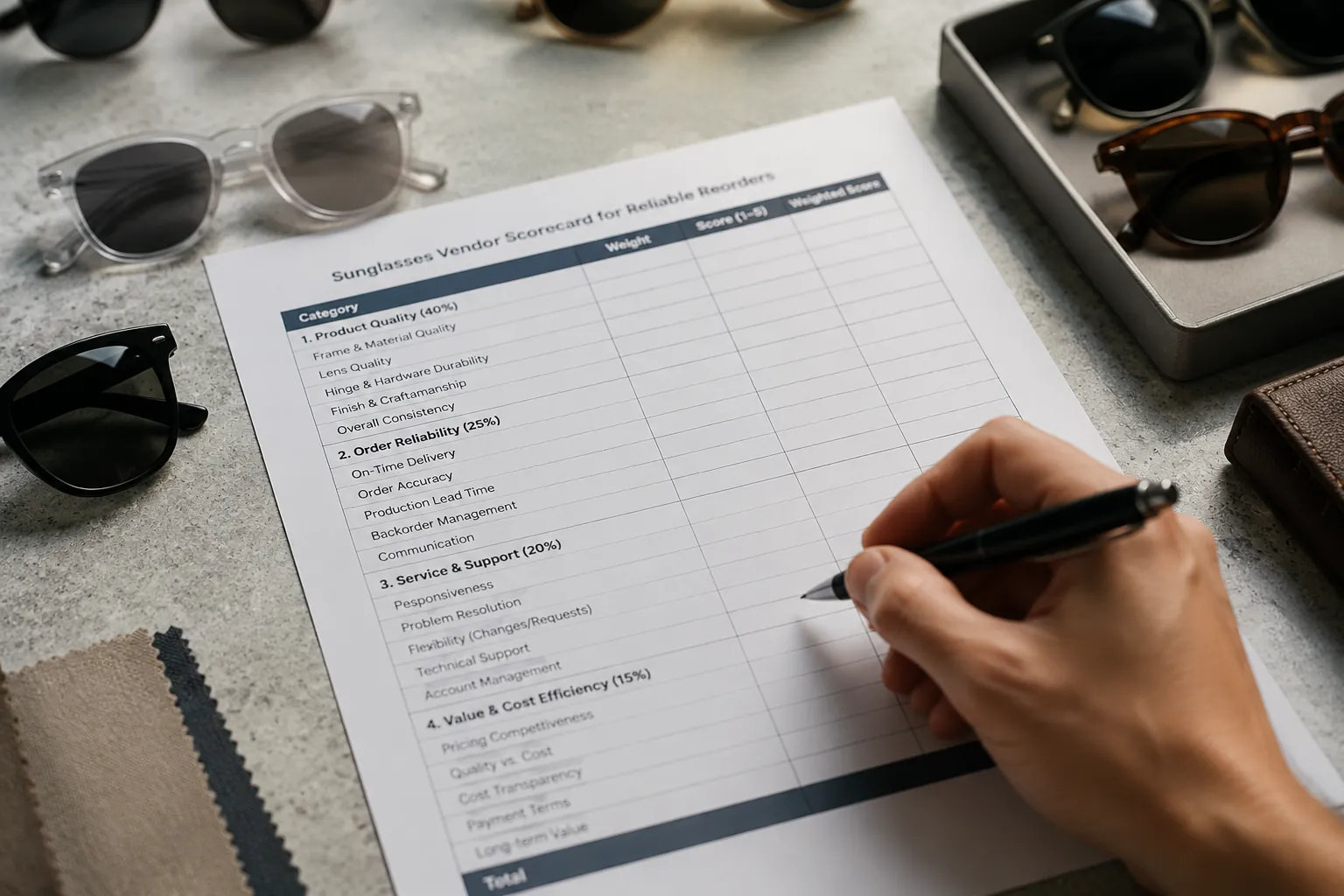
This guide is for distributors, importers, promotional buyers, and chain-store suppliers buying custom sunglasses in volume. The aim is simple: fewer relabeling jobs, fewer receiving disputes, fewer carton shortages, and fewer retailer chargebacks caused by loose packing instructions. Use it before sample approval and before bulk cartons are sealed. Retail-ready packing is not an afterthought. It is part of the product specification.
Start With the Retail Receiving Rule
Most packing problems start the same way. The buyer sends artwork, frame specifications, and lens requirements, then leaves packing to the factory's default method. That is a risk. A retail order should start with the final warehouse rule: how it scans, how it counts, how it handles exceptions, and what it treats as a chargeable error.
For sunglasses, define the unit hierarchy in plain terms: one pair, one selling unit, one inner pack, one master carton, and pallet configuration if required. If the retailer receives by each, the barcode on the retail box, hangtag, or polybag label matters most. If the retailer receives by case, the carton label and shipping mark carry the biggest receiving risk. If both are scanned, both must match the purchase order and retailer item master exactly.
A useful packing brief answers five questions: What is the sellable unit? What code identifies it? How many units go into each inner and master carton? Which carton panels carry the label? Who approves the barcode scan result before bulk packing?
At the factory, packing should sit inside the production route, not at the edge of it. Frames may move from assembly and lens fitting to logo decoration, cleaning, pouch or case insertion, unit labeling, and carton packing. Acetate and glossy finishes need careful handling because polished surfaces can scratch if frames are stacked loosely before pouching. Barcode labels, SKU stickers, microfiber pouch insertion, retail box packing, and carton marking should be checked at the packing station against the approved packing specification.
Barcodes: UPC, EAN, Code 128, QR, and Scan Checks
Do not ask a factory to "add a barcode" and leave the rest open. Name the barcode type, encoded data, label size, print method, and placement. Retail POS systems commonly use UPC-A or EAN-13 for the selling unit. Warehouse carton labels often use Code 128 because it can hold longer alphanumeric data such as PO number, SKU, color code, and quantity.
| Barcode type | Common use | Format | Recommended minimum size | Buyer risk if unspecified |
|---|---|---|---|---|
| UPC-A | US retail unit label | 12 numeric digits | Confirm with the retailer; include required quiet zones | Wrong check digit, wrong data, or EAN format may fail retailer setup or POS scan |
| EAN-13 | EU and global retail unit label | 13 numeric digits | Confirm with the retailer; include required quiet zones | Retailer may reject goods or require relabeling if the code is not in its item master |
| Code 128 | Carton, case, warehouse label | Numeric or alphanumeric | Depends on encoded data length and scanner distance | PO, SKU, carton count, or quantity may be missing, too dense, or unscannable |
| QR code | Consumer information, warranty, instructions, internal tracking | Variable data | Depends on data length and print quality | Often not accepted as the receiving barcode unless the retailer specifically approves it |
Place the unit barcode on a flat, scannable surface such as a hangtag, retail box, or polybag label. Avoid curved temple labels and labels wrapped around edges. They scan poorly and make the product look unfinished. On boxed sunglasses, one common location is the short side of the box so warehouse staff can scan units without opening every package.
Ask for three proofs before bulk packing: a label artwork file, a close-up photo of the printed label at actual size, and the decoded number from a real scan. The human-readable digits under the barcode must match the buyer's item master. If the retailer requires barcode verification, follow its stated standard and minimum grade. If no formal grade is required, still test printed labels with the same type of scanner used in receiving where possible. A barcode that looks clean but scans to the wrong SKU is worse than no barcode. It may pass a visual check and fail at receiving.
SKU Labels: Fields, Sizes, Adhesives, and Color Control
A SKU label is not decoration. It is an error-control tool. Sunglasses create mix-up risk because one frame style may have several lens colors, frame finishes, logo methods, and packaging versions. Matte black with smoke lens and gloss black with smoke gradient lens can look similar in a busy packing area if labels are weak.
Use one fixed label layout across the program. Keep it simple. Keep it consistent. Consistent labels reduce picking, packing, and receiving errors.
- Account or brand name: useful when a warehouse handles several private-label programs.
- Buyer SKU: the code the buyer's warehouse receives against, not only the factory model number.
- Factory model or style name: secondary identifier for production, inspection, and reorders.
- Frame and lens description: for example, "TR90 matte black / TAC polarized smoke lens."
- Barcode number: printed as human-readable digits below or near the symbol.
- Country of origin: exact wording required for the destination market and retail program.
- Quantity: required for inner and master carton labels, not usually for individual retail unit labels.
- Version control: add a packaging version, revision date, or item setup code when artwork changes between orders.
Choose label size based on required content and scanning distance. For small polybag labels, confirm that the SKU, color, barcode, and origin text remain readable at final print size. For retail boxes, use a larger label if warnings, importer details, multilingual text, or retailer routing information must be included. Warehouse staff should be able to distinguish colors and SKUs without guessing.
Adhesive choice matters. Labels can lift from matte paper boxes after humidity, temperature changes, or long transit. Gloss-varnished boxes may need a different adhesive than kraft boxes. Test the final label stock on the final packaging material before bulk packing. Do not place adhesive labels directly on lenses or frame surfaces unless the buyer has approved that method for that exact material and coating. Residue removal can damage polished acetate, mirror lenses, coated lenses, and some decorative finishes.
Carton Marks: Enough Data, Not Too Much Exposure
Carton marks should help a warehouse count, route, and audit stock. They should not expose more commercial information than needed. Print or label the core receiving data on two adjacent carton sides where possible, especially for mixed pallets. Cartons are harder to process when the only label is hidden against another carton, covered by stretch film, or damaged by tape.
A practical master carton mark for sunglasses includes PO number, buyer SKU, style or model, frame color, lens color, quantity, carton number, gross weight, net weight, carton dimensions, and country of origin. If the retailer has routing instructions, follow its label placement diagram exactly. Keep labels away from seams, tape lines, straps, and carton corners so the barcode and text remain readable after handling.
Use carton numbering in a clear sequence, such as "CTN 1 of 24, CTN 2 of 24." The total carton count should match the packing list and commercial invoice. If a final short carton is allowed, mark it clearly with the actual quantity. For mixed-SKU cartons, add carton-level contents detail and mark the outside "MIXED SKU" in large text. Better still, avoid mixed master cartons for chain-store replenishment unless the retailer requires or approves them. Mixed cartons can save space. They also raise receiving and allocation risk.
Do not print internal prices, production costs, unnecessary supplier details, or confidential customer names on the outside carton unless the buyer or retailer requires it. Some buyers prefer neutral shipping marks because cartons may pass through third-party warehouses. Neutral does not mean vague. The carton still needs PO, SKU, quantity, carton number, and any required routing label.
Factory-floor rule: if carton marks are applied after cartons are stacked, the bottom row may be missed. Carton labeling should be part of the packing station flow, with label application checked before sealing and palletizing.
Case Pack Math: 12, 24, 48, or 100 Pairs?
Case pack is where cost, damage risk, carton cube, and retailer handling rules meet. Sunglasses are light compared with many consumer products, but retail boxes, hard cases, microfiber pouches, hangtags, and inserts add volume fast. A carton that is too large can crush lower layers or deform retail packaging. A carton that is too small increases carton count, label count, warehouse touches, and handling cost.
Common case packs for sunglasses include 12, 24, 48, or 100 pairs, depending on packaging and retailer rules. Premium retail boxes with hard cases may fit best in smaller cartons. Standard boxed sunglasses often work in medium case packs. Polybagged promotional sunglasses may use larger case packs only if the retailer accepts bulk-style packing and the product is protected from abrasion and color mix-ups.
| Case pack | Best for | Typical carton behavior | Main control point |
|---|---|---|---|
| 12 pairs | Store-ready allocation by color, premium boxed sets | Lower compression risk but more cartons | Low counting risk and easier store allocation |
| 24 pairs | Retail boxes, hard cases, mixed store orders where approved | Often a practical balance of cube and handling | Confirm carton dimensions, weight, and retailer preference |
| 48 pairs | Wholesale replenishment and standard boxes | Moderate weight and more layer pressure | Use inner cartons, dividers, or layer protection if needed |
| 100 pairs | Promo polybag packing and simple SKUs | Efficient carton use but higher mix-up and scratch risk | Use only with approved bulk packing and clear color separation |
Tell the factory whether the case pack is fixed or "up to." These are different instructions. "24 pairs per carton fixed" means every full carton except an approved final short carton must hold 24. "Up to 24" gives the factory flexibility, but the buyer's warehouse may receive uneven cartons and dispute the count if that flexibility was not approved.
Set a carton weight limit and carton-strength requirement if the retailer or freight method requires one. Retail programs may set manual-handling limits, pallet-height rules, or drop-test requirements. If drop testing is required, state the test method, carton condition, and acceptance criteria. Do not rely on a vague instruction such as "export packing." Sunglasses with retail boxes, hard cases, or delicate lens coatings should be packed to prevent compression, shifting, rubbing, and label damage during normal transport and handling.
Materials, Decoration, and Packing Behavior
Packing should reflect the actual sunglasses construction. Different materials behave differently during transit and handling. TR90 and PC injection frames are flexible and may tolerate movement better than some rigid materials, but glossy finishes can still scuff if parts rub together. Acetate frames usually need more protection because polished surfaces can scratch before inner packing. Metal frames can bend at the bridge, nose pads, or temple tips if pressure is uneven.
Lens type also changes packing risk. TAC polarized lenses should be protected from rubbing because surface marks are visible in strong light. Mirror-coated lenses require clean pouch or lens-contact material; lint, dust, or hard particles can leave haze or micro-scratches. Gradient and fashion lenses may have different coating performance by SKU. Do not assume one packing method is safe for every lens option.
Decoration adds another control point. Pad-printed or screen-printed logos should be fully cured before pouching or boxing according to the ink supplier's process and the factory's validated production method. Laser-engraved areas should be cleaned if residue or dust remains. Metal logo plates, rivets, and trim pieces should be checked for sharp edges that can mark pouches, retail boxes, or neighboring units. If a hangtag string is used, confirm that it does not press against the lens surface inside the retail box.
Retail packaging needs the same level of detail as the frame. State the pouch material, hard case material, retail box board or paper specification if required, insert size, label stock, and any retailer-required warning or product information insert. If the box uses matte lamination, test label adhesion. If the packaging includes a window, check that the sunglasses cannot shift in a way that exposes the lens to abrasion or creates poor shelf presentation.
Packing Approvals Before Bulk Cartons Are Sealed
The best time to catch packing mistakes is during sample development, pre-production, or first packed carton approval. Not after all cartons are sealed. Packing approvals should be documented in writing and matched to the purchase order, artwork files, barcode data, and retailer routing guide.
- Send a packing specification sheet: include barcode files, SKU data, label sizes, carton marks, case pack, inner pack, retail packaging photos or drawings, and tolerance rules.
- Approve a label proof: check encoded barcode data, check digit, font size, origin text, compliance text, and placement.
- Request a packed sample: one complete selling unit with pouch, case or box, hangtag, label, warning insert, barcode, and any retail sticker.
- Confirm carton layout: ask for a photo or diagram showing inner packs, dividers, orientation, layer count, and quantity per layer.
- Run a scan check: scan unit and carton barcodes and record the decoded data, not just a photo of the barcode.
- Approve a first packed carton: weigh and measure it, count the units, check label placement, and compare the result against the packing list format.
- Freeze the packing spec: after approval, changes should be controlled like product changes and confirmed by the buyer before use.
Set inspection tolerances in writing. Quantity per master carton should be exact except approved final short cartons. Carton dimension and gross-weight tolerances should be realistic for the product and agreed before production. Label-position rules can be simple: correct panel, correct orientation, no label over a seam, no barcode under tape or strap, and no wrinkles or damage that affect scanning.
Small programs still need packing discipline. A small order can create the same receiving problem as a large order if the barcode is wrong, the origin marking is missing, or mixed colors are not identified. For higher-volume programs, validate packing early because a repeated label or carton error can affect every carton in the shipment. Quote retail boxes, EVA cases, polarized lenses, metal logo plates, multi-color decoration, and special labels as separate line items when possible so the buyer can see which packing choices affect cost and lead time.
Compliance Text and a One-Page PO Packing Appendix
Sunglasses packing often carries compliance text. That text must match the actual product, test evidence, and target market. Common eyewear-related standards and compliance references include CE EN ISO 12312-1, ANSI Z80.3, AS/NZS 1067, REACH, FDA registration, ISO 9001, and BSCI. Do not print a mark, standard, claim, or certification unless it applies to the specific product, supplier, factory, or market and is supported by current documentation.
For sunglasses sold in the EU, EN ISO 12312-1 is relevant for sunglass performance and filter category information. In the US, ANSI Z80.3 is relevant for nonprescription sunglass performance. Australia and New Zealand programs may reference AS/NZS 1067. REACH concerns chemical restrictions for materials, coatings, inks, pouches, and accessories sold into the EU. FDA registration may be relevant to the business or product route for the US market, but buyers should confirm the exact requirement with their compliance adviser or importer of record.
Country-of-origin marking should be agreed before packing. If the product is made in China, the marking should be visible as required and should not be hidden under a removable sleeve or covered by a price sticker. Retailers may also require UV protection wording, lens category, importer details, choking hazard text for accessories, or California Prop 65 language where applicable. Provide exact approved language. Factories should not write market compliance copy from memory.
Attach a one-page packing appendix to the PO. Include unit packing, barcode type and number, label size, inner pack, master carton quantity, carton label fields, mixed-carton rules, inspection checks, and approval contact. State whether mixed cartons are forbidden, whether the final carton can be short, and whether the packing list must show carton-level SKU detail.
Retail-ready packing is not difficult, but it is unforgiving. One wrong digit can turn good product into a warehouse relabeling job. One unclear case-pack instruction can create receiving disputes across a shipment. Specify packing early. Test it with real labels and cartons. Freeze it before mass packing begins.
Have a custom sunglasses project in mind?
Send us your styles, target market and quantities and we will return a detailed quote with MOQ, lead time and a sample plan.
Get a QuoteWhy source this from Wenzhou with LumiShades
Wenzhou in Zhejiang Province is widely regarded as China’s eyewear manufacturing capital, producing a large share of the world’s sunglasses. That concentration matters to buyers: a deep local supply chain for acetate sheet, hinges, lens blanks, plating and packaging means shorter component lead times, easier color and material matching, and a workforce with decades of eyewear-specific skill. LumiShades has manufactured in this ecosystem since 2009, and our vertical integration — in-house injection molding, acetate cutting, CNC milling, lens tinting, decoration and quality control — means no part of your order is quietly subcontracted to a workshop you cannot audit.
For international buyers, that vertical control translates into accountability. When a single factory owns every step, defects are traced and fixed at source rather than bounced between vendors, and your specifications survive intact from first sample to bulk. We back this with 15+ years of experience, shipments to 60+ countries, more than 5 million pairs produced per year and a 98.5% on-time delivery rate. Our certifications — CE EN ISO 12312-1, FDA registration, ANSI Z80.3, AS/NZS 1067, REACH, ISO 9001 and BSCI audit — mean the compliance documentation your market requires already exists. Explore our manufacturing capabilities and quality control process to see how this works in practice.
Frequently asked questions
Can LumiShades print retailer barcodes on individual sunglasses packaging? Yes, if the buyer supplies the approved barcode type, encoded number, artwork file, label size, placement, and any retailer routing requirements. Before bulk packing, request a printed label photo at actual size and a scan result showing the decoded data. The decoded number must match the buyer's item master and purchase order.
What is the safest case pack for chain-store sunglasses orders? Use the retailer's routing guide first. If the retailer does not specify a case pack, 24 pairs per master carton is often a practical starting point for boxed sunglasses or sunglasses with cases because it balances handling, carton size, and count control. Confirm the final choice by checking carton dimensions, gross weight, compression risk, and whether the warehouse receives by each, inner, or case.
Should each color have a separate carton? If the warehouse receives by SKU, separate cartons by SKU and color whenever possible. Mixed-color cartons should be used only when approved by the buyer or retailer. If mixed cartons are allowed, the outside carton label and packing list should identify the carton as mixed and show carton-level contents by SKU, color, and quantity.
Can packing be changed after production is finished? Yes, but it usually adds labor, time, and error risk. Finished goods may need to be reopened, relabeled, rescanned, recounted, repacked, and resealed. To avoid this, approve unit labels, barcode data, carton marks, case pack, carton layout, and the first packed carton before full production packing begins.
Which compliance marks can be printed on sunglass packaging? Only print marks, standards, or claims supported by the specific SKU and target market. Relevant references may include CE EN ISO 12312-1, ANSI Z80.3, AS/NZS 1067, REACH, FDA registration, ISO 9001, and BSCI, but each must be applicable and documented. Do not print UV400, polarized, lens category, CE, or other claims unless they are true for that SKU and approved for the destination market.
What information should be on a master carton label? A master carton label should normally include PO number, buyer SKU, style or model, frame color, lens color, quantity, carton number, gross weight, net weight, carton dimensions, and country of origin. Add the retailer's required routing label, Code 128 carton barcode, pallet label, or ASN-related data if specified. Place labels on approved carton panels where they remain visible and scannable after sealing and palletizing.
Ready to start?
Explore our cat-eye sunglasses or request a quote — our sales team replies within 12 hours.
Request a Quote