
Sunglass Packaging Specs for Amazon, Retail, and Wholesale
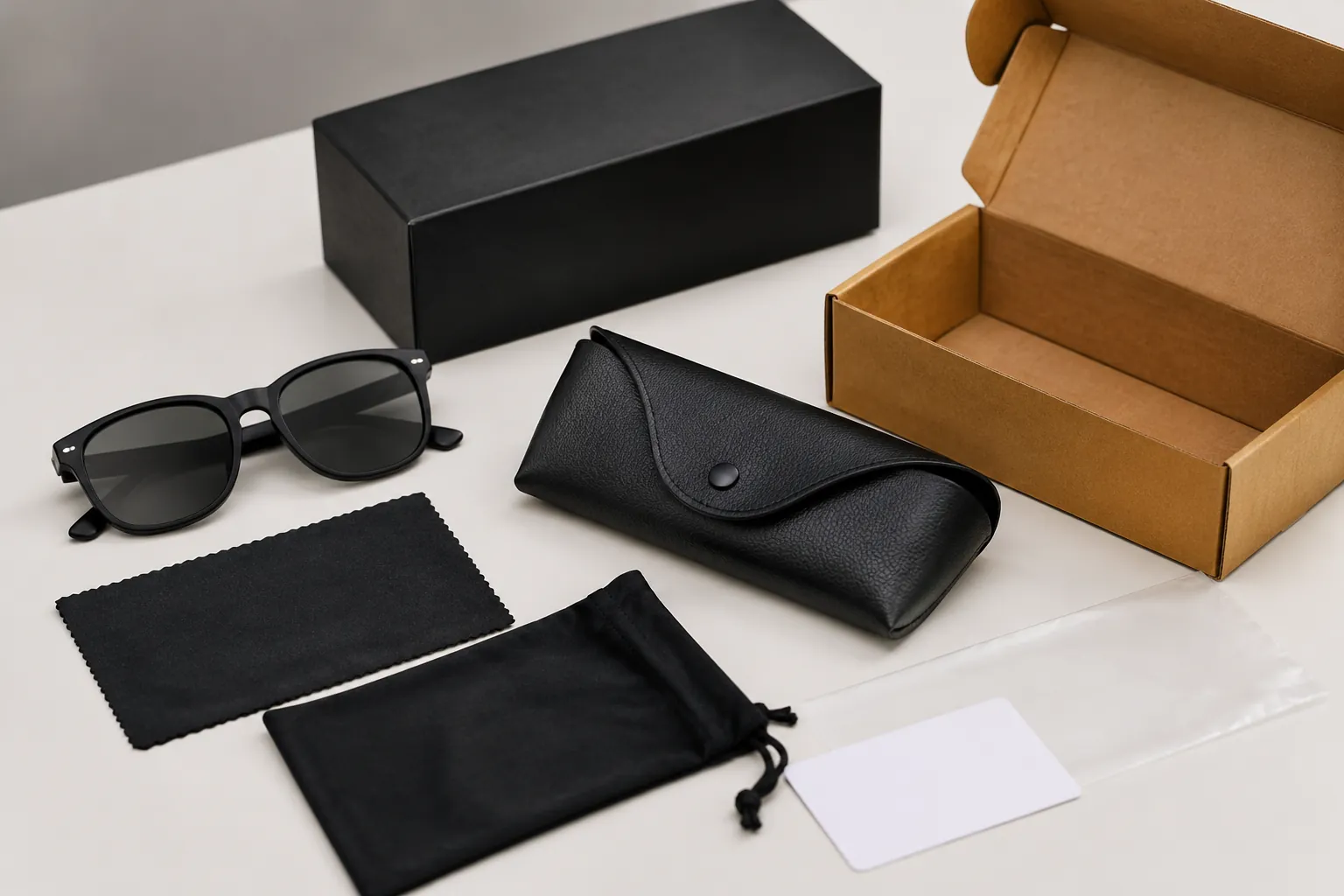
This guide is for brand owners, importers, distributors, and retail buyers sourcing sunglasses in volume. The goal is practical: define packaging that protects frames and lenses, fits the sales channel, and avoids preventable freight, relabeling, repacking, and damage claims. In eyewear, packaging is not just a branding choice. It affects barcode scanability, carton compression, dimensional efficiency, packing speed, and the number of pairs that fit per master carton. A useful packaging brief gives the supplier measurable instructions on fit, materials, labeling, and carton loading before production starts.
Start with the channel, not the artwork
A common mistake is approving artwork before the selling channel is clear. Amazon fulfillment, retail shelf display, and bulk wholesale put different demands on the same product. One pack format can serve more than one channel. Often it just adds cost in one place and protection gaps in another.
For Amazon, the unit pack has to stay closed, keep its barcode readable, and survive parcel handling and fulfillment-center processing. For retail, presentation matters more, but the pack still has to hold shape through container loading, pallet movement, and store replenishment. For wholesale, buyers usually care most about delivered cost per saleable pair, so cube efficiency, clean receipt, and low damage rates matter more than shelf appearance.
Write the packaging brief around three questions:
- Will the sunglasses ship as an individual consumer unit or as replenishment stock for warehouse handling?
- What labels are required on the unit: retail barcode, Amazon FNSKU, polybag warning text where applicable, country of origin, importer information, or internal SKU ID?
- What level of transit risk is acceptable, and what type of damage is not acceptable at receipt?
Set commercial boundaries early. If the target price point is tight, a rigid gift box may not fit the program. If the item is positioned as premium retail, a more protective or higher-finish pack may be justified. Start with the commercial model. Not the graphics file.
Packaging also affects timing. A frame sample and a packaging sample do not move on the same path. Folding cartons need dielines, artwork approval, and print confirmation. Fitted cases or custom inserts need dimensional confirmation and fit review. If the frame size is still changing, packaging approvals tend to stall or repeat.
Pick the unit pack by protection, cube, and finish risk
Most sunglass unit packs fall into four practical tiers: polybag only, microfiber pouch plus polybag, folding carton with pouch, and hard case with outer box. The best choice depends on frame finish, lens sensitivity, shipping route, and selling price.
| Unit pack option | Typical use | Protection level | Added unit cost | Freight and cube effect |
|---|---|---|---|---|
| Polybag only | Promotional or very low-cost wholesale | Low | Lowest among common options | Best cube efficiency, lowest freight impact |
| Microfiber pouch plus polybag | Wholesale, marketplaces, basic DTC | Medium | Low to moderate | Efficient packing, limited dimensional penalty |
| Folding carton with pouch | Retail shelf, Amazon-ready unit sales | Medium to high | Moderate | Higher cube, often acceptable for branded units |
| Hard case plus outer box | Premium retail, delicate finishes | High | Highest among common options | Highest cube and dimensional-weight impact |
Material behavior matters. Standard injected plastic frames are often more forgiving in transit than highly polished acetate or metal styles with exposed hardware. Acetate surfaces scratch more easily, and thicker fronts can create point contact if units shift inside a carton. Metal frames, hinges, and logo plates can mark adjacent units unless the lens face and hardware are kept apart.
If the order uses mirrored, flash-coated, gradient, or high-gloss lenses, specify lens-facing protection clearly. A pouch helps only if hard components are kept off the lens. If a hinge tip, rivet, or trim part can touch the lens during compression, soft fabric alone is not enough.
Decoration method should influence packaging choice too. Simple printed branding may tolerate basic separation. Raised metal plates, glossy surfaces, plated trim, and decorative hardware usually need tighter spacing and orientation. Test the claim against the finish. Do not assume.
Write the spec like a production document
A usable packaging spec reads like an instruction sheet for purchasing, print vendors, and packing lines. If a requirement is not written, the supplier will fill the gap with an assumption. That is where variation starts.
Your packaging specification should include measurable items such as:
- Unit pack dimensions with tolerance, for example 165 x 70 x 55 millimeters plus or minus 2 millimeters
- Board or material grade, such as SBS board, rigid board, EVA shell, PET tray, or microfiber pouch fabric
- Print process and finish, including CMYK, Pantone references where used, matte or gloss lamination, spot UV, foil, embossing, or debossing
- Insert design, such as die-cut card, PET tray, EVA tray, or no insert
- Barcode type and placement, with a quiet zone and a flat scan area free of seams or folds
- Country of origin mark, importer information, warning text, and any market-specific labeling requirement
- Pack count per inner carton, master carton dimensions, and gross-weight limit set by the buyer or warehouse
Fit is where many packaging programs fail. Sunglasses should not rattle inside a retail box, but the insert also cannot be so tight that it twists the temples or presses the lenses. Ask the supplier to confirm packed dimensions of the finished product with temples folded, not only the flat dieline size of the carton.
Volume matters because packaging setup and material minimums affect unit economics. Smaller runs usually favor simpler formats. Larger runs make custom pouches, printed cartons, and upgraded finishes easier to justify because fixed setup costs are spread across more units. Simple rule: match the structure to the order size.
Build Amazon packaging for compliance and parcel handling
Amazon packaging should be designed for the real inbound process, not for a product photo. Units may be relabeled, handled repeatedly, and moved through mixed parcel conditions. If the pack opens, scuffs easily, or loses barcode readability, the result can be extra prep work, delays, or non-compliance with program requirements.
For Amazon-ready sunglass packaging, confirm these points before bulk packing:
- Each sellable unit has one scannable barcode in a consistent location, usually on a flat underside or rear panel
- If a polybag is used, warning text is printed where bag size or market rules require it
- The package stays closed during normal handling and does not open under routine compression or impact
- The unit protects the product from ordinary abrasion and handling marks during parcel movement
- The SKU identity on the unit, inner carton, and master carton matches the shipping documents
Rigid boxes are not automatically safer. A loose lid can open in transit, while a well-designed folding carton with a locking tab and a secure insert may perform better and use less space. Structural security matters more than premium appearance in an e-commerce chain.
Compliance statements on the pack must match the product file. If the sunglasses are sold for general sun protection, any performance claim should be supported by the applicable test standard or market documentation, such as CE EN ISO 12312-1, ANSI Z80.3, or AS/NZS 1067 where relevant. Do not print unsupported UV, impact, or lens-category claims. Buyers may also request REACH declarations, FDA registration details where applicable in the U.S. supply chain, ISO 9001 quality-system records, or BSCI audit documentation, but those are usually managed in the compliance file rather than printed broadly on the consumer pack.
Keep retail packaging useful, not wasteful
Retail packaging has to protect the product and support the sale visually. The common mistake is overbuilding. Thick rigid boxes, oversized windows, magnets, and multiple insert layers all increase material cost, assembly time, and freight volume. In many programs, they add less value than a better-designed folding carton.
For many mid-range sunglass lines, a folding carton paired with a microfiber pouch gives a strong balance of branding, protection, and freight control. If a retailer wants a more premium presentation, consider upgrading the surface finish first with matte lamination, soft-touch coating, spot UV, or foil, instead of moving immediately to a bulky hard case. These finishes improve appearance without adding as much shipping volume.
Ask for a carton loading plan before approving retail packaging. You need to know units per inner carton, units per master carton, gross weight, and whether the box geometry creates dead space. If the frame is slim, internal clearance may be reduced safely. If it is a thick acetate shape or has broad end pieces, the insert may need more width or height to avoid sidewall pressure.
Window cutouts need caution. They can improve visibility, but they also reduce panel strength and may increase dust entry or corner crush risk unless the board grade is adjusted. If the retailer is not specifically asking for a visible product window, a closed carton is usually stronger, simpler, and easier to stack.
Treat wholesale packing as a damage-rate problem
Wholesale buyers supplying chains, distributors, and promotional channels usually care less about the unboxing moment and more about receiving clean, saleable stock with minimal handling cost. In this channel, effective packaging often looks plain because it is optimized for transport, counting, and storage.
A practical wholesale format is an individual polybag, often combined with a pouch, packed into layered or partitioned inner cartons and then loaded into export master cartons with controlled compression. The key risks are hinge pressure, lens-to-lens contact, hardware-to-lens contact, and carton collapse under stack load.
Ask the factory how units are oriented inside the inner and master cartons. Random fill creates pressure points and inconsistent compression. A planned orientation works better: temples folded inward, fronts alternating direction where appropriate, and stack height kept consistent. For mixed-color or mixed-SKU orders, require clear carton-level assortment labels so warehouse teams do not need to open cartons to identify variants.
Master carton requirements should be written clearly. Set a gross-weight ceiling that fits your warehouse handling practice. Confirm carton strength for the route and stacking method, especially for ocean freight or multi-warehouse distribution. In wholesale programs, a stronger export carton often does more to reduce claims than a more expensive consumer-facing unit pack.
Match lead time and MOQ to packaging complexity
Packaging can delay a sunglass order when approvals happen in the wrong sequence. A frame sample may be ready before the packaging structure is final, but custom packaging cannot be approved fully until folded size, barcode assignments, required text, and internal fit are confirmed.
As a rule, the more custom the package, the more approval points it creates. A plain pouch with a label is usually faster to finalize than a printed folding carton. A hard case with a decorative logo, fitted insert, and outer sleeve adds more sourcing, decoration, assembly, and inspection steps.
Use this sequence to reduce delays:
- Approve final frame dimensions and folded temple size first
- Approve packaging structure and internal fit second
- Approve artwork, barcode, and legal text third
- Approve carton assortment and shipping marks last
This order matters because fit changes often force dieline and artwork revisions. On lower quantities, keep packaging simple unless presentation is central to the program. At higher volumes, custom cartons, inserts, and upgraded finishes become easier to justify because tooling, print setup, and purchasing minimums are spread across more units.
Inspect packaging before final random inspection
Do not wait until final random inspection to review packaging. By then, most cost is already committed and corrections are slower. Packaging should be checked during sampling, pre-production, and live packing because many failures appear only where finished eyewear meets inserts, bags, and cartons.
A strong packaging checkpoint list includes:
- Fit test: frame sits correctly, temples close naturally, and the lenses do not rub against insert walls or hard trim
- Print check: barcode scans, text is legible, and print finish matches the approved sample
- Label check: origin mark, importer information, warnings, and SKU data are correct and placed consistently
- Closure check: carton tabs, sleeves, or case zippers hold securely during normal handling
- Drop and compression check: packed units and master cartons tolerate routine handling without opening or crushing
- Carton audit: pack count, assortment, gross weight, and shipping marks match the packing list
These checks matter because packaging defects are often created by process variation, not by the original design alone. A decorated temple may scratch a neighboring frame if bagging orientation changes. A barcode may be correct in artwork but still fail if it sits on a fold line or reflective finish. A lens may pass product inspection and still arrive damaged if the packing density is too tight.
Good suppliers treat packaging as part of quality control, not as a final wrapping step. Buyers should do the same. Write the spec, sample the pack, verify fit, confirm labels, and inspect against the written instruction. That is the reliable way to reduce avoidable claims and control landed cost.
Have a custom sunglasses project in mind?
Send us your styles, target market and quantities and we will return a detailed quote with MOQ, lead time and a sample plan.
Get a QuoteWhy source this from Wenzhou with LumiShades
Wenzhou in Zhejiang Province is widely regarded as China’s eyewear manufacturing capital, producing a large share of the world’s sunglasses. That concentration matters to buyers: a deep local supply chain for acetate sheet, hinges, lens blanks, plating and packaging means shorter component lead times, easier color and material matching, and a workforce with decades of eyewear-specific skill. LumiShades has manufactured in this ecosystem since 2009, and our vertical integration — in-house injection molding, acetate cutting, CNC milling, lens tinting, decoration and quality control — means no part of your order is quietly subcontracted to a workshop you cannot audit.
For international buyers, that vertical control translates into accountability. When a single factory owns every step, defects are traced and fixed at source rather than bounced between vendors, and your specifications survive intact from first sample to bulk. For procurement review, buyers can request process records, approved samples, quality checkpoints and project-specific compliance files before placing a bulk order. Required testing and documentation are confirmed against the destination market and product specification rather than assumed from a generic certificate list. Explore our manufacturing capabilities and quality control process to see how this works in practice.
Frequently asked questions
What is the safest low-cost packaging for wholesale sunglasses? For many wholesale programs, an individual microfiber pouch inside a polybag is a practical low-cost starting point, but it is only safe if the carton packing method is controlled. Ask the supplier to confirm three points in writing: unit orientation inside the inner carton, separation between hardware and lenses, and master carton strength for the shipping route. If the frames have exposed metal trim, mirrored lenses, or delicate finishes, request a packed sample and check for rubbing after transit simulation or handling review before approving bulk packing.
Should Amazon orders use hard cases for better protection? Not automatically. A hard case can improve crush resistance, but it also increases package volume and may create closure or relabeling issues if the outer presentation is not secure. For many Amazon programs, a folding carton with a pouch is more efficient if it stays closed, protects the lenses from rubbing, and carries one clean, scannable barcode. The right decision should come from a packed-sample review based on closure security, barcode placement, and ordinary parcel handling risk, not from appearance alone.
How early should packaging be approved in production? Approve packaging structure as soon as final frame dimensions and folded temple size are confirmed. Then verify the actual fit with the finished frame before releasing artwork. This sequence avoids the most common delay: approving graphics first and then changing the box size later, which forces updates to the dieline, barcode position, and legal text layout. In practice, buyers should request one approved sample for structure and one approved sample for final artwork before mass packing starts.
What compliance details belong on sunglass packaging? Only information required for the market or supported by the product file should appear on the pack. That may include country of origin, importer information, barcode labels, warning text where applicable, and supported product claims tied to CE EN ISO 12312-1, ANSI Z80.3, or AS/NZS 1067 when relevant to the product and market. REACH declarations, FDA registration details where applicable, ISO 9001 records, and BSCI audit documents are usually retained in the compliance file rather than printed on every consumer unit. Before artwork approval, ask your supplier or compliance team to confirm which statements are mandatory, optional, and prohibited for the target market.
How does MOQ affect packaging choice? MOQ affects packaging because print setup, tooling, and material minimums do not scale down efficiently. At lower order quantities, simple packaging usually keeps the unit cost under control and reduces approval complexity. At higher quantities, custom cartons, printed pouches, inserts, and upgraded finishes become easier to justify because the fixed costs are spread across more units. A buyer can act on this by requesting two quotations at the same time: one for a simple pack structure and one for the preferred branded structure, each with the same carton-loading assumptions, so the cost difference is clear before approval.
Ready to start?
Explore our rimless sunglasses or request a quote — our sales team replies within 12 hours.
Request a Quote