
One OEM Order for Sunglasses, Cases and POS Materials
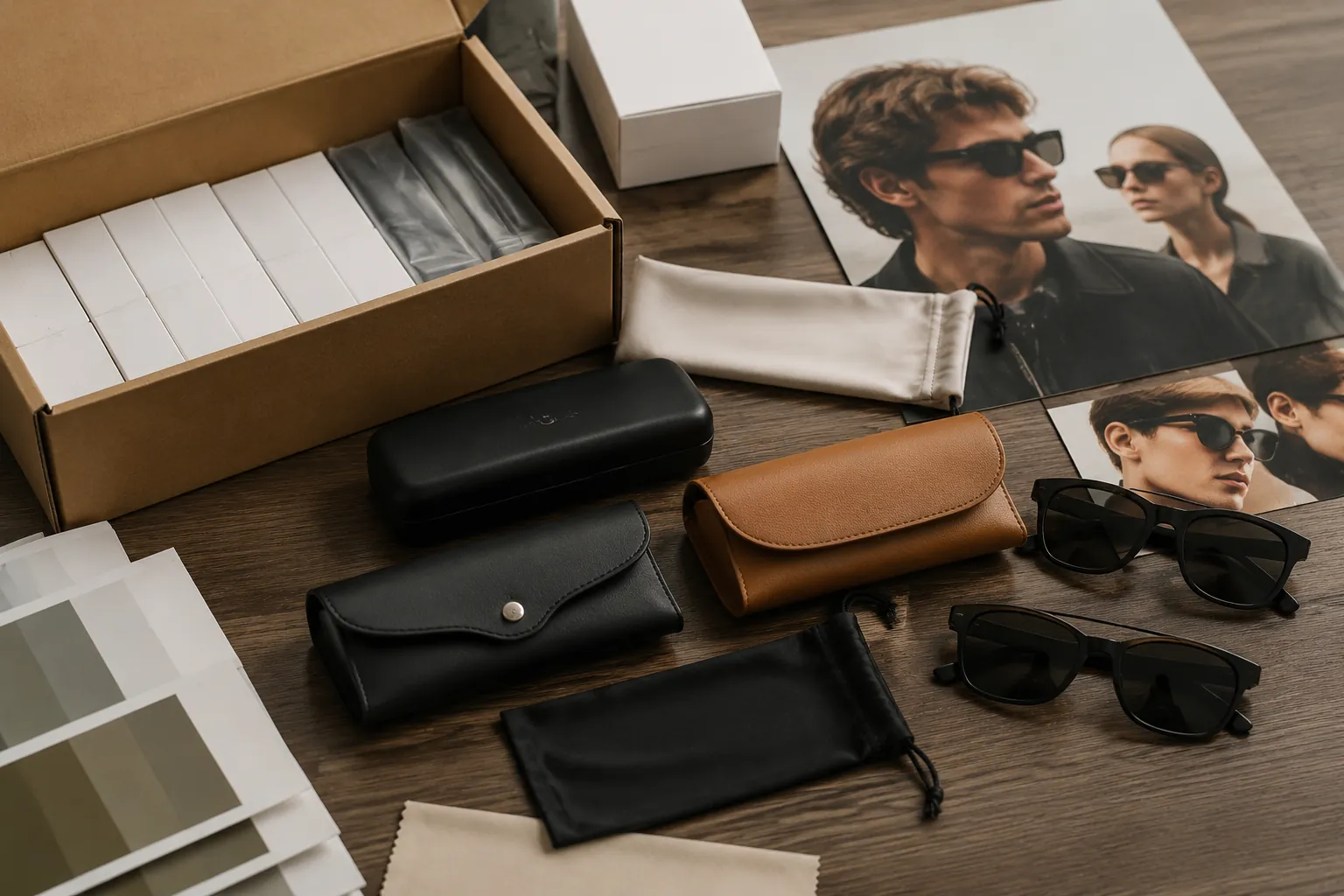
This article is for brand owners, importers, distributors and retailers buying custom sunglasses in volume. When frames, cases and retail materials move on separate timelines, the result is usually the same: extra cartons, duplicate handling, partial arrivals and goods that can ship but are not ready for sale. Plan the order as one retail program from the start. Build the product spec, packaging spec, artwork files, compliance file set and final pack-out plan together. That keeps receiving cleaner, supports launch timing and helps control landed cost.
Start with one shipment map, not three purchase orders
Most consolidation problems start early. The buyer confirms the sunglasses, adds cases later, then remembers hang tags, display cards or counter stands. By then, carton assumptions may already be fixed, accessory lead times may be different and artwork approvals may be late.
Start instead with one shipment map at quotation stage. List every part that must arrive together: sunglasses, microfiber pouch or hard case, cleaning cloth, hang tag, barcode label, instruction insert, display tray and POS materials. Treat the order as one landed retail program, not separate SKUs sharing a container.
For custom sunglasses, product and packaging specs are linked. Frame width, folded temple position, lens curve, hinge shape and logo placement can all affect case fit, label placement and final pack-out. Drawings help, but they are not enough. A case that looks correct on paper can still fail on a real sample if the temples press against the lenses, the hinge corners strain the pouch seam or the closure puts pressure on the frame during stacking.
A practical shipment map should include concrete operating rules, not broad intentions:
- Selling unit: 1 pair + 1 case or pouch + 1 cloth + 1 hang tag + 1 barcode label.
- Pack-out rule: for example, 10 retail sets per inner box and 10 inner boxes per master carton.
- Carton size rule: define a target maximum based on your freight mode, pallet standard and warehouse handling limits.
- Arrival rule: all components ship together, or any partial shipment requires written approval and a latest-arrival deadline.
Set those rules early. If you do not, each party will optimize for a different problem. The eyewear supplier pushes frame output. The printer pushes artwork timing. The forwarder pushes loading. A small saving at component level can turn into a higher landed cost at shipment level.
Build the bill of materials around the retail unit
Buyers often manage sunglasses, cases and POS as separate cost lines. Freight and receiving do not work that way. Landed cost is shaped by cubic volume, carton count, stackability, damage risk and how quickly the warehouse can identify a complete saleable unit.
Start from the retail unit and work backward. If one store-ready unit is one sunglass, one folding case, one microfiber cloth and one hang tag, lock that structure before approving decoration. A temple logo may work with a simple pouch. But if the product will sit in a printed box or sleeve, the brand panel, barcode location and mandatory warning text must match the packaging dieline and the retail-facing panel.
The approval sequence should stay simple: approve the frame and lens sample first, confirm the case using the real folded sample rather than a drawing, then freeze artwork for labels and POS. That order cuts avoidable fit errors and keeps packaging decisions tied to the actual product.
Tolerances matter. A soft pouch can absorb some variation. A molded hard case cannot. Case dimensions should be based on the folded frame's real width, height and depth, with enough clearance to prevent pressure marks or hinge stress while limiting wasted space. The right allowance depends on frame shape, case material, lining thickness and whether the product includes raised decorations such as metal logos.
Keep the bill of materials disciplined. Too many accessory variants create mixed cartons, picking errors and higher MOQ pressure. Frame MOQ and accessory MOQ are often different, especially for printed cloths, rigid boxes, molded cases and acrylic display parts. Before approving style-specific accessories, confirm the minimum order quantity, print setup requirements and the effect on leftover inventory.
Low frame pricing does not help if you later pay for missing cases, relabeling or reprinting retail materials.
Know which items should be packed together and which should not
Not every component belongs in the same carton. The right answer depends on fragility, finish sensitivity, customs treatment, receiving method and final retail presentation. Flat materials usually ship well. Empty air does not.
| Item | Best Packing Method | Main Risk | Buyer Note |
|---|---|---|---|
| Sunglasses with microfiber pouch | Packed as a complete retail set in inner boxes | Lens rub if the cloth or pouch surface is too abrasive | Approve cloth material, edge finish and fold method before bulk |
| Hard EVA or PU cases | Separate master cartons unless inserted at final pack-out | Dead air and higher cubic volume if oversized | Match case size to the actual folded frame, not only the drawing |
| Printed paper boxes or sleeves | Flat-packed where possible with edge protection | Crush damage, corner damage or scuffing | Agree on board specification, packing method and transit protection |
| Counter displays and POS cards | Separate, clearly marked cartons by region or store allocation | Arrival mismatch with eyewear assortment | Use an allocation list tied to SKU, destination and carton number |
Material behavior changes the packing decision. Microfiber cloths add little volume, but they should be packed in a clean environment to avoid dust transfer. Dark printed boxes can show scratches and pressure marks if overpacked. Acrylic display parts scratch easily when packed loose. Rigid shell cases protect well, but they use far more space than pouches or folding cartons.
Decoration method matters too. Pad printing is common on temples and cases, but the print must be fully cured and protected from abrasion during handling. Laser marking is usually more durable, but it works only on suitable materials and can have limited contrast on some finishes. Metal logo plates add assembly steps and should be checked for secure attachment before pack-out. Sensitive finishes need more separation from rough handling. Simple as that.
As a rule, pack retail sets together only when the set is truly the selling unit and every component has passed inspection. If a hard case, printed box or display item is still pending approval or arrival, separate cartons are usually safer than rushed manual insertion.
Plan MOQs and price breaks across the whole program
Most eyewear buyers understand frame MOQ. Many underestimate accessory MOQ. A sunglass style may be available at a low minimum, but custom boxes, branded cloths, molded cases and display hardware can raise the practical minimum for the full program.
So the accessory strategy should follow total program size. If you are testing several frame colors at low volume, separate hard cases, separate cloth designs and separate display cards can add complexity far out of proportion to the frame order. In smaller programs, shared accessories are often the safer choice.
| Program Size | Frame Strategy | Accessory Strategy | Cost Logic |
|---|---|---|---|
| 50-150 pairs per design | Keep frame color options limited | Use shared pouch, shared cloth and simple POS | Avoid custom tooling and small-run print waste |
| 300-1000 pairs per design | Add more decoration or color variation | Consider branded cloth, printed box and common collection case | Setup cost spreads better across volume |
| 5000+ pairs total | Optimize by collection and market channel | Use dedicated packaging families and regional POS versions | Higher volume supports tighter unit economics and more tailored packs |
Four rules keep the program economical:
- Keep SKU-specific differentiation only where the shelf genuinely needs it.
- Standardize accessories across related frame colors or styles where possible.
- Use one outer case design for a collection instead of one case per SKU when fit allows.
- Place regional or campaign variation into lower-cost inserts or labels rather than expensive hardware.
This cuts leftover stock, simplifies replenishment and makes carton planning easier. Ask for a total program quote, not just a frame quote. You need component pricing, estimated packing method and a freight-relevant volume estimate together.
Line up lead times so nothing waits for the slowest item
Bulk sunglasses may be ready on one timeline, while printed packaging, molded cases, metal trims or display materials follow another. The order is not ready until the slowest critical item is ready and approved.
Work backward from the target ship date. Fix dates for sample approval, artwork freeze, case fit confirmation, compliance file review and final carton approval. If one item sits on the critical path, name it. Do not assume it will catch up.
A practical timing model looks like this:
- Days 1-3: confirm quotation, shipment map and complete bill of materials.
- Days 4-10: make frame sample and basic branding sample.
- Days 11-14: confirm fit using the real sample, including folded dimensions, clearance and label position.
- Days 15-18: freeze artwork for logo application, barcode labels, inserts and POS files.
- Days 19-35: run eyewear and accessory production in parallel with incoming checks on non-eyewear items.
- Final 3-5 days: matched pack-out, final inspection, carton marking and loading.
Two bottlenecks show up often. First, the buyer approves the frame but keeps changing packaging artwork. Second, buyer-nominated accessories arrive late at the factory, leaving too little time for incoming inspection or trial assembly. Both push final pack-out into rush work. That is where mismatch risk jumps.
State clearly in the purchase order whether partial shipment is allowed. If the program supports a coordinated retail launch, require written approval for any split shipment and define the latest acceptable arrival date for delayed POS or accessories.
Treat compliance and labeling as shipment items, not office paperwork
Sunglasses are regulated goods. Cases and POS are usually lower-risk items from a product-compliance standpoint, but the labels and claims attached to them can still cause delays or retail rejection if they do not match the approved eyewear file. In practice, the problem is often not the case itself. It is the warning text, country-of-origin mark, lens-category statement or marketing claim printed on packaging and retail materials.
For sunglasses, the document set may include CE EN ISO 12312-1, ANSI Z80.3, AS/NZS 1067, FDA registration details where required and REACH material compliance. ISO 9001 and BSCI can support supplier qualification and process review, but they do not replace product test reports or market-specific labeling compliance.
Consolidated planning helps because the warning text on the hang tag, the barcode label on the case and the claim on the counter card all need to match the approved product specification. If the lens category or required market wording is fixed in the test and approval file, the POS team should not change that wording later.
Ask the supplier for a compliance pack that mirrors the shipment pack:
- Approved product specification with frame material, lens material, color and logo method.
- Applicable test reports and declarations for the destination market.
- Label artwork showing origin mark, SKU, barcode and warnings where required.
- Carton marks matched exactly to the purchase order and packing-list structure.
This prevents relabeling, customs delays and retail holdbacks. A complete shipment is not only physically complete. It must also be document-complete.
Use final pack-out QC to prevent arrival mismatches
Many suppliers inspect sunglasses at component level. Fewer inspect the complete retail set with the same discipline. That gap is where missing cloths, wrong barcode labels, mixed case colors and regionally incorrect POS often appear.
Final inspection should happen at matched pack-out level, not only at component level. The inspector should verify the actual retail set, the actual carton assortment and the actual shipping marks against approved records.
Your final pack-out checklist should include:
- Frame color, lens color, hinge function and logo application against the approved sample.
- Case fit with no excessive pressure on temples, bridge or lens surface.
- Correct cloth, hang tag, barcode and warning label by SKU and market.
- Correct POS allocation by carton number, destination code or store list.
- Carton count, net weight, gross weight, dimensions and outer marks.
Add objective checks where possible. Scan barcodes on live samples. Measure carton dimensions on random cartons. Verify that mixed-SKU cartons match the approved assortment map exactly. For case fit, check not only whether the frame fits inside but also whether it can be inserted and removed without catching on zippers, logo plates or molded edges.
Request carton photos and assortment records before loading. For mixed-SKU programs, ask for a carton map showing the contents of each master carton. This reduces warehouse labor and lowers the risk of stores receiving display materials for products that have not yet arrived. Consolidation works only when final pack-out is controlled as one saleable program, not as separate piles of acceptable components.
Choose the right coordination model before bulk starts
There are two main consolidation models. In the first, the eyewear factory produces the sunglasses and also manages cases, labels and POS from approved vendors. In the second, the buyer sources those items separately and sends them to the factory for final assembly. A hybrid model combines the two.
| Model | Best For | Advantage | Trade-Off |
|---|---|---|---|
| Factory-managed accessories and POS | Buyers wanting fewer vendors and one operating window | Single packing plan, clearer accountability and easier schedule control | Requires disciplined approval of artwork, materials and substitution rules |
| Buyer-nominated accessory vendors | Brands with fixed packaging sources or protected print supply | More direct control over accessory sourcing and finish | Higher risk of late arrivals, fit mismatch and inbound receiving errors |
| Hybrid model | Buyers keeping premium packaging in-house but outsourcing basics | Balances brand control with assembly efficiency | Needs tight inbound dates, trial fit checks and written liability rules |
Neither model is automatically better. The right choice depends on who can control specifications tightly enough to avoid rework. If buyer-supplied cases arrive late or do not match the approved folded frame, the sunglasses may be finished on time while the launch is still delayed. If factory-managed POS is used without a clear approval chain, print errors can scale fast.
Put dates and liability in writing before bulk starts. State who approves print accuracy, who bears the cost if buyer-supplied accessories arrive late, who pays for repacking if carton assumptions change and whether partial shipments are allowed. Consolidation is not just combining goods in one container. It is coordinating specification control, timing, labeling and QC so the order arrives complete, compliant and easy to receive.
Have a custom sunglasses project in mind?
Send us your styles, target market and quantities and we will return a detailed quote with MOQ, lead time and a sample plan.
Get a QuoteWhy source this from Wenzhou with LumiShades
Wenzhou in Zhejiang Province is widely regarded as China’s eyewear manufacturing capital, producing a large share of the world’s sunglasses. That concentration matters to buyers: a deep local supply chain for acetate sheet, hinges, lens blanks, plating and packaging means shorter component lead times, easier color and material matching, and a workforce with decades of eyewear-specific skill. LumiShades has manufactured in this ecosystem since 2009, and our vertical integration — in-house injection molding, acetate cutting, CNC milling, lens tinting, decoration and quality control — means no part of your order is quietly subcontracted to a workshop you cannot audit.
For international buyers, that vertical control translates into accountability. When a single factory owns every step, defects are traced and fixed at source rather than bounced between vendors, and your specifications survive intact from first sample to bulk. For procurement review, buyers can request process records, approved samples, quality checkpoints and project-specific compliance files before placing a bulk order. Required testing and documentation are confirmed against the destination market and product specification rather than assumed from a generic certificate list. Explore our manufacturing capabilities and quality control process to see how this works in practice.
Frequently asked questions
Can I consolidate a small trial order, or does this only work for large volumes? Yes, small trial orders can be consolidated, but the accessory plan needs to stay simple. For a low-volume test, ask the supplier to quote one shared pouch, one shared cloth design and minimal POS variation across the whole order. Before approving any custom rigid packaging or SKU-specific accessories, request the MOQ, setup charge, packing method and leftover-stock risk for each item. Keep the trial focused. Test the product and the market first, not several accessory formats at the same time.
Should hard cases be packed with each sunglass or in separate cartons? Decide this from the selling unit and the shipping impact, not from appearance alone. First, confirm whether the hard case is part of the retail promise for every unit. Then ask for a trial pack-out using the real folded frame inside the actual case, plus the proposed inner and master carton configuration. Compare two scenarios: matched retail-set packing and separate case cartons for final assembly at destination or at the factory. Review case fit, carton cube, handling steps and receiving accuracy before approving the final method.
What is the main cause of arrival mismatches in coordinated eyewear shipments? The most common cause is late control of accessories and artwork. Frames move into production while case approvals, label files or POS allocations are still changing. That forces rushed final pack-out and raises the risk of mixed labels, missing accessories or wrong regional materials. To prevent this, freeze the bill of materials, artwork and allocation list before bulk starts, and do not accept buyer-nominated accessory deliveries without a defined arrival deadline and incoming inspection step.
Which compliance documents should match the packaging and POS claims? Use the approved product specification together with the applicable market file set: CE EN ISO 12312-1, ANSI Z80.3, AS/NZS 1067, FDA registration details where required and REACH material compliance. Check that the packaging and POS do not introduce claims beyond those approved documents. In practice, verify lens-category wording, warning text, origin marking, SKU identity and any performance statements before printing. Ask the supplier to send one consolidated approval file containing the product spec, test references and all label artwork for sign-off.
How early should I finalize carton specs and barcode rules? Finalize them before bulk production and definitely before final pack-out materials are printed. Once the sample, case fit and artwork are approved, lock the master carton structure, pieces per carton, barcode placement, outer carton marks and assortment rules in the purchase order and packing specification. Then require the supplier to use those same rules on the packing list, carton labels and inspection checklist. If any of these items stay open too long, relabeling, mixed-carton errors and loading delays become much more likely.
Ready to start?
Explore our sport wrap sunglasses or request a quote — our sales team replies within 12 hours.
Request a Quote