
Retail-Ready Sunglasses Packaging & SKU Setup
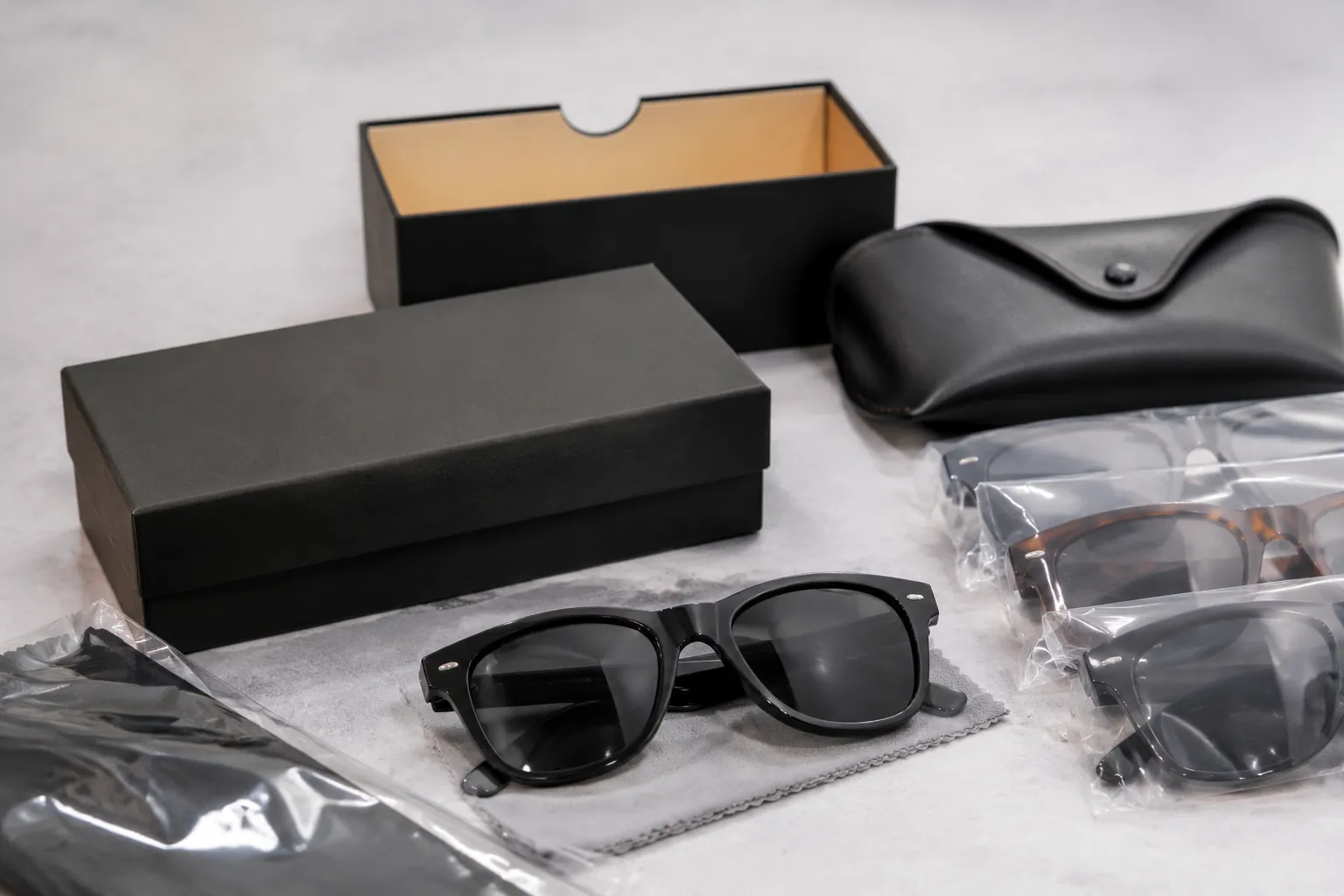
This guide is for importers, distributors, chain retailers, promotional buyers, and eyewear brands that need sunglasses ready for store shelves, 3PL intake, retailer distribution-center receiving, or e-commerce fulfillment. The goal is simple: fewer scan failures, less relabeling, cleaner SKU data, and no need to reopen cartons after shipment. It covers barcode data, label placement, packaging materials, carton marks, compliance wording, and QC checks used for retail-ready custom sunglasses in Wenzhou.
Start With the Receiving Method
Retail-ready sunglasses are not just sunglasses with a branded swing tag. Start with one question: how will the goods be received?
A retailer distribution center, 3PL warehouse, buyer warehouse, direct-to-store shipment, and e-commerce fulfillment center do not need the same setup. Each route uses different data at unit, inner-pack, and master-carton level.
If the order goes to a retailer DC, carton labels, PO matching, ASN data, and routing-guide compliance may matter more than the consumer tag. If the order goes straight to store shelves, barcode position, price stickers, hang-tag strength, and lens sticker behavior matter more. For e-commerce, SKU separation, polybag labels, pick accuracy, and barcode readability usually come first.
A complete retail-ready setup normally includes four layers:
- Unit level: UPC-A or EAN-13 barcode, buyer SKU, product description, price sticker if required, lens category, country of origin where required, and importer or responsible-party details where applicable.
- Branding level: hang tag, temple logo, lens sticker, microfiber pouch print, case logo, printed insert, or metal badge.
- Inner pack: SKU, color, lens type, quantity, pack ratio, and barcode if the warehouse scans inner boxes or polybags.
- Master carton: PO number, carton number, SKU or SKU mix, quantity, gross weight, net weight, carton size, destination, shipping mark, and scannable carton label if required by the buyer or retailer.
These details should be confirmed in the production file before bulk packing starts. Sunglasses may pass through frame production, surface finishing, lens preparation, decoration, assembly, inspection, and final packing. If barcode instructions, price labels, or carton requirements arrive after cartons are sealed, the factory may need to reopen cartons, re-sort SKUs, replace labels, and reseal. That is slow. It is avoidable.
Barcode Types, Size Rules, and Scan Testing
For retail sunglasses, the most common unit barcodes are EAN-13 and UPC-A. EAN-13 is widely used outside North America. UPC-A is common for US and Canadian retail. Code 128 is often used for warehouse, carton, PO, or internal SKU labels because it can encode longer alphanumeric data strings. QR codes are useful for warranty pages, product education, authentication pages, or care instructions. They should not replace the retailer-required POS barcode unless the retailer approves that format.
The factory should not create barcode numbers for the buyer. The buyer or brand should provide the barcode number, barcode type, SKU mapping, and assignment confirmation through GS1, the retailer, or its internal item master system. LumiShades can prepare print-ready barcode artwork, print labels, apply labels, and run scan checks. The buyer controls the number structure and is responsible for avoiding duplicate or wrongly assigned barcodes.
| Barcode type | Best use | Typical size guidance | Main failure risk |
|---|---|---|---|
| EAN-13 | Retail unit labels outside North America | Follow GS1 and retailer size rules; keep quiet zones clear | POS rejection, wrong item match, or duplicate item conflict |
| UPC-A | US and Canada retail programs | Use high-contrast black bars on a white or light matte background | Checkout scan failure or mismatch with retailer item master |
| Code 128 | Warehouse SKU, carton, PO, ASN, or internal labels | Print large enough for the intended scan distance and equipment | 3PL or DC cannot match cartons to receiving data |
| QR code | Warranty, product page, care instructions, authentication | Test on the final printed material, not only on screen | Useful for web links but usually not accepted as the primary POS barcode |
Barcode readability depends on contrast, quiet zones, print resolution, label material, surface flatness, and final placement. Glossy transparent stickers may look premium, but they can reflect scanner light. A barcode wrapped around a curved temple or placed over a fold can distort. For most sunglasses programs, a white matte barcode area on a hang tag, polybag, or box is safer than a tiny barcode printed on the frame.
Test before mass printing. A PDF proof is not enough. Printed samples should be scanned at final size on the final material, using the type of scanner likely to be used at checkout, warehouse receiving, or 3PL intake. If the barcode is resized, laminated, printed on kraft paper, printed on a dark tag, or placed on textured material, test it again before bulk application.
Choose Barcode Placement by Sales Channel
The best barcode location depends on how the sunglasses are sold, stored, and scanned. A hang-tag barcode is convenient for retail checkout. A polybag barcode helps warehouse receiving and e-commerce picking, but it disappears if store staff remove the bag before merchandising. A box label works well for gift-boxed sunglasses. It may not suit open-rack displays.
- Hang-tag sticker: flexible, easy to replace, and suitable for multi-SKU programs, short runs, or price changes.
- Printed hang-tag barcode: clean retail presentation, but it requires final SKU, barcode, price, and retailer data before tag printing.
- Polybag sticker: useful for warehouse receiving, pick-and-pack operations, returns processing, and e-commerce fulfillment.
- Box label: suitable for rigid case sets, gift packs, premium retail boxes, and boxed online inventory.
- Temple sticker: generally not recommended for consumer-facing retail labeling because adhesive can mark coatings and the curved surface can reduce scan reliability.
Material behavior matters. PC and TR90 frames often tolerate removable labels better than rubberized or soft-touch coated frames, but every surface should be checked. Acetate can often be polished during production, but strong adhesive, heat, and pressure can still leave marks. Mirror and gradient lenses need extra care. Lens stickers should use suitable low-tack adhesive and should not be pressed hard near curved lens edges. If a lens sticker says "polarized," the lens must be polarized and should pass the buyer's required polarization check.
During packing approval, check two things. The label must stay attached through handling and transit. It must also remove cleanly if store staff or consumers are expected to remove it. For export cartons, place carton barcode labels away from seams, heavy tape, strapping, and crushed edges so they remain readable after handling and pallet stacking.
Use Packaging Materials That Survive Transit
A hang tag has to look good, scan properly, stay attached, and avoid damaging the product. A stiff tag with sharp corners can rub against a lens during transport. A metal pin can scratch mirror lenses if the sunglasses are packed tightly. A thin paper tag may curl or tear in humid conditions. Small choices create large problems when SKU counts rise.
Common retail-ready components include coated paper hang tags, kraft paper tags, PET or PVC tags, removable price stickers, barcode stickers, UV400 or polarized lens stickers, anti-scratch lens film, microfiber pouches, EVA cases, rigid gift boxes, polybags, inner carton labels, and master carton labels. For many retail orders, a matte barcode sticker or a matte white barcode block on the tag scans more reliably than a small white sticker on a glossy black tag.
| Component | Typical specification | Best use | Production note |
|---|---|---|---|
| Paper hang tag | Commonly 300–400 gsm coated paper | Most retail sunglasses | Good print quality; rounded corners reduce scratching risk |
| Kraft tag | Commonly 300–450 gsm kraft paper | Eco-style or natural branding | Natural color can lower barcode contrast unless a white barcode panel is used |
| PET/PVC tag | Commonly 0.3–0.5 mm sheet | Water-resistant or premium display tags | Durable, but edges should be smooth to protect lenses and coatings |
| Removable sticker | Low- or medium-tack adhesive, selected by surface | Price, SKU, temporary labels, lens information | Test on matte coating, acetate, mirror lenses, and rubberized finishes before bulk use |
| Carton label | Thermal or printed label sized for warehouse scanning | Warehouse receiving, DC intake, 3PL handling | Keep away from carton seams, tape, straps, and high-abrasion areas |
Match packaging to the order. For trial orders or many small SKU splits, digital tags and stickers keep changes manageable. For repeat programs, standardized tags, SKU stickers, and fixed carton label formats reduce handling time. For larger programs, printed hang tags, custom pouches, printed inner labels, and retailer-specific carton labels should be part of the product specification from the start.
Build One SKU File the Factory Can Use
The cleanest retail-ready orders use one master SKU spreadsheet. Not screenshots. Not scattered email notes. Not file names that only one buyer understands. One structured file lets production, packing, and QC inspect against the same source of truth.
Each sellable unit should have a unique SKU if any retail-facing attribute changes: frame color, lens color, lens function, size, packaging set, barcode, price, language, destination market, or compliance wording. Do not use the same SKU for black smoke lenses and black polarized lenses. They may look similar in a carton. They are still different retail items.
A good SKU file should include:
- Buyer PO number, destination, ship-to location, and required ship date.
- Factory model number, custom mold reference, approved sample code, or buyer style number.
- Buyer SKU, retailer SKU if different, and clear product description.
- Barcode number and barcode type, such as UPC-A, EAN-13, or Code 128.
- Frame material: PC, TR90, acetate, stainless steel, aluminum, or combination material.
- Frame color reference: Pantone, painted sample, plated sample, approved photo reference, or physical standard.
- Lens color and function: smoke, brown, gradient, mirror, polarized, photochromic, or standard tint.
- Lens category and compliance text required for the destination market.
- Decoration method: pad print, silk screen, laser engraving, hot stamping, metal logo plate, temple insert, or case/pouch printing.
- Packaging components: pouch, case, box, hang tag, barcode sticker, price sticker, polybag, insert card, inner label, and carton label.
- Pack ratio: for example, pairs per polybag, pairs per inner box, pairs per master carton, or retailer-specified mixed-SKU ratio.
LumiShades uses the SKU file from component preparation through final packing. This reduces handoff errors between frame production, decoration, lens fitting, and packing teams. It also supports inspection. QC can pull samples by SKU and verify the exact frame, lens, barcode, tag, packaging component, and carton mark before shipment.
Control Decoration, Compliance Text, and Claims
Decoration and compliance wording must match the actual product. Logo methods for sunglasses can include pad printing on temples, laser engraving on metal parts, hot stamping on acetate, silk-screen printing on lenses or pouches, metal logo plates, debossing on cases, and printed microfiber cloths. Each method has limits. Pad printing is economical, but adhesion should be checked on coated or rubberized surfaces. Laser engraving is durable on many metal parts and some acetate surfaces, but it may look subtle on dark finishes. Lens printing must be positioned carefully so it does not interfere with vision or conflict with retailer presentation rules.
Compliance claims need strict control. LumiShades works with requirements and buyer documentation related to CE EN ISO 12312-1, ANSI Z80.3, AS/NZS 1067, REACH, FDA registration, ISO 9001, and BSCI. These terms are not interchangeable. EN ISO 12312-1, ANSI Z80.3, and AS/NZS 1067 relate to sunglass performance requirements in specific markets. REACH concerns chemical restrictions for the EU market. FDA registration relates to US regulatory obligations for applicable eyewear products and establishments. ISO 9001 is a quality-management-system standard. BSCI is a social-compliance audit framework. None of these should be printed as a product claim unless the wording is accurate and supported by the relevant documentation.
Do not add unsupported icons or claims because they look reassuring. A mirror coating is not polarization. UV400, polarized, category 3, blue-light, photochromic, impact-related, or driving-use claims must match the tested lens and the target market. If different SKUs use different lenses, the hang tag and lens sticker must not make a blanket claim that only applies to part of the order.
Retail labels may require UV protection information, lens category, warnings or use restrictions where applicable, manufacturer or importer information, country of origin, and local-language text. Some retailers also specify font size, bilingual wording, importer address placement, recycling marks, or exact carton label layout. The factory can print approved wording, but the importer or brand should confirm legal text with its compliance team before production.
Practical rule: approve compliance text before printing hang tags. Reprinting tags is inconvenient. Repacking finished sunglasses because the label claim is wrong is worse.
Inspect Packing Before Cartons Are Sealed
Retail-ready work should be inspected during packing, not only after cartons are sealed. Once cartons are closed and palletized, fixing a wrong price sticker, mixed SKU, or unreadable carton barcode becomes slower and more disruptive.
A typical LumiShades retail-ready packing flow is:
- Approve production sample, including frame color, lens tint, logo position, packaging, and barcode placement.
- Confirm SKU spreadsheet, barcode list, artwork files, carton marks, and retailer routing guide.
- Print or receive hang tags, stickers, inner labels, inserts, and carton labels.
- Scan-test printed barcode samples before full application.
- Assemble sunglasses after frame production, finishing, lens preparation, decoration, and lens fitting.
- Inspect frame finish, hinge function, screw tightness, lens scratches, lens tint consistency, lens function where applicable, and logo position.
- Apply lens stickers, hang tags, barcode stickers, pouches, cases, polybags, and unit packaging by SKU.
- Pack by approved quantity or ratio, then label inner cartons and master cartons.
- Audit carton number, SKU, quantity, PO number, gross weight, net weight, dimensions, destination, and barcode readability before shipment.
For custom sunglasses orders, sampling and bulk production timelines depend on frame type, lens work, decoration method, packaging components, SKU count, and whether all artwork and data are approved on time. Many packaging delays are self-inflicted. If barcode data, price stickers, compliance text, or carton labels arrive late, finished products may sit in the packing area while labels are corrected.
The process depends on traceable data and physical checks. Volume does not forgive messy information. A wrong barcode repeated across multiple cartons is still wrong. A clean-looking carton label is useless if the PO, SKU, or quantity does not match the buyer's receiving file.
Match Cost and Lead Time to Order Size
Retail-ready packaging adds factory-side work, but it can remove larger buyer-side costs: destination relabeling, warehouse handling, rework space, receiving disputes, chargebacks, and mixed inventory. Factory-applied labels are usually more efficient when the buyer provides final data before bulk packing.
The right setup depends on the order structure. For small trial runs, keep packaging flexible and use stickers rather than fully printed SKU-specific tags if price, barcode, or retailer data may change. For repeat orders, standardize hang tags, barcode stickers, polybag labels, and carton labels. For larger programs or many-SKU assortments, lock the SKU file early and treat packaging as part of the product engineering file, not as a late packing task.
| Order type | Recommended setup | Cost logic | Key risk |
|---|---|---|---|
| Trial order or small SKU run | Digital tags, barcode stickers, simple carton marks | Low setup cost and easier last-minute changes | Manual errors if many SKUs are packed together |
| Repeat order with stable data | Standard tag plus SKU, price, and barcode stickers | Better consistency while keeping some flexibility | Barcode ownership and SKU mapping must be confirmed |
| Retail program with fixed item data | Printed hang tags, inner labels, carton scan labels | Packaging setup is justified by repeated use and lower handling time | Artwork or compliance errors affect the full production run |
| Large multi-SKU or retailer-directed program | Full retail pack plan with routing guide, carton data, and inspection checklist | Lowest rework risk when data is locked before packing | Requires controlled SKU file, barcode audit, and carton-level QC |
Best practice: send the SKU file, barcode list, packaging artwork, compliance wording, carton requirements, and retailer routing guide with the purchase order or before sample approval. Retail-ready sunglasses are built on accurate data first. The paper, plastic, ink, labels, and cartons come after.
Have a custom sunglasses project in mind?
Send us your styles, target market and quantities and we will return a detailed quote with MOQ, lead time and a sample plan.
Get a QuoteWhy source this from Wenzhou with LumiShades
Wenzhou in Zhejiang Province is widely regarded as China’s eyewear manufacturing capital, producing a large share of the world’s sunglasses. That concentration matters to buyers: a deep local supply chain for acetate sheet, hinges, lens blanks, plating and packaging means shorter component lead times, easier color and material matching, and a workforce with decades of eyewear-specific skill. LumiShades has manufactured in this ecosystem since 2009, and our vertical integration — in-house injection molding, acetate cutting, CNC milling, lens tinting, decoration and quality control — means no part of your order is quietly subcontracted to a workshop you cannot audit.
For international buyers, that vertical control translates into accountability. When a single factory owns every step, defects are traced and fixed at source rather than bounced between vendors, and your specifications survive intact from first sample to bulk. For procurement review, buyers can request process records, approved samples, quality checkpoints and project-specific compliance files before placing a bulk order. Required testing and documentation are confirmed against the destination market and product specification rather than assumed from a generic certificate list. Explore our manufacturing capabilities and quality control process to see how this works in practice.
Frequently asked questions
Can LumiShades apply retailer-specific UPC or EAN labels before shipment? Yes. Send the final barcode numbers, barcode type, SKU mapping, label artwork, label size, and placement instructions before bulk packing. If the retailer has a routing guide or item-label specification, include it with the PO. LumiShades can print and apply the labels and scan-check printed samples, but the buyer should confirm that each barcode is correctly assigned in GS1, the retailer item master, or the buyer's internal system.
Should we print the barcode on the hang tag or use a sticker? Use a printed barcode when the SKU, barcode number, price, retailer data, and compliance text are final and will not change during the order. Use a sticker when one tag design covers several SKUs, when pricing may change, when retailer data is not locked, or when the order is a trial run. For best scan reliability, place the barcode on a flat matte white or light background and test the final printed label before mass application.
What files should we send for a retail-ready sunglasses order? Send print-ready AI or PDF artwork, a master SKU spreadsheet, barcode numbers and barcode types, product descriptions, pack ratios, packaging instructions, carton mark requirements, PO number, destination, ship-to details, compliance wording, country-of-origin wording, and any retailer routing guide. The SKU file should clearly map each frame color, lens color, lens function, packaging set, barcode, and carton quantity so packing and QC teams inspect against one source of truth.
Can compliance marks such as CE be printed on the hang tag? Yes, but only when the product, documentation, and destination market support the claim. For sunglasses, relevant requirements may include CE EN ISO 12312-1, ANSI Z80.3, AS/NZS 1067, REACH, and FDA registration depending on market and product type. ISO 9001 and BSCI relate to management-system or social-compliance audits, not lens performance. Do not print UV400, polarized, category, impact, or driving-use claims unless they match the tested lens and approved compliance wording.
How early should barcode and packaging data be finalized? Ideally, finalize the SKU file, barcode list, hang-tag artwork, compliance text, price stickers, polybag labels, carton labels, and routing-guide requirements before sample approval. At the latest, approve them before bulk packing starts. Late changes can require relabeling, carton reopening, SKU re-sorting, or replacement carton labels, which can delay shipment and increase handling cost.
Ready to start?
Explore our aviator sunglasses or request a quote — our sales team replies within 12 hours.
Request a Quote