
Recycled PC Sunglass Frames: Approval Checklist
This guide is for brand owners, importers, distributors, and retailers reviewing recycled polycarbonate frame programs for sunglasses. The point is simple: decide whether a recycled PC frame can hold appearance, fit, branding, and compliance at scale. Recycled PC can work well in eyewear. But approval should rest on resin source, process control, cosmetic consistency, dimensional stability, and finished-product testing. A frame described only as "eco-friendly" is not ready for commercial approval.
1) Start with feedstock reality: post-industrial, post-consumer, or blended
Recycled PC is not one uniform material. Many buyer mistakes start here. Recycled content is often treated as a broad claim instead of a controlled input with different risk levels.
The first question is not whether the frame contains recycled polycarbonate. The first question is what kind of recycled polycarbonate is being used, and how tightly that input is controlled.
In commercial eyewear, post-industrial recycled PC is often easier to control than post-consumer material because the source stream is usually narrower and more traceable. It may come from manufacturing scrap that is reground or from an approved industrial recycling stream. Post-consumer recycled PC can also work, but buyers should expect more scrutiny around sorting, contamination control, color consistency, and material history.
Many viable programs use a blend of recycled and virgin PC rather than a 100% recycled formula. That can improve process stability and cosmetic consistency, especially in designs with thin sections, light colors, or demanding surface finishes. That does not mean 100% recycled PC is off the table. It means the percentage should be approved on performance, not on label copy.
Ask for the declared recycled content, the resin source description, and the supplier's lot-control method. If the supplier cannot explain whether the resin is post-industrial, post-consumer, or blended, stop there. Approval is premature.
Because polycarbonate is hygroscopic, moisture control matters too. Poor drying can lead to visual and mechanical defects. The correct drying condition depends on the resin grade and the resin supplier's data sheet, so the buyer should ask the factory to confirm the drying standard used for the approved material.
For approval, request an actual sample frame made from the same resin type and blend intended for production. A color chip, plaque, or generic recycled sample is not enough.
- Request the declared recycled content percentage and any allowed production variance.
- Confirm whether the resin is post-industrial, post-consumer, or a recycled/virgin blend.
- Ask how incoming resin lots are identified, segregated, and controlled.
- Ask the factory to confirm drying and handling practice against the resin supplier's processing guidance.
- Approve the exact material specification before bulk production begins.
2) Cosmetic consistency is usually the first failure point
In recycled PC frame programs, complaints often show up first in cosmetics, not structure. Typical issues include lot-to-lot shade shift, gloss mismatch between front and temples, visible flow lines near thicker sections, and contamination specks in light or transparent colors. These problems usually trace back to feedstock variation, moisture control, contamination, color formulation, or unstable molding conditions.
Color choice matters. Black, dark tort, navy, and other deep opaque shades are generally more forgiving because they hide minor variation. Clear, crystal, white, beige, pastel, and transparent fashion colors are less forgiving and should be approved with more caution. If the line depends on high-clarity translucent effects, ask whether the supplier recommends a lower recycled-content ratio or a different material route for those SKUs.
Cosmetic yield affects cost, timing, and replenishment reliability. A frame may be moldable yet still be a bad commercial choice if it needs heavy sorting, polishing, repainting, or rejection. That is why buyers should review not only prototypes but also a small pilot lot or a production-like sample set.
| Buyer concern | What to inspect | Typical recycled PC risk | Best control method |
|---|---|---|---|
| Color consistency | Approved master sample under consistent lighting | Lot-to-lot shade variation | Lock resin source, color formula, and approval standard |
| Gloss level | Front vs temple sheen on polished and matte surfaces | Uneven gloss or appearance mismatch | Stable molding and finishing conditions, documented surface standard |
| Flow marks | Hinge area, temple roots, thick-to-thin transitions | Visible swirls, weld lines, or stress marks | Correct drying, suitable gate design, controlled molding conditions |
| Contamination | White, clear, and transparent samples under direct light | Black specks, inclusions, haze, or foreign particles | Incoming-lot control, segregation, clean handling, and screening |
Require at least one production-like review, not just hand-picked development samples. A strong prototype confirms design intent. It does not prove repeatable cosmetic output.
3) Molding and finishing controls matter more than the claim
A recycled PC frame can meet basic dimensions and still fail commercially if the surface looks inconsistent or cheap. Buyers should ask how the frame is both molded and finished. Surface texture may come from the mold itself, from polishing, from coatings, or from a mix of processes. Each step affects appearance, scratch visibility, and repeatability.
Recycled material is less forgiving when process discipline is weak. So the supplier should be able to explain how key molding variables are controlled for the approved material and finish. The buyer does not need confidential machine settings. The buyer does need evidence that the process is defined and repeatable.
Matte textures are often more forgiving than high-gloss solids because they reduce the visibility of minor surface variation. Coatings such as soft-touch or decorative sprays may improve shelf appeal, but they add another approval point. If a buyer wants effects such as rubberized touch, mirror paint, or translucent lacquer, adhesion and wear should be checked on the final recycled substrate and finish combination. Do not assume performance from another project.
- Approve a natural molded sample first, before decorative coating where possible.
- Approve the final finished sample second, with the exact color and surface standard.
- Define the cosmetic acceptance standard by viewing condition and defect type.
- Seal a golden sample and reference it in the purchase order and QC criteria.
Do not accept vague language such as "small marks acceptable." Spell out what fails. For example: visible black specks on white frames, visible flow marks on the brow line, left-right gloss mismatch, or coating rub-through after normal handling.
4) Decoration methods are not interchangeable on recycled PC
Branding limits on recycled PC are real. Buyers often assume that any logo method used on acetate or virgin PC will transfer cleanly to recycled polycarbonate. Not always. Adhesion and appearance depend on surface energy, texture, coatings, curvature, and local stress areas around the hinge or temple.
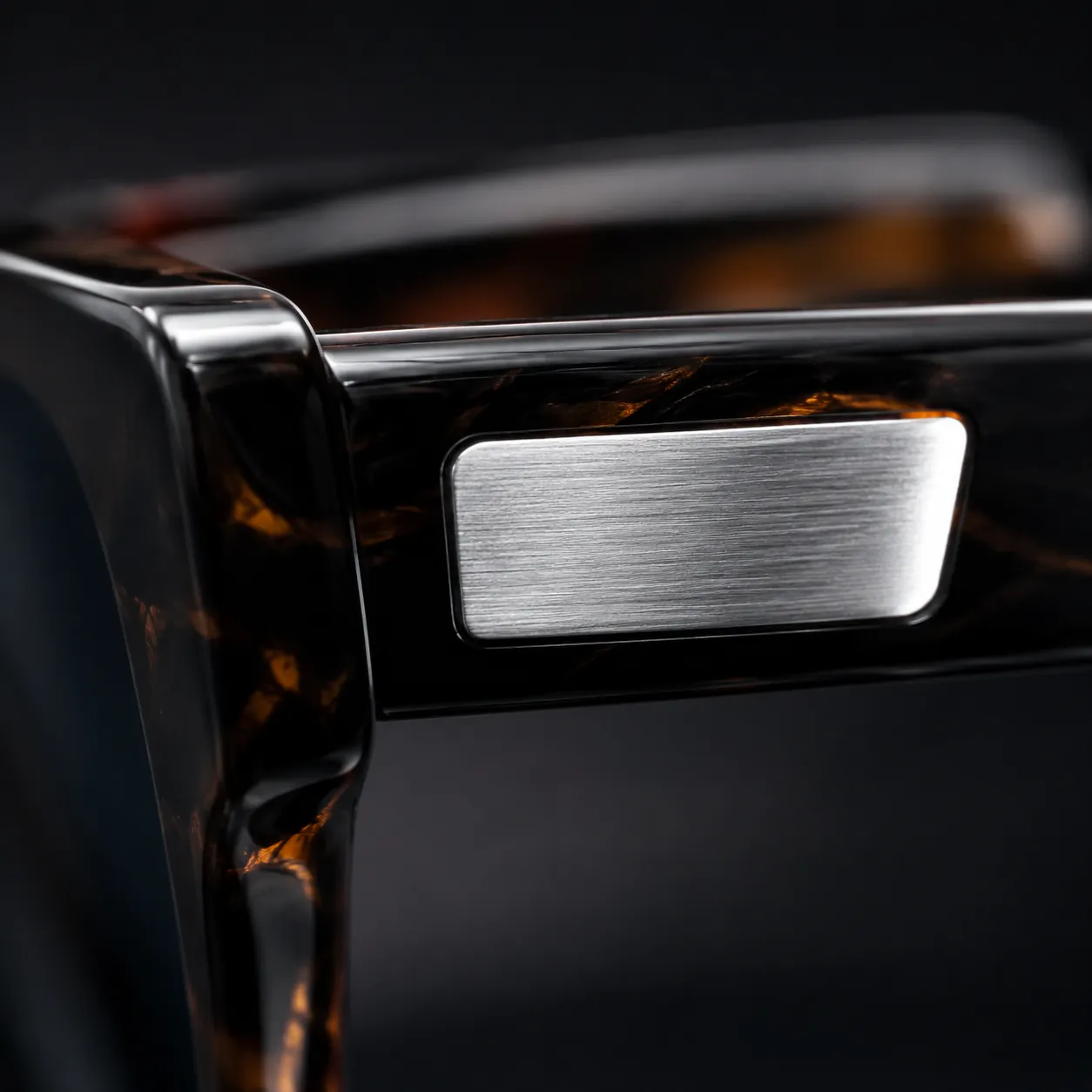
For recycled PC sunglasses, common branding methods include pad printing, laser engraving, and metal logo plates. Each has trade-offs. Pad printing is usually the most flexible and economical for simple logos, but edge definition can soften on textured or coated surfaces. Laser engraving is durable, but contrast may be weak on some dark colors or heavily textured finishes. Metal logo plates can create a more premium look, but they require stable recess dimensions and a reliable fixing method.
Decoration should be judged after handling, packing, and basic abrasion review. That is the real test. The question is not whether the logo looks perfect right after application. The question is whether it still looks acceptable after assembly, packing, shipment, and normal retail handling.
| Decoration method | Best use | Typical MOQ logic | Main risk on recycled PC |
|---|---|---|---|
| Pad printing | Small logos, inside temple branding, lower-cost launches | Usually the lowest setup burden | Edge softness or wear on textured or coated surfaces |
| Laser engraving | Durable branding without ink wear | Useful for repeat artwork and stable material/finish combinations | Low contrast on dark or highly textured surfaces |
| Metal logo plate | Premium shelf appearance | Usually makes more sense when volume justifies extra tooling or labor | Fit tolerance, bonding reliability, and added assembly complexity |
- Pad printing: approve after adhesion and abrasion review on the final finish.
- Laser engraving: confirm legibility at final size, placement, and temple curvature.
- Metal plates: confirm recess fit, fixing method, and post-handling stability.
5) Verify fit stability and dimensions with data
Recycled PC can process well, but buyers should not assume dimensional stability without proof. Small variation can affect hinge alignment, lens seating, temple closure symmetry, and front warpage. If the supplier cannot explain dimensional control with actual measurements, pause approval.
For full-rim sunglass frames, ask for the supplier's internal control points on dimensions such as eye size, bridge, temple length, front curve, and lens groove condition. Exact tolerances may vary by structure, tooling, and lens assembly method, so ask the supplier to define the acceptance standard for the approved style rather than rely on a generic claim.
Lens groove consistency is critical. If groove condition varies, lenses may seat loosely, create insertion stress, or show visible gaps. Hinge alignment and front warpage should also be reviewed across multiple units, not from one selected sample.
Blunt rule: if the supplier cannot show how hinge alignment, lens seating, and warpage are checked across a lot, the recycled-content claim should not persuade you.
Minimum approval package:
- 3 to 5 first-off or pilot samples from the same run, not one selected piece.
- Measurement report for the supplier's defined critical dimensions.
- Photos or video showing front alignment, temple symmetry, and flat-lay stability.
- Lens fit confirmation on assembled units.
6) Compliance is a finished-product issue, not a resin claim
Some buyers hear polycarbonate and assume compliance is covered. It is not. Sunglasses should be reviewed and tested as finished products, especially once recycled content, coatings, inks, metal trims, and lenses are added. The resin family alone does not certify the assembled product.
The certifications and references buyers may need to discuss include CE EN ISO 12312-1, ANSI Z80.3, AS/NZS 1067, REACH, FDA registration, ISO 9001, and BSCI. Use these terms carefully. EN ISO 12312-1, ANSI Z80.3, and AS/NZS 1067 are product-related sunglass standards or requirements. REACH concerns chemical compliance obligations relevant to the market. FDA registration may be requested for certain U.S.-related importer or product categories, but buyers should confirm current applicability with their compliance team or counsel. ISO 9001 and BSCI reflect management-system or social-compliance frameworks; they do not prove that a sunglass style itself passes optical, labeling, or finished-product requirements.
Ask whether compliance review and testing are being carried out on the exact frame-and-lens configuration being purchased, including lens category, logo application, trims, and labeling. A prior report on another style may be useful background. It is not a substitute for checking the actual configuration.
Good practice is to tie compliance review to the final pre-production sample and keep the documentation file with the approved product specification.
7) Use MOQ, price breaks, and timing to structure a low-risk trial
Recycled PC is best approved in stages. Start with a controlled pilot, not a large one-shot commitment. The right pilot size depends on the supplier's MOQ, the frame complexity, the finish sensitivity, and the commercial cost of failure.
When comparing quotes, do not compare headline price alone. Confirm what is included: logo application, lens type, coating, packaging, labeling, testing support, spare rate, and reject handling. A lower nominal price can turn into a higher real cost if the program depends on heavy sorting, rework, or re-approval because cosmetic consistency was never properly validated.
| Order stage | Typical use | Buyer objective | What to confirm before moving up |
|---|---|---|---|
| Pilot lot | Material trial or market test | Check appearance, fit, and logo feasibility | Production-like samples, not showroom-selected pieces |
| Small launch | Initial commercial run | Measure consistency across a modest lot | Sorting rate, logo stability, and packed condition |
| Core SKU validation | Repeatable ongoing style | Confirm economics and process repeatability | QC report, dimensional data, and lot-to-lot stability |
| Volume program | Scaled replenishment | Lock cost and delivery performance | Fixed material spec, golden sample, and production controls |
Before mass production, add one checkpoint that matters more than speed: lot-confirmed pre-production approval. In practical terms, this means the buyer signs off on the actual material specification, final finish, and decoration method for the run before bulk output begins. That step helps prevent later disputes over color shift, surface quality, or logo acceptance.
If the finish is sensitive, especially white, crystal, pastel, soft-touch, or mirror-coated, build extra time into the schedule for review. A short delay is usually cheaper than a disputed shipment or remake.
8) Final approval checklist serious buyers should use
If you want one practical screen before approving a recycled PC sunglass frame program, use this list. If several points are still vague, ask for evidence. Do not fill in the gaps for the supplier.
- Material type confirmed: post-industrial, post-consumer, or blended.
- Declared recycled content percentage defined for the approved product.
- Resin source and color formula locked for bulk production.
- Drying, molding, and contamination-control methods explained by the factory.
- Cosmetic standard approved for color, gloss, flow marks, contamination specks, and surface defects.
- Branding method tested on the final finish, not only on raw substrate.
- Measurement report reviewed for hinge alignment, warpage, and lens fit.
- Compliance plan confirmed for the final assembled sunglasses: CE EN ISO 12312-1, ANSI Z80.3, AS/NZS 1067, REACH, and buyer-specific requirements where applicable.
- Golden sample sealed and referenced in the PO and QC criteria.
- Pilot quantity completed before scaling to a high-volume order.
Recycled PC can be a strong commercial material for sunglasses, especially in darker opaque colors and less fragile finishes. But buyers should treat it as an engineered production program, not a sustainability shortcut. Approve the material. Approve the process. Then approve the frame.
Have a custom sunglasses project in mind?
Send us your styles, target market and quantities and we will return a detailed quote with MOQ, lead time and a sample plan.
Get a QuoteWhy source this from Wenzhou with LumiShades
Wenzhou in Zhejiang Province is widely regarded as China’s eyewear manufacturing capital, producing a large share of the world’s sunglasses. That concentration matters to buyers: a deep local supply chain for acetate sheet, hinges, lens blanks, plating and packaging means shorter component lead times, easier color and material matching, and a workforce with decades of eyewear-specific skill. LumiShades has manufactured in this ecosystem since 2009, and our vertical integration — in-house injection molding, acetate cutting, CNC milling, lens tinting, decoration and quality control — means no part of your order is quietly subcontracted to a workshop you cannot audit.
For international buyers, that vertical control translates into accountability. When a single factory owns every step, defects are traced and fixed at source rather than bounced between vendors, and your specifications survive intact from first sample to bulk. We back this with 15+ years of experience, shipments to 60+ countries, more than 5 million pairs produced per year and a 98.5% on-time delivery rate. Our certifications — CE EN ISO 12312-1, FDA registration, ANSI Z80.3, AS/NZS 1067, REACH, ISO 9001 and BSCI audit — mean the compliance documentation your market requires already exists. Explore our manufacturing capabilities and quality control process to see how this works in practice.
Frequently asked questions
Is recycled PC suitable for premium-looking sunglasses? Yes, but only if the color, finish, and branding method stay within the material's control limits. Dark opaque colors are generally easier to keep consistent than white, crystal, pastel, or highly transparent looks. For a premium program, ask for: 1) a natural molded sample, 2) a finished decorated sample, and 3) a small production-like sample set reviewed under consistent lighting. Approve premium appearance only after you see repeatability, not a single prototype.
Should I insist on 100% recycled PC? Not automatically. The better question is whether the approved formula can deliver the appearance, fit, and consistency your program needs. A blend of recycled and virgin PC may be the more practical choice for demanding colors, thin sections, or premium finishes. Ask the supplier to declare the recycled content percentage, identify the source type, and provide samples made from the exact production formula under review.
What is the biggest risk on a first recycled PC order? The biggest practical risk is inconsistency from lot to lot or run to run. Buyers usually see it first in color shift, gloss mismatch, visible flow marks, or contamination specks. To manage that risk, require a pre-production approval tied to the actual material specification for the run, ask for multiple units from the same lot, and define the cosmetic acceptance standard in writing before bulk production starts.
Can pad printing and metal logos both work on recycled PC temples? Yes, but they need different approval steps. For pad printing, review edge definition, adhesion, and wear on the final coated or textured surface. For metal logo plates, review recess fit, fixing method, and stability after handling and packing. In both cases, approve logos after basic abrasion and shipping-style handling checks, not only when the parts are fresh off the line.
Do recycled PC frames change compliance requirements? They do not replace or remove the normal compliance requirements for sunglasses. The key point is that compliance should be assessed on the final assembled product, not assumed from the resin type. Buyers should confirm the applicable finished-product requirements for their market, which may include CE EN ISO 12312-1, ANSI Z80.3, AS/NZS 1067, REACH, and any buyer-specific labeling or documentation requirements. Ask for documentation that matches the actual frame-and-lens configuration being purchased.
Ready to start?
Explore our aviator sunglasses or request a quote — our sales team replies within 12 hours.
Request a Quote