
Private vs Open Mold Sunglasses: ROI Decision Guide
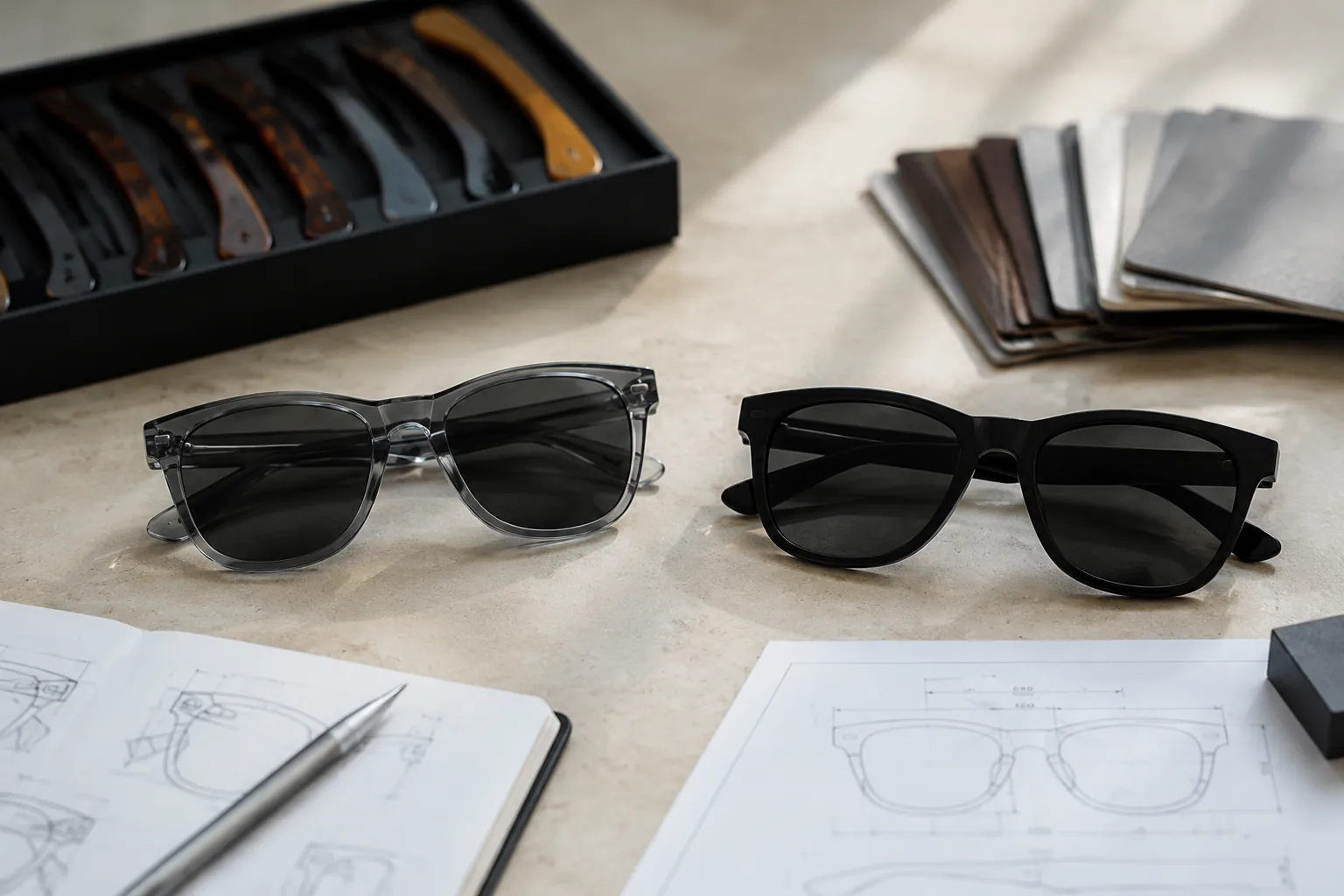
This guide is for buyers sourcing sunglasses at volume for brands, importers, distributors, and retail programs. It shows when open-mold sourcing is the better commercial choice and when private mold can justify higher tooling cost, higher MOQ pressure, and a longer development cycle. The focus is not design vanity. It is speed to market, cash tied up in development, control over fit and exclusivity, and whether repeat demand is strong enough to absorb the extra investment. The process details below follow standard factory development logic for sunglasses, including sample approvals, tolerance control, material limits, decoration constraints, and the commercial conditions that usually drive the mold decision.
Start with the business case, not the sketch
Buyers often treat this as a styling decision. It is not. It is a sourcing and capital-allocation decision first, with design consequences attached.
Open mold lowers upfront commitment, usually shortens launch timing, and lets you test whether a silhouette, price point, and color package will sell before you fund proprietary tooling. Private mold gives you more control over shape, fit, and exclusivity. It also adds non-recoverable development cost, more approval steps, and a higher risk of tying cash to a style before demand is proven.
For a young or fast-moving program, open mold is usually the smarter first move. It shortens the learning cycle. You can compare sell-through by channel, test several colorways, and see whether the frame supports the target retail price. That matters more than owning a unique shape too early.
Private mold starts to make sense when three things happen at the same time. First, reorder probability is high enough to spread tooling cost across multiple runs. Second, shared-market competition is compressing margin because similar frames are easy to source. Third, the design brief includes fit or structural requirements that an existing mold cannot meet without compromise.
Typical examples are small but important: a different bridge geometry for comfort, thicker temples for a heavier hand feel, a revised lens base curve, a tighter lens groove for better retention, or a logo insert that needs a dedicated seat in the temple. In eyewear, small changes can affect fit, perceived quality, and repeat sales. The rule is simple. Do not pay for exclusivity because it sounds premium. Pay for it when the numbers beat a shared mold.
What open mold actually gives you
Open mold does not mean fully generic. It means the base frame tooling already exists, so the supplier is not building the front and temple architecture from zero. That usually cuts development cost and lead time while still leaving room for meaningful customization, depending on the supplier's in-house capabilities and the frame construction.
With a capable supplier, an open-mold program may still include frame color matching, transparent or crystal effects, matte or gloss finishing, polarized or non-polarized lenses, mirror or flash coatings, anti-scratch coatings, laser engraving, pad printing, hot stamping, and metal logo plates where the frame structure allows. On acetate styles, there may also be options to adjust lamination color, edge polishing, visible core wire effects, and some finishing details. On injection styles, material options may include TR90, PC, or other resins, depending on mold compatibility and performance targets.
The main commercial advantage is lower cash exposure. You avoid a separate tooling bill for a new frame shape and reduce the risk of paying for corrections if the first engineering decisions are wrong. You also get a more flexible MOQ structure. That makes open mold useful for trial orders, seasonal assortments, distributor programs, and mixed-SKU testing.
- Best use case: market testing, seasonal drops, chain-retail replenishment, distributor programs, and price-sensitive wholesale channels.
- Main benefit: faster launch with lower upfront cash commitment and fewer engineering approvals.
- Main limitation: the frame shape is not exclusive, even if the color, lens specification, branding, and packaging are customized.
- Typical pricing logic: smaller runs carry more setup cost per unit, while larger runs can improve material utilization, decoration efficiency, and packing efficiency.
- Typical timing logic: because no new frame tooling is required, sample and production planning are usually simpler and more predictable.
For many buyers, that is enough. If your market wins on speed, assortment, and controlled landed cost rather than shape exclusivity, open mold can deliver better ROI for longer than expected.
What private mold changes on the factory floor
Private mold changes more than the quotation. It changes the development path, the number of technical checkpoints, and the level of engineering discipline required before bulk production can run safely.
Once a supplier cuts steel for injection tooling or commits to dedicated tooling, jigs, or fixtures for a proprietary frame, design changes get slower and more expensive. That is the tradeoff. More control, less flexibility.
A typical private-mold path has five stages. First, the buyer confirms a technical brief or drawing covering eye size, bridge width, temple length, lens base curve, target material, hinge type, logo position, and decorative hardware. Second, engineering reviews feasibility, including wall thickness, draft angle, undercuts, parting lines, shrinkage behavior, lens groove dimensions, hinge seat strength, and assembly tolerances. Third, the factory makes trial tooling or production tooling. Fourth, T1 samples are assembled and checked for symmetry, fit, logo position, lens retention, opening force, and cosmetic quality. Fifth, tooling corrections are completed before a final approved sample is locked for mass production.
The technical risk is real. In injection frames, resin shrinkage can shift final dimensions, so tooling may need compensation to hit the intended eye shape and lens fit. Small deviations matter. If the lens groove is too tight or too loose, lens retention suffers. Misalignment at the hinge seat can create uneven opening force. If the wall is too thin near the end piece, screw hold strength can drop or surface defects can show.
Acetate private mold behaves differently, but it is not risk-free. The frame front may be cut and CNC-finished rather than injection-formed, yet process variation still matters. Tumbling and polishing can soften edges and slightly change final dimensions. Hand finishing can improve feel and appearance, but weak process control can also introduce left-right inconsistency. Good factories measure key dimensions after finishing, not just after initial cutting.
That is where private mold earns its keep. It gives you control over bridge pressure, temple wrap, end-piece alignment, logo hardware placement, and visual proportion in ways an open mold rarely can. But control only matters if the style repeats often enough to pay back the extra work.
Cost, MOQ, lead time, and control side by side
The right choice depends more on order pattern than on headline unit cost. Compare four things together: upfront investment, per-unit economics over time, development timing, and the commercial risk of sharing a common frame shape.
| Factor | Open Mold | Private Mold |
|---|---|---|
| Upfront investment | Low; usually no new frame tooling, mainly sampling and decoration cost | Higher; tooling, engineering review, trial samples, and possible correction cost before bulk |
| MOQ logic | Usually easier for small test orders and mixed SKUs | Usually requires stronger volume confidence because tooling cost must be absorbed across future orders |
| Sample timing | Often faster when changes are limited to color, lens tint, or branding | Usually longer because T1/T2 samples and tooling corrections may be required |
| Bulk timing | Usually shorter on standard programs because no new frame tooling is involved | Longer on the first run due to tooling completion, validation, and final sample approval |
| Design control | Limited to the existing architecture of the frame | High; geometry, fit, branding hardware, and structure can be built around your brief |
| Margin protection | Weaker if similar frames are widely available from multiple suppliers | Stronger if the style becomes a repeat seller and exclusivity supports price discipline |
| Tolerance flexibility | Lower; you work within dimensions already proven by the shared mold | Higher; critical points can be engineered around your target tolerances |
Volume changes the math. A fragmented order spread across too many proprietary SKUs often performs badly because the buyer carries development cost without enough repeat volume to improve per-unit cost in a meaningful way. By contrast, if a style is likely to reorder over multiple seasons, or if the same core frame can run in several colorways for different markets, private mold starts to amortize properly.
So ask the blunt question: will repeat volume be strong enough for the margin benefit from exclusivity to outweigh the tooling burden, slower approvals, and longer cash cycle? If the answer is not clear, stay with open mold.
When to move from open mold to private mold
There is no universal unit threshold. The right timing depends on margin structure, retail price, SKU discipline, reorder visibility, and how much value exclusivity adds in your channel. Still, the shift usually becomes clear before the spreadsheets do.
- Repeat demand is visible: you have already reordered the same look, or a closely related shape, and expect further runs.
- Shared competition is hurting margin: comparable frames are easy for competitors to source, which makes price defense harder.
- Open-mold fit is inadequate: available bridges, eye sizes, or temple geometry do not suit the target wearer profile.
- Your channel supports a premium: the retail story can justify better fit, stronger exclusivity, or more distinctive hardware details.
- Your SKU count is becoming disciplined: you are narrowing into proven winners instead of spreading budget across too many experiments.
For many brands, the cleanest transition comes after one or two successful open-mold seasons. By then, you know which silhouette sells, which lens colors move, which color families reorder, and whether customers accept the planned retail price. Now the development brief gets sharper. That matters.
Instead of asking the supplier to create something vague, you can specify the exact change: increase temple thickness for a heavier hand feel, reduce bridge pressure, create a cleaner seat for a metal logo plate, or adjust the lens opening to improve retention stability. Specific briefs waste less time and produce better first samples.
Compliance, materials, and decoration can change the decision
Compliance is part of the mold decision. It is not a separate box to tick later. A frame may look commercially right and still fail if lens category, impact-related requirements, chemical restrictions, or labeling obligations are not defined early.
Buyers should align the destination market, lens specification, and document scope before approving either open-mold production or private-mold tooling. Common requirements in the sunglasses trade include CE EN ISO 12312-1 for the EU market, ANSI Z80.3 for the US market, AS/NZS 1067 for Australia and New Zealand, REACH for chemical restrictions relevant to the EU supply chain, FDA registration where applicable to the supplier and US market process, plus management and social compliance standards such as ISO 9001 and BSCI. These standards do not apply in the same way to every product or every claim. Buyers need to confirm exactly which test reports, declarations, and records are required for each SKU and destination.
Material choice also affects risk. PC lenses are common for clarity and cost efficiency. TAC polarized lenses add glare reduction but also add layered construction. Nylon lenses may suit higher-performance applications. Coatings such as mirror, flash, hydrophobic, or hard-coat layers affect durability expectations and test planning. On frames, TR90 is often chosen for flexibility and low weight, PC is common in lower-cost injection styles, and acetate supports a more premium visual finish but usually brings more manual finishing variation.
Decoration method matters too. Pad printing is economical and fast, but it may wear differently from laser engraving or inset metal plates. Hot stamping can suit some surfaces. Raised or recessed logo hardware needs accurate seat dimensions to avoid crooked placement, weak adhesion, or assembly variation. Painted details and soft-touch coatings can improve shelf appeal, but they may also create extra abrasion or chemical-resistance concerns depending on the market.
Ask concrete questions early:
- Lens category: what visible light transmittance range is required for the destination market and intended use?
- Material safety: do frame materials, coatings, metal trims, inks, and packaging components align with the required chemical restrictions?
- Decoration durability: will the selected logo method hold up under the handling, sweat, and rub conditions expected in the market?
- Documentation: what test reports, declarations, labeling files, and traceability records will be provided for each SKU and market?
Open mold can reduce risk when the same construction has already been produced many times. Private mold can increase workload because a new structure or hardware concept may need fresh validation. Either way, settle compliance assumptions before production is booked.
How to reduce tooling risk before approving steel
Most expensive private-mold mistakes are small. That is why they are dangerous. They get repeated across every future production run.
Control the risk before steel is cut, not after a first sample fails. Use a pre-tooling checklist with measurable points. Confirm eye size, bridge width, temple length, front curve, base curve, hinge specification, material grade, logo method, and lens retention approach. For injection styles, ask how the supplier is accounting for resin shrinkage, wall-thickness balance, and tolerance control at the hinge seat and lens groove. For acetate, ask how CNC shaping, tumbling, polishing, and hand finishing may influence final dimensions and edge definition.
Good process control means more than a nice render. The supplier should be able to measure critical dimensions at multiple stages and connect engineering feedback to production correction. That matters when a T1 sample reveals practical issues such as loose lens fit, left-right temple imbalance, logo plate drift, over-polished edges, or weak screw hold at the hinge.
Insist on a physical sample review with measured dimensions and wear-check comments before approving final tooling or mass production. In eyewear, a render can look correct while the assembled product opens too tightly, pinches at the bridge, or shows asymmetry in hand. Slow down here if needed. It is cheaper than carrying avoidable defects into bulk.
The working rule is straightforward. Choose open mold when you are testing a new category, launching small mixed volumes, or getting enough differentiation from color, tint, and logo alone. Move to private mold after a style proves repeat demand, when fit or geometry requirements exceed existing options, or when margin loss from shared designs is greater than the added development cost. Many strong programs stay hybrid: open mold for faster commercial volume, private mold for the few frames that define the brand and show the best reorder potential.
Have a custom sunglasses project in mind?
Send us your styles, target market and quantities and we will return a detailed quote with MOQ, lead time and a sample plan.
Get a QuoteWhy source this from Wenzhou with LumiShades
Wenzhou in Zhejiang Province is widely regarded as China’s eyewear manufacturing capital, producing a large share of the world’s sunglasses. That concentration matters to buyers: a deep local supply chain for acetate sheet, hinges, lens blanks, plating and packaging means shorter component lead times, easier color and material matching, and a workforce with decades of eyewear-specific skill. LumiShades has manufactured in this ecosystem since 2009, and our vertical integration — in-house injection molding, acetate cutting, CNC milling, lens tinting, decoration and quality control — means no part of your order is quietly subcontracted to a workshop you cannot audit.
For international buyers, that vertical control translates into accountability. When a single factory owns every step, defects are traced and fixed at source rather than bounced between vendors, and your specifications survive intact from first sample to bulk. For procurement review, buyers can request process records, approved samples, quality checkpoints and project-specific compliance files before placing a bulk order. Required testing and documentation are confirmed against the destination market and product specification rather than assumed from a generic certificate list. Explore our manufacturing capabilities and quality control process to see how this works in practice.
Frequently asked questions
What is the minimum order if I want to test an open-mold sunglasses design first? MOQ depends on the supplier, frame construction, lens specification, and decoration method, so confirm the MOQ per SKU in writing before sampling. For a useful test order, ask four things together: the MOQ by colorway, whether polarized and non-polarized lenses have different minimums, whether packaging customization changes the MOQ, and how reorders are priced if the test performs well. That gives you a real commercial comparison instead of a headline MOQ that hides the details.
How much faster is open mold than private mold? Open mold is usually faster because the base frame tooling already exists. The real timing difference comes from the number of engineering loops. Open mold may only need cosmetic sample approval, while private mold may require technical drawing review, tooling, T1 sample evaluation, corrections, and final approval before bulk starts. Ask the supplier for a stage-by-stage timeline covering sampling, approvals, tooling corrections if needed, and bulk production. Do not plan a launch around one quoted lead time.
Can I still customize branding on an open-mold frame? Yes, often you can. Common options include laser engraving, pad printing, hot stamping, and metal logo plates, but the right method depends on the frame material and structure. Ask for photos or retained samples showing the exact branding method on a similar frame, confirm logo position tolerances, and ask how the decoration performs under handling and rub conditions. Also confirm whether branding is done in-house or outsourced, because that can affect consistency and lead time.
When does private mold usually pay off? Private mold usually pays off when the same frame is likely to repeat across multiple orders, seasons, or markets, and when exclusivity protects margin enough to offset tooling cost and slower development. A practical way to test this is to estimate the style's lifetime volume, compare that volume with the added tooling and approval cost, and then ask whether the proprietary design improves sell-through, price discipline, or fit enough to recover the difference. If demand is still uncertain, open mold is usually the safer first step.
Does a private mold automatically make compliance easier? No. A private mold gives you more control over structure and fit, but a new design may require more validation, not less. Confirm which standards apply to the target market, whether the lens category and materials support the intended claim, and what evidence the supplier will provide for each SKU. At minimum, ask for the planned compliance path for standards such as CE EN ISO 12312-1, ANSI Z80.3, AS/NZS 1067, REACH, and any relevant FDA registration documentation, and align those requirements before tooling approval and bulk booking.
Ready to start?
Explore our rimless sunglasses or request a quote — our sales team replies within 12 hours.
Request a Quote