
Private-Label Sunglasses Branding That Sells
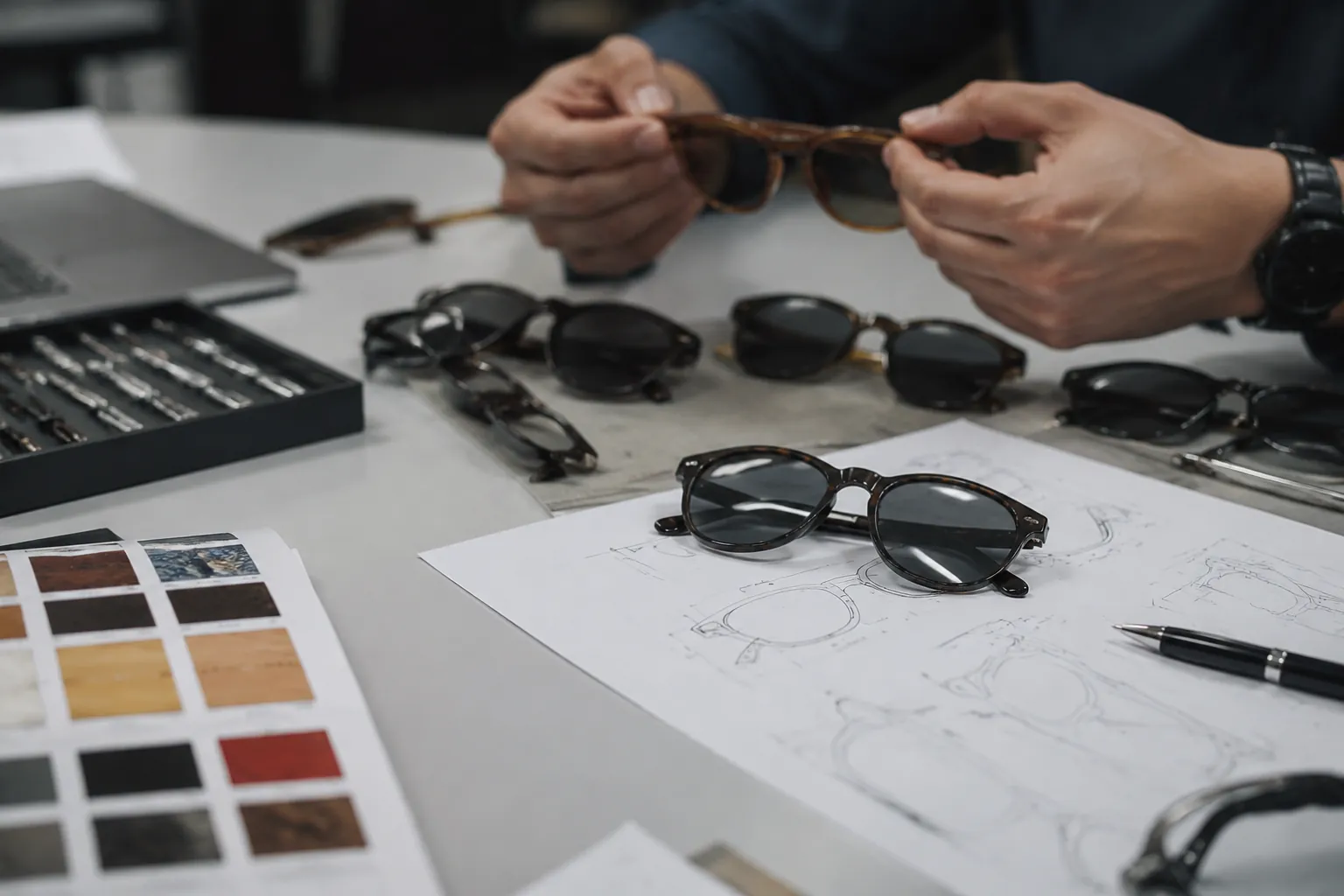
This guide is for brand owners, importers, distributors, and retailers sourcing custom sunglasses in volume. It focuses on the branding choices that most affect sell-through: what shoppers notice first, what makes a frame look coordinated instead of accidental, and how to structure customization at 50, 300, 1000, or 5000+ pairs per design. The goal is to lock the right details in the right order, reduce sample loops, and avoid late revisions that add cost, extend lead times, or weaken the retail presentation.
Start with the brand details shoppers see first
Most private-label sunglasses do not fail because the frame shape is wrong. They miss because the visible branding looks inconsistent. In store, or on first unboxing, shoppers read a product in seconds. The usual order is simple: silhouette first, temple branding second, lens tint third, packaging last. If those signals do not point to the same price band, the frame loses trust fast.
Start with the high-visibility pieces. Then move to the details that depend on them. That matters in production too. Each branding choice can affect tooling, assembly, yield, and QC. A recessed logo plate may need a thicker temple wall. A crystal frame can expose glue lines that black frames hide. A shiny gold hinge can look right on warm tortoise and wrong on a cool smoke lens.
Work from a clear brief before asking for sample work. Define the target customer, the retail channel, the price band, and the frame family. Then choose the primary logo location, the secondary branding point, the approved color family, the hardware finish, and the packaging format. If those decisions are made in sequence, the factory can build one coherent sample instead of a pile of disconnected options.
- Lock the frame family, target customer, and retail price band.
- Choose one primary logo position and one supporting branding point.
- Approve frame color and lens tint together under the same light.
- Select hardware finish after color approval, not before.
- Build packaging around the channel: e-commerce, retail, gift, or promo.
Late branding changes can trigger new artwork, plating, packaging, or labeling checks. Even a small revision after sample approval can add time and cost if it touches tooling or pre-production materials. That is why sequence matters. Early decisions do the heavy lifting. Add-ons do not.
Logo placement: pick one hero spot and match the method
Too many private-label programs put the logo everywhere: outer temple, inner temple, lens corner, pouch, cloth, box, hangtag. The result is usually visual noise. Stronger programs pick one hero branding spot, make it readable at normal viewing distance, and let secondary branding support packaging or traceability.
The outer temple is the fastest brand read. It shows when the frame is folded, side-displayed, or worn. On many adult sunglasses, a logo area around the mid-temple works well, but the exact placement should follow temple height, curvature, and the mark itself. If the logo is not clear at arm's length on the sample, shrinking it more will not make it look premium. It will just disappear.
The method should follow material and MOQ. For injected plastic at lower MOQs such as 50 to 300 pairs per design, pad printing is common because setup is simple, color control is manageable, and sampling is fast. For acetate, laser engraving with paint fill can look cleaner and last longer. Fitted metal logo plates create a more premium result once volume justifies the extra assembly. Molded-in logos can work, but they make more sense when tooling cost is spread across larger runs.
Placement should also reflect how the frame is worn and merchandised. A logo on the outer temple reads clearly in hand, on shelf, and in social photos. A logo on the inner temple is useful for model control and traceability, but it is rarely the strongest sales signal. Lens corner marks can help with fashion drops or launch collections, yet they should stay small enough not to disturb the optical field or the overall clean look of the lens.
| Logo method | Best use case | Typical MOQ logic | Main risk |
|---|---|---|---|
| Pad printing | Injected frames, fast programs, simple one- or two-color logos | Efficient from about 50 pairs per design | Wear or edge softness if surface prep is poor |
| Laser engraving with paint fill | Acetate temples needing a clean, premium mark | Usually practical from about 100-300 pairs | Fill inconsistency if groove depth is not controlled |
| Metal logo plate | Mid- to premium-positioned collections | Better value from about 300-1000 pairs upward | Extra assembly time, alignment and scratch risk |
| Molded-in logo | Long-run programs with stable branding | Most viable when tooling cost spreads over high volume | High revision cost if artwork changes later |
- Best hero position: outer temple, clearly visible when folded or displayed side-on.
- Best secondary branding: case or pouch for recall after purchase.
- Use lens marks selectively: useful for fashion drops, less useful for durable everyday programs.
- Keep inner temple functional: reserve it for model, size, origin, and compliance marking.
Lens branding can work for trend-led launches, but use it carefully. A small printed lens corner mark may help first-glance recognition. It adds less to long-term recall once the frame is worn. Inner temple printing is operationally necessary, but it rarely drives sell-through. The rule is simple: one strong logo location usually beats several weak ones.
For a first order, ask for the logo applied on the actual production material, not just on a dummy sample. A mark that looks sharp on paper may blur on curved plastic, scratch on polished acetate, or distort near a hinge. Confirm the logo size, stroke thickness, and exact distance from the hinge before the factory books production.
Color matching is where cheap-looking products start
Color mismatch is one of the fastest ways to make a product look unplanned. A warm beige front, a cooler beige temple, a logo ink that skews yellow, and a smoke lens that reads green under store lighting can make a good mold feel off spec. Approve color as a system: front, temples, lenses, logo treatment, and packaging accents together.
Material behavior matters. Injected plastic color can shift with resin base, pigment load, mold temperature, and surface texture. A matte finish often reads lighter than a polished surface made from the same pigment formula. Acetate behaves differently again. Transparency, pattern flow, and lamination variation are normal from sheet to sheet. That is why acetate approvals should use an acceptable range, not an exact screenshot match.
The safest approval path is a signed physical sample checked under daylight-equivalent lighting. Screen approvals are risky. Monitor calibration, ambient light, and photo exposure all distort tone. For translucent or crystal frames, inspect the assembled product, not loose parts, because glue lines, wire-core visibility, and internal reflections change the look. For lenses, approve tint density and base tone together. A lens can hit the darkness target and still read too brown, green, or gray on shelf.
Color control should also cover the secondary details people notice only after the first glance: logo ink, inner temple print, hardware tone, pouch fabric, microfiber cloth, and box board. If those items are left to chance, the order can still look mismatched even when the frame itself is accurate.
| Branding choice | What to approve | Main risk | Practical control |
|---|---|---|---|
| Opaque injected frame | Master sample plus color reference | Front and temple parts shift between lots | Check first articles from the same production batch |
| Crystal or translucent frame | Assembled sample under strong neutral light | Flow marks, glue visibility, internal color inconsistency | Inspect finished frame, not loose parts only |
| Acetate pattern | Range approval rather than exact image match | Sheet pattern placement varies naturally | Define acceptable variation before cutting |
| Lens tint | Density and base color together | Store lighting shifts gray toward green or brown | Review in a daylight-equivalent light box |
If your brand uses a signature color, say so before tooling and material booking. Early sample rounds are the time to tune pigment, plating tone, and print ink. After bulk materials are reserved, small color changes get slower and more expensive.
Do not approve by file name alone. Request the physical color chip, the resin batch if available, and the lighting condition used for approval. If the supplier cannot state the light source or the sample source, the approval is incomplete.
Hardware finish sets the price signal fast
Customers may not understand hinge barrel count or wire-core construction, but they read hardware finish quickly. Bright yellow gold, pale champagne, brushed silver, matte gunmetal, and dark nickel each suggest a different market position. Do not choose hardware in isolation. Match it to frame tone, logo treatment, and target retail price.
On a black or deep tortoise frame, shiny light gold can look appropriate when the logo plate is small, crisp, and centered. The same finish can look cheap if the logo is oversized or if plating quality is uneven across the hinge, core, and decorative parts. Matte dark nickel and brushed gunmetal are often safer on unisex or sport-casual styles because they hide fingerprints and small variation better than mirror-bright finishes.
Finish choice also affects yield. Bright mirror plating shows scratches, edge marks, and handling damage sooner during assembly and packing. Brushed or matte finishes are more forgiving and often produce fewer rejects. That matters most near lower MOQs, where rework cost spreads over fewer units. On a 50-pair trial run, one bad finish decision hurts far more than it does on a 5000-pair order.
The goal is not to pick the most expensive look. The goal is to choose a finish that reads consistent across hinge, logo plate, rivet, and exposed core wire. Mixed finishes can work, but only when the contrast is intentional and tested on a full sample, not on a metal swatch card.
- Safer commercial finishes: matte dark nickel, brushed silver, brushed gunmetal.
- Higher visual impact but tighter control needs: bright gold, rose gold, mirror silver.
- Match visible metal together: hinge, logo plate, rivet, and exposed core should read as one family.
- Approve finish after color: hardware that looks right on a rendering may clash on the actual sample.
Evaluate hardware next to the final frame and lens combination, not as a separate swatch. Finish is not a small detail. It is one of the fastest price signals the customer reads.
If the collection has multiple SKUs, standardize the metal family where possible. A single plating tone across related styles cuts confusion in the line sheet, simplifies spare parts planning, and reduces the risk of mismatch between top sample and bulk run.
Packaging should fit the channel and the cost
Packaging is not just branding. It is freight, damage prevention, storage efficiency, and perceived value. The right packaging for e-commerce is different from the right packaging for resort retail, optical counters, chain-store display, or promotional giveaways. Define the channel early. Packaging affects unit cost, carton dimensions, and approval complexity.
Soft microfiber pouches are usually the lowest-risk branded packaging touch. They add visible identity at relatively low cost, work well at smaller MOQs, and avoid large freight penalties. Folding cases reduce shipping volume compared with rigid shells but need structure checks so they do not collapse or mark the lenses in transit. Rigid cases can raise perceived value, but they add material cost and carton space quickly. On price-sensitive programs, a heavy case can erase savings from efficient frame production.
Packaging also changes depending on whether the customer sees the case first or the sunglasses first. In e-commerce, the first visible branded surface may be the mailer insert, pouch, or box label. In display retail, the frame often carries the sale, so oversized packaging decoration may do little. Packaging should support the selling path. It should not just copy a factory catalog option.
Packaging design should also include practical details that affect fulfillment. Barcodes need a flat, scannable surface. Insert cards should not block the frame shape. Box dimensions should fit pallet and carton planning. If a package looks good but wastes cube space, it can damage the landed cost even when the unit price looks acceptable.
- E-commerce: prioritize scratch protection, barcode area, and efficient mailer fit.
- Retail display: prioritize front-facing consistency and easy shelf replenishment.
- Gift or premium sets: coordinate case finish, cloth print, insert card, and carton tone carefully.
- Promotional programs: keep packaging simple and put more budget into visible frame branding.
Use this test: if upgraded packaging adds more cost than the customer will notice at the point of sale, spend the money on temple branding, better finish coordination, or cleaner color control.
Do not approve packaging from a supplier catalog without checking freight impact. A case that adds only a small amount of material cost can still add major expense if it forces larger cartons, less efficient pallet loading, or higher damage rates during shipping.
Use MOQ and lead time to decide how much to customize
Not every branding choice makes sense at every order size. Match customization depth to volume, margin, and launch speed. At 50 pairs per design, the best return usually comes from low-risk options: stock colors, pad printing, standard lenses, simple pouch branding, and existing packaging formats. At 300 pairs, more precise color matching, selective hardware upgrades, and better packaging print start to make sense. At 1000 pairs and above, custom logo plates, coordinated hardware families, and broader packaging systems become easier to justify because setup costs spread across more units.
This is where many importers lose margin. They ask for high-complexity branding on a low-volume trial order, then act surprised by cost, lead time, or sampling delays. A staged program works better. Validate the frame and sell-through first. Then scale into deeper customization after reorder confidence improves.
The right customization level also depends on how many variants sit inside the same order. One color with one logo is much easier to control than three colors, two lens tints, and two packaging versions. Variety increases the chance that a sample looks right but the bulk run shifts across versions. Keep the first run narrow unless there is a strong channel reason to widen it.
| Order level | Branding options that usually make sense | Cost effect | Lead-time effect |
|---|---|---|---|
| 50 pairs per design | Pad print logo, stock colors, simple pouch or box label | Higher unit cost, low setup commitment | Fastest approval path |
| 300 pairs per design | Refined color matching, upgraded packaging print, selective metal detail | Better unit economics | Moderate sample complexity |
| 1000 pairs per design | Custom hardware finish, logo plate, coordinated packaging set | Stronger cost efficiency per unit | More pre-production checks required |
| 5000+ pairs per design | Full branding system across frame, hardware, lenses, and packaging | Can improve efficiency through setup amortization | Requires disciplined scheduling and locked approvals |
Sample lead time often runs one to two weeks for straightforward programs. Bulk production commonly takes several weeks after approval, depending on specification, volume, and factory schedule. Those timelines hold only when branding decisions are locked in order. A late logo move, packaging revision, or metal finish change often resets approvals and pushes booking back. Complexity is fine. Complexity without volume support usually is not.
If the launch date is fixed, protect it by reducing custom elements before it is protected by faster factory promises. The cheapest way to stay on schedule is to remove avoidable variation before the order is placed.
Branding still has to pass compliance and production reality
Branding decisions cannot override compliance, labeling, or optical performance. Sunglasses sold into regulated markets still need to align with the standards and documentation path for the destination region. Depending on the program, that may include CE EN ISO 12312-1, ANSI Z80.3, AS/NZS 1067, REACH, and FDA registration or related documentation. The point is not only passing testing. It is making sure the approved branding details do not conflict with the approved spec.
A fashion-driven dark tint still has to fit the intended use category and final test result. A printed lens mark should not intrude into the optical zone. Inner temple text must remain legible after handling, cleaning, and packing. If one SKU goes to multiple countries, define at sample stage what stays on the frame, what can move to packaging, and what belongs only in inserts or paperwork. Waiting until after color and artwork approval creates expensive loops.
The cleanest approval package puts all commercial and technical inputs together, not scattered across email threads. Include vector artwork, placement notes, color standards, finish callouts, packaging map, destination market, and target launch date in one decision set. If the supplier also needs factory qualification criteria, align those early with the procurement plan and compliance brief.
Compliance should also be checked against the final decoration plan. A logo that covers too much temple area can interfere with required markings. A lens mark can create issues if it sits where an optical standard expects clear viewing area. A packaging claim can also create trouble if it suggests a performance level that the product does not actually meet. These problems are avoidable if product, packaging, and claims are reviewed together.
- Artwork file: vector logo with exact size and placement notes.
- Color standard: approved physical frame and lens reference.
- Finish callout: matte, brushed, or shiny with metal tone defined.
- Packaging map: pouch, case, cloth, label, box, and carton requirements.
- Compliance brief: destination market, standards, and required claims or markings.
- Commercial target: MOQ, target cost, and ship date.
Fast private-label programs are not the ones with the most ideas. They are the ones with the clearest approval structure. If the supplier gets a complete decision package, sampling moves faster and bulk planning is more reliable. If gaps stay open, the factory fills them with assumptions. That is where avoidable sample loops and sell-through problems begin.
Build a repeatable approval process before the first order
The best private-label programs are not built on intuition alone. They are built on a repeatable approval process that keeps branding, color, compliance, and packaging aligned from sample to bulk. The process should make it easy to say yes to the right details and easy to spot problems before production starts.
A practical workflow is to review the master sample, confirm the exact logo method, lock color against a physical reference, approve the final hardware finish, and then sign off the packaging set and markings together. If the supplier works under a formal quality system, ask how the order will be controlled through production. An ISO 9001-aligned process can help structure documentation and change control, while BSCI may matter if your sourcing program needs social compliance visibility. These are management signals. They do not replace product testing.
What matters most is consistency. A frame that looks good alone can still fail as a retail package if the logo, lens, hardware, and carton do not read as one brand story. The buyer's job is to remove uncertainty before bulk starts, not after goods are already in the line.
Use a written approval checklist and do not close the order until every item is signed off. The checklist should include the frame sample, logo artwork, placement drawing, color reference, finish sample, packaging artwork, labeling text, carton marks, and destination-market compliance notes. If one item is missing, the order is not ready.
- Approve one master sample: use it as the reference for appearance and placement.
- Freeze the artwork set: logo, size, position, and print method.
- Freeze the color set: frame, lens, ink, and packaging tone.
- Freeze the marking plan: compliance text, origin, and model details.
- Freeze the channel fit: e-commerce, retail, gift, or promotion.
Good branding is not decoration after the fact. It is part of product engineering, sourcing, and sell-through planning. When those pieces move together, private-label sunglasses look intentional, price correctly, and are easier to reorder.
If the line is expected to repeat, save the approved sample set, the artwork files, the color references, and the production notes in one place. The next order should not depend on memory or old email threads.
Have a custom sunglasses project in mind?
Send us your styles, target market and quantities and we will return a detailed quote with MOQ, lead time and a sample plan.
Get a QuoteWhy source this from Wenzhou with LumiShades
Wenzhou in Zhejiang Province is widely regarded as China’s eyewear manufacturing capital, producing a large share of the world’s sunglasses. That concentration matters to buyers: a deep local supply chain for acetate sheet, hinges, lens blanks, plating and packaging means shorter component lead times, easier color and material matching, and a workforce with decades of eyewear-specific skill. LumiShades has manufactured in this ecosystem since 2009, and our vertical integration — in-house injection molding, acetate cutting, CNC milling, lens tinting, decoration and quality control — means no part of your order is quietly subcontracted to a workshop you cannot audit.
For international buyers, that vertical control translates into accountability. When a single factory owns every step, defects are traced and fixed at source rather than bounced between vendors, and your specifications survive intact from first sample to bulk. For procurement review, buyers can request process records, approved samples, quality checkpoints and project-specific compliance files before placing a bulk order. Required testing and documentation are confirmed against the destination market and product specification rather than assumed from a generic certificate list. Explore our manufacturing capabilities and quality control process to see how this works in practice.
Frequently asked questions
What is the safest logo method for a first order of 50 pairs per design? Pad printing on the outer temple is usually the safest starting point. It keeps setup cost lower, works on many injected-frame surfaces, and is easier to revise than custom metal plates or molded-in logos. For the first order, ask the supplier to confirm print size, placement, color, and curing method on a physical sample before bulk approval.
How should I approve color for acetate or translucent frames? Use a signed physical sample under daylight-equivalent lighting and compare it against a clear reference. For acetate, approve an acceptable variation range because sheet pattern and depth naturally vary. For translucent frames, approve the assembled product, not just loose parts, because glue lines and internal reflections affect the final look.
Does custom packaging make sense on small MOQs? Yes, but keep it simple. At low MOQs, branded pouches, labels, insert cards, or standard cartons usually make more sense than fully custom rigid packaging. Start with the packaging that protects the product and supports the channel, then add higher-cost elements only if the retail price can absorb them.
When do custom hardware finishes become commercially sensible? They usually make more sense once the order size can absorb setup, plating, and inspection effort. For many programs, that starts around a few hundred pairs per design and becomes more efficient as volume rises. The right decision depends on the frame price, finish complexity, and how visible the metal parts are on the final product.
What compliance points should I confirm before final sample approval? Confirm the destination market, the required standard or documentation path, the intended use category, and exactly where each marking will appear. Depending on the market, that may include CE EN ISO 12312-1, ANSI Z80.3, AS/NZS 1067, REACH, or FDA registration-related requirements. Also confirm that logo placement, lens marking, and temple text do not interfere with the approved product specification.
Ready to start?
Explore our cat-eye sunglasses or request a quote — our sales team replies within 12 hours.
Request a Quote