
Private Label Sunglasses MOQ: Split Styles, Colors, Packaging
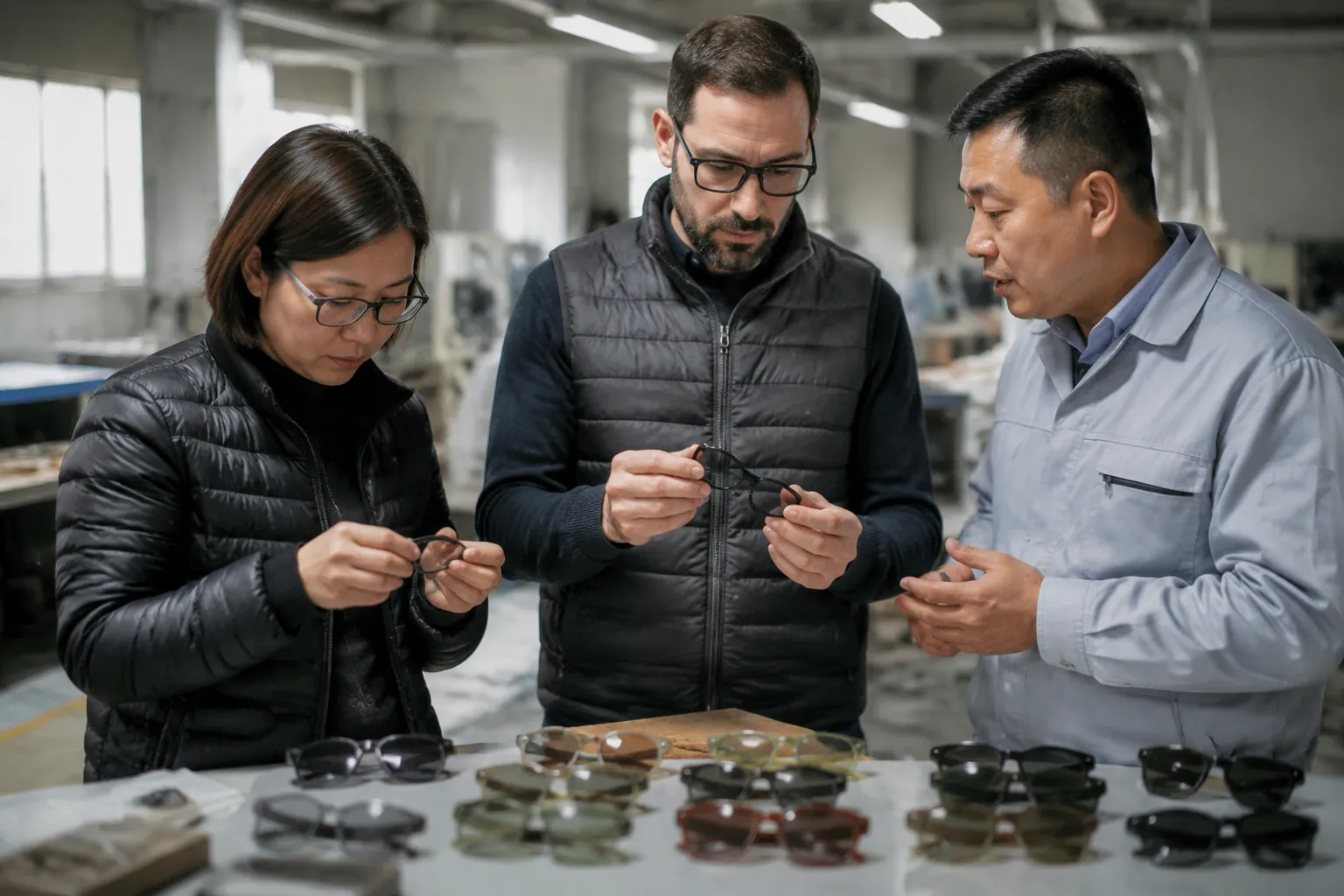
If you buy sunglasses for a brand, chain, or distributor, MOQ is not a side note. It shapes how many SKUs you can launch, how much cash sits in slow stock, and whether your first reorder improves margin or repeats the same mistakes. The real question is not "What is the minimum?" It is "Which parts of this SKU can change without adding avoidable cost, delay, or quality risk?" This guide shows how B2B buyers split styles, colors, decoration, and packaging to create assortment without breaking the factory plan.
One retail SKU touches several factory steps
On a line sheet, one sunglass SKU looks simple: frame, lens, logo, pouch, box. In production, it is not simple. One SKU can trigger changes in molding, lens tinting, decoration, inspection, and packing. Factories think in setups, switchovers, scrap risk, and labor efficiency. Not just design.
A private label order for an injection-molded TR90 or polycarbonate frame shows the issue fast. A color change is not only a different pigment. It may require resin loading, barrel purging, first-off approval, dimensional checks, and a short stabilization run before parts are acceptable. On acetate, the problem changes. A new color means different sheet stock, different cutting yield, different polishing behavior, and sometimes tone variation from lot to lot.
Lens variation adds another layer. A standard smoke lens usually creates fewer appearance variables than mirrored or gradient lenses, which need tighter coating or tint control. Even a logo change can slow flow: pad printing needs plates and ink matching, laser engraving needs fixture alignment, and metal logo inserts may need separate hardware sourcing and adhesive cure time.
That is why a factory may accept a low MOQ per design but still push for fewer variants. Technical minimum and commercial minimum are not the same thing. A factory can often make the order. That does not mean the SKU structure is efficient.
- Low MOQ reality: good for sampling, market testing, or showroom use.
- Mid-volume reality: setup cost starts to dilute and QC becomes steadier.
- High-volume reality: material buying, labor planning, and decoration runs are usually more efficient.
If you ask for 12 colors, 4 lens tints, and 3 gift-box versions on a tiny total quantity, you are not buying assortment. You are buying fragmentation.
Split the SKU by function, not by habit
The cleanest MOQ strategy is to decide which elements must stay fixed and which can vary. Most launch programs work best with three buckets:
- Core product: frame shape, construction, hinge type, base lens type, lens category, and the main compliance target.
- Controlled variants: frame color, lens tint, logo method, temple print, or pouch color.
- Late-stage changes: barcode labels, inserts, sleeves, outer cartons, and regional packaging text.
The core product should change as little as possible in the first order. That protects tooling, reduces tolerance drift, and keeps fit consistent. Finished sunglasses still need stable front width, temple length, bridge geometry, and lens seating so assembly and wear comfort stay inside spec. If you add several style changes at once, you multiply the risk of misfit, loose hinges, or lens seating variation.
Controlled variants are where you create sellable assortment. Frame color is usually the best first lever because it keeps the fit and silhouette that buyers are testing. Packaging is even safer because it does not change the product build. If you need channel segmentation, it is often smarter to sell the same frame in a standard fold carton for mass retail and a rigid gift box for e-commerce or holiday sets.
A practical launch structure for many overseas buyers is:
- 1 core frame platform
- 2 to 3 frame colors
- 1 standard lens tint, with 1 optional fashion tint only if demand is clear
- 1 logo method across the full run
- 2 packaging versions at most
That gives enough variety to test the market. It does not overwhelm the line or your reorder logic.
What to split first: style, color, logo, or packaging
Use the lowest-risk split first. Packaging is usually safest. Color is next. Logo method follows. Style should be last.
| Split option | Best commercial use | Factory impact | Typical hidden cost | Risk level |
|---|---|---|---|---|
| By style | Different customer segments or channels | Highest; separate tooling, fit checks, assembly flow, and QC criteria | More sample rounds, slower approvals, lower volume per style | High |
| By color | Retail assortment on one proven frame | Medium; separate resin batches, paint runs, or acetate sheet planning | Color matching, short-run scrap, uneven sell-through by shade | Medium |
| By logo method | Premium vs mass positioning | Low to medium; depends on pad print, laser, or metal insert setup | Artwork revision, durability testing, alignment rejects | Medium |
| By packaging | Regional programs, gift sets, market tests | Low; mostly printing, labeling, and final pack labor | Carton complexity, barcode mismatch, print MOQs | Low |
If you are unsure where to split, start with packaging. Then color. Then logo. Style comes last because it changes too much at once.
Example: 600 total pairs can be managed several ways. Three styles at 200 pairs each usually creates more QC complexity than one style in three colors at 200 pairs each. One style in two colors at 300 pairs each often gives cleaner purchasing, better carton efficiency, and clearer reorder data.
MOQ changes unit cost fast at 50, 300, 1000, and 5000+ pairs
MOQ is a cost-per-variant problem. The more you split volume, the less efficiently the factory can run. At very low quantity, setup time, in-line inspection, and packing labor are spread across too few pairs. At higher quantity, those fixed efforts dilute.
| Order level | Typical use | Unit-cost behavior | What usually improves | Buyer takeaway |
|---|---|---|---|---|
| 50 pairs/design | New design test, showroom sample stock, buyer seeding | Highest unit cost | Little; you are mainly paying for flexibility | Use for learning, not for margin targets |
| 300 pairs/design | Small launch, early reorder, boutique rollout | Noticeably better | Setup waste falls, inspection flow becomes more stable | Good point for first serious commercial run |
| 1000 pairs/design | Distributor or multi-store program | Much better | Material buying, labor planning, and packing all become more efficient | Volume can support stronger landed-cost planning |
| 5000+ pairs/design | Core seasonal program or national distribution | Best pricing when specs and forecasting are stable | Factory can optimize scheduling, purchasing, and output consistency | Keep variants limited and forecasts disciplined |
The trap is common. Buyers place a 200-pair order and split it into four frame colors, two packaging types, and two logo treatments. That leaves only 25 pairs per actual combination. No factory can price that like a concentrated run because it is not one.
If your goal is lower unit cost, push volume into the winning variant instead of creating more weak ones. Simple rule. MOQ works best when demand concentration and factory concentration point in the same direction.
Where extra variation adds cost inside the factory
Small changes trigger real production work. Here is where variation usually adds time and risk:
- Injection molding: color masterbatch change, machine purge, first-off approval, and dimensional verification. Dark-to-light color changes usually create more purge waste than dark-to-dark transitions.
- Acetate cutting and polishing: sheet selection, nesting yield, edge finishing, tumbling, and hand polishing. Some tortoise or laminated sheets show more lot variation than solid black, which makes color consistency harder.
- CNC or hardware fitting: jig setting, hinge alignment, screw torque control, and temple symmetry checks. Small setup shifts can affect opening feel and long-term durability.
- Lens tinting or coating: color matching, transmission consistency, drying or curing time, and scratch-risk handling. Mirrored or gradient lenses usually need tighter appearance control than standard smoke.
- Decoration: pad print plate registration, laser depth control, or placement of metal logo plates. Decoration errors may be cosmetic, but they still create rejects.
- Final QC and packing: lens cleanliness, hinge motion, logo position, barcode accuracy, inner pack count, and carton assortment verification.
Even when a factory runs these steps in-house, variation is not free. It is just more controllable. In-house molding, lens work, decoration, and packing often reduce handoff delays and improve accountability. But every extra variant still uses setup time, labor, and QC attention.
That is the hidden logic behind MOQ. Factories are protecting line stability. Not just forcing volume.
A practical SKU matrix for low- and mid-volume launches
If your launch budget is limited, control complexity before the PO is issued. This matrix is a workable starting point for private label programs that need breadth without chaos.
| SKU element | Recommended launch setting | Reason |
|---|---|---|
| Frame shape | 1 core shape | Protects tooling, fit consistency, and approval speed |
| Frame color | 2 to 3 colors max | Creates visible assortment without over-splitting quantity |
| Lens tint | 1 standard tint; add 1 fashion tint only if required | Keeps compliance and demand planning simpler |
| Logo method | 1 primary method across the program | Reduces artwork changes and reject risk |
| Packaging | 2 versions: standard and premium | Allows channel segmentation with minimal production disruption |
For example, one acetate style in black and tortoise with a single smoke lens can be packed in either a standard retail box or a premium gift box. Commercially, that creates four sellable combinations. Operationally, it is still one frame build, one lens program, and one decoration standard. That is productive complexity.
By contrast, if you change the frame shape, lens tint, logo plate, and box all at once, you do not have four combinations. You have four separate mini-programs, each with its own failure points.
Compliance and lead time should follow the SKU plan
Compliance is easier when the SKU plan is disciplined. Different frame materials, lens categories, and decoration methods can affect labeling, documentation, and test consistency. Private label buyers should start from a stable compliance baseline, then vary only what the market needs.
Common documents and standards buyers may request, depending on market and channel, include CE EN ISO 12312-1, FDA registration, ANSI Z80.3, AS/NZS 1067, REACH, plus factory management system credentials such as ISO 9001 and BSCI. These are not sales badges. They help buyers check whether a supplier has documented processes, traceability, and quality-control discipline.
To keep the launch clean:
- Use the same lens category across the first run if possible.
- Keep the same base material family unless there is a strong retail reason to change.
- Standardize logo placement so artwork and labeling stay consistent.
- Use one packaging footprint where possible, even if graphics differ by market.
For lead time, the exact schedule depends on material availability, tooling status, decoration method, and packaging complexity. A typical buyer workflow is to plan samples first, then release bulk only after artwork, packaging files, and final specs are frozen. Most delays come from late color changes, packaging revisions after sampling, and decoration edits that were not locked before bulk booking.
The safest workflow is simple:
- Select one frame platform.
- Lock lens category and target performance.
- Approve 2 to 3 colors only.
- Confirm one logo method.
- Separate packaging changes from product changes.
- Approve a pre-production sample or gold seal sample.
- Run bulk only after artwork and carton details are frozen.
- Reorder the best seller first; do not expand the weakest seller.
Blunt rule: if your SKU logic cannot be explained clearly in one paragraph, it is probably too complex for the first order.
Have a custom sunglasses project in mind?
Send us your styles, target market and quantities and we will return a detailed quote with MOQ, lead time and a sample plan.
Get a QuoteWhy source this from Wenzhou with LumiShades
Wenzhou in Zhejiang Province is widely regarded as China’s eyewear manufacturing capital, producing a large share of the world’s sunglasses. That concentration matters to buyers: a deep local supply chain for acetate sheet, hinges, lens blanks, plating and packaging means shorter component lead times, easier color and material matching, and a workforce with decades of eyewear-specific skill. LumiShades has manufactured in this ecosystem since 2009, and our vertical integration — in-house injection molding, acetate cutting, CNC milling, lens tinting, decoration and quality control — means no part of your order is quietly subcontracted to a workshop you cannot audit.
For international buyers, that vertical control translates into accountability. When a single factory owns every step, defects are traced and fixed at source rather than bounced between vendors, and your specifications survive intact from first sample to bulk. We back this with 15+ years of experience, shipments to 60+ countries, more than 5 million pairs produced per year and a 98.5% on-time delivery rate. Our certifications — CE EN ISO 12312-1, FDA registration, ANSI Z80.3, AS/NZS 1067, REACH, ISO 9001 and BSCI audit — mean the compliance documentation your market requires already exists. Explore our manufacturing capabilities and quality control process to see how this works in practice.
Frequently asked questions
Should I split MOQ by style or by color first? In most cases, split by color first. A color change keeps the core fit and tooling stable, while a style change can require different tooling, different assembly checks, and a separate QC standard. Use style splits only when each style serves a clearly different customer segment or sales channel.
Is 50 pairs per design enough for a launch? Yes for testing, showroom use, buyer presentations, or very small market validation. No if you expect competitive unit pricing or broad assortment. At 50 pairs, you are mainly buying information about demand, not production efficiency. If the goal is a commercial launch, use the 50-pair run to validate one or two winners before scaling.
What is the safest way to add assortment without hurting production? Packaging is usually the safest place to add variety. Different sleeves, inserts, stickers, barcodes, or box versions can create channel-specific offers without changing frame molding, lens processing, or core assembly. If you need more assortment after that, add one color at a time before adding more styles.
How fast can samples and bulk production move? The timeline depends on whether tooling, materials, artwork, and packaging are already ready. A realistic process is to plan samples first, then bulk only after final approval. To avoid delays, freeze the frame spec, lens spec, decoration method, and carton artwork before you book production. Late changes usually extend the schedule more than the factory's base lead time.
Which certifications should I ask for on private label sunglasses? Ask for the documents that match your market and channel: CE EN ISO 12312-1, FDA registration, ANSI Z80.3, AS/NZS 1067, and REACH. If you also want to assess the factory's management system, request ISO 9001 and BSCI. Then verify that the documents correspond to the exact product and shipment you are buying, not just a general company profile.
Ready to start?
Explore our wayfarer sunglasses or request a quote — our sales team replies within 12 hours.
Request a Quote