
How to Compare Sunglasses Quotes Like for Like
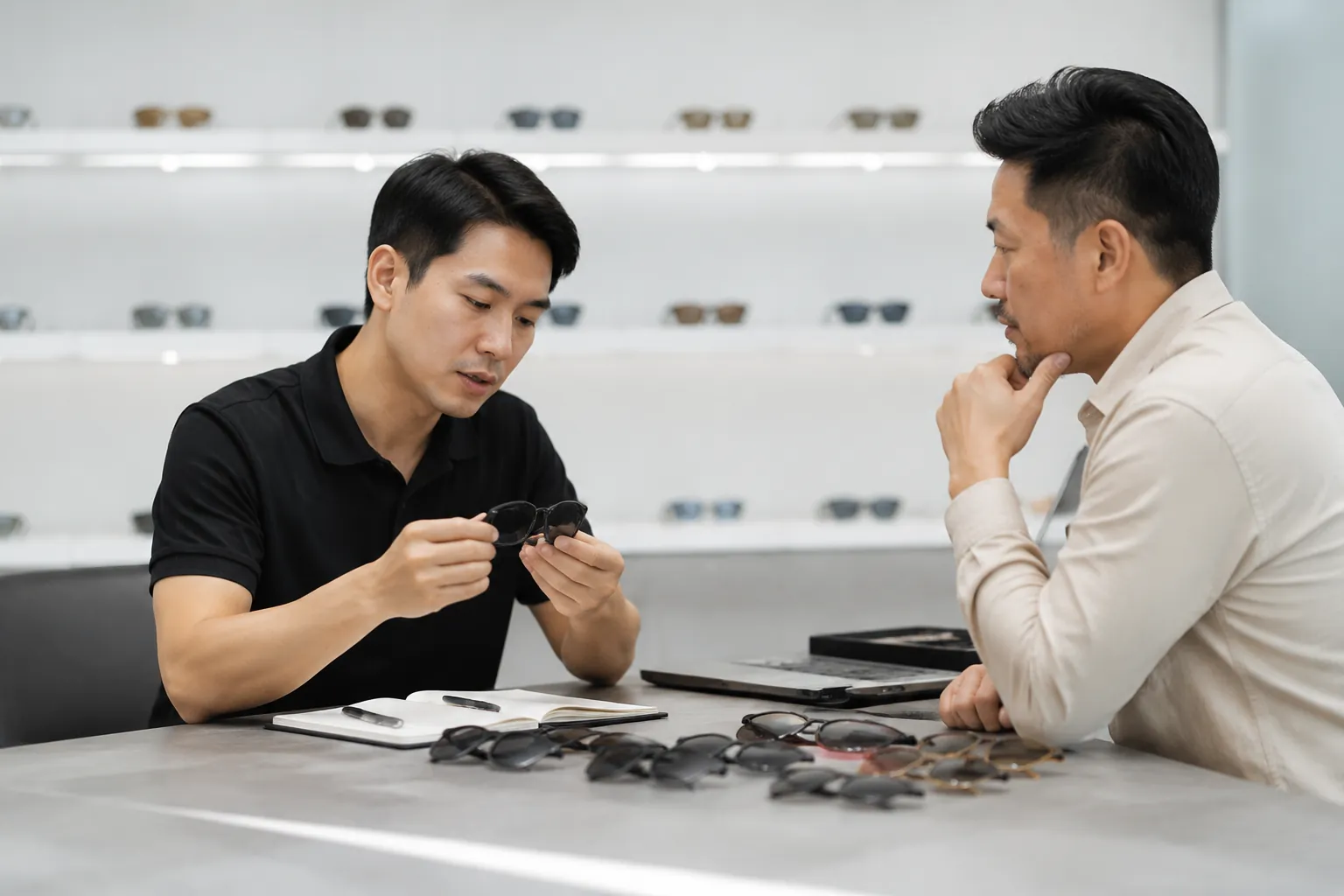
This guide is for importers, brand owners, distributors, and retail buyers sorting through custom sunglasses quotes that do not match line by line. The aim is simple: rebuild each offer into one like-for-like specification so you can compare true cost, risk, and lead time. Do that first. Price alone is noise until frame and lens materials, hinge construction, logo method, packaging, testing scope, and trade terms are aligned.
Rebuild every quote into one master specification
Most sunglasses quotes are not directly comparable. Suppliers often change the build to hit a target price. One may quote injected PC frames with 1.0 mm PC lenses. Another may quote TR90 frames with 1.1 mm TAC polarized lenses. A third may include a pouch, folding carton, barcode label, and master cartons. Same look on page one. Different product underneath.
Before you compare unit price, ask every supplier to quote against one fixed specification sheet. It should define the product in enough detail to cover materials, process steps, tolerances, and packing. If a supplier cannot hold a quote at that level, take note. That usually points to weak process control or too much room for substitution.
- Frame material: injected PC, TR90, metal, or acetate; specify finish such as matte, glossy, rubberized, or hand-polished
- Lens material: PC, TAC, CR-39, or nylon; polarized or non-polarized; lens thickness such as 1.0 mm, 1.1 mm, or 1.5 mm
- Construction: standard screw hinge or spring hinge; wire core yes or no; adjustable nose pads for metal frames
- Decoration: 1-color or 2-color pad print, laser engraving, foil stamp, inside temple print, or metal logo plate
- Packaging: polybag, microfiber pouch, paper box, EVA hard case, barcode label, silica gel, tissue wrap, and master carton specification
- Compliance scope: destination-market standard, required material declarations, and whether third-party test support is included or excluded
- Trade term: EXW, FOB, or CIF on the same destination basis
For a 1,000-unit program, the quote should also define tolerance-sensitive points such as lens color consistency, print position, temple spread, hinge feel, and carton packout. If those are vague, the supplier has room to call defects acceptable later. Do not leave that open.
Factories with more in-house control over molding, acetate shaping, CNC work, lens tinting, decoration, and QC often issue cleaner quotes because fewer steps are subcontracted. Still, every supplier needs to work from the same build sheet. Otherwise the price means very little.
Normalize the quote lines buyers miss
The biggest price gaps usually come from details buried in notes or left out entirely.
- Tooling status. If the frame is fully custom, ask whether mold cost is included, excluded, or amortized into unit price. A low unit quote can quickly stop looking low once tooling appears later. If the style uses an existing mold, confirm that only color, logo, and lens options are being customized.
- Lens specification. "UV400" is not enough. Ask for material, thickness, polarization method, base curve, and color tolerance. A 1.1 mm TAC polarized lens and a 1.0 mm PC non-polarized lens can differ in look, performance, scrap rate, and cost. Mirrored coating, hard coating, and anti-scratch layers also affect both price and lead time.
- Logo method. Pad printing is usually the lowest-cost option and works for promotional programs, but it can wear under abrasion or sunscreen exposure. Laser marking is more durable on suitable surfaces. Metal logo plates look premium, but they add parts, alignment risk, adhesive or pin-fix issues, and more manual labor.
- Packaging packout. Unit box size, assembled versus flat pack, and master carton quantity directly affect freight cost. An EVA hard case can increase cube sharply compared with a fold-flat paper box. If one supplier packs 100 units per carton and another packs 200, freight and damage risk will not be equal.
- Testing and documentation. Ask whether the quote includes internal QC only, third-party lab cost, sample submission prep, or just copies of old files. A generic declaration is not the same as product-specific support for your target market.
Short version: never compare a bare product quote from one factory with a retail-ready, compliance-supported quote from another. That is not a fair comparison.
Use a table to expose substitutions fast
Put every offer into the same comparison table. Once you do, the reason for the price spread is usually obvious. Materials, process steps, packaging, or trade terms will tell the story.
| Quote item | Vendor A | Vendor B | Vendor C | What buyer should verify |
|---|---|---|---|---|
| Frame material | Injected PC, gloss black | TR90, matte black | Acetate, polished tortoise | Material grade, flexibility, finish labor, weight, reject risk |
| Lens | 1.0 mm PC, non-polarized smoke | 1.1 mm TAC polarized grey | 1.5 mm nylon polarized green | Optical clarity, thickness tolerance, coating durability, polarization consistency |
| Hinge | Standard screw hinge | 5-barrel metal hinge | Spring hinge | Torque feel, opening cycle durability, repairability, assembly time |
| Logo | 1-color pad print outside temple | Laser mark + inside print | Metal plate + inside temple print | Tooling, abrasion resistance, placement tolerance, manual labor content |
| Packaging | Polybag only | Pouch + fold-flat paper box | Pouch + EVA case + barcode label | Retail readiness, carton cube, transit protection, packing labor |
| Compliance docs | Generic declaration | CE EN ISO 12312-1 + REACH support | ANSI Z80.3 + AS/NZS 1067 support | Whether documents match destination market and exact SKU configuration |
| Trade term | EXW | FOB Ningbo | FOB Ningbo | Local charges, export handling, port fees, freight responsibility |
| Quoted unit price | $1.85 | $2.38 | $3.12 | Only comparable after all rows above are normalized |
The table also helps you test sales claims. If Vendor A is cheaper but uses a thinner non-polarized PC lens, no retail packaging, and EXW terms, it is not cheaper for the same program. It is a different offer. Full stop.
Know how materials and process choices change cost
Material selection changes both the bill of materials and the production route. Injected PC and TR90 usually move faster once color and logo are approved. The frame comes off the mold, then goes through trimming, lens fitting, logo application, cleaning, and packing. Acetate is slower. It often involves sheet cutting, tumbling, beveling, polishing, hinge insertion, and more manual finishing. More labor. More variation. More chances for scrap.
Lens choice matters just as much. PC lenses are common in value and sport programs because they are lightweight and impact-friendly, but optical consistency depends on supplier grade and coating control. TAC polarized lenses are common in private-label programs because they balance cost and performance. Nylon lenses can give strong optics and a more premium feel, but the cost has to fit the retail price point.
Decoration adds another layer. A basic one-position pad print is quick. A metal logo plate is not. It may require part prep, adhesive curing or pin fixing, alignment checks, and rework on units that fail visual inspection. Multi-pass painting, mirrored lens coating, hand-polished acetate edges, and spring hinges also add labor and defect risk.
Ask which process steps are in-house and which are outsourced. This matters. It affects lead time, rework speed, and consistency lot to lot.
Read MOQ and lead time with the right logic
MOQ should never be judged on its own. A factory willing to accept 50 pairs per color may still be the wrong fit if your program needs custom lens color, spring hinges, and retail-ready packaging. Setup cost has to land somewhere. At low volume, it lands in the unit price.
Most suppliers work on stepped economics. Around 50 pairs, you are usually paying for flexibility and sample-like handling. At 300 pairs, basic customization becomes more workable. At 1,000 pairs, unit economics often improve because material purchasing, print setup, and packing efficiency are better. At 5,000+ pairs, deeper reductions may be possible if the style is stable and the process is standardized.
Lead time follows the same pattern. Break it into stages:
- Sampling: about 7 to 10 days for color, logo, and packaging confirmation on a standard mold
- Approval gap: depends on buyer response; 2 to 5 days is common for fast-moving projects
- Raw material prep: 5 to 10 days for lenses, packaging, or hardware if not in stock
- Assembly and finishing: 10 to 20 days depending on material and decoration complexity
- QC and packout: 2 to 4 days for inspection, rework, and carton closing
- Booking and handoff: additional time depending on EXW or FOB arrangement
If a supplier offers a very short lead time for acetate frames with custom metal logo plates, polarized lenses, and hard-case packout, ask how each stage is being compressed. If the answer is vague, the promise probably is too.
Packaging and trade terms often decide landed cost
Many buyers focus too hard on ex-factory unit cost and not hard enough on freight math. That is a mistake. Packaging changes carton cube, gross weight, and damage rate. All three affect landed cost.
A polybag-only pack may look efficient on paper but creates weak retail presentation and can increase scuff claims. A pouch plus fold-flat paper box often gives a better balance between presentation and cube. An EVA hard case gives better protection but can push freight high enough to wipe out an apparently cheaper product quote.
Then there is the trade term. If one quote is EXW and another is FOB, you are not comparing the same thing. EXW pushes local pickup, export handling, and port coordination onto you or your forwarder. FOB usually gives overseas buyers a cleaner basis for comparison because the supplier handles export clearance and delivery to the named port.
- EXW: lower visible price, but buyer absorbs local charges and coordination
- FOB: easier for most importers to compare and budget
- CIF: useful for rough planning, but freight assumptions may not match your route or forwarder rates
Ask every supplier for the same packout data: units per inner, units per master carton, carton dimensions, gross weight, net weight, and whether retail packs ship assembled or flat. This is not admin detail. It is cost data.
Check compliance, then score suppliers on more than price
Compliance has to match the exact SKU build and destination market. A quote that says "CE approved" without naming the standard or support scope is weak. The same goes for recycled claims, UV claims, or generic test files from unrelated products.
For many programs, buyers may ask for support for standards or document sets such as CE EN ISO 12312-1, ANSI Z80.3, AS/NZS 1067, REACH, FDA registration, ISO 9001, and BSCI. These are not interchangeable. They matter only if they match the actual market and final product configuration.
Ask one direct question: Does the quoted document set match this exact frame material, lens material, lens tint, coating, and destination market? If the answer is vague, treat that as risk.
Also watch for common red flags:
- No lens thickness or material listed
- No hinge specification or cycle expectation
- "Logo included" without method, size, or position
- No tolerance stated for color, fit, or print placement
- No carton details or drop-test expectation
- No note on replacements for transit damage or production defects
- Lead time given without a sample approval checkpoint
Once the quotes are normalized, stop ranking suppliers by price alone. Use a weighted scorecard instead. A practical model might assign 30% to total cost, 20% to sample quality, 15% to compliance and documentation support, 15% to lead-time reliability, 10% to communication speed, and 10% to packaging and freight efficiency. Adjust the weights to fit your channel. Promotional programs may favor cost and speed. Retail private-label programs usually need to put more weight on finish quality, packaging, and compliance.
Finally, ask each supplier for a process-level timeline covering sample, approval, raw materials, assembly, QC, and shipping handoff. If a supplier resists that level of detail, there is usually a reason. Good factories do not need ambiguity to compete.
Have a custom sunglasses project in mind?
Send us your styles, target market and quantities and we will return a detailed quote with MOQ, lead time and a sample plan.
Get a QuoteWhy source this from Wenzhou with LumiShades
Wenzhou in Zhejiang Province is widely regarded as China’s eyewear manufacturing capital, producing a large share of the world’s sunglasses. That concentration matters to buyers: a deep local supply chain for acetate sheet, hinges, lens blanks, plating and packaging means shorter component lead times, easier color and material matching, and a workforce with decades of eyewear-specific skill. LumiShades has manufactured in this ecosystem since 2009, and our vertical integration — in-house injection molding, acetate cutting, CNC milling, lens tinting, decoration and quality control — means no part of your order is quietly subcontracted to a workshop you cannot audit.
For international buyers, that vertical control translates into accountability. When a single factory owns every step, defects are traced and fixed at source rather than bounced between vendors, and your specifications survive intact from first sample to bulk. We back this with 15+ years of experience, shipments to 60+ countries, more than 5 million pairs produced per year and a 98.5% on-time delivery rate. Our certifications — CE EN ISO 12312-1, FDA registration, ANSI Z80.3, AS/NZS 1067, REACH, ISO 9001 and BSCI audit — mean the compliance documentation your market requires already exists. Explore our manufacturing capabilities and quality control process to see how this works in practice.
Frequently asked questions
How do I compare quotes if one supplier offers EXW and another offers FOB? Convert both to the same basis before deciding. Ask the EXW supplier to itemize local pickup, export handling, documentation, and port charges, or ask them to requote FOB. Then compare the same unit price basis, carton data, and destination. If you cannot get both offers on one trade term, treat the EXW quote as incomplete.
Is a lower MOQ always better for custom sunglasses? No. A lower MOQ helps only if it fits your launch risk and cash flow. A 50-pair MOQ is useful for testing a design, but the unit cost is usually higher because setup, materials, and packing labor are spread over fewer pieces. For a commercial order, compare MOQ against forecast demand, packaging needs, and whether the style uses a custom mold or standard parts.
What usually causes sunglasses quotes to differ by 20% or more? The build is usually different. Common causes are frame material, lens type and thickness, polarization, hinge construction, logo method, packaging level, and trade term. Compliance support and testing scope can also change the price. To find the real reason, normalize every quote to the same material, packout, and delivery basis.
Which logo method is safest for long-term wear? For wear resistance, laser marking is often the most durable option on suitable surfaces. Pad printing is lower cost and common for promotional programs, but it can wear faster under abrasion. Metal logo plates can look premium, but they add parts, alignment risk, and more assembly steps. Choose the method based on frame material, target price, and expected handling.
Should I ask for compliance documents before sampling or after? Ask early which standards and documents the supplier can support for your destination market, then confirm again after the final SKU is locked. If you change frame material, lens material, coating, tint, or logo placement after testing, the paperwork may no longer match the finished product. Keep the sample, quote, and compliance scope tied to the same SKU revision.
Ready to start?
Explore our round sunglasses or request a quote — our sales team replies within 12 hours.
Request a Quote