
Private Label Sunglasses Specs for Pharmacy Chains
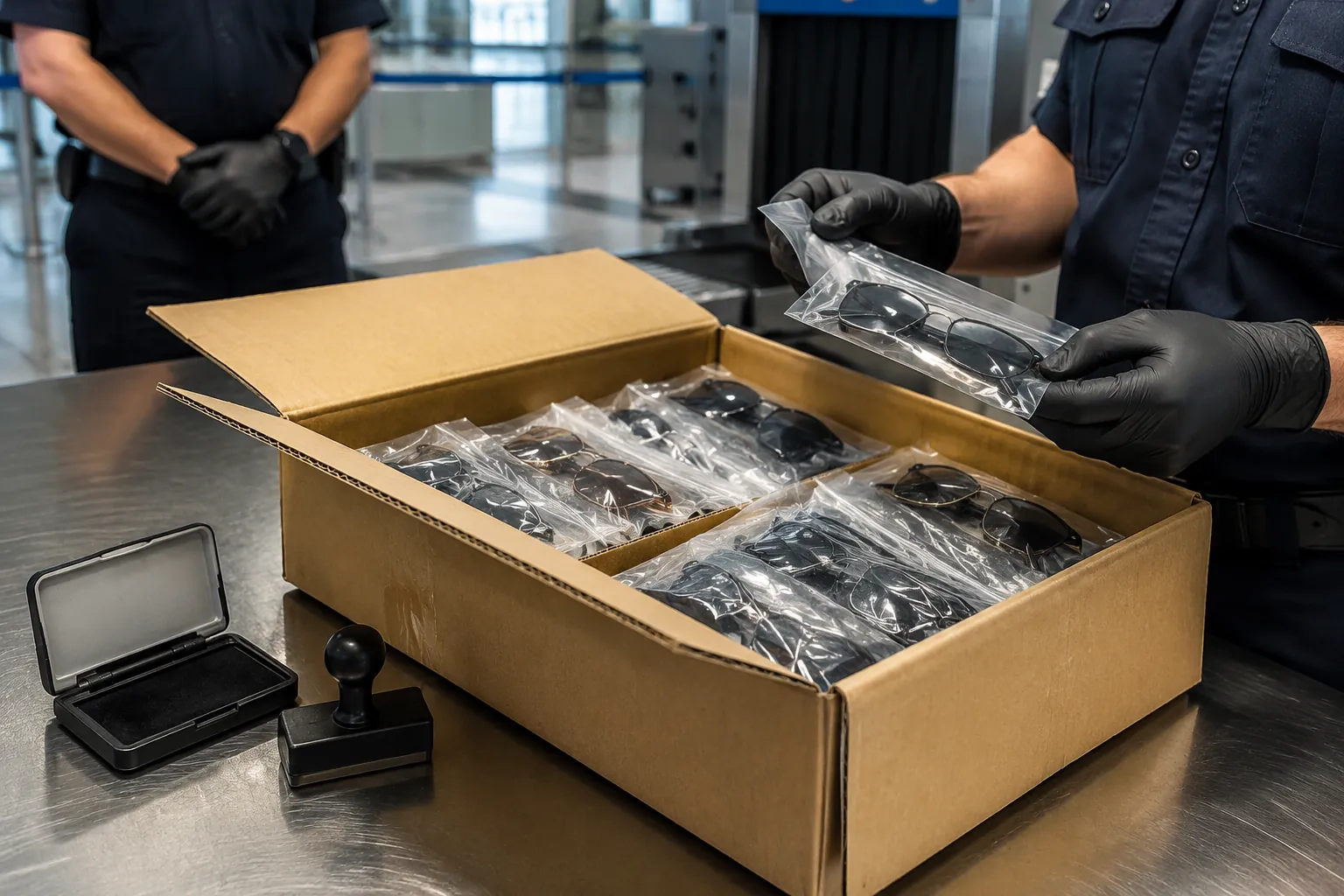
This guide is for pharmacy buyers, optical chains, distributors, and private label eyewear brands building repeatable sunglass programs, not one-off seasonal drops. In this channel, problems usually start with vague specs: fit tolerances, barcode placement, warning text, carton rules, replenishment timing, or missing compliance documents. Fix that early. When commercial terms, technical specs, and QC checkpoints are defined up front, approvals move faster, stores execute better, and repeat orders are easier to control.
Start with the retail model, not the frame shape
Pharmacy and optical chains buy differently from boutiques. They need broad fit coverage, repeatable specs, clear labeling, and simple replenishment by SKU. So the first decision is not whether the frame is square or round. It is the retail job the product needs to do.
Define the program before sampling: impulse rack, optical add-on, or a chain-owned private label line. Each model changes the acceptable material cost, packaging complexity, and number of live SKUs. An impulse rack may need only a few proven shapes with limited colorways. A branded counter line may support more shapes, upgraded packaging, and tighter color control.
| Program type | Typical retail target | Specs to lock early | Commercial logic | Main risk if vague |
|---|---|---|---|---|
| Impulse rack | Low-price, fast-turn seasonal volume | Core shapes, simple pouch, barcode position, inner pack count | Works best when SKU count stays low and replenishment stays simple | Too many slow-moving SKUs and inefficient refill handling |
| Optical add-on | Prescription-adjacent sale near dispensary or cashier | Fit range, lens category, hinge durability, compliance file, conservative colors | Higher return risk makes fit and comfort more important than styling variety | Customer complaints on comfort, clarity, or looseness |
| Mid-tier private label | Chain-owned brand with stronger shelf identity | Logo method, packaging set, color standard, reorder trigger, approved golden sample | Brand consistency matters across repeat POs and store groups | Visible batch variation and brand dilution |
| Multi-market chain rollout | Regional or national replenishment program | Market-specific labeling, carton coding, frozen BOM, MOQ by color | Needs disciplined forecasting and repeatable production routing | Compliance mismatch or refill delays by market |
Treat MOQ as a commercial variable, not a quality signal. Ask for MOQ by frame color, lens color, and packaging version because those are often the real production constraints. A pilot quantity may be enough for internal approval or a small store test. But chain efficiency usually depends on order size being large enough to support stable pack-out, clean SKU splits, and predictable replenishment.
Define fit as a measurable buying spec
Fit problems are expensive, and they often stay hidden. Customers try on the frame, reject it quietly, and walk away. The store sees weak sell-through, not a formal complaint. That is why style approval is not enough. Buyers need a size architecture with measurable tolerances.
For pharmacy and optical chains, a disciplined fit range usually performs better than a broad fashion assortment. A practical starting point is two core fits that cover most adult customers without multiplying SKUs.
- Small-medium fit: define eye size, bridge, temple length, and front width as a complete set rather than relying on one number
- Medium-large fit: create a second fit family with the same measured approach so store teams can understand the difference
- Temple spread: request open-temple angle and total width at a defined measuring point, not just the nominal size code
- Nose geometry: specify saddle bridge depth or adjustable pad range if your market needs more fitting tolerance
- Tolerance control: ask the supplier to state dimension tolerances and left-right symmetry tolerances on the approved spec sheet
Material choice affects fit repeatability. Injection-molded plastic is common in chain programs because geometry can stay consistent once tooling and process settings are stable. Acetate can look more premium, but finishing and manual adjustment can introduce more variation if tolerances are loose. Metal can allow easier in-store adjustment through nose pads and temples, but it adds assembly variables and may deform more visibly during heavy shelf handling.
If the product is meant for replenishment into the same planogram, approve a sealed reference sample and a measured spec sheet before bulk production. That sample matters. It becomes the physical benchmark for repeat orders, which is far more useful than an old artwork PDF or a generic size code.
Choose materials and decoration for shelf handling
Do not approve sunglasses on first-look appearance alone. Frames need to hold alignment after repeated try-ons. Lenses need to resist marking in normal handling. Branding needs to survive friction from packing, transit, and customer use in store.
Ask which operations the factory handles in-house and which are outsourced. That affects consistency, lead time, and what level of detailing is realistic at your volume.
| Option | Best use | Strengths | Trade-offs |
|---|---|---|---|
| Injection-molded plastic | High-volume chain programs | Consistent geometry, scalable production, cost efficiency | Usually lower perceived premium value than acetate |
| Acetate | Higher retail tier, optical counter sale | Richer finish, deeper color, stronger perceived value | Higher labor input and tighter process control needed for repeatability |
| CNC-milled parts | Structured styles with sharper shaping | Precise shaping on selected designs | More machining time and usually less suitable for value-led mass programs |
| Pad-printed logo | Short runs, test orders, value programs | Lower setup burden, flexible placement, quick artwork changes | May show wear sooner on high-contact outer temples |
| Laser engraving | Repeat programs with understated branding | Good durability, clean detail, lower risk of print rub-off | Visual contrast depends on substrate color and finish |
| Metal logo plate | Mid-tier branded collections | Premium perception, durable branding, stronger shelf presence | Higher unit cost, extra assembly steps, tighter placement control needed |
Be direct about durability. If the logo sits on the outside temple, ask how the supplier checks rub resistance and how parts are protected during packing. For a value line, pad printing may be enough. For a repeat program, laser engraving or metal logo plates may hold appearance better over time.
Also define lens expectations beyond tint color. Ask whether a hard coat is standard, whether scratch resistance is tested internally, and what appearance standard applies after normal shelf handling. Low-cost product can still work well at retail if it stays presentable through the selling period.
Lock lens performance and compliance before sampling
Paperwork can delay a launch just as easily as product faults. Buyers should set the compliance path before pre-production samples are approved, because standards, lens categories, and labeling language affect both testing and packaging.
Depending on destination market, relevant requirements may include CE EN ISO 12312-1, ANSI Z80.3, and AS/NZS 1067. Chemical compliance requests often include REACH. In the US, some buyers also request FDA registration details for their vendor file if their import process requires it. Supplier-level documents may include ISO 9001 and BSCI, but those do not replace product testing to the applicable sunglass standard.
- State the destination market by SKU or purchase order, not only in email discussion.
- Define the lens category and visible light transmission target range.
- Confirm whether polarized lenses are required and whether polarization applies to all colors or only selected SKUs.
- Request the relevant test report set before final shipment release, not after goods arrive.
Do not write vague requirements such as "UV400 only." That is incomplete. State the applicable standard, intended lens category, tint type, and any warning or age-use language that must appear on packaging. If the line includes gradient or fashion tints, confirm that they still fall within the intended classification.
A simple rule helps: map each live SKU to one compliance record set and one packaging artwork version. That cuts the risk of one color variant shipping with outdated warning text or the wrong compliance reference.
Specify packaging like an operations file
For pharmacies and chains, packaging is an operations tool first and a branding tool second. The product must scan correctly, fit the fixture, carry the required warnings, and survive transport without looking damaged on shelf. Approvals often stall here because packaging decisions are made too late or left too loose.
Put every packaging detail into one master file. Include barcode symbology, barcode size, quiet zone requirement, placement tolerance, swing tag dimensions, pouch or case requirement, polybag rule, inner pack quantity, outer carton marks, and language version. Also define whether labels are applied to each unit, each inner box, or both.
- Retail unit: frame, cloth if required, pouch or case, swing tag, barcode label, market warning text
- Fixture handling: peg-ready hole position or tray presentation dimensions
- Barcode execution: keep placement consistent across all SKUs so staff can scan without opening the pack
- Transit pack: master carton dimensions, SKU separation, carton count, ship marks, orientation marks if needed
- Artwork control: lock revision number, approval date, and market version to avoid mixed packaging in bulk
Two mistakes show up often. First, approving a premium sample box that adds too much hand-packing time in bulk. Second, forgetting that replenishment teams need the barcode visible both on shelf and in the back room. For chain programs, predictable packaging usually beats elaborate packaging.
Ask the supplier to confirm pack-out assumptions in numbers: units per inner, inners per master, master carton gross weight, and whether cartons are mixed or single-SKU. Those details affect receiving speed, damage risk, and store refill efficiency as much as the product itself.
Build replenishment rules into the first PO
Many private label sunglass programs do not fail on the launch order. They fail on the second and third orders, when timelines tighten and teams assume "same as before" without defining what "same" means. That is when color drift, mixed logo versions, and wrong barcode labels show up.
Use the first purchase order to freeze the replenishment logic. Define what must stay constant and what can change only with written approval. Frame geometry, logo placement, hinge construction, barcode location, and warning text usually stay fixed. Seasonal lens color, pouch color, or card background may change if approved separately.
Lead time also needs to be written precisely. Ask for sampling lead time, bulk production lead time, artwork approval timing, test-report timing, and the exact point at which the clock starts—for example, after deposit, after final artwork approval, or after sample sign-off. If your chain needs regular refill stock, standard factory lead time may not be enough. You may need reserved raw materials, a rolling forecast, or a call-off arrangement on proven SKUs.
| Order size | Typical use | Commercial logic | Buyer note |
|---|---|---|---|
| Pilot quantity | Account test, internal approval, limited launch | Useful for validation but may carry higher unit cost and lower freight efficiency | Confirm whether packaging and labeling will match production format |
| Launch quantity | Controlled store rollout | Supports clearer SKU allocation and more realistic replenishment planning | Ask for MOQ by color and by packaging version |
| Replenishment quantity | Planned repeat order on proven SKUs | Usually improves setup absorption and carton efficiency | Tie reorder to the approved golden sample and frozen BOM |
| National or multi-market quantity | Broad chain rollout across regions | Requires stronger forecasting, labeling control, and allocation discipline | Validate market-specific packaging and compliance before production starts |
If the chain's order pattern is fragmented across many stores with low units per SKU, ask for a replenishment matrix before launch. It should show MOQ by color, carton constraints, repeat-order lead time, and whether reorders will match the original approved sample without new tooling or artwork charges.
Ask for the factory control file, not just a sample
A good-looking salesman sample does not prove that bulk production will be consistent. Serious buyers should request the control file behind the sample: the working spec set used by production and QC. This matters even more when the sunglass program is expected to repeat across seasons or markets.
Ask for measurable checkpoints, not just visual promises. If a supplier says the product is "the same as sample," that claim should be backed by an approved spec sheet, a dated reference sample, and documented QC criteria.
- Approved spec sheet: dimensions, tolerances, material callout, lens type, hinge spec, logo method, and packaging breakdown
- Golden sample: sealed, dated, and linked to artwork revision and BOM version
- QC checkpoints: frame alignment, lens seating, left-right symmetry, logo position, color match, barcode placement, carton count
- Acceptance rules: define what is critical, major, and minor for your account before shipment
- Reorder discipline: require the same reference sample and spec sheet to be used for all repeat lots unless a deviation is approved in writing
If acceptance logic is not defined, the buyer and supplier can end up arguing over subjective points such as "temple feels loose" or "logo looks slightly high." Measured checkpoints reduce that risk. Even a simple chain program benefits from a short QC table with pass-fail criteria and photo references for appearance points.
Before releasing bulk, make sure the commercial file and technical file match exactly. That final check is simple. It prevents delay. A common failure point is the buying team approving one version while packaging or compliance approves another. One pre-PO review across sample, artwork, barcode, and test-report request can prevent unnecessary rework.
Have a custom sunglasses project in mind?
Send us your styles, target market and quantities and we will return a detailed quote with MOQ, lead time and a sample plan.
Get a QuoteWhy source this from Wenzhou with LumiShades
Wenzhou in Zhejiang Province is widely regarded as China’s eyewear manufacturing capital, producing a large share of the world’s sunglasses. That concentration matters to buyers: a deep local supply chain for acetate sheet, hinges, lens blanks, plating and packaging means shorter component lead times, easier color and material matching, and a workforce with decades of eyewear-specific skill. LumiShades has manufactured in this ecosystem since 2009, and our vertical integration — in-house injection molding, acetate cutting, CNC milling, lens tinting, decoration and quality control — means no part of your order is quietly subcontracted to a workshop you cannot audit.
For international buyers, that vertical control translates into accountability. When a single factory owns every step, defects are traced and fixed at source rather than bounced between vendors, and your specifications survive intact from first sample to bulk. We back this with 15+ years of experience, shipments to 60+ countries, more than 5 million pairs produced per year and a 98.5% on-time delivery rate. Our certifications — CE EN ISO 12312-1, FDA registration, ANSI Z80.3, AS/NZS 1067, REACH, ISO 9001 and BSCI audit — mean the compliance documentation your market requires already exists. Explore our manufacturing capabilities and quality control process to see how this works in practice.
Frequently asked questions
What is the right MOQ for a pharmacy or optical chain launch? There is no single MOQ that fits every chain program. Ask the supplier for MOQ at four levels: by frame, by color, by lens variant, and by packaging version. Then compare those constraints against your planned store count and SKU split. For a pilot, confirm whether the low-volume run will use the same labeling, barcode placement, and packaging format as production. For a launch, choose a quantity that supports practical color allocation, full compliance paperwork, and workable replenishment rather than chasing the lowest entry number.
Should we standardize one fit or multiple fits across the range? For most chains, two core fit families are easier to manage than one fit across the whole range. Build each family around a full size architecture: eye size, bridge, temple length, front width, and temple spread. Require the supplier to show those measurements on the approved spec sheet and define dimensional tolerances. This gives buyers and store teams a clear basis for assortment planning and reduces the risk of stocking many styles that fit the same customer poorly.
What compliance documents should we request before shipment? Request product test reports that match the destination market and the exact SKU being shipped, such as compliance to CE EN ISO 12312-1, ANSI Z80.3, or AS/NZS 1067 where applicable. Request REACH documentation if required by your market or company policy. If your import or vendor-setup process asks for it, obtain the supplier's FDA registration details for the file. Also request the packaging artwork version tied to the same SKU so warning text and product documentation stay aligned.
How should we choose between pad printing and metal logo plates? Choose based on wear exposure, target price, and brand position. Pad printing is usually more flexible for lower-cost programs, short runs, and faster artwork changes, but it may wear sooner on high-contact outer temples. Metal logo plates generally suit higher-tier private label lines where stronger brand presence and better durability justify extra cost and assembly control. If you want a lower-profile but durable option, ask whether laser engraving suits the material and finish you selected.
How do we avoid reorder mismatches after the first PO? Freeze the repeat-order standard on the first PO. That means approving a sealed golden sample, a measured spec sheet, a BOM, and final packaging artwork with revision control. State in writing which elements are fixed for all repeats—such as frame geometry, lens category, logo position, barcode location, packaging format, and warning text—and which may change only with written approval. Require every repeat order to reference the same approved documents so the supplier is not working from informal instructions or an older sample.
Ready to start?
Explore our square sunglasses or request a quote — our sales team replies within 12 hours.
Request a Quote