
ODM vs OEM Sunglasses: Which Model Fits Your Order?
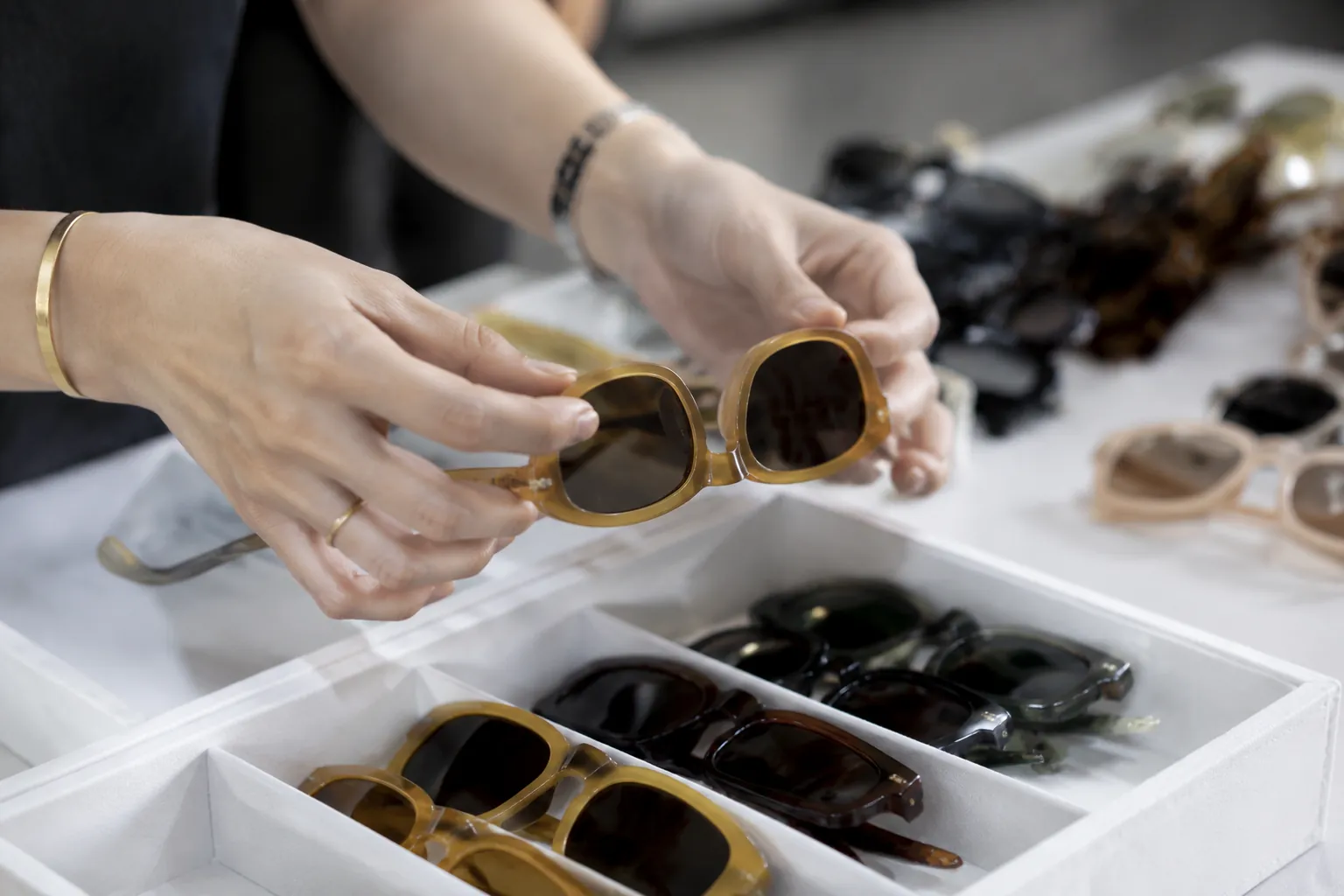
This guide is for brand owners, importers, distributors, and retailers buying sunglasses in volume from China. If you are choosing between an ODM frame and a full OEM program, the decision affects more than design freedom. It changes development cost, sample timing, approval workload, specification control, and how reliably you can reorder later. Start with a simple question: do you need a proven factory platform with your branding, or do you need a frame structure the supplier does not already make?
Start With the Commercial Brief, Not the Sketch
Many buyers begin with a mood board or hand sketch. That is usually the wrong starting point. Start with four constraints: target landed cost, planned first-order quantity, required in-stock date, and target retail price. Those inputs often tell you whether ODM or full OEM is realistic before design discussion goes too far.
ODM means you choose an existing factory-developed sunglass platform and customize details such as frame color, lens tint, logo application, packaging, and sometimes limited trim or finish changes. The base mold, fit geometry, and construction are already set. Full OEM means the frame is developed from your drawing, reference sample, or technical pack. That usually adds technical review, prototype work, fit correction, tooling or CNC setup where needed, and a pre-production approval step before bulk production begins.
For smaller test orders, ODM is often the cleaner option because it avoids extra development work. Lead times vary by factory, material, workload, and component availability, so ask for written timing for sample making, approvals, and production. Do not rely on a vague promise. Full OEM usually takes longer because more variables must be defined, reviewed, and approved before the line can run.
If your goal is to test colorways, validate price points with retailers, or launch a seasonal program without funding new tooling, ODM usually fits better. If your product depends on a specific eye shape, custom temple structure, integrated trim, or dimensions that cannot be reached through an existing platform, full OEM deserves a serious look.
Head-to-Head: MOQ, Cost, Lead Time, and Tolerances
| Factor | ODM sunglasses | Full OEM sunglasses |
|---|---|---|
| Starting MOQ | Often lower because the base style already exists; exact MOQ depends on material, color split, packaging, and decoration method | Usually higher because development cost, setup time, and custom components need volume support |
| Sample time | Usually shorter because the frame structure is already established; timing depends on branding, lens specification, and packaging scope | Usually longer because prototype making, technical review, and revisions may be required before approval |
| Bulk lead time | Often more predictable once the customized sample is approved and materials are confirmed | Depends on tooling readiness, approved specifications, and whether additional corrections are needed before production |
| Tooling and setup | Usually limited for active catalog styles, though some custom trims or packaging may still require setup | Higher if new molds, CNC programs, fixtures, or special components are required |
| Approximate price logic | Lower upfront risk because development cost is reduced; unit pricing still depends on material, lens type, logo process, and packaging | Can become efficient at repeat volume, but the economics depend on spreading development and setup cost over enough units |
| Dimensional control | Existing geometry is already in production, but buyers should still define critical checks for appearance, fit, and assembly | Custom dimensions are possible, but tolerances need to be documented against approved drawings or control samples from the start |
| Reorder risk | Usually lower if the style remains available and all approved materials, colors, and artwork are documented clearly | Depends heavily on tooling control, archived specifications, approved samples, and consistency of custom components |
The hidden difference is error cost. In ODM, if one lens tint sells better than another, you can usually rerun the same platform with a revised color specification. In OEM, a wrong call on bridge shape, temple fit, lens retention, or trim placement can trigger another prototype round and more delay. Small dimensional changes can affect fit, appearance, or assembly stability. Treat specification changes carefully once development starts.
That is why many experienced buyers use a staged model: launch quickly with ODM, collect sell-through data, then move proven winners into OEM only after the market proves the shape is worth dedicated development.
When ODM Is the Smarter Commercial Move
ODM works best when speed, MOQ discipline, and cash control matter more than structural exclusivity. In many programs, frame shape is only part of the result. Sell-through often depends just as much on price point, lens category, color story, packaging quality, and how well the brand presentation fits the target channel.
- Seasonal drops: You need samples and production quickly and do not want to wait through a full development cycle.
- Retail testing: You want to trial several styles in manageable quantities before backing winners more heavily.
- Private label programs: You need proven shapes with your own logo, lens tint, barcode labeling, and packaging.
- Price-sensitive channels: You want to protect margin and avoid loading first orders with development cost.
- Short reorder windows: You want a practical path to repeat an active style without restarting engineering work.
ODM is also more flexible than many first-time buyers expect. On an existing platform, a capable supplier can often change surface finish, lens color, polarized option, mirror treatment, logo technique, and packaging format. Common logo methods include pad printing, laser engraving, hot stamping on cases, and applied metal logo parts. Each method has a different cost, durability profile, and visual effect, so ask for production samples rather than approving from artwork alone.
Material behavior still matters. Injection-molded frames can be efficient for volume, but appearance depends on control of flash, sink marks, parting lines, and warpage. Acetate can carry a higher perceived value and richer color effects, but polishing consistency, lamination quality, and lens fitting stability still need review. In ODM, those risks are often lower because the base style has already gone through production.
When Full OEM Earns Its Extra Cost
Full OEM makes sense when the frame itself is central to the product story and the design cannot be achieved by recoloring or lightly modifying an existing platform. Usually that means a custom front curve, a distinctive temple profile, integrated trim, a specific lens base, or fit targets that catalog styles do not meet.
For example, switching from a standard temple to a thicker temple with embedded metal detail is not just a cosmetic change. It can affect weight distribution, hinge stress, assembly sequence, finishing steps, and the manufacturing method used to make the part. The same applies when you need a different bridge profile, temple length, wrap angle, or material combination for a specific market or fit brief.
In commercial terms, OEM is easier to justify when your custom specification supports at least one of the following: a higher selling price, stronger retailer commitment, defensible design differentiation, or repeat volume that can absorb development cost across multiple production runs. Without that support, OEM can become an expensive way to test basic consumer preferences.
Be specific. On OEM projects, vague language such as "premium feel" or "better comfort" is not enough. Control points should include dimensions, material specification, lens base where relevant, hinge behavior, trim placement, logo position, and cosmetic standards. A good supplier should convert those requirements into an approved sample and a documented specification so bulk production is measured against something objective.
What Changes in the Factory Workflow
The workflow difference between ODM and OEM is not just paperwork. It affects schedule, defect risk, and the amount of communication needed to keep the project under control.
Typical ODM flow: select base style, confirm material and colorway, choose lens specification, confirm logo method, make customized sample, approve counter-sample, run bulk production, inspect, and ship. Because the frame geometry already exists, sample making focuses mainly on branding, finish, packaging, and final specification match.
Typical OEM flow: review sketch or reference sample, confirm construction and key dimensions, select materials, develop technical files, create prototype tooling or CNC process where needed, make first prototype, correct fit and finish issues, approve revised sample, approve pre-production sample, run bulk production, inspect, and ship. Every step can add time if the brief is incomplete or approvals are slow.
Most delays are predictable. Hinge alignment may need correction if temples close unevenly. Lens fitting may be too loose or too tight after finishing. Logo placement can drift if artwork is approved without a fixed location reference. Packaging mistakes are common when barcode, warning text, country-of-origin marking, or carton marks are approved late. In OEM, these are not minor annoyances. The approved sample becomes the production reference, so unresolved details can stop the order.
Factories with stronger in-house capability for molding, cutting, milling, lens processing, printing, and assembly often coordinate better because fewer steps are outsourced. Buyers can also ask about quality and social compliance systems such as ISO 9001 and BSCI, but those do not replace product-level approvals. Artwork, lens category, carton marks, and packaging files still need to be locked before production starts.
Margin Math Buyers Often Miss
The lowest ex-works price is not always the best sourcing decision. Look at total program economics, not just unit cost.
With ODM, you usually reduce development expense, shorten the learning cycle, and get to market faster. That lowers cash exposure before the first sell-through results arrive. For buyers testing a collection, that flexibility often matters more than theoretical long-run unit economics. With OEM, unit cost may become competitive only after development cost is spread across enough repeat volume.
If the custom frame supports a higher retail price, helps win a retailer program, or strengthens long-term brand differentiation, OEM can be commercially sound. If the first order is mainly a test, the math is often weaker because design, setup, and approval effort are being carried by limited volume.
Practical rule: if the first order is mainly a market test, ODM usually protects cash and cuts avoidable complexity. If reorder confidence is already high and frame differentiation is central to the brand, OEM may justify the extra upfront spend.
Another issue buyers often miss is SKU complexity. Too many colors in shallow quantities create cost pressure fast. Small runs across too many colorways increase setup time, complicate material planning, raise the risk of leftover packaging or lenses, and weaken purchasing leverage. Fewer colors, deeper quantities, and simpler decoration usually produce better first-order economics.
Compliance, QC, and Spec Control Are Not Optional
Whether you buy ODM or OEM, compliance applies to the finished product configuration, not just the frame shape. Lens category, visible light transmittance, UV performance, material inputs, chemical requirements, and destination-market labeling all matter. A supplier's certification list is useful background. It is not proof that every SKU is compliant in every market.
First confirm the standard that applies in the destination market. Then match that requirement to the exact sunglass specification being purchased. Common references include CE EN ISO 12312-1 for applicable CE-marked markets, ANSI Z80.3 for the United States, AS/NZS 1067 for Australia and New Zealand, and REACH where chemical-substance compliance applies. Suppliers may also mention FDA registration, but buyers should confirm what is actually registered and avoid treating registration as a substitute for product-specific testing or labeling review.
- Lens checks: verify category, tint consistency, UV performance, polarization claim where applicable, and packing methods that protect against scratching.
- Frame checks: verify hinge function, lens retention, temple alignment, cosmetic finish, logo position, and color consistency against the approved sample.
- Injection-frame checks: review parting lines, sink marks, flash, warpage, and stress whitening near hinges or stressed areas.
- Acetate-frame checks: review polishing consistency, lamination quality, color-lot match, and stable lens fitting after finishing.
- OEM-specific checks: measure key dimensions against the approved drawing or signed control sample and confirm hardware and trim match the approved version.
For reorder protection, keep three records: the approved physical sample, the final artwork files, and the exact packing specification. Also retain the inspection standard used for the first shipment and note any approved deviations in writing. Many repeat-order problems start with missing reference standards, not poor factory capability.
A Simple Rule Set for Choosing the Right Model
If you need a fast decision, use this framework.
- Choose ODM if your launch is time-sensitive, your first order is modest, and your differentiation comes mainly from branding, color, lens tint, and packaging.
- Choose ODM if you want to reduce development complexity and work from an existing production-proven frame platform.
- Choose ODM if you are testing retailers, entering a new market, or limiting first-order cash exposure while you learn what sells.
- Choose full OEM if the frame architecture is central to the product story and existing mold platforms cannot deliver the required shape, fit, or trim integration.
- Choose full OEM if your planned selling price and repeat volume can absorb longer development timing and higher setup cost.
- Use a staged approach if you want both speed and differentiation: launch with ODM, measure sell-through, then convert proven winners into OEM-backed core styles when the data supports it.
For many overseas buyers, that staged model is the most rational choice. It gives you faster learning, lower early-stage risk, and better evidence before you invest in dedicated development.
Have a custom sunglasses project in mind?
Send us your styles, target market and quantities and we will return a detailed quote with MOQ, lead time and a sample plan.
Get a QuoteWhy source this from Wenzhou with LumiShades
Wenzhou in Zhejiang Province is widely regarded as China’s eyewear manufacturing capital, producing a large share of the world’s sunglasses. That concentration matters to buyers: a deep local supply chain for acetate sheet, hinges, lens blanks, plating and packaging means shorter component lead times, easier color and material matching, and a workforce with decades of eyewear-specific skill. LumiShades has manufactured in this ecosystem since 2009, and our vertical integration — in-house injection molding, acetate cutting, CNC milling, lens tinting, decoration and quality control — means no part of your order is quietly subcontracted to a workshop you cannot audit.
For international buyers, that vertical control translates into accountability. When a single factory owns every step, defects are traced and fixed at source rather than bounced between vendors, and your specifications survive intact from first sample to bulk. We back this with 15+ years of experience, shipments to 60+ countries, more than 5 million pairs produced per year and a 98.5% on-time delivery rate. Our certifications — CE EN ISO 12312-1, FDA registration, ANSI Z80.3, AS/NZS 1067, REACH, ISO 9001 and BSCI audit — mean the compliance documentation your market requires already exists. Explore our manufacturing capabilities and quality control process to see how this works in practice.
Frequently asked questions
Can I make an ODM style look different enough for my brand? Usually yes, if your goal is strong brand presentation rather than a fully unique frame structure. Ask the supplier which elements can be customized on that exact style: frame color, lens color, finish, polarized option, logo method, case, pouch, barcode label, and outer carton marks. Then request a physical counter-sample that shows the real logo position, finish, and packaging before approving production. If you need a new front shape, custom temple construction, or non-standard trim integration, that is usually an OEM project rather than ODM.
At what order size does OEM start to make financial sense? There is no fixed threshold because it depends on tooling scope, material, number of prototypes, and expected repeat volume. The practical approach is to request a side-by-side cost breakdown: ODM sample cost and bulk price versus OEM development cost, prototype cost, tooling cost if any, and bulk price at your expected order levels. Then spread the OEM development cost across the units you realistically expect to buy over the product's life. If the first order is mainly a market test and repeat demand is uncertain, ODM is usually the lower-risk option.
Does a factory certification list mean every sunglass I order is automatically compliant? No. Compliance depends on the exact finished SKU and the market where it will be sold. Confirm which standard applies to your shipment, such as CE EN ISO 12312-1, ANSI Z80.3, or AS/NZS 1067, and make sure the factory understands the exact lens category, labeling, and packaging requirements for that product. If chemical-substance requirements apply, confirm REACH-related expectations as well. Ask for product-specific test evidence or a testing plan tied to the final approved specification, not just a general company certificate list.
How should I reduce risk on my first order? Keep the program simple. Limit the number of colorways, use standard materials where possible, choose one clear logo method, and approve a physical sample that matches the production spec. Lock artwork, barcode data, warning text, and carton marks before bulk starts. Confirm the inspection criteria in writing, including cosmetic expectations and any critical measurements. After shipment, retain the approved sample, final artwork files, packing specification, and inspection record so your reorder is based on documented references rather than memory.
What lead times should I expect from LumiShades? Lead time depends on the sourcing model, material, current production loading, and how complete your approvals are. ODM projects are usually faster because the frame platform already exists, while full OEM takes longer because prototypes, technical review, and any tooling or process setup must be completed before bulk production begins. The practical step is to request a written timeline that separates sample development, revision rounds, approval deadline, production window, and shipping handoff so you can see where the schedule risk actually sits.
Ready to start?
Explore our rimless sunglasses or request a quote — our sales team replies within 12 hours.
Request a Quote