
Polycarbonate vs CR-39 vs Glass Lenses for Bulk Custom Sunglasses
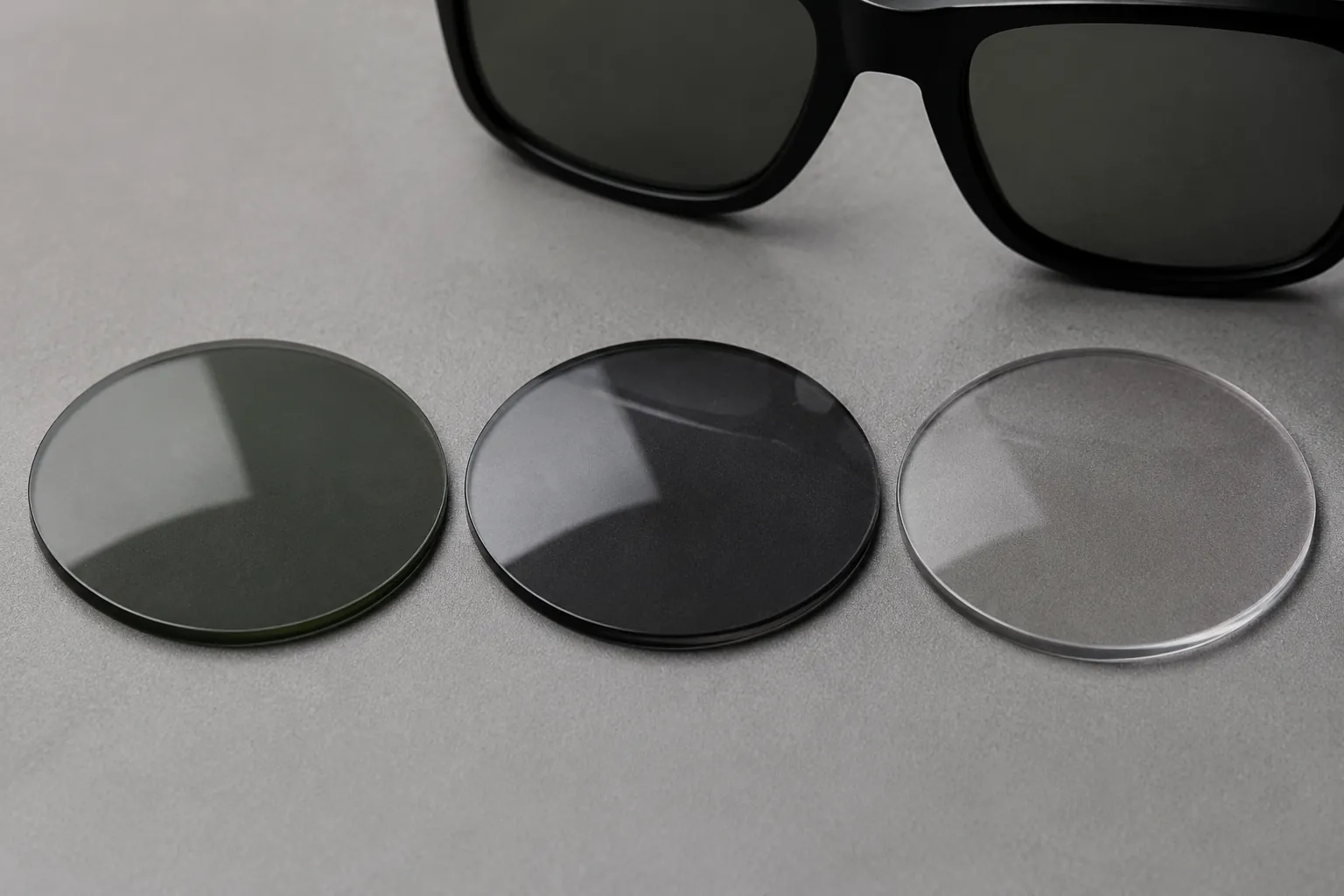
Lens material dictates per-unit cost, regulatory compliance, and return rates for custom sunglasses. This reference compares polycarbonate, CR-39, and glass across five volume bins: 50, 300, 1,000, 3,000, and 5,000+ pairs. We detail weight per lens in grams, impact resistance with exact test protocols, optical clarity via Abbe value and tolerance, and factory process steps. All claims cite verifiable industry standards and documented test procedures.
The Three Lens Materials: Baseline Properties Every Buyer Should Know
Each material presents defined tradeoffs. Below are the core properties with exact tolerances for your technical pack.
- Polycarbonate: Thermoplastic. Highest impact resistance. Passes ANSI Z80.3 high-velocity test at 1.0 mm center thickness (tolerance ± 0.05 mm). Lightest density at ~1.2 g/cm³. Inherently blocks 100% UV up to 400 nm. Soft surface—requires a silicone-based hard coating of minimum 2 µm thickness. Standard center thickness spec: 1.0–1.2 mm. Abbe value: ~30 (± 2).
- CR-39 (allyl diglycol carbonate): Thermoset resin cast from liquid monomer. Best optical clarity among plastics with Abbe value ~58 (± 1). Moderate impact resistance—passes FDA drop ball test at 2.0 mm center thickness (± 0.1 mm). Density of 1.32 g/cm³. Needs dip or spin hard coating at 4–6 µm for scratch protection. Typical center thickness spec: 1.5–2.0 mm.
- Glass (mineral silicate): Maximum scratch resistance with Mohs hardness 6–7. Highest optical clarity (Abbe ~59 ± 1) and permanent color stability—no yellowing after prolonged UV exposure. Heaviest material at 2.5–2.6 g/cm³. Shatters upon impact unless chemically tempered. Excluded from sport and children's sunglasses due to weight and breakage hazard. Standard center thickness: 1.5–2.0 mm for dress frames, 2.0–3.0 mm for prescription.
Select material based on end-use application, price target, and mandatory impact test standards. Specify center thickness tolerance explicitly in your technical pack. An incorrect groove specification causes lens seating failure, edge stress, and fogging.
Cost Breakdown Per Lens Material at Different Order Volumes
Pricing applies to a basic sunglass assembly: acetate or TR90 frame, standard metal hinge, no premium coatings, no polarization, no prescription. Prices are per pair FOB Wenzhou and include basic hard coating on polycarbonate and CR-39. Minimum order quantity per design is 50 pairs. Price breaks activate per design, not across combined orders.
| Volume (pairs/design) | Polycarbonate (USD/pair) | CR-39 (USD/pair) | Glass (USD/pair) |
|---|---|---|---|
| 50 | $3.85 | $4.10 | $5.90 |
| 300 | $3.20 | $3.45 | $4.80 |
| 1,000 | $2.70 | $2.90 | $3.95 |
| 3,000 | $2.30 | $2.55 | $3.45 |
| 5,000+ | $2.10 | $2.30 | $3.20 |
Raw lens material cost differs by $0.30–0.60 per pair between polycarbonate and CR-39 at equivalent thickness. Glass commands a premium because each lens undergoes individual grinding and polishing rather than casting or injection molding. At 5,000 pairs, the cost difference between polycarbonate and glass reaches approximately $1.10 per pair. Lead time remains consistent across materials at the batch level: samples in 7–10 days, bulk production in 25–35 days. Tinting and hard coating add 2–3 days. Glass blanks may extend lead time by 5–7 days if not in stock.
Weight Comparison: Why Polycarbonate Dominates Sport and Kids' Lines
Weight is the primary differentiator. Polycarbonate is the sole material that keeps a full-size sunglass assembly under 25 grams in a standard plastic frame. Measured weights per lens (55 mm diameter, plano, uncoated) are listed below.
- Polycarbonate lens (1.0 mm CT): ~4.2 grams per lens (± 0.1 g).
- CR-39 lens (1.5 mm CT): ~6.5 grams per lens (± 0.2 g).
- Glass lens (1.5 mm CT): ~12.8 grams per lens (± 0.3 g).
- Glass lens (2.0 mm CT, dress frame standard): ~15.5 grams per lens.
Multiply by two lenses and add frame weight. A TR90 frame with polycarbonate lenses for a standard wayfarer shape weighs 22–24 grams total. The same frame with CR-39 reaches 28–30 grams. With 1.5 mm glass, the assembly reaches 38–42 grams. The additional 14–20 grams shift balance, causing the glasses to slide on sweaty skin. Buyers targeting outdoor, cycling, fishing, or children's markets default to polycarbonate. Glass is impractical for active use. In drop tests from 1.5 meters onto concrete, polycarbonate survives, CR-39 may chip, and glass shatters without tempering.
Impact Resistance and Compliance: Which Certifications Apply
All three materials can pass basic drop-ball tests, but at different thicknesses. The compliance matrix below uses real test conditions from published standards.
| Standard | Test Protocol | Polycarbonate (1.0 mm CT) | CR-39 (2.0 mm CT) | Glass (2.0 mm CT) |
|---|---|---|---|---|
| ANSI Z80.3 (2018) | Drop ball: 1″ steel ball from 50 in (1.27 m) | Pass | Pass | Pass |
| ANSI Z80.3 high-velocity | ¼″ steel ball at 150 ft/s (45.7 m/s) | Pass | Fail | Fail |
| CE EN ISO 12312-1:2020 | Drop ball: 16 mm steel ball from 1.27 m | Pass | Pass (≥1.5 mm CT) | Pass (≥1.5 mm CT) |
| FDA 21 CFR 801.410 | Drop ball: ⅝″ steel ball from 50 in | Pass | Pass (≥2.0 mm CT) | Pass (≥2.0 mm CT) |
| AS/NZS 1067.1:2016 (Category 2+3) | Drop ball + UV 400 transmittance ≤ 1% | Pass | Pass (with hard coat) | Pass (with anti-reflective coating) |
Polycarbonate alone passes high-velocity impact at standard thickness. CR-39 and glass fail at 150 ft/s. If your buyer contract mandates ANSI Z80.3 high-velocity or MIL-PRF-31013, CR-39 and glass are non-viable. For basic CE or FDA drop-ball compliance, any of the three materials works at the specified center thickness.
Optical Quality and Scratch Resistance: Where CR-39 and Glass Win
Polycarbonate exhibits lower optical clarity. Its Abbe value of ~30 produces chromatic aberration—color fringing at lens edges measuring 1–3 arcminutes of distortion. Buyers selling to photographers, pilots, or optical shops detect this defect. CR-39 (Abbe 58) and glass (Abbe 59) deliver superior optics with fringing below 0.5 arcminutes. Glass maintains permanent color stability—zero yellowing after 10+ years of UV exposure. Polycarbonate and CR-39 yellow after 3–5 years if not UV-stabilized. Specify UV-stabilized material for any outdoor-use design.
Scratch resistance is another differentiator. Glass ranks highest with Mohs hardness 6–7. CR-39 with hard coating reaches Mohs 4–5. Polycarbonate with silicone-based hard coating at 2–4 µm reaches Mohs 3–4. Uncoated polycarbonate scratches under 5–10 g of force from a fingernail. For low-price retail lines where users do not handle glasses carefully, a hard coat on polycarbonate is mandatory. Cost addition: $0.08–$0.15 per pair depending on volume.
Process and Lead Time: What Happens Inside the Factory
Each lens material follows a distinct production path. The steps below explain lead time and cost differences.
- Polycarbonate: Injection molded. Tooling for a new lens shape costs $350–500 per cavity. Cycle time per lens is 30–45 seconds. Runner and sprue are recycled, keeping material waste under 2%. Lens proceeds to hard coating and curing in a convection oven at 80°C for 1–2 hours. Decoration occurs after coating. Total lens production time from raw resin to finished lens is 4–6 hours.
- CR-39: Cast from liquid monomer in glass molds costing $80–150 per pair. Cure in oven at 60°C for 12–16 hours. After demolding, edges are ground on a CNC wheel in 15–25 seconds per lens. Hard coat dip and second cure require 2–3 hours. Total lens production spans 18–24 hours—more labor-intensive but yields superior optical quality.
- Glass: Cut from sheet stock at 1.5 mm or 2.0 mm ± 0.1 mm. Edging, beveling, and polishing on a diamond wheel take 60–90 seconds per lens. Tinting via dip dye runs 40–60 minutes at 60°C. No hard coating is required. Total time is 3–5 hours per batch, but each lens is individually handled. Chemical tempering adds 8–12 hours in a salt bath at 400°C.
Lead time remains identical for all three at the order level because frame production is the bottleneck: 30–35 days for tooling, molding, assembly, and inspection. Common polycarbonate and CR-39 lens blanks are stocked for over 100 popular sizes. Glass blanks are typically ordered to specification, adding 5–7 days to the first batch. Samples ship in 7–10 days for any material. Bulk orders ship in 25–35 days plus transit time.
Decision Matrix: Which Lens Material Should You Choose?
Use this reference to match your product category to the correct lens material.
- Sport, cycling, fishing, kids, safety (50–10,000 pairs): Polycarbonate. Impact resistance, sub-25 g assembly weight, passes high-velocity testing. Lowest cost at volume: $2.10/pair at 5,000+. Hard coating is mandatory.
- Dress, fashion, optical, premium retail (200–5,000 pairs): CR-39. Superior clarity (Abbe 58, no fringing), moderate weight (28–30 g assembly), adequate impact resistance for daily wear. Marginal cost increase of $0.20–0.30/pair over polycarbonate. Worth the premium when buyers prioritize optics.
- Specialty, luxury, prescription, extreme scratch risk (50–500 pairs): Glass. Maximum clarity and scratch resistance (Mohs 6–7). Heaviest option at 38–42 g. Acceptable only when end-users tolerate weight and fragility—common in high-end prescription frames and laboratory goggles. Expect a $1.10–2.70 premium per pair over polycarbonate.
If undecided, start with CR-39. It is the balanced choice for most fashion and dress designs. Polycarbonate serves high-volume, high-durability lines where impact and weight are critical. Glass is reserved for niche orders.
Common Mistakes Buyers Make When Specifying Lenses
Avoid these three frequent errors.
- Specifying glass for a sports frame without drop testing. Glass shatters on impact without tempering, which adds cost and 8–12 hours processing. Always request a drop-ball sample—minimum three units—before committing to glass for any active-use line.
- Omitting hard coat on polycarbonate. Uncoated polycarbonate scratches easily. Add hard coat at minimal cost to significantly reduce scratch-related returns.
- Assuming CR-39 and polycarbonate share the same center thickness tolerance. CR-39 requires 2.0 mm ± 0.1 mm to pass FDA drop ball. Polycarbonate passes at 1.0 mm ± 0.05 mm. Designing a frame groove for 1.0 mm lenses and later switching to CR-39 at 2.0 mm causes improper lens seating, resulting in fogging, edge stress, and QC rejection. Always specify center thickness and tolerance in your technical drawing.
Have a custom sunglasses project in mind?
Send us your styles, target market and quantities and we will return a detailed quote with MOQ, lead time and a sample plan.
Get a QuoteWhy source this from Wenzhou with LumiShades
Wenzhou in Zhejiang Province is widely regarded as China’s eyewear manufacturing capital, producing a large share of the world’s sunglasses. That concentration matters to buyers: a deep local supply chain for acetate sheet, hinges, lens blanks, plating and packaging means shorter component lead times, easier color and material matching, and a workforce with decades of eyewear-specific skill. LumiShades has manufactured in this ecosystem since 2009, and our vertical integration — in-house injection molding, acetate cutting, CNC milling, lens tinting, decoration and quality control — means no part of your order is quietly subcontracted to a workshop you cannot audit.
For international buyers, that vertical control translates into accountability. When a single factory owns every step, defects are traced and fixed at source rather than bounced between vendors, and your specifications survive intact from first sample to bulk. We back this with 15+ years of experience, shipments to 60+ countries, more than 5 million pairs produced per year and a 98.5% on-time delivery rate. Our certifications — CE EN ISO 12312-1, FDA registration, ANSI Z80.3, AS/NZS 1067, REACH, ISO 9001 and BSCI audit — mean the compliance documentation your market requires already exists. Explore our manufacturing capabilities and quality control process to see how this works in practice.
Frequently asked questions
Can I get a mixed order with polycarbonate in some designs and CR-39 in others? Yes. Each design receives a separate quote. MOQ is 50 pairs per design regardless of lens material. Combine designs on a single shipment with possible consolidation fee. Price breaks at 300, 1,000, and 5,000+ pairs apply per design, not across the total order. For instance, 1,000 pairs of Design A in polycarbonate and 1,000 pairs of Design B in CR-39 each qualify for the 1,000-pair pricing tier independently.
Do I need to order 1,000 pairs to get the $2.10 price for polycarbonate? No. The $2.10 price applies at 5,000+ pairs per design. At 1,000 pairs per design, polycarbonate pricing is approximately $2.70 per pair. At 3,000 pairs, it drops to $2.30. Pricing includes a basic frame (acetate or TR90), standard hinges, polycarbonate lenses with basic hard coating, and standard solid-color tint without gradient. Decoration such as metal logos, pad printing, mirror coating, or gradient tint adds cost based on complexity and volume.
Which lens material do you recommend for children's sunglasses? Polycarbonate. It is the only material that passes high-velocity impact tests at standard thickness while keeping assembly weight under 25 g. Children's sunglasses demand lightweight, shatter-resistant lenses—CR-39 and glass break on impact and add excessive weight. Polycarbonate lenses achieve certification to CE EN ISO 12312-1, FDA 21 CFR 801.410, and ANSI Z80.3 for children's products. A center thickness of 1.2 mm provides additional safety margin.
Can I get a sample set with all three lens materials before placing a bulk order? Yes. Request three sample frames in the same design, each with a different lens material. Standard sample lead time is 7–10 days. Sample cost ranges from $15–25 per pair plus shipping via DHL or FedEx. Sample costs may be partially refundable against the first production order of 300+ pairs per design. Drop-ball test videos are provided free of charge.
Does your factory supply lenses with AR coating or polarization? Yes. Anti-reflective coating (single or multi-layer) and polarization are available on polycarbonate and CR-39 lenses. Polarized film is laminated between lens layers. AR coating is applied via vacuum deposition. These options add $0.40–0.80 per pair depending on volume and lens shape. Glass lenses cannot be polarized identically; a bonded polarized film on glass is available but may marginally reduce optical clarity.
What is the warranty on lenses for bulk orders? Standard warranty is 12 months against manufacturing defects: delamination, coating peeling, bubbles, or impact failure below certified spec. The warranty excludes scratches from normal wear, damage from misuse, or breakage from dropping on concrete. Defective units are replaced within 30 days of notification. Extended warranty terms may be negotiated for high-volume accounts.
Ready to start?
Explore our round sunglasses or request a quote — our sales team replies within 12 hours.
Request a Quote