
OEM Sunglasses Lens Materials: PC, TAC, Nylon, CR-39, Glass
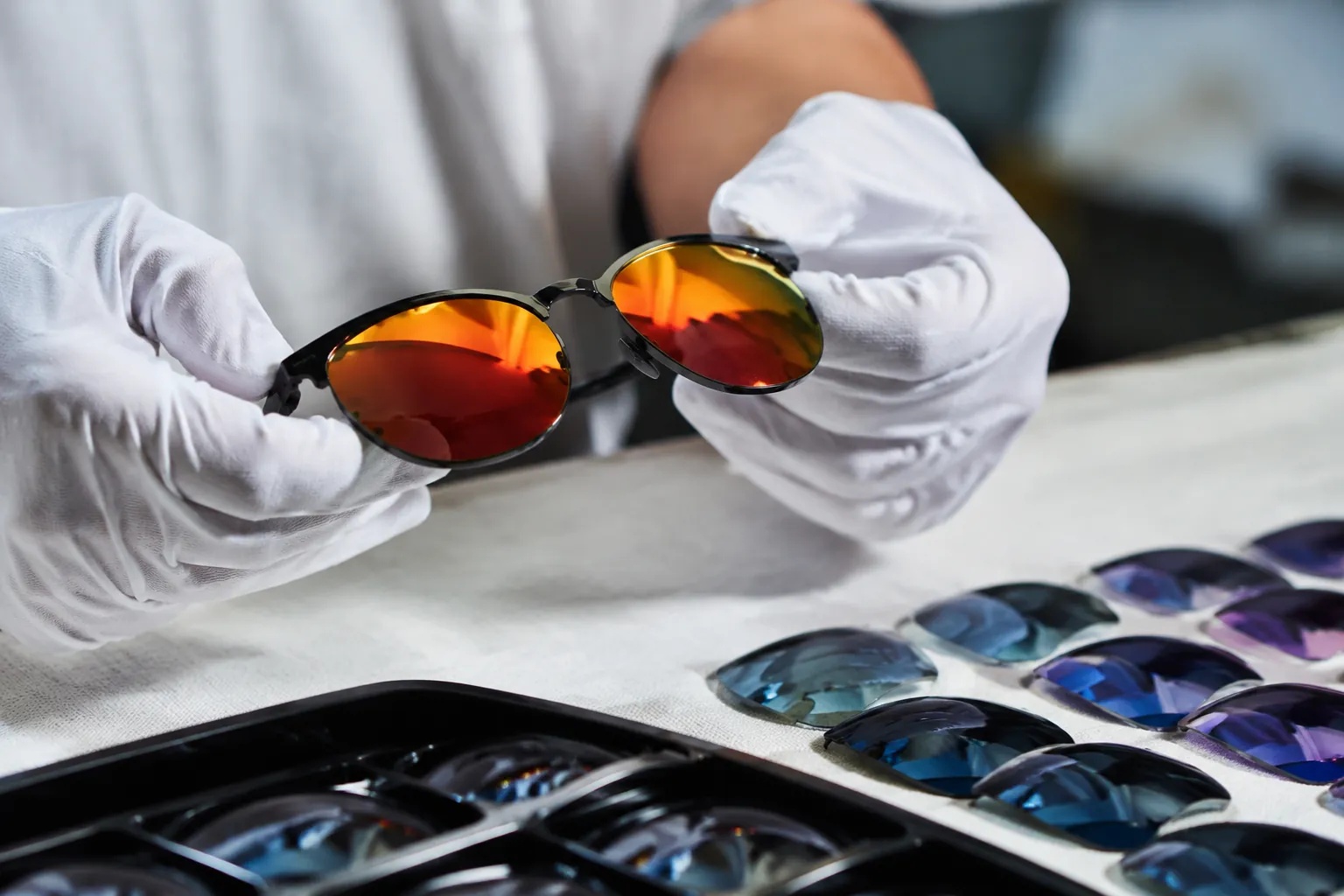
Lens material is not a cosmetic detail. In OEM sunglasses, it affects frame design, groove fit, base curve, coatings, impact performance, packaging, inspection, and landed cost. This guide compares PC, TAC, nylon, CR-39, and glass for overseas brands, importers, distributors, and retail buyers who need a usable lens specification before asking a supplier for a quote.
Match Lens Material To The Order
Most OEM sunglasses problems start with a mismatch. The lens does not fit the product brief. A basic PC lens may work for a low-cost fashion or promotional order, but retail programs usually need a hard coat. A TAC polarized lens can be right for lifestyle sunglasses, but it is a poor shortcut for aggressive wrap designs unless the supplier proves curve stability and optical quality. Glass can support a premium position. It also adds weight, breakage risk, and packaging pressure.
For volume OEM sunglasses, the practical materials are PC, TAC, nylon, CR-39, and glass. The lens decision affects the whole build: frame groove width, rim tension, lens thickness, base curve, coating process, visible light transmission category, impact testing risk, inner packaging, carton protection, and inspection method. A serious RFQ defines the lens material with the frame structure and target market. It does not treat the lens as a last-minute color choice.
| Lens material | Typical refractive index | Relative weight | Best OEM fit | Main caution | Typical cost position |
|---|---|---|---|---|---|
| PC | About 1.586 | Very light | Fashion, promo, kids, basic sport-style frames | Needs hard coating for better scratch resistance in retail use | Lowest to low-mid |
| TAC | Varies by laminate structure | Light | Mass-market polarized lifestyle sunglasses | Heat, edging, lamination, and high-curve limits | Low-mid |
| Nylon | Often around 1.52-1.54 depending on grade | Light | Wraps, shields, cycling, outdoor performance | Higher material, forming, and fixture-control cost | Mid to high |
| CR-39 | About 1.498 | Medium | Optical shops, acetate fashion, prescription-ready lines | Lower impact resistance than PC or nylon | Mid |
| Glass | Often around 1.52 or higher depending on type | Heavy | Premium heritage, driving, fishing, specialty retail | Breakable, heavy, and packaging-sensitive | High |
PC Lenses: Low Weight, Strong Impact, Tight Cost
Polycarbonate, or PC, is common in OEM sunglasses because it is light, impact resistant, and efficient to process. It suits fashion frames, kids sunglasses, promotional orders, basic sport-style frames, and large color assortments. For many buyers, PC is the starting point: low weight, good toughness, and manageable cost.
PC lenses may be injection molded or cut from lens blanks, depending on the design and supplier process. Lens thickness, edge profile, and base curve must match the frame. In full-rim frames, the lens should sit cleanly without rattle, edge stress, or visible whitening. Tolerances should be agreed with the supplier based on frame material, groove design, lens size, and inspection method. PC is tough. It is not impossible to damage. Tight rims, uneven heating, and poor edging can still create failures.
The main weakness is surface hardness. PC is not naturally scratch-proof. A hard coat is normally required for retail programs, especially for optical chains, department stores, travel retail, and e-commerce orders where returns are expensive. Mirror coatings also need controlled inspection. Check adhesion, edge coverage, color consistency, scratches, and pinholes under consistent light and at an angle. General factory lighting is not enough.
PC can be used in products designed for CE EN ISO 12312-1, ANSI Z80.3, AS/NZS 1067, REACH, and FDA registration-related import requirements, but compliance depends on the finished sunglasses. The material name alone proves little. The RFQ should state material, UV claim, VLT category, tint, mirror color, hard coat, polarization requirement if any, base curve, frame type, and target market. "Black PC lens" is not a usable OEM specification.
TAC Lenses: Polarized Value, Clear Limits
TAC is a common choice for affordable polarized sunglasses. It is a laminated lens structure, usually built around a polarizing film. The consumer benefit is simple: polarized lenses reduce reflected glare from water, roads, vehicle hoods, and glass. That makes TAC a strong fit for beach shops, resort retail, fishing lifestyle ranges, online marketplaces, and mid-price fashion programs.
The limits are physical. TAC is more sensitive to heat, aggressive bending, poor edging, and lamination defects than stronger lens materials. Long exposure to high heat during storage or transport can raise the risk of warpage or delamination. High-base curves can also create optical distortion or stress marks if the lens and frame are not designed together. For many TAC programs, moderate curves are easier to control than aggressive wrap shapes. If the buyer wants a high-wrap sport look, the supplier should verify distortion, fit, and polarization performance on physical samples before bulk production.
- Use TAC for standard full-rim polarized fashion, beach, resort, and lifestyle sunglasses.
- Avoid TAC for aggressive shields or high-wrap sport designs unless curve stability and distortion checks pass on physical samples.
- Specify UV400, VLT category, polarization, base curve, tint color, mirror color, coating surface, and target market.
- Check lenses with a polarization tester, daylight inspection, and a simple distortion check against straight lines.
- Control storage and handling: avoid high heat, long uncontrolled storage, pressure stacking, and rough edging.
TAC usually costs more than basic non-polarized PC, but it can keep mass-market polarized programs accessible. Lead time depends on laminate type, color, mirror, coating, and curve. Standard options are easier to source. Custom films, unusual mirror colors, low-volume laminates, and non-standard curves need extra confirmation because the supplier must check availability, adhesion, cutting yield, and optical quality.
Nylon Lenses: For Wraps, Shields, And Sport Shapes
Nylon lenses are used when the product shape is more technical: shield sunglasses, rimless sport frames, cycling eyewear, high-wrap outdoor styles, and performance-focused collections. Nylon offers low weight, good toughness, flexibility, and better stability on curved shapes than many low-cost alternatives. It costs more than PC or TAC. In large, curved, drilled, or structural lens designs, that higher cost can reduce bigger production risks.
The factory challenge is curve control. A shield lens can look correct in CAD and still fail in wear if cutting, drilling, coating, or assembly creates distortion. Drill holes for rimless or semi-rimless styles must be clean, centered, and free of visible cracks or stress marks. Screw tension needs control. Over-tightening can create stress around the hole. For sport shields, sample approval should usually move in stages: lens curve and outline, drill position and frame fit, coating approval, then final assembled sample. Skip those checks and the risk moves into bulk production.
For nylon programs, buyers should ask for the lens grade or supplier material reference, base curve, center thickness, critical edge thickness, coating stack, drill-hole requirements, impact target, and applicable standard. Hole-position tolerance and outline tolerance should be agreed in the technical drawing and verified against a fixture or approved sample. For shield lenses, small dimensional errors can change nose fit, temple pressure, and face clearance. A front-view check is not enough.
If the product will be sold with sport, cycling, outdoor, or impact-related positioning, nylon is often the more responsible choice than TAC. PC may still work for simpler sport-style frames, especially full-rim designs with moderate curves. Decide from physical samples, target testing, and the way the product will be marketed.
CR-39 Lenses: Cleaner Optics For Fashion And Optical Accounts
CR-39 is a hard resin material valued for optical clarity and tint quality. It is heavier than PC but usually lighter than glass. It is less impact resistant than PC or nylon, so it is not the first choice for children's sunglasses, rough sport use, thin rimless designs, or frames that must be flexed heavily during assembly. Used in the right channel, CR-39 gives a cleaner, more traditional optical feel.
CR-39 fits acetate sunglasses, optical-shop programs, premium fashion lines, and prescription-ready collections. Brown gradients, G15-style green, smoke grey, and refined fashion tints can look more controlled than low-cost lens options when the tinting process is well managed. It also suits brands that want an optical position without the weight and breakage risk of glass.
Processing needs care. Lens edging should be controlled to avoid chips, especially around sharp lens corners, thin edges, or drilled areas. Acetate frame grooves must match the lens thickness and bevel. If the lens is forced into a tight rim, edge stress can build and later show up as fit problems after temperature changes or handling. Physical sample approval is necessary because a rendering cannot show tint depth, optical feel, coating appearance, or rim stress.
For CR-39 orders, confirm UV claim, VLT category, tint standard or approved color sample, coating requirements, lens thickness, frame groove fit, and target compliance standard. If the line is intended for optical accounts, the supplier should also clarify whether the product is for plano sunglasses only or part of a prescription-ready frame program.
Glass Lenses: Premium Clarity, Higher Handling Risk
Glass offers strong scratch resistance and high optical clarity. It also gives a premium hand feel that some customers expect in heritage, driving, fishing, and specialty retail sunglasses. The trade-off is weight, breakage risk, and higher processing cost. Glass is not a general-purpose OEM upgrade. Choose it only when the sales channel can explain and sell the benefit.
Frame design must be stable because glass will not flex like PC or nylon during assembly. Metal frames need controlled rim closure. Acetate frames need accurate groove fit and careful heating. A twisted frame can create pressure points. Weak packaging can turn transit vibration or compression into cracked lenses. For glass orders, packaging belongs in the product specification: individual protection, clean pouch or inner bag choice, suitable case selection, carton strength, and drop-test logic appropriate to the shipment method.
Glass sunglasses still need normal compliance discipline. UV protection, visible light transmission category, labeling, coating chemistry, nickel release on metal parts, and restricted substances remain relevant. For CE EN ISO 12312-1, ANSI Z80.3, AS/NZS 1067, REACH, and FDA registration-related markets, plan testing before bulk production. Glass does not remove sunglass testing. It changes the handling, impact, and packaging risk profile.
How Lens Choice Changes MOQ, Price, And Lead Time
Lens material changes more than one line on a quote. It affects sample count, lens sourcing, coating yield, inspection time, packaging, and the chance that testing or sample approval must be repeated. MOQ and lead time are supplier-specific, so treat quoted numbers as conditional until the material, frame, decoration, packaging, and testing plan are locked.
Standard PC and TAC programs are usually easier to quote and schedule because materials and coatings are widely available. Nylon shields may need extra time for curve forming, drilling fixtures, and distortion checks. CR-39 may need tint matching and edge-fit approval. Glass may require careful sourcing, controlled assembly, and upgraded packaging validation. Special mirror coatings, metal logo plates, laser logos, pad-printed temples, custom cases, retail boxes, barcode labels, and hangtags can also add setup time.
| Order factor | Effect on quote | Effect on lead time | Buyer action |
|---|---|---|---|
| Small pilot order | Higher unit cost because setup is spread over fewer pairs | Useful for sampling, distributor review, and market testing | Keep colors, coatings, and packaging simple |
| Mid-size order | Better material and labor efficiency than a pilot order | Usually stable when materials and decorations are standard | Lock lens category, coating, decoration, and packaging before approval |
| Large retail order | Stronger price leverage on lenses, frames, packaging, and QC | May need staged material approval and production inspection | Confirm the test plan before production starts |
| High-volume program | Best efficiency but higher compliance, inventory, and consistency exposure | May require staged production, pre-shipment inspection, and retained samples | Use approved pre-production samples and AQL inspection |
A cheap lens does not guarantee a cheap finished product. A basic PC lens combined with acetate cutting, custom metal logos, a hard case, printed box, hangtag, barcode label, and multiple colorways can cost more than a simpler frame with a higher-grade lens. Compare complete bills of materials, not isolated lens names.
Buyer Rules Before You Quote
A good lens brief is short, but it must be complete. Vague briefs create false price comparisons because each supplier fills in missing details differently. One supplier may quote basic PC. Another may include hard coating. A third may assume TAC polarized. The lowest quote may simply be the least defined quote.
Practical rule: specify lens material, UV claim, VLT category, polarization, tint, coating, base curve, target market, frame structure, decoration method, packaging, and applicable standard before comparing prices.
Use PC when impact resistance, low weight, and cost control matter most. Use TAC when polarized value matters and the design is not too curved. Use nylon when performance shape, drilling, flex, and curved optics matter. Use CR-39 when optical clarity and tint quality matter more than rough-use impact. Use glass only when the channel can justify weight, cost, and careful handling.
Decoration should also be part of the lens and frame discussion. Lens logos may use laser marking, pad printing, or other methods depending on the lens surface and coating. Temple logos may use pad printing, laser engraving, metal plaques, hot stamping, or embedded marks. Each method has durability and tolerance limits. A lens logo must be checked for position, contrast, adhesion, coating damage, and cleaning resistance. A metal logo plate can change temple tooling, assembly time, and inspection criteria.
For overseas OEM buyers, process control matters as much as material selection. Ask the supplier which processes are handled in-house and which are subcontracted. Then confirm how samples, materials, inspections, and test reports are controlled. Compliance references should be real and relevant: CE EN ISO 12312-1, ANSI Z80.3, AS/NZS 1067, REACH, FDA registration, ISO 9001, and BSCI. Ask for the applicable test plan before production. Fixing lens compliance after bulk goods are packed is expensive and slow.
Have a custom sunglasses project in mind?
Send us your styles, target market and quantities and we will return a detailed quote with MOQ, lead time and a sample plan.
Get a QuoteWhy source this from Wenzhou with LumiShades
Wenzhou in Zhejiang Province is widely regarded as China’s eyewear manufacturing capital, producing a large share of the world’s sunglasses. That concentration matters to buyers: a deep local supply chain for acetate sheet, hinges, lens blanks, plating and packaging means shorter component lead times, easier color and material matching, and a workforce with decades of eyewear-specific skill. LumiShades has manufactured in this ecosystem since 2009, and our vertical integration — in-house injection molding, acetate cutting, CNC milling, lens tinting, decoration and quality control — means no part of your order is quietly subcontracted to a workshop you cannot audit.
For international buyers, that vertical control translates into accountability. When a single factory owns every step, defects are traced and fixed at source rather than bounced between vendors, and your specifications survive intact from first sample to bulk. We back this with 15+ years of experience, shipments to 60+ countries, more than 5 million pairs produced per year and a 98.5% on-time delivery rate. Our certifications — CE EN ISO 12312-1, FDA registration, ANSI Z80.3, AS/NZS 1067, REACH, ISO 9001 and BSCI audit — mean the compliance documentation your market requires already exists. Explore our manufacturing capabilities and quality control process to see how this works in practice.
Frequently asked questions
Which lens material is best for a low-cost OEM sunglasses order? PC is usually the best starting point for a low-cost order because it is light, impact resistant, widely available, and efficient to process. For retail use, do not specify only "PC lens." Add UV400, VLT category, tint color, hard coating if scratch resistance matters, mirror coating if required, base curve, frame type, target market, and the standard the finished sunglasses must meet.
Should I choose TAC or PC for polarized sunglasses? Choose TAC for most standard polarized lifestyle sunglasses when you need glare reduction at mass-market pricing and the frame has a moderate curve. Choose polarized PC only if the supplier can confirm the polarizing construction, impact target, coating quality, and optical performance for your design. For either option, ask for a physical sample and check polarization, VLT category, UV protection, distortion, coating appearance, and fit in the final frame.
Which material works best for sport wrap sunglasses? Nylon is usually the safer choice for curved sport wraps and shields because it handles flex, drilling, impact demands, and curved optics better than TAC in many designs. PC can work for simpler sport-style full-rim frames with moderate curves. Use TAC cautiously on aggressive wraps and only after the supplier verifies curve stability, distortion, polarization performance, and assembly fit on physical samples.
Can all five materials meet CE or ANSI requirements? All five materials can be used in compliant sunglasses, but compliance is judged on the finished product, not on the lens material alone. Confirm the target market first, then test the complete sunglasses for applicable requirements such as CE EN ISO 12312-1, ANSI Z80.3, AS/NZS 1067, REACH, and FDA registration-related import requirements. Also confirm labeling, VLT category, UV protection, impact requirements, and restricted-substance controls before bulk production.
What lens details should I include in an RFQ? Include lens material, UV400 requirement, VLT category, tint color or approved color reference, polarization requirement, mirror or hard coating, base curve, lens thickness if critical, frame style, target market, order quantity, logo method, packaging, and required standard. If the design is a shield, rimless frame, drilled lens, or high-wrap style, also include hole locations, fixture requirements, impact target, and sample approval steps.
Will premium lenses increase lead time? Often, yes. Standard PC and standard TAC are usually easier to source and approve. Nylon shields may need curve, drilling, and distortion validation. CR-39 may need tint matching and edge-fit approval. Glass may need extra handling and packaging checks. Special mirrors, custom colors, metal logos, custom cases, retail boxes, and compliance testing can also extend the development schedule, so lock the full bill of materials before confirming delivery dates.
Ready to start?
Explore our cat-eye sunglasses or request a quote — our sales team replies within 12 hours.
Request a Quote