
OEM Sunglass Lens Materials: PC, TAC, Nylon, CR-39, Glass
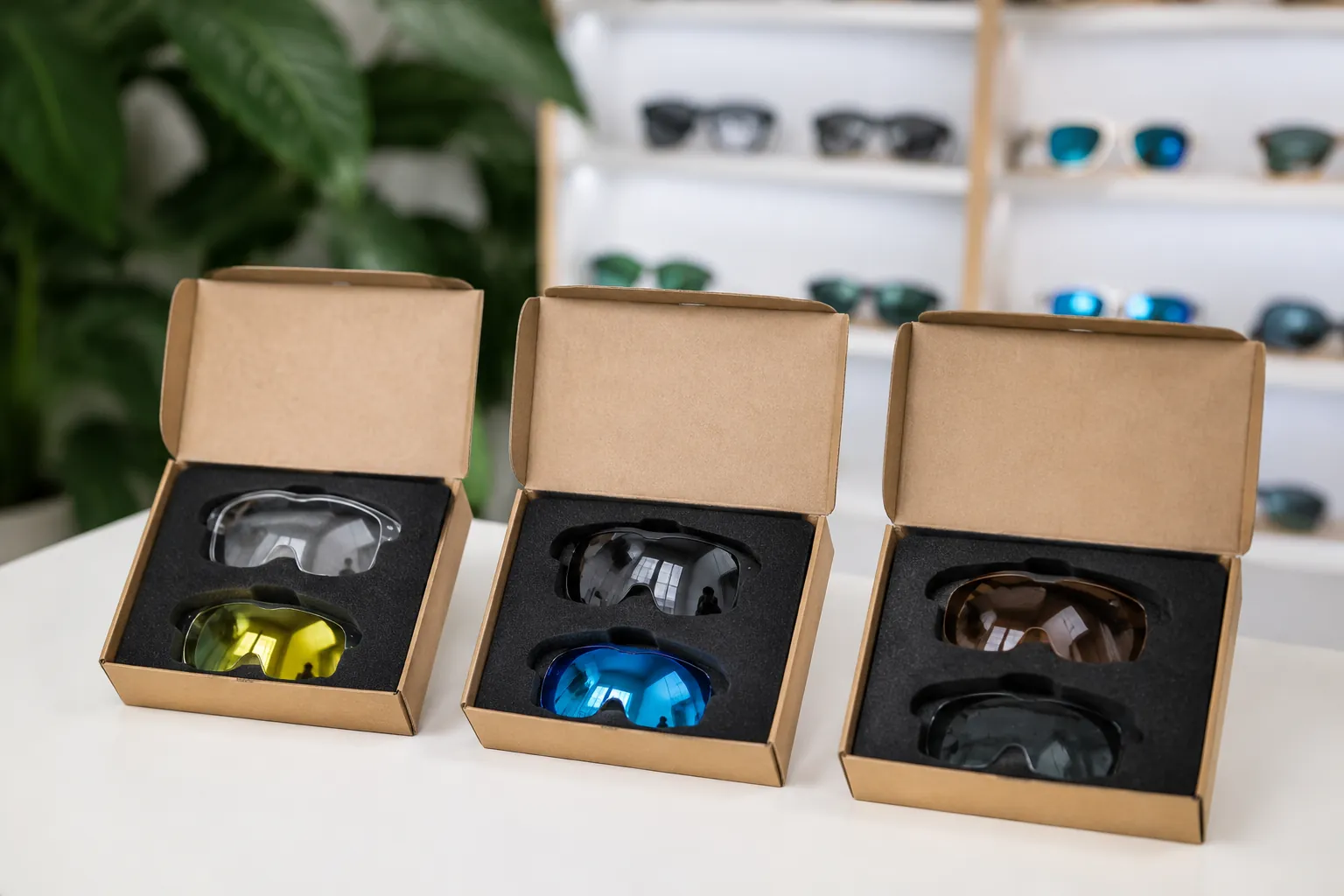
This guide is for overseas brands, importers, distributors, and retail buyers choosing lenses for custom sunglasses programs. The goal is practical: match PC, TAC, nylon, CR-39, or glass to the product position, sales market, frame design, decoration plan, and order quantity before samples are approved. Lens choice affects impact performance, optical distortion, coating adhesion, lens fit, packing risk, freight weight, and after-sales claims. Many lens problems do not show clearly in a photo sample. They show up later in bulk production, when color matching, edge fit, coating durability, or polarized axis consistency starts drifting across cartons.
Fast Decision Matrix For Bulk Buyers
Lens material is not just a style choice. It affects the production route, inspection focus, coating stack, compliance risk, and landed cost. For OEM sunglasses, the main practical choices are PC, TAC, nylon, CR-39, and glass. Each material has a place. None is best for every order.
| Material | Best Use Case | Typical Thickness | Impact Resistance | Optical Clarity | Bulk Cost Position |
|---|---|---|---|---|---|
| PC | Sports, kids, promotional, safety-style sunglasses | Commonly around 1.8-2.2 mm, design dependent | Very high for sunglass applications | Good, but molding stress can affect optics | Low to mid |
| TAC | Polarized fashion, retail multipacks, fishing promotions | Commonly around 0.7-1.1 mm sheet lens, design dependent | Moderate | Good for the price when lamination is controlled | Low to mid |
| Nylon | Rimless, shield, cycling, running, premium sports | Commonly around 1.8-2.0 mm, design dependent | High | Very good on high curves when processed correctly | Mid to high |
| CR-39 | Optical-quality fashion sunglasses | Commonly around 1.8-2.2 mm, design dependent | Moderate to low compared with PC and nylon | Excellent | Mid |
| Glass | Premium heritage and mineral lens collections | Commonly around 1.8-2.0 mm, design dependent | Low unless specially strengthened and tested | Excellent | High after handling, packing, and freight are included |
For a low-MOQ trial or promotional price point, PC or TAC usually makes more sense than CR-39 or glass. For a brand built on clarity, scratch resistance, or premium outdoor performance, the cheapest lens can become expensive through returns. Compare material, lens curve, UV performance, visible light transmission category, coating requirements, decoration, packaging, test documents, and inspection standards together. A low unit price means little if the lens cannot pass the buyer's target market requirements.
PC: Strong, Light, And Easy To Scale
Polycarbonate, usually called PC in sunglass sourcing, is the workhorse material for OEM sunglasses that need impact resistance, low weight, and scalable production. PC lenses are often injection molded, so lens curve, edge shape, groove fit, and center thickness can be controlled once the mold and process window are stable. Final dimensions still depend on the frame design, base curve, groove depth, and assembly pressure.
The main advantage is toughness. PC is the first material to consider for kids' sunglasses, sports frames, outdoor promotions, and markets where buyers ask direct questions about breakage. It is also light. That matters for wearer comfort and carton planning, though the real freight impact depends on the full product and packaging.
The weak point is optical stress. Poor molding temperature control, short cooling time, bad gate position, uneven lens thickness, or excessive frame pressure can create birefringence and distortion. Under polarized inspection, stressed PC may show rainbow patterns. End users may notice distortion while driving, looking at screens, or viewing straight lines through high-curve lenses.
- Use PC for sports, youth, event, outdoor, and cost-sensitive retail programs where impact resistance matters.
- Specify UV400, visible light transmission category, base curve, center thickness, lens color, and coating requirement before sampling.
- For mirror PC, approve both color and adhesion using agreed checks such as tape testing, rub testing, or light abrasion checks.
- Control lens fit after assembly; a tight frame groove can distort a lens that looked acceptable before assembly.
- Avoid strong scratch-resistance claims unless a hard coating is included and verified against the buyer's inspection standard.
PC fits injection-molded frames, promotional programs, and repeatable high-volume production. For sampling, use an existing mold and available lens color where possible. Custom curves, special mirrors, new tooling, or third-party testing add time. Confirm them before the buyer commits to a launch date.
TAC: The Polarized Volume Choice
TAC means triacetate cellulose. In sunglasses sourcing, buyers choose it because it makes polarized lenses affordable. TAC polarized lenses are made from laminated sheet material, then cut to shape. A typical structure includes TAC layers around a polarizing film, with UV, tint, adhesive, and sometimes hard-coat layers depending on the supplier and price level.
TAC works well for fashion sunglasses, retail multipacks, resort channels, fishing-style promotions, and mid-price private label lines. It gives the buyer a polarized claim without the cost of nylon or glass. It is also MOQ-friendly when standard smoke, brown, green, grey, or gradient sheets are available.
But TAC has limits. It is not as impact resistant as PC or nylon. It is also sensitive to lamination quality, edge sealing, humidity, heat, and coating adhesion. Poor TAC can delaminate at the edge, show uneven color, lose mirror coating, or create left-right mismatch. A sales sample may look clean. Bulk can still fail after storage, sweat exposure, or transit in hot containers.
For TAC sourcing, do not only ask for "polarized lenses." Ask the supplier to confirm polarization efficiency, axis control, UV400 performance, visible light transmission, and color tolerance. For driving-category sunglasses, VLT must match the legal market category. Traffic signal recognition must also be considered under the applicable standard, such as CE EN ISO 12312-1, ANSI Z80.3, or AS/NZS 1067.
TAC is practical when the buyer wants affordable polarization and can accept moderate impact performance. Standard sheet colors are the safest route for small test orders. Custom gradient, flash mirror, special polarizing color, or uncommon curve can push minimums higher because sheet waste, development time, and setup loss are real costs.
Nylon: Better For Curved Performance Frames
Nylon lenses are often the better answer for performance sunglasses with aggressive wrap, rimless mounting, or shield shapes. They are lighter than glass, stronger than TAC, and can deliver cleaner optics than poorly molded PC when the curve is demanding. For cycling, running, fishing, golf, and premium outdoor frames, nylon can solve problems that lower-cost lens options create.
The reason is material behavior. Nylon suits high base curves and complex shapes when the lens is designed and processed correctly. It also drills and machines well for rimless or semi-rimless frames when the hole diameter, bridge slot, screw position, and edge distance are engineered properly. If the buyer wants a one-piece shield with vent holes, lens logo engraving, and a mirror coating, nylon belongs on the shortlist.
Cost is the catch. Nylon blanks and processing usually cost more, and yield losses hurt more. Surface preparation also matters. Mirror layers, hydrophobic coatings, anti-scratch coatings, and oleophobic finishes can perform well, but only if cleaning, curing conditions, and coating thickness are controlled. A premium nylon lens with a weak coating stack still creates complaints.
MOQ is less friendly than PC or standard TAC when color is custom. Standard smoke, brown, green, and selected mirror combinations are easier. Brand-matched tints, unusual transparent colors, or exact VLT targets may require higher quantity, longer development, or third-party lab confirmation. For a new model, use an existing lens color for the first sample round where possible. Move to custom color after confirming the frame design and sales case.
Nylon is not necessary for every sunglass. For a simple acetate fashion frame with a low base curve, TAC or CR-39 may be more logical. For an 8-base wrap, rimless shield, or premium sports model, nylon often earns its cost through better fit, strength, and wearer experience.
CR-39 And Glass: Clarity With Trade-Offs
CR-39 is a cast resin material with excellent optical clarity. It has a long history in optical lenses and works well for fashion sunglasses where the buyer wants a cleaner view than low-cost PC or TAC. It accepts solid and gradient tinting well and can produce rich colors for acetate and metal frames.
The trade-off is impact resistance. CR-39 is not the first choice for kids, sports, rimless shields, or high-abuse retail channels unless the buyer understands the testing and claim risk. It is also heavier than PC in many designs. In a full-rim acetate or metal frame, that may be acceptable. In a thin rimless frame, it requires careful review of thickness, hole position, edge finish, and assembly method.
Glass provides excellent optics and strong scratch resistance. It can also support premium positioning in heritage, outdoor, or mineral lens collections. The problems appear in bulk handling. Glass is heavy, can break, needs careful edging, and requires better protective packing. Freight cost can rise, drop-test risk increases, and QC handling slows down. Chips, cracks, and edge damage are harder to dismiss than minor cosmetic marks on some plastic lenses.
Blunt sourcing note: if a buyer wants the cheapest possible sunglass and also asks for mineral glass, the specification is fighting itself. The pressure points will be margin, delivery time, packing cost, and claim risk.
For both CR-39 and glass, confirm regulatory needs early. UV protection, luminous transmittance, traffic signal recognition, and category labeling are not decoration issues. They affect whether the product can be sold cleanly under CE EN ISO 12312-1 in Europe, ANSI Z80.3 in the United States, and AS/NZS 1067 in Australia and New Zealand. REACH may also apply to chemical compliance for materials, coatings, and frame components. FDA registration may be relevant for the US eyewear supply chain, but it does not replace sunglass lens performance testing.
Coatings, Tinting, Decoration, And QC Checks
The base material is only half the lens decision. Tinting, polarization, mirror coating, hard coating, hydrophobic coating, logo decoration, and packing method can change both cost and failure rate. A low-cost lens with too many surface processes can become less stable than a better material with a simpler finish.
For OEM orders, put the coating requirement into the purchase specification, not only in email. Define lens category, UV400 requirement, color tolerance, mirror color, scratch expectation, logo method, and whether the decoration sits on the lens, temple, hinge area, pouch, or outer box. If multiple suppliers or subcontractors are involved, identify who owns lens coating, frame assembly, final cleaning, packing, and corrective action if defects appear.
Agree useful production tolerances before bulk starts. Discuss center thickness tolerance, lens edge fit, allowable lens gap, visible scratch limits by inspection distance, coating pinholes, color matching, logo position tolerance, and polarization axis control for polarized lenses. Exact limits depend on the design and target market. Write them into the approved specification or QC checklist before final inspection.
- Approve the physical sample under daylight, indoor LED light, and against a white background.
- Check left and right lens color match before approving the sales sample.
- For polarized lenses, check axis alignment, phone-screen blackout consistency, and supplier test documentation.
- Run agreed adhesion checks on mirror, printed, or coated surfaces before bulk packing.
- Check lens fit after frame assembly, not only loose lens dimensions.
- Confirm carton packing prevents lens rubbing during sea or air transit.
A practical QC plan checks incoming lens lots, in-process assembly, finished pair inspection, and final random inspection. ISO 9001 certification can support process control and documentation discipline, but it does not prove that a specific sunglass shipment meets CE EN ISO 12312-1, ANSI Z80.3, or AS/NZS 1067. BSCI is relevant to social compliance, not lens performance. Do not treat it as a substitute for product inspection or laboratory testing.
MOQ, Lead Time, And Landed Cost Logic
A lens that is cheap on paper may not be cheap landed. Tooling, sheet waste, coating rejection, packing, freight weight, defect allowance, and compliance testing all sit behind the unit price. Do not ask only, "what is the lens price?" Ask what changes at 50, 300, 1000, and 5000 pairs, or whatever quantity ladder matches the sourcing plan.
| Order Situation | Best Lens Fit | Why It Fits | Main Buyer Risk |
|---|---|---|---|
| Small trial order | Standard PC or TAC | Uses available molds, sheet colors, and lower setup burden | Custom tint or mirror may not be economical |
| Retail test order | TAC, PC, selected CR-39 | Enough volume for basic decoration and more stable unit pricing | Too many SKUs split the savings |
| Brand reorder | PC, TAC, nylon, CR-39 | Stable QC plan and upgraded material options become more practical | Late compliance or packaging changes delay shipment |
| Seasonal volume program | Material chosen by channel | Volume can support custom colors, coatings, tooling, and better landed cost | A small defect rate becomes a large claim count |
Ask the supplier to separate standard options from custom options. Standard PC colors and standard TAC polarized sheets usually move faster than new lens colors, uncommon mirror finishes, new molds, or special coatings. Confirm bulk lead time only after the supplier reviews the final frame, lens material, decoration, packaging, compliance documents, and lab testing needs.
For landed cost, include duty code assumptions, inner bag or pouch cost, carton dimensions, defect allowance, and whether the order ships by air or sea. Glass can look acceptable at FOB level and then become expensive through freight and breakage control. PC can look cheap and then disappoint if the coating is under-specified. The spreadsheet needs a quality and compliance column, not only a unit-price column.
A Practical Spec To Send The Factory
Factories quote faster and more accurately when the buyer sends a usable specification. Vague language like "premium polarized lens" creates rework because it does not define material, category, curve, coating, compliance market, or inspection limits. A good spec does not need to be long. It does need to be precise.
- Frame type: injection, acetate, metal, rimless, semi-rimless, or shield.
- Lens material: PC, TAC, nylon, CR-39, or glass.
- Lens curve and thickness: for example 6-base, 2.0 mm, subject to frame fit and supplier confirmation.
- Lens function: non-polarized, polarized, gradient, mirror, or photochromic if available and confirmed.
- UV and category: UV400 and required visible light transmission category.
- Compliance market: CE EN ISO 12312-1, ANSI Z80.3, AS/NZS 1067, REACH, and FDA-related US documentation if applicable.
- Decoration: laser engraving, pad print, metal logo plate, temple logo, lens logo position, pouch, and box branding.
- Inspection points: scratches, coating adhesion, color match, lens fit, optical distortion, packing rub marks, and logo position.
- Quantity ladder: trial quantity, reorder quantity, and seasonal program quantity where relevant.
For a first sourcing round, ask the supplier to recommend two options: one cost-controlled and one quality-upgraded. Require the supplier to identify what changes between the options, such as material, coating, lens category, polarization quality, expected MOQ, and test documentation. Then compare physical samples, not photos only. Hold the sunglasses, flex the frame, inspect the lens edge, wear them outside, check straight-line distortion, and test polarized pairs against a phone screen.
For most overseas buyers, the safest default is simple: PC for impact resistance and low cost, TAC for affordable polarization, nylon for curved performance, CR-39 for optical fashion, and glass only when the brand and price point can absorb the weight, packing, handling, and breakage risk.
Have a custom sunglasses project in mind?
Send us your styles, target market and quantities and we will return a detailed quote with MOQ, lead time and a sample plan.
Get a QuoteWhy source this from Wenzhou with LumiShades
Wenzhou in Zhejiang Province is widely regarded as China’s eyewear manufacturing capital, producing a large share of the world’s sunglasses. That concentration matters to buyers: a deep local supply chain for acetate sheet, hinges, lens blanks, plating and packaging means shorter component lead times, easier color and material matching, and a workforce with decades of eyewear-specific skill. LumiShades has manufactured in this ecosystem since 2009, and our vertical integration — in-house injection molding, acetate cutting, CNC milling, lens tinting, decoration and quality control — means no part of your order is quietly subcontracted to a workshop you cannot audit.
For international buyers, that vertical control translates into accountability. When a single factory owns every step, defects are traced and fixed at source rather than bounced between vendors, and your specifications survive intact from first sample to bulk. We back this with 15+ years of experience, shipments to 60+ countries, more than 5 million pairs produced per year and a 98.5% on-time delivery rate. Our certifications — CE EN ISO 12312-1, FDA registration, ANSI Z80.3, AS/NZS 1067, REACH, ISO 9001 and BSCI audit — mean the compliance documentation your market requires already exists. Explore our manufacturing capabilities and quality control process to see how this works in practice.
Frequently asked questions
Which lens material is best for a low-MOQ OEM sunglasses test order? Standard PC or TAC is usually the safest starting point because existing molds, common sheet colors, and established processes keep setup risk lower. Ask the supplier which colors, curves, and coatings are already available. Avoid custom tint, custom mirror, unusual base curve, or special polarizing film until the frame design and sales potential are proven.
Is TAC polarized lens quality good enough for retail sunglasses? Yes, if the supplier controls lamination, polarization axis, UV protection, visible light transmission, color matching, coating adhesion, and edge quality. Do not approve TAC from photos. Request physical samples, check left-right color match, test blackout against a phone screen, inspect the lens edge for delamination, and request test documents for the market where the sunglasses will be sold, such as CE EN ISO 12312-1, ANSI Z80.3, or AS/NZS 1067.
When should we pay more for nylon lenses? Use nylon when the design needs high-curve performance, a shield lens, rimless mounting, drilled holes, or better optical stability in a sports frame. It is usually unnecessary for a simple low-curve fashion frame. Before upgrading, compare PC and nylon samples in the actual frame, then check distortion, lens fit, coating adhesion, screw-hole strength if drilled, and final wearer comfort.
Are glass lenses worth using in bulk sunglasses orders? Glass is worth considering only for premium programs where optical clarity, scratch resistance, and brand positioning justify higher weight, stronger packing, slower handling, and breakage risk. Ask for packed-drop testing, edge-chip inspection criteria, replacement allowance, carton protection details, and freight comparison before approving glass for volume production.
What lens tolerances should we discuss before bulk production? Discuss center thickness, edge fit, allowable lens gap, color tolerance, coating pinholes, visible scratch limits, polarization axis control, optical distortion, and logo position. Put the agreed limits in the purchase specification or QC checklist before production starts. The right tolerance depends on frame type, lens material, base curve, and target retail quality level.
What compliance documents should we request for OEM sunglasses lenses? Request documents for the sales market, not generic certificates. For Europe, ask about CE EN ISO 12312-1. For the United States, ask about ANSI Z80.3 and FDA registration where applicable. For Australia and New Zealand, ask about AS/NZS 1067. For chemical compliance, ask about REACH where relevant. FDA registration or ISO 9001 certification does not replace lens performance testing for the specific sunglass product.
How should we compare supplier quotes for different lens materials? Compare the complete specification: material, base curve, thickness, UV performance, VLT category, polarization, coating stack, decoration, packaging, test documents, defect allowance, MOQ, lead time, and freight impact. A cheaper PC or TAC quote may become expensive if the coating fails or the product needs retesting. A higher nylon, CR-39, or glass quote is justified only when it solves a real design, optical, or brand-positioning requirement.
Ready to start?
Explore our aviator sunglasses or request a quote — our sales team replies within 12 hours.
Request a Quote