
PC Injection vs Hand-Cut Acetate Sunglasses
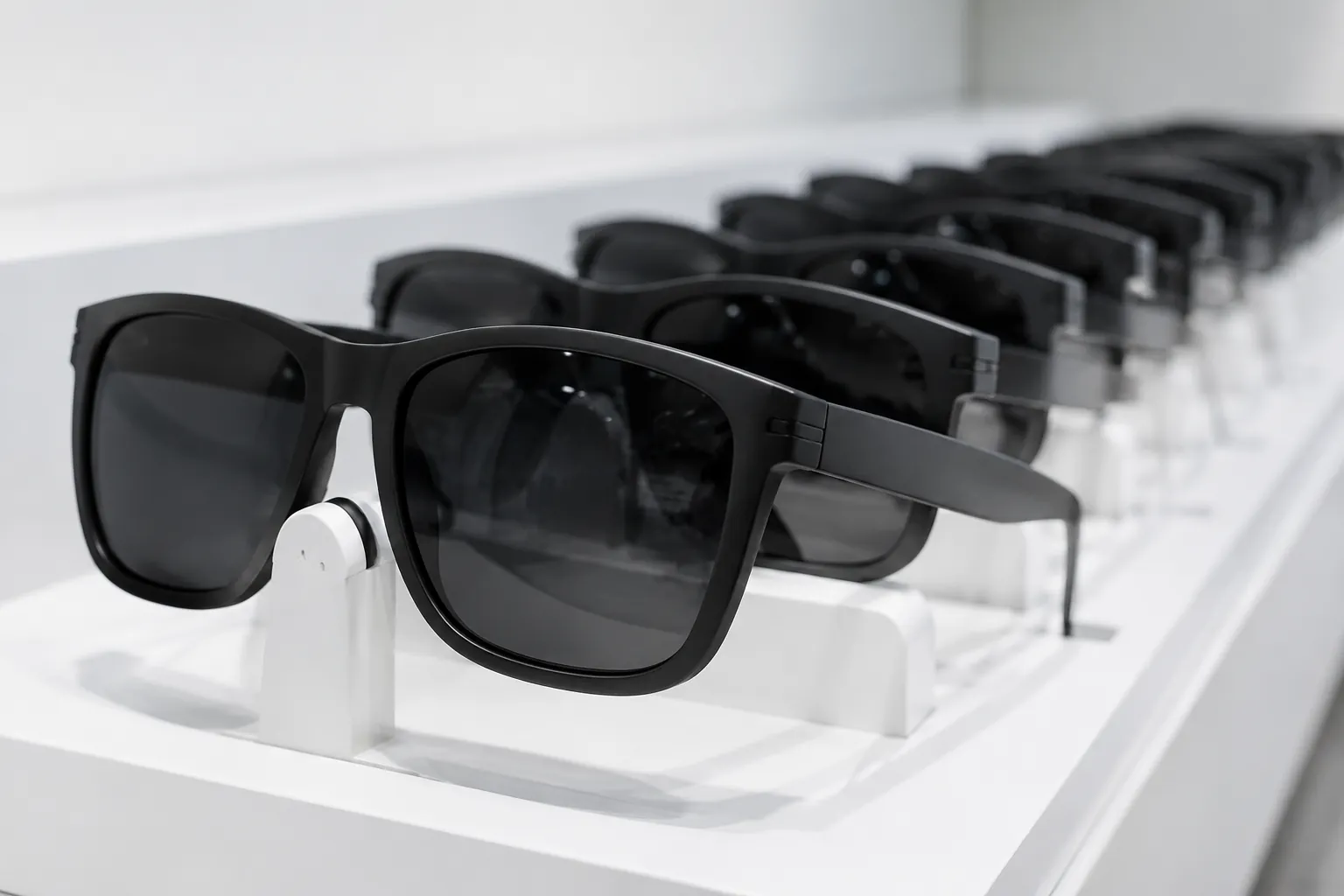
If you buy sunglasses for a brand, chain, or distribution business, material choice is not a style decision. It affects labor, defect risk, tooling cost, lead time, and the price band you can actually sell into. This guide compares PC injection and hand-cut acetate in practical terms so you can match construction to margin target, not just to a mood board. It also explains where LumiShades' factory setup can support each route.
Start with the margin question, not the material label
PC injection and hand-cut acetate can both work for private label and custom sunglass programs. They do not behave the same in a P&L. The right choice depends on landed cost, order quantity, cosmetic spec, and how much rework your channel can tolerate. A frame that works at 5,000 pairs may be a bad fit at 50 pairs if setup and finishing eat the margin.
Ask the commercial question first: what is the buyer's acceptable ex-factory band at 50 pairs, 300 pairs, 1,000 pairs, and 5,000+ pairs? At LumiShades, MOQ starts at 50 pairs per design. That is useful for launch tests and smaller programs. But the economics change fast as fixed costs are spread across more units. Tooling, color matching, decoration setup, and QC sit differently on PC injection versus acetate. Injection is usually lower cost at scale. Acetate usually carries more manual labor per pair.
Do not start with "which material looks premium." Start with "which construction still leaves room for my margin after tooling, packaging, decoration, and rejects?" If your channel needs an opening price point, PC injection usually has the cost advantage. If the channel can support a higher ticket and wants a richer hand-feel, acetate can justify the added labor. Decide before styling is locked. Not after prototypes are approved.
Blunt rule: if the selling price cannot support the labor, do not choose a labor-heavy frame just because it feels better in hand.
What the two constructions are, and how they are made
PC injection uses polycarbonate formed in an injection mold. The front, temples, or both can be molded parts. Once the tool is stable, cycle times are fast and repeatable. That makes PC a strong fit for programs that need consistent output, stable color, and controlled unit cost. PC is also common where impact resistance matters, which is why it shows up often in sport, active lifestyle, and promotional sunglasses.
Hand-cut acetate starts with acetate sheet, usually in thicknesses that vary by frame design and profile. Sheets are cut, layered, rough-shaped, milled, tumbled, polished, and assembled. A typical acetate front goes through several manual and semi-manual steps before it is ready for hinges and lenses. That gives the frame more visual depth and a heavier feel, but it also creates more room for variation if the process is not controlled tightly.
At LumiShades, both routes can be built in-house. Injection molding supports PC-style production. Acetate cutting, CNC milling, lens tinting, and decoration are also in-house, which reduces handoff errors and makes dimensional control easier during development. That matters. An eyewear sample can look fine on a desk and still fail in production if the lens seat, hinge angle, or temple symmetry is not locked early.
| Item | PC Injection | Hand-Cut Acetate |
|---|---|---|
| Main process | Injection molding | Sheet cutting, CNC milling, tumbling, polishing, assembly |
| Labor input | Lower per pair | Higher per pair |
| Typical tolerance focus | Lens seat, hinge pocket, surface uniformity | Temple symmetry, edge polish, front thickness, hinge alignment |
| Visual effect | Clean, consistent, less material depth | Richer color depth, more texture and weight perception |
| Best commercial fit | Value, sport, promo, high volume | Fashion, premium private label, optical-style sunglasses |
In practice, many buyers choose by channel rather than by material label. If the program needs tight cosmetic control on visible edges and a premium finish under retail lighting, acetate can earn its place. If the program mainly needs consistent pair-to-pair output and predictable pack-out, PC injection is usually the cleaner route.
Labor, tooling, and where the cost actually sits
PC injection is cost-driven by tooling, resin, and cycle time. Once the mold is stable, output is consistent and labor per pair stays low. The risk sits early in the project: mold design, gate placement, shrinkage control, and first-article approval. If the tool is right, repeatability is strong. If the tool is wrong, the run can be hit by flash, sink marks, or uneven lens fit.
Acetate spends more money on the floor. A typical acetate frame may need several finishing passes: rough cut, CNC contouring, barrel installation, alignment correction, edge tumbling, surface polishing, and final inspection. Each step adds labor hours and scrap risk if the template is off by even a small amount. A minor mismatch in temple symmetry or hinge position can be obvious once the pair is assembled.
That is why the buying decision should be tied to channel economics. A retailer selling at mid-market price points can often support acetate if the frame design and branding justify it. A distributor supplying promotional or opening-price programs usually cannot. If your margin target depends on hitting a low landed cost, labor-heavy construction can quickly consume the spread you thought you had.
- PC injection favors shorter handling time per pair and steadier output.
- Acetate favors higher perceived value, but the factory absorbs more labor and more in-process QC.
- Both routes need stable dimensional control, but acetate usually needs tighter visual inspection at multiple stages.
- For small runs, setup and color-matching effort can weigh more heavily on acetate because the labor is not diluted.
- For large runs, injection usually improves faster on cost because the tool and cycle time are leveraged across more pieces.
Cosmetic finish, tolerances, and what buyers will notice
PC injection usually gives clean lines, stable color, and strong consistency from pair to pair. That consistency matters for chains and private label programs where every carton has to look the same on arrival. In well-made injection frames, the main cosmetic risks are gate marks, small surface texture shifts, and lens-seat accuracy. Buyers should define the acceptable cosmetic range before production. The right tolerance depends on frame size, design complexity, and the channel's inspection standard.
Hand-cut acetate usually wins on depth and surface character. It can be polished to a high gloss, and layered acetate creates color richness that sells well in fashion channels. But acetate also exposes flaws fast. Uneven temple thickness, weak hinge alignment, poor polishing, or a slightly twisted front will show. Buyers paying for acetate usually expect cleaner lines and tighter visual balance. If the finish is off, the product can look cheap even when the raw material is expensive.
Decoration is part of the finish story, not an afterthought. LumiShades handles laser engraving, pad printing, and metal logo plates in-house. That gives more control over placement, depth, and repeatability. A logo that is poorly positioned can reduce perceived quality even when the frame itself is fine. On glossy acetate, laser engraving is often used for subtle branding. On PC, pad printing may be better for color and speed. Metal plates work best when the design is fixed and the volume is stable.
Practical decoration guidance:
- Pad printing is useful when artwork changes often or when you need color logos without committing to a fixed metal tool.
- Laser engraving is useful for subtle branding, serial marks, or a minimal look.
- Metal logo plates add perceived value but need stable artwork and consistent placement.
- Hot stamping can work on selected surfaces, but adhesion and wear should be tested before approval.
Practical note: if artwork changes often, pad printing is usually easier to adjust than metal logo tooling. If the logo is fixed and the volume is stable, metal plates can work well on acetate and some PC styles.
Durability, feel, and how material behavior changes in use
Buyers often mix up perceived durability with actual test performance. PC is known for impact resistance and is often the better option when the frame may be dropped, flexed, or used in active settings. Acetate is valued for rigidity, shape retention, and a more substantial feel. Neither route is automatically better. They fail in different ways, and the selling channel should decide which failure mode is more acceptable.
PC can show stress whitening, hinge pull issues, or surface scratches depending on resin quality, wall thickness, and handling after molding. Thin-walled designs can flex too much if the arm geometry is aggressive, and a poor hinge pocket can lead to loosening over time. Acetate can warp if heat control is poor during polishing or storage, and it can lose alignment if milling and temple fitting are sloppy. In short: PC tends to punish tooling and handling mistakes; acetate tends to punish finishing and assembly mistakes.
There is also a feel difference that matters commercially. A customer who wants an active-use sunglass may prefer the lighter, more resilient behavior of PC. A customer shopping fashion or premium private label may prefer the denser, more substantial hand-feel of acetate. That is why a lower-cost acetate frame can still lose to a better-engineered PC frame in the market: the buyer may pay for finish, but not for avoidable defects.
For export programs, compliance is not optional. LumiShades references the following standards and registrations where applicable to the destination market: CE EN ISO 12312-1, ANSI Z80.3, AS/NZS 1067, REACH, FDA registration, ISO 9001, and BSCI. The right construction can be chosen for margin and market fit while the finished line is still built to the relevant test and documentation requirements.
MOQ, price bands, and lead time: how the numbers usually move
At LumiShades, MOQ is 50 pairs per design. That works for sampling a style or testing a niche market, but small runs carry more setup cost per pair. The cost curve improves as volume rises because artwork setup, production adjustment, and QC are spread across more units. At every order level, final unit cost depends on construction, lens spec, decoration, packaging, and the approval scope.
PC injection usually reaches a lower unit cost faster because production is more automated and the per-pair labor is lower. Acetate needs more manual work, so it tends to have a steeper price curve at low quantity. At 50 pairs, acetate is usually treated as a development and small-batch project. At 1,000 pairs and above, it becomes more viable if the brand can sell into a higher retail band that pays for the finish.
Lead time depends on approval discipline as much as on capacity. Samples usually take 7 to 10 days when the brief is clear. Bulk production usually runs 25 to 35 days after approval, assuming artwork, lens tint, and packaging are locked. If there is a color mismatch, lens-transmittance adjustment, or logo revision, acetate jobs often need extra correction because the finish is more visibly sensitive to small changes.
| Order level | PC Injection economics | Hand-cut acetate economics | Typical buyer use |
|---|---|---|---|
| 50 pairs | Setup cost matters, but the route is manageable | Highest cost pressure | Sampling, niche launch, showroom test |
| 300 pairs | Better spread of setup cost | Still labor-heavy, but viable | Regional test, small chain order |
| 1,000 pairs | Strong cost advantage | Competitive if retail price is higher | Seasonal private label, targeted rollout |
| 5,000+ pairs | Usually the better margin route | Works if the brand can support premium pricing | Core line, replenishment, national program |
Simple rule: if your target gross margin depends on every point of cost, start with PC injection. If your retail story depends on the frame itself being the premium signal, acetate may be worth the extra unit cost.
A simple decision framework for buyers
If you need a fast answer, use this framework:
- Choose PC injection if your target is low-to-mid retail, your order is large, and consistency matters more than material depth.
- Choose hand-cut acetate if your channel can pay for a richer finish, the frame is part of a fashion story, and you can tolerate higher labor cost.
- Choose PC injection if you expect frequent color changes, fast replenishment, or promotional packaging changes.
- Choose acetate if the frame itself is a selling point and the buyer inspects polish, edge quality, and temple symmetry closely.
- Ask for decoration samples before approving the final route, because a logo that works on one substrate may not look right on the other.
- Confirm the lens spec early so the frame choice aligns with UV requirements, lens tint, and final retail positioning.
There is also a mixed route. Some programs use injected components with acetate-style visual cues, or keep the frame in PC but upgrade the lens tint, logo treatment, and pack-out. That can be smarter than forcing acetate into a price band that cannot support it. In practice, buyers often get better margin by improving the selling presentation instead of overbuilding the frame.
One more point: what looks premium to a product team is not always what converts in the channel. A buyer aiming for a lower retail point may need cost discipline more than material romance. A buyer building a premium retail story may have enough room to justify acetate, metal detailing, and a more elaborate finish.
How LumiShades would run the project
The useful part of a factory is process control. At LumiShades, a project starts with target market, target price, and target construction. From there, the team can sample in 7 to 10 days, then move to bulk in 25 to 35 days after approval.
For PC injection, the factory checks mold flow, surface finish, hinge fit, lens seat dimensions, and decoration placement. For acetate, the focus shifts to cut accuracy, temple symmetry, polish quality, hinge alignment, and color consistency across the batch. QC is not a single checkpoint. It is spread through the line, because one missed dimensional issue can turn into a batch-wide cosmetic problem later.
A realistic development flow usually looks like this:
- Brief and target price: define retail channel, margin target, and acceptable ex-factory band.
- Material selection: confirm PC or acetate based on finish, durability, and cost.
- Prototype: sample the frame, lens tint, logo method, and packaging.
- Fit and cosmetic review: check alignment, surface quality, and decoration placement.
- Pre-production approval: lock artwork, color, and pack-out before bulk.
- Mass production and final QC: inspect first-pass yield, then ship only after sign-off.
The cheapest frame on paper is not always the cheapest frame delivered. If a batch misses the cosmetic spec, the buyer pays again in sorting, complaints, or markdowns. A buyer trying to protect margin should care as much about first-pass yield as about unit price.
Bottom line: PC injection is usually the easier path to price control. Hand-cut acetate is usually the easier path to a premium look. Pick the one your selling price can actually support.
Have a custom sunglasses project in mind?
Send us your styles, target market and quantities and we will return a detailed quote with MOQ, lead time and a sample plan.
Get a QuoteWhy source this from Wenzhou with LumiShades
Wenzhou in Zhejiang Province is widely regarded as China’s eyewear manufacturing capital, producing a large share of the world’s sunglasses. That concentration matters to buyers: a deep local supply chain for acetate sheet, hinges, lens blanks, plating and packaging means shorter component lead times, easier color and material matching, and a workforce with decades of eyewear-specific skill. LumiShades has manufactured in this ecosystem since 2009, and our vertical integration — in-house injection molding, acetate cutting, CNC milling, lens tinting, decoration and quality control — means no part of your order is quietly subcontracted to a workshop you cannot audit.
For international buyers, that vertical control translates into accountability. When a single factory owns every step, defects are traced and fixed at source rather than bounced between vendors, and your specifications survive intact from first sample to bulk. We back this with 15+ years of experience, shipments to 60+ countries, more than 5 million pairs produced per year and a 98.5% on-time delivery rate. Our certifications — CE EN ISO 12312-1, FDA registration, ANSI Z80.3, AS/NZS 1067, REACH, ISO 9001 and BSCI audit — mean the compliance documentation your market requires already exists. Explore our manufacturing capabilities and quality control process to see how this works in practice.
Frequently asked questions
Which construction is usually cheaper at 1,000 pairs or more? PC injection is usually the lower-cost route at higher volume because labor per pair is lower and production is more automated. Acetate can still work, but the price has to support the extra cutting, polishing, assembly, and inspection effort. If you compare quotes, ask for the same lens spec, same decoration method, and same packaging before judging the unit price.
Can I start with 50 pairs and still choose acetate? Yes. LumiShades supports MOQ 50 pairs per design. Treat it as a small-batch or development order, not a volume-cost benchmark. At that quantity, acetate usually carries more setup burden per pair, so confirm the target retail price and test the decoration and finish before you commit to a larger run.
Which route is better for a sport or active-use sunglass line? PC injection is usually the better fit because it is typically more impact-resistant and suits active-use positioning. Confirm the frame geometry, lens specification, hinge strength, and the market standard you need to meet. If the style must survive heavier flex or motion, ask the factory to review stress points before approval.
What is the normal sampling and bulk timeline? Samples usually take 7 to 10 days when the brief, artwork, and construction direction are clear. Bulk production usually takes 25 to 35 days after sample approval and sign-off on artwork, lens tint, and packaging. If you change color, logo, or lens spec after approval, the timeline can extend because the factory has to recheck fit and finish.
What tolerance should I expect on a custom sunglass frame? Tolerance should be agreed by style, material, and market requirement before production begins. As a working guide, buyers often ask for tighter visual consistency on visible acetate elements than on molded PC features, but the exact numbers should be written into the tech pack or approval sheet. Do not rely on a generic tolerance from a previous project; define the critical dimensions for the exact frame you are buying.
Which compliance documents should I ask for? Ask for the documents relevant to your market and product, such as CE EN ISO 12312-1, ANSI Z80.3, AS/NZS 1067, REACH, FDA registration, ISO 9001, and BSCI where applicable. The right request depends on destination market, product type, and buyer requirements. Do not assume one document covers every country or every selling channel.
Can decoration methods change the material choice? Yes. Laser engraving, pad printing, hot stamping, and metal logo plates behave differently on PC and acetate, and the result can affect both appearance and durability. If the logo is central to the sale, ask for decoration samples on the actual substrate before approving production. That is the safest way to check visibility, adhesion, and placement.
Ready to start?
Explore our shield & oversized sunglasses or request a quote — our sales team replies within 12 hours.
Request a Quote