
Choosing Temple Tips, Nose Pads, and Hinges
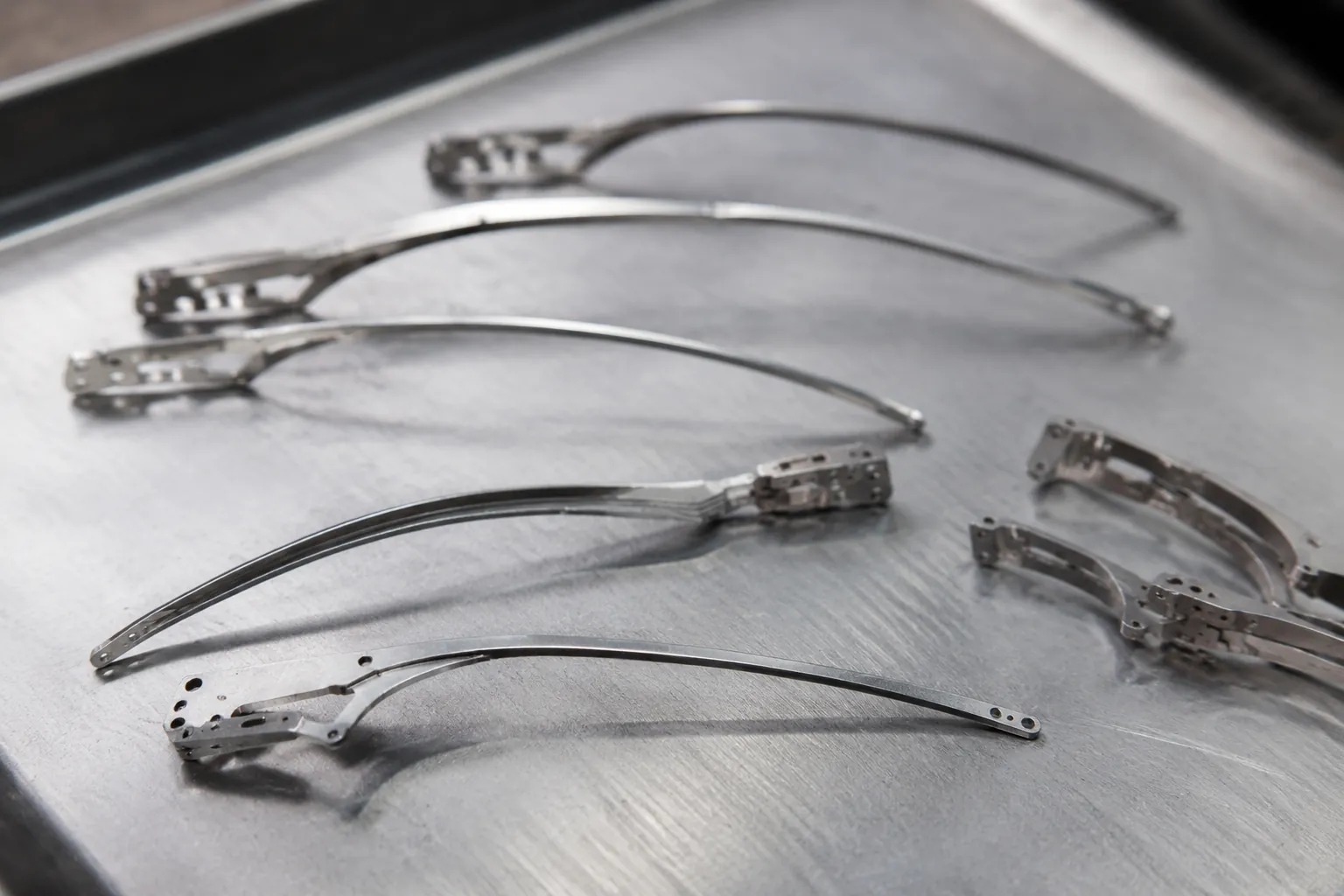
In private-label sunglasses, small parts are not small issues. Temple tips, nose pads, and hinges affect comfort, fit, durability, assembly consistency, and return rates. They also affect tooling, material compatibility, and inspection standards. If you buy for a brand, retailer, or distributor, these parts need clear specifications. This guide shows what to choose, what to check, and what to lock before bulk production.
Start with failure modes, not the catalog
Most preventable frame complaints start in three places: pressure behind the ear, slipping at the bridge, and loose or uneven hinges. Those are usually component or assembly problems. Not styling problems.
The patterns are familiar. A temple tip that is too hard, too short, or poorly fitted to the temple can create a pressure point. The wrong nose pad material or geometry can make sunglasses slide. A weak hinge design or loose assembly tolerance can leave the temples uneven or sloppy after limited use.
For private-label sunglasses, the goal is rarely the most complex part. It is the right part for the frame material, target use, and price band. Ask three basic questions for each component:
- What conditions will the product face in the target market: heat, sweat, salt air, cold weather, or mainly indoor use?
- How much fit adjustment is expected at retail or by the end user?
- Does the part suit the frame material and assembly method without adding avoidable QC risk?
At low volume, you can often work from standard component families. At higher volume, loose specs become expensive. Small variations in fit, finish, and reject rate spread fast across the order.
Temple tips: comfort first, retention second
Temple tips do two jobs. They soften the contact point and help keep the frame stable during wear. The right option depends on frame weight, temple shape, frame material, and use case.
A heavier acetate front may need a softer or longer contact area to spread pressure. A lighter injection frame may work with a simpler tip because the temple itself can flex more.
Common options:
- Injected TPE/TPR tips: commonly used where softness and grip matter. Often suitable for casual or sport-oriented styles. Compound quality needs checking because feel, odor, and wear life can vary.
- Injected PVC tips: can be economical and easy to color-match, but material controls need review. Confirm compliance expectations, including REACH where relevant.
- Acetate-compatible tips: often chosen when appearance and finish consistency matter, especially on acetate fashion frames.
- Overmolded tips: can improve grip and feel, but they add process complexity. Check bonding quality and cosmetic consistency closely.
Put the details in writing: tip length, inner diameter or fit method, wall thickness, texture, hardness range if relevant, and color standard. Color mismatches are obvious. Approve against physical samples, not photos.
During sample review, check comfort and finish together. Look for rotation, gaps at the temple end, flash, or a surface that feels too tacky after handling. Minor defects, yes. But customers notice them.
Nose pads: balance grip, comfort, and stability
Nose pads decide how the sunglasses sit, how secure they feel, and whether the wearer gets pressure or slippage. Pad choice depends on frame construction, sales channel, and wearing conditions.
For OEM and private-label programs, the main pad families are simple:
| Pad type | Best use | Buyer watch-out | Typical trade-off |
|---|---|---|---|
| Silicone | Higher-comfort fit, sweaty use, more grip | Can attract dust and lint; confirm surface finish and aging behavior | Better hold, softer feel |
| TPR/TPE | Value sunglasses, general retail | Compound quality varies; confirm odor, feel, and consistency | Lower cost, moderate grip |
| Rigid plastic pad arm with separate pad | Adjustable metal or hybrid frames | Assembly tolerance and pad attachment must be controlled | Better adjustability, more parts |
| Integrated molded bridge | Fashion frames with molded fit | Less adjustability after production; fit must be right in development | Cleaner look, less flexibility |
Specify the basics in writing: pad width, pad thickness, bridge angle, contact height, attachment method, and whether the pad is replaceable. For hot climates or active use, ask for wear checks under warm conditions. Slip problems often show up there first. If the frame uses an integrated bridge, spend more time on fit in development. Adjustment options later are limited.
Compliance matters too. Pad materials should be controlled under applicable chemical requirements such as REACH where relevant. Finished sunglasses should also be checked against the destination-market standard, such as CE EN ISO 12312-1 for Europe, ANSI Z80.3 for the U.S., or AS/NZS 1067 for Australia/New Zealand. FDA registration may be required in the U.S. supply chain, but it does not replace product testing.
Hinges: the easiest place to under-specify
Hinges are often described too loosely in buyer briefs. That creates predictable trouble later: uneven temples, loose opening feel, missing screws, or early wobble after handling and transport.
The right hinge depends on frame material, style type, and how much flex the product needs.
The main choices are simple:
- Standard metal hinge: common on acetate and mixed-material frames. Usually the safest starting point when you want predictable assembly and a familiar repair path.
- Spring hinge: useful if you need a broader fit range or more forgiving opening action. It also adds parts, assembly steps, and inspection points.
- Integrated injection hinge: can suit molded frames, but design and molding control must be tight to avoid looseness, stress whitening, or breakage.
Do not stop at naming the hinge type. Specify pin or screw details, barrel count, base material, mounting method, opening angle, torque feel standard, and left-right alignment tolerance. A hinge can look fine in a photo and still fail in use.
Sample inspection should include repeated opening and closing, symmetry checks on a flat surface, and a review of how the temples close against the front. If one side opens looser than the other, or the tips do not land evenly when closed, fix it before bulk approval. Not after.
Match components to the frame body
Temple tips, nose pads, and hinges are not isolated add-ons. They have to work with the frame body in function and appearance. Acetate, injection plastic, metal, and mixed-material frames behave differently in production and in wear.
Use this logic:
- Acetate frames: prioritize finish consistency, polished edges, and hinge installation quality. Visible parts should support the look of the front and temples.
- Injection frames: prioritize repeatability, material compatibility, and hinge structures that perform reliably within molded tolerances.
- Mixed-material frames: watch for surface mismatch, assembly complexity, and the extra risk that comes with more parts and interfaces.
A glossy acetate frame with a mismatched soft tip can look inconsistent unless the contrast is intentional. A sport-oriented injected frame may benefit from higher-grip tips and pads even if the finish looks more technical than refined.
Also check color stability realistically. Black parts are usually easier to match. Transparent, translucent, or skin-tone parts are less forgiving because haze, specks, yellowing, and color drift show quickly. If decoration sits near the hinge area, make sure it does not interfere with assembly, screw access, or cosmetic standards.
Cost, MOQ, and lead-time logic
Small parts rarely drive the full landed cost of sunglasses, but they do affect quoting, development time, tooling choices, and inspection complexity. Component choices should match order size and program maturity.
| Order level | Typical component choice | Price effect | Practical sourcing note |
|---|---|---|---|
| 50 pairs/design | Standard tip/pad/hinge options | Higher unit cost | Best for testing fit, appearance, and sell-through before deeper customization |
| 300 pairs/design | Custom color or simple material change | Better unit-cost efficiency than very small runs | Enough volume to justify clearer written specs and sample sign-off |
| 1,000 pairs/design | More controlled custom parts | Customization becomes easier to justify operationally | QC sampling and incoming component checks should be tightened |
| 5,000+ pairs/design | Full program optimization | Production efficiency generally improves if the design is stable | Best for long-run private-label and retail programs with locked specifications |
Lead time depends on the factory, material route, and whether parts are standard, modified, or newly tooled. The main buyer control point is approval timing. If tip design, pad geometry, or hinge configuration stays open after sample approval, schedule risk goes up fast.
One rule holds in most sourcing situations: if the component spec is vague, the supplier will default to a standard option that fits the quote and production plan. Sometimes that is fine. If comfort, finish, or fit consistency matters, define the part before bulk production starts.
What to put in the spec sheet before approval
A clear spec sheet prevents confusion, supports QC, and makes supplier comparisons easier. Small parts should be documented directly, not left to a rendering or a verbal comment.
- Temple tip material, color, finish, hardness or feel requirement if needed, and length
- Nose pad type, width, thickness, contact area, and attachment method
- Hinge style, screw or pin type, barrel count, mounting method, and opening feel requirement
- Frame material and any decoration near the hinge or bridge area
- Target market standard: CE EN ISO 12312-1, ANSI Z80.3, AS/NZS 1067, plus REACH controls where applicable
- Factory documentation where relevant: FDA registration for U.S. supply-chain needs, and quality or social-compliance documents such as ISO 9001 or BSCI if required by your program
- Required sample approval steps and acceptable cosmetic tolerance
During sample checks, do not look at the frame only from the front. Open and close the temples repeatedly, check symmetry on a flat surface, inspect bridge contact, and review pad alignment and hinge seating. Confirm that left and right opening feel are consistent and that the frame does not rock because of assembly imbalance.
Ask suppliers to state clearly which features are standard, which are custom, and which need new tooling or special sourcing. That reduces disputes later and makes quotes easier to compare.
A quick selection rule set for buyers
If you need a fast decision, use this:
- For comfort-driven retail: choose softer temple-contact surfaces, higher-grip nose pads, and a hinge with consistent opening feel.
- For value volume: keep components simple, standardize colors, and avoid extra moving parts unless they solve a proven fit or return issue.
- For fashion programs: prioritize finish consistency, clean pad placement, and hinge alignment because visible symmetry affects perceived quality.
- For sport or hot climates: use higher-grip pads and tips, and review samples for slip and feel under warm conditions.
Do not overbuild the frame. Extra parts add assembly steps and inspection points. But do not strip out grip or adjustment features so aggressively that the product becomes uncomfortable. In most programs, the best component choice is the one that performs consistently and does not call attention to itself.
Small parts rarely sell sunglasses on their own, but they often decide whether the product feels acceptable after real wear.
When comparing suppliers, ask how these parts are specified, assembled, and checked in production. A clear process answer is more useful than a broad claim about customization.
Have a custom sunglasses project in mind?
Send us your styles, target market and quantities and we will return a detailed quote with MOQ, lead time and a sample plan.
Get a QuoteWhy source this from Wenzhou with LumiShades
Wenzhou in Zhejiang Province is widely regarded as China’s eyewear manufacturing capital, producing a large share of the world’s sunglasses. That concentration matters to buyers: a deep local supply chain for acetate sheet, hinges, lens blanks, plating and packaging means shorter component lead times, easier color and material matching, and a workforce with decades of eyewear-specific skill. LumiShades has manufactured in this ecosystem since 2009, and our vertical integration — in-house injection molding, acetate cutting, CNC milling, lens tinting, decoration and quality control — means no part of your order is quietly subcontracted to a workshop you cannot audit.
For international buyers, that vertical control translates into accountability. When a single factory owns every step, defects are traced and fixed at source rather than bounced between vendors, and your specifications survive intact from first sample to bulk. We back this with 15+ years of experience, shipments to 60+ countries, more than 5 million pairs produced per year and a 98.5% on-time delivery rate. Our certifications — CE EN ISO 12312-1, FDA registration, ANSI Z80.3, AS/NZS 1067, REACH, ISO 9001 and BSCI audit — mean the compliance documentation your market requires already exists. Explore our manufacturing capabilities and quality control process to see how this works in practice.
Frequently asked questions
Should I choose silicone or TPR nose pads for private-label sunglasses? Choose based on use case, not habit. Silicone is usually better when you need more grip, softer contact, or stronger performance in heat and sweat. TPR can work well for value-oriented retail if the compound is controlled properly. Ask for approved samples of both, then compare grip, odor, dust attraction, appearance, and comfort on the actual frame. For active wear or hot climates, silicone is usually the safer starting point. For casual use where cost control matters most, TPR may be enough.
What hinge type is safest for a new private-label program? For many acetate and mixed-material frames, a standard metal hinge is the safest starting point because it is widely used, relatively easy to assemble, and familiar to repair. Use a spring hinge only if you have a clear fit or comfort reason, since it adds parts and inspection points. For molded injection frames, an integrated hinge can be suitable, but only if the supplier can show stable tooling and assembly control. In every case, ask for hinge details in writing: type, barrel count, screw or pin type, mounting method, and approval criteria for alignment and opening feel.
How do temple tips affect returns? Temple tips affect comfort and perceived quality. If they are too hard, too short, loose on the temple, poorly finished, or visibly mismatched in color, wearers may report pressure, slipping, or a cheap feel. Complaints can follow even if the lenses and frame front are fine. To reduce that risk, specify material, texture, fit method, length, and color standard. During sample review, check comfort after wear, inspect for rotation or gaps, and confirm that left and right tips match in finish and appearance.
What should I lock before sample approval? Lock every small-part detail that affects fit, assembly, or appearance before sample approval: temple tip material and finish, nose pad type and geometry, hinge style and hardware, component colors, attachment methods, and cosmetic acceptance criteria. Also confirm the compliance path for the destination market: CE EN ISO 12312-1, ANSI Z80.3, or AS/NZS 1067 as applicable, plus REACH controls where relevant. If your U.S. import process requires it, confirm FDA registration status in the supplier file set. If your program requires factory-system or social-compliance documents, request ISO 9001 or BSCI records before bulk production.
What should I ask a supplier to prove before I place a bulk order? Ask for three types of proof: product proof, process proof, and compliance proof. Product proof includes approved samples, hinge alignment review, pad and tip material confirmation, and final appearance approval. Process proof includes a written specification sheet, confirmation of which components are standard versus custom, and an explanation of how hinge fit, pad placement, and cosmetic defects are checked in production. Compliance proof includes applicable test reports or test plans for CE EN ISO 12312-1, ANSI Z80.3, or AS/NZS 1067, plus REACH controls where relevant. If your sourcing program requires them, also request FDA registration information, ISO 9001 documentation, and BSCI records.
Ready to start?
Explore our round sunglasses or request a quote — our sales team replies within 12 hours.
Request a Quote