
OEM vs ODM Sunglasses: MOQ, Tooling, Cost, Timeline
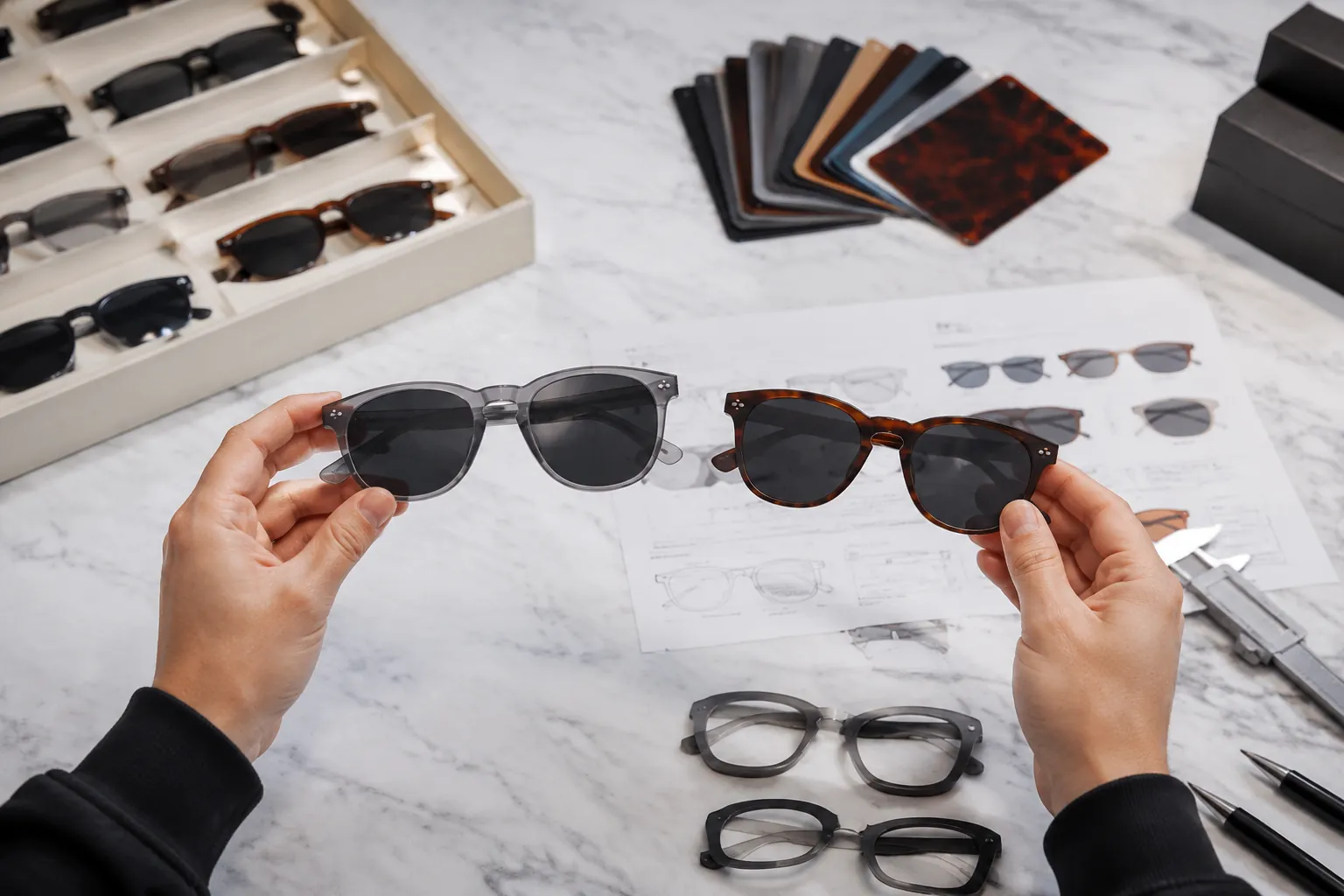
This guide is for overseas brands, importers, distributors, and retailers choosing how far to customize a sunglasses line. The goal is simple: pick stock ODM, modified ODM, or full OEM without wasting tooling budget, delaying approvals, or missing a selling season. The right route depends on factory facts: MOQ, tooling needs, material behavior, sampling time, decoration limits, compliance targets, inspection standards, packaging, and margin risk.
The Three Routes: Stock ODM, Modified ODM, and Full OEM
Buyers often use OEM and ODM as if they mean the same thing. They do not. The route you choose affects budget, design ownership, development risk, and launch timing.
Stock ODM means the factory already has the frame design, mold or cutting program, lens shape, fit, and production process. You choose an available model and customize practical details: frame color, lens color, logo, pouch, case, hangtag, instruction sheet, and carton label. This is usually the fastest and lowest-risk route because the frame has already been made before.
Modified ODM starts from an existing factory frame but changes selected details. Examples include temple decoration, hinge finish, lens coating, rubber insert, metal logo plate, acetate colorway, or packaging system. It works best when the change does not affect the core frame geometry. Once you change lens shape, bridge width, temple thickness, hinge position, lens groove, or frame front curvature, the project may need new tooling, new fixtures, or extra engineering checks.
Full OEM means your design is developed into a production-ready sunglass. It may involve 2D drawings, 3D files, prototype printing, CNC samples, mold making, trial shots, lens matching, hinge testing, fit correction, and several approval rounds. OEM gives the most control over shape and fit. It also carries the highest cost and schedule risk.
Simple rule: if your value is color, logo, packaging, and speed, start with ODM. If your value is a private silhouette, distinct fit, or long-term proprietary style, budget for OEM.
Side-by-Side Decision Table for Buyers
| Route | Best Use Case | Typical MOQ Logic | Sample Time | Bulk Lead Time | Main Risk |
|---|---|---|---|---|---|
| Stock ODM | Fast launch, market test, distributor catalog, retail trial, promo program | Can suit low MOQ when existing materials and decoration options are available; better pricing usually needs higher volume | Often 7-10 days when frame, lens, logo method, and packaging materials are available | Commonly 25-35 days after sample approval and deposit for standard ODM orders | Other buyers may be able to buy similar frame shapes unless exclusivity is agreed |
| Modified ODM | Brand needs a more private look without full mold investment | Usually needs higher MOQ than stock ODM if special colors, plates, non-standard lenses, or sourced components are required | Often 10-20 days depending on component sourcing, color matching, and decoration trials | Commonly 30-45 days if non-standard parts or packaging are involved | Small design changes can trigger tooling, fixture, testing, or minimum-material costs |
| Full OEM | Signature frame, private fit, protected collection direction, long-term repeat program | Usually justified only when order volume or repeat demand can absorb development and tooling cost | Often 20-45+ days for prototype, mold trial, correction, and approval; complex projects can take longer | Commonly 35-60+ days after final sample approval, depending on material, mold status, and inspection requirements | Tooling revisions, fit failure, shrinkage, lens mismatch, delayed approvals, and unclear specifications |
| Hybrid Program | One OEM hero model plus ODM volume styles | Use ODM for assortment and margin; use OEM for brand identity | Mixed schedule; ODM and OEM approvals must be managed separately | May require split shipments if OEM development runs longer than ODM production | Buyer treats all styles as one timeline and misses the launch date |
This is how factory planning works. Injection molding, acetate cutting, CNC milling, lens tinting, mirror coating, logo decoration, assembly, and QC all compete for capacity. A small ODM order with one standard logo can move quickly if components are ready. A multi-SKU program with several lens colors, frame colors, metal plates, printed pouches, retail boxes, and compliance checks needs a locked schedule, material plan, and inspection plan.
Budget Reality: Unit Price Is Only One Line
Many buyers ask for the lowest unit price before defining the development route. That creates false comparisons. A stock ODM frame and a full OEM frame at the same order quantity are not the same business case.
For suitable ODM models, low-MOQ production can be practical when the buyer uses existing frames, available lens options, and standard decoration methods. Pricing normally improves as volume increases. Material purchasing, machine setup, decoration setup, packaging setup, and QC time are spread across more units. Final unit price depends on frame material, lens specification, hinge type, logo method, packaging, inspection level, destination labeling, and whether components are in stock or specially sourced.
Tooling changes the math. A minor fixture or insert change may be limited. A new sunglass frame mold can cost much more, depending on structure, number of parts, number of cavities, temple design, lens groove, surface finish, and correction rounds. If you invest in tooling, you need enough volume over one or more orders to absorb that cost. A small trial order usually should not start with full OEM unless retail margin, launch strategy, or exclusivity clearly supports it.
- Frame material: PC is economical and common for fashion, event, and promo styles. TR90 is lighter and more flexible, but it needs good control of molding, cooling, and deformation. Acetate has richer color depth and a premium hand feel, but cutting, tumbling, polishing, bending, and manual assembly add labor and time.
- Lens choice: Standard tinted UV400 lenses are common for entry-level sunglasses. Polarized, mirrored, gradient, category-specific, TAC, nylon, or impact-tested lenses add cost and require more checks for optical quality, transmission, coating consistency, and labeling.
- Decoration: Laser engraving is clean and durable for many small logos. Pad printing is cost-effective for color logos but should be checked for ink adhesion and placement. Hot stamping works for selected packaging and components. Metal logo plates require component sourcing, adhesive or rivet control, alignment, and consistent placement.
- Packaging: A polybag and microfiber pouch keep carton volume and freight cost lower. EVA cases, rigid boxes, printed sleeves, and retail display packaging improve presentation but increase carton volume, packaging lead time, freight cost, and damage-control requirements.
- Compliance: CE EN ISO 12312-1, ANSI Z80.3, AS/NZS 1067, REACH, FDA registration-related requirements, ISO 9001, and BSCI may affect lens testing, labeling, user instructions, documentation, factory evaluation, and buyer due diligence.
Materials, Tolerances, and Fit Control
Sunglasses look simple. They are not. Small dimensional errors can change comfort, appearance, and production consistency. A temple that feels acceptable on one sample may feel tight across a full run. A bridge that is too narrow can lift the frame, change lens angle, and increase return risk. Do not approve only from photos.
Useful control points include lens width, bridge width, temple length, frame front width, frame curvature, pantoscopic angle, temple opening angle, hinge resistance, lens base curve, lens groove fit, and logo position. Dimensional tolerances should be agreed by part and material because injection plastic, TR90, acetate, and metal parts behave differently. For many plastic frame parts, tolerance may be discussed in tenths of a millimeter, but the approved range must be confirmed on the drawing, control plan, or golden sample. Never assume it.
Color tolerance should be judged against a physical Pantone chip, material swatch, or approved production sample. Not a phone photo. Lens color should be checked by visible light transmission category and product claim, not only by appearance. A dark-looking lens is not automatically compliant for every market or use.
Material behavior matters. PC injection frames are common for high-volume fashion programs, but surface finish, molding conditions, and mold maintenance affect appearance. TR90 is flexible and comfortable, but shrinkage and deformation must be controlled during processing. Acetate avoids injection shrinkage but adds other variables: sheet thickness, lamination pattern, polishing pressure, hand bending, and manual assembly. Metal components such as hinges, screws, nose pads, and logo plates add another tolerance stack. If the hinge seat is inconsistent, temples may open unevenly or loosen during wear testing.
For OEM projects, sample review should include real face-fit evaluation, lens retention check, hinge open-close test, surface inspection, logo position measurement, screw torque or tightness check where applicable, and packaging drop or compression review if retail boxes are used.
Timeline: Where the Days Actually Go
Sampling in 7-10 days can be realistic for existing ODM styles with available materials and simple logo work. It does not mean every custom sunglass can be sampled in 10 days. More changes mean more time. Geometry, components, lens performance, decoration, compliance scope, and packaging all add calendar days.
- Spec confirmation: Frame code or drawing, Pantone or material reference, lens color, lens category, logo method, packaging, destination market, and compliance requirement should be confirmed before sampling.
- Material check: The factory confirms whether frame material, acetate sheet, lens blank, hinges, screws, nose pads, pouch fabric, case, carton, and decoration parts are in stock or need ordering.
- Sample production: Injection molding or acetate cutting is followed by trimming, polishing, lens edging, assembly, logo decoration, cleaning, and packing.
- Internal QC: The factory checks symmetry, hinge movement, lens fit, logo position, color match, surface defects, screw tightness, and basic wearability before dispatch.
- Buyer review: This is often the slowest step. If a buyer takes two weeks to approve or reject a sample, the bulk schedule moves by the same amount.
- Bulk production: Standard ODM bulk production often runs in several weeks after approval and deposit, assuming no late design changes, unavailable materials, or new test requirements.
For OEM, add 3D review, prototype correction, mold design, mold machining, trial shots, shrinkage adjustment, lens fitting, and final sample approval. Plastic does not always behave like a rendering. PC and TR90 shrink differently. A curve that looks good in CAD may create lens stress after assembly. A lens that fits a prototype may pop out after mold correction if the groove depth changes. These are normal engineering problems. They still need time.
Design Ownership and Differentiation
If your sales channel is Amazon, retail chains, resort shops, event promotion, or distributor catalogs, you may not need a unique frame shape on day one. Color story, lens quality, packaging, reliable replenishment, compliance documents, and price control may matter more. Stock ODM protects cash and helps you learn which shapes sell before you commit to molds.
If you are building a brand around a recognizable silhouette, ODM has limits. A factory-owned frame can usually be sold to more than one buyer unless exclusivity is agreed in writing and supported by commercial terms. For very low-volume orders, exclusivity is difficult. The factory has already invested in the mold and needs to keep it active.
Modified ODM is often the practical middle route. A custom translucent color, matte finish, smoke lens, metal temple badge, laser logo, private pouch, or retail-ready packaging set can create enough difference for many programs without full mold development. Ask one direct question: does this change affect tooling or testing? Changing temple artwork is very different from changing temple thickness. Changing lens tint is very different from changing lens shape or filter category.
Full OEM fits buyers who already understand their customer, target price, fit preference, and order plan. You should provide drawings, reference samples, target dimensions, bridge width, temple length, lens base curve, hinge preference, material target, logo location, packaging requirement, and destination market. If you only have a mood board, start with ODM sampling. It is cheaper to learn from existing frames than to correct an unproven mold.
Compliance Is Not a Sticker on the Temple
Sunglasses compliance depends on destination market and product claim. A buyer selling in the EU should review CE EN ISO 12312-1 requirements. The United States commonly involves FDA registration-related requirements and ANSI Z80.3 for non-prescription sunglasses. Australia and New Zealand buyers should check AS/NZS 1067. REACH may apply to restricted chemicals in materials, coatings, inks, and packaging components. ISO 9001 and BSCI relate to management systems and social compliance evaluation. They do not replace product testing.
Do not treat all dark lenses as compliant sun lenses. Lens category, visible light transmission, UV protection, optical quality, traffic signal recognition, labeling, and warning statements matter. Very dark fashion lenses can create compliance risk if transmission does not match the intended category or if user information is wrong. Mirror coatings, gradient lenses, and polarized lenses may need extra review because performance can vary by lens type and coating process.
LumiShades can support orders that require documentation or production control related to CE EN ISO 12312-1, FDA registration, ANSI Z80.3, AS/NZS 1067, REACH, ISO 9001, and BSCI. Buyers should state the destination market at the RFQ stage. A factory cannot prepare the right markings, carton labels, user instructions, or test plan if the buyer only says "export quality." That phrase is not a technical specification.
For private label orders, ask what the test report covers: product description, model reference, frame material, lens material, lens type, filter category, coating, and product claim. A report for one black standard lens does not automatically cover every blue mirror, brown gradient, polarized, or category 4 lens added later. If compliance matters to your sales channel, confirm the test basis before bulk production.
RFQ Framework Before You Ask for Price
A good RFQ reduces delay because the factory can quote the right route instead of guessing. It also protects the buyer from comparing a stock ODM price against an OEM price and calling the factory inconsistent.
| Buyer Situation | Recommended Route | Reason | What to Send the Factory |
|---|---|---|---|
| Need samples for a seasonal retail pitch in two weeks | Stock ODM | Existing molds and available materials give the best chance of fast samples | Style references, logo file, lens color, packaging choice, destination market, required sample date |
| Have moderate volume per design and want stronger brand difference | Modified ODM | Volume may support special colors, lenses, decoration, or packaging without full mold cost | Chosen factory frame, Pantone references, logo placement, lens category, packaging artwork, compliance target |
| Have a signature frame planned for repeat orders | Full OEM | Tooling is easier to justify when volume, margin, and repeat demand support it | 2D/3D drawings, dimensions, reference sample, material, hinge details, lens base curve, destination market, compliance target |
| Distributor needs a broad catalog quickly | ODM mix | Range, availability, and replenishment may matter more than private molds at first | Price bands, preferred shapes, target quantities, destination countries, carton labeling needs, compliance requirements |
State your order plan honestly. A factory plans differently for a trial order, a moderate reorder program, and a high-volume seasonal program. Capacity is scheduled by material, process, component availability, inspection requirement, and approval date. Reliable delivery depends on buyers locking specifications, confirming artwork, approving samples on time, and avoiding late changes.
If your margin target is tight, avoid complex decoration and too many SKUs. If your launch date is fixed, avoid new mold work unless the schedule can absorb it. If your brand identity depends on shape, accept the OEM schedule and budget for it. No route gives private tooling, very low MOQ, immediate samples, full compliance testing, premium packaging, and the lowest unit price at the same time.
Have a custom sunglasses project in mind?
Send us your styles, target market and quantities and we will return a detailed quote with MOQ, lead time and a sample plan.
Get a QuoteWhy source this from Wenzhou with LumiShades
Wenzhou in Zhejiang Province is widely regarded as China’s eyewear manufacturing capital, producing a large share of the world’s sunglasses. That concentration matters to buyers: a deep local supply chain for acetate sheet, hinges, lens blanks, plating and packaging means shorter component lead times, easier color and material matching, and a workforce with decades of eyewear-specific skill. LumiShades has manufactured in this ecosystem since 2009, and our vertical integration — in-house injection molding, acetate cutting, CNC milling, lens tinting, decoration and quality control — means no part of your order is quietly subcontracted to a workshop you cannot audit.
For international buyers, that vertical control translates into accountability. When a single factory owns every step, defects are traced and fixed at source rather than bounced between vendors, and your specifications survive intact from first sample to bulk. We back this with 15+ years of experience, shipments to 60+ countries, more than 5 million pairs produced per year and a 98.5% on-time delivery rate. Our certifications — CE EN ISO 12312-1, FDA registration, ANSI Z80.3, AS/NZS 1067, REACH, ISO 9001 and BSCI audit — mean the compliance documentation your market requires already exists. Explore our manufacturing capabilities and quality control process to see how this works in practice.
Frequently asked questions
Can I start with a low MOQ and still use my own logo? Yes, if you choose suitable ODM styles and standard decoration methods. Send your vector logo file, preferred placement, logo size, frame color, lens color, and packaging request. The factory should confirm whether laser engraving, pad printing, a metal logo, or another method is practical for the selected frame and whether a setup charge or minimum quantity applies.
When does full OEM tooling make financial sense? Full OEM usually makes sense when you expect repeat orders, need a proprietary shape, or have enough margin to absorb prototype work, mold cost, correction rounds, and longer approval time. Before approving tooling, ask for estimated mold cost, sample schedule, correction process, ownership or exclusivity terms, and the minimum order quantity needed to make the project commercially viable.
Will changing lens color affect compliance? It can. Lens color, visible light transmission, UV performance, polarization, mirror coating, gradient treatment, and filter category may affect testing and labeling under CE EN ISO 12312-1, ANSI Z80.3, or AS/NZS 1067. Treat each lens type or coating change as a compliance question, not just a cosmetic change. Ask whether the existing test report covers the exact lens variation you plan to order.
How fast can I get sunglasses samples? For existing ODM styles with available frames, lenses, logo method, and packaging, samples are often possible in about 7-10 days. Modified ODM may take longer because of color matching, sourced components, lens trials, or decoration testing. Full OEM usually requires prototype and tooling steps, so agree on the sample schedule in stages: design confirmation, prototype, correction, mold trial, and final approval sample.
What information should I include in an RFQ? Include the expected development route, frame reference or drawing, order quantity by design and color, material, lens type, lens category if known, logo method, artwork file, packaging, destination market, compliance requirement, target price, inspection requirement, and required delivery date. If you do not know the best route, state your budget, deadline, and brand goal so the factory can recommend ODM, modified ODM, or OEM.
Can one test report cover all colors and lenses in my order? Not always. A test report should match the product description, model, lens material, lens color or coating, filter category, and product claim. A report for a standard smoke lens may not cover a blue mirror lens, brown gradient lens, polarized lens, or category 4 lens. Before bulk production, ask the factory or lab to confirm which variations are covered and which require additional testing.
Ready to start?
Explore our cat-eye sunglasses or request a quote — our sales team replies within 12 hours.
Request a Quote