
OEM vs ODM Sunglasses: Pick the Right Build Path
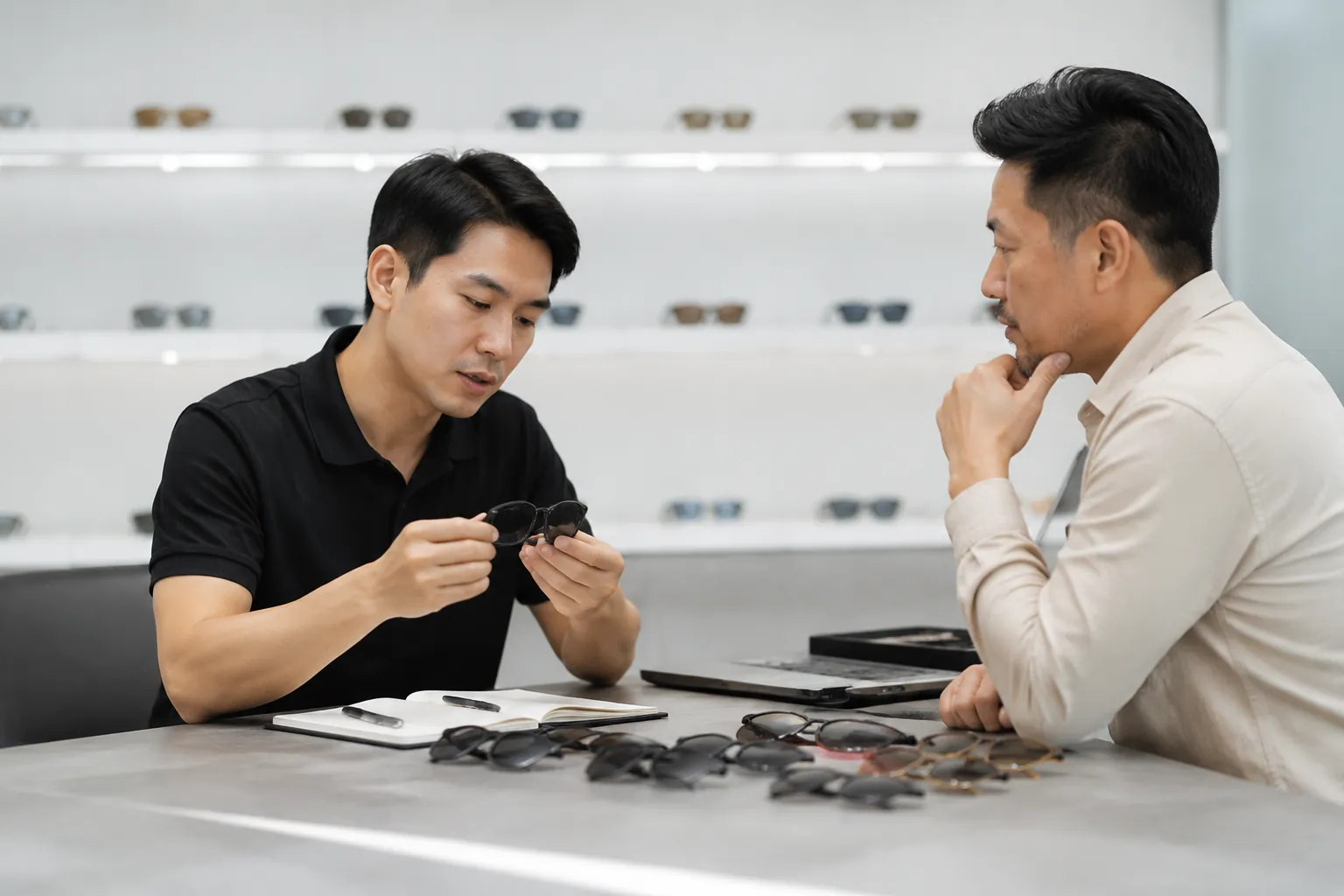
This guide is for brands, importers, distributors, and retail buyers choosing how to develop custom sunglasses without burning time, budget, or margin. It explains when to use stock molds, when to modify an ODM frame, and when full OEM tooling makes commercial sense. The goal is simple: match the development route to your order volume, launch date, target price, destination market, compliance needs, and required level of design control.
The Three Development Routes Buyers Use
Most custom sunglasses projects follow one of three routes: stock mold, modified ODM, or full OEM tooling. Pick the wrong route and the damage shows up later. Late samples. Weak margins. Fit problems. Tooling costs you did not need. A frame shape your competitor is also selling.
Stock mold means the factory already has the frame mold, acetate pattern, lens shape, or metal tooling ready for production. The buyer customizes frame color, lens tint, mirror coating, logo, packaging, barcode labels, and sometimes small hardware details. This is usually the fastest route. It suits first orders, promotional programs, resort retail, online launches, and distributor catalog expansion.
Modified ODM starts with an existing factory design and changes visible or functional details. Common changes include temple decoration, a metal logo plate, rubber temple tips, hinge finish, acetate sheet color, lens color, or adjusted temple length. This route gives the product more brand identity without the cost, risk, and timing of a fully new frame.
Full OEM means the buyer provides drawings, CAD files, reference samples, or a technical brief, and the factory develops new tooling, jigs, fixtures, CNC programs, or production processes as needed. Use this route for protected shapes, specific fit requirements, signature collections, licensed programs, or long-term retail lines where design ownership matters.
LumiShades works across stock mold, modified ODM, and OEM development routes in Wenzhou. The issue is not which route sounds more premium. The issue is which route fits the job: quantity, schedule, price target, compliance market, and exclusivity.
Fast Comparison: Cost, Timing, MOQ, and Control
| Route | Best For | Typical MOQ Logic | Sample Time | Bulk Time After Approval | Main Risk |
|---|---|---|---|---|---|
| Stock mold | Fast launches, test orders, promo programs, retail trials | Can start from low quantities when materials and decoration methods are standard; unit cost improves as volume rises | Often about 7-10 days when existing parts, colors, and lenses are available | Often about 25-35 days for standard colors, logos, and packaging after final sample approval | Limited exclusivity; other buyers may use the same base frame |
| Modified ODM | Seasonal lines needing a more ownable look without full tooling | Usually more practical from a few hundred pairs per design, depending on changed parts and setup needs | Often about 10-20 days for cosmetic changes; longer if fit, tooling, or parts change | Often about 30-45 days depending on parts, finish, approval speed, and material readiness | Small changes can affect hinge strength, lens seating, balance, or fit |
| Full OEM tooling | Owned designs, private collections, proprietary fit, repeat programs | Best when forecasted volume can absorb tooling, development, sampling, and testing cost | Commonly requires several weeks or more depending on drawings, CAD, tooling trial, and revisions | Bulk timing should be confirmed only after tooling trial, pre-production sample, and required compliance checks | Higher upfront cost, more revision cycles, and greater schedule risk |
MOQ is not just a factory preference. It reflects setup time, decoration setup, material batching, lens preparation, inspection, packing, and production line changeover. A small test order can be useful, but the unit cost is higher because logo setup, color matching, lens preparation, and QC are spread across fewer units. As volume rises, material purchasing, packaging sourcing, lens batching, and line scheduling usually become more efficient.
For a fair comparison, ask for tiered pricing using the same assumptions at every tier: frame material, lens type, UV claim, logo method, packaging, labels, destination market, compliance requirements, and inspection level. Do not compare a basic injected stock frame with a single-color lens and pad-printed logo against an acetate frame with polarized lenses, metal logo plates, custom case, retail box, barcode labeling, and third-party inspection. They are different products.
Do not judge by unit price alone. Add sample rounds, tooling or mold modification, packaging development, carton volume, freight method, compliance testing, inspection, and the cost of missing a selling season. A stock mold at a slightly higher unit price may still be the better choice if it gets approved product into market earlier with less development risk.
Use Stock Molds When Speed and Cost Matter More
Stock molds are often the right choice when the buyer needs a dependable product quickly. They work well for festival merchandise, tourist retail, corporate giveaways, resort shops, online launches, private label tests, and mixed-SKU distributor orders. The base engineering has already been used in production, so development time goes into appearance, packaging, labeling, and documents. Not frame structure.
A stock mold order still needs clear decisions. Specify frame material, frame color, lens tint, lens category, UV requirement, logo method, pouch or case, retail box, barcode label, carton mark, destination market, and inspection level. For injected plastic frames, color is usually controlled through resin color chips, masterbatch references, or approved physical samples. For acetate, color is less uniform because sheet pattern, lamination, cutting direction, tumbling, and polishing all affect the final look.
- Good stock mold customizations: solid or translucent frame colors, smoke or brown lenses, gradient lenses, mirror coatings, UV400 lenses where supported by testing, temple pad printing, laser logo, hot stamping, metal logo plate, hang tag, microfiber pouch, EVA case, retail box, SKU label, and carton labeling.
- Risky stock mold requests: changing lens shape without checking groove fit, thinning temples, moving hinge positions, widening a narrow-fit frame, changing front curvature, or using a heavier lens in a frame designed for a lighter one.
- Sample approval points: physical frame color, lens color under consistent light, logo size and position, temple opening tension, hinge screw tightness, nose fit, lens retention, packaging, barcode, and carton mark.
Agree on tolerances before approval. Logo placement tolerance depends on decoration method, surface shape, fixture stability, and operator process. Temple length, bridge, front width, and lens seating should be checked against the approved sample or drawing. Approve lens tint against a physical master sample, not a screen image. Monitor color is not a production standard.
Use Modified ODM When You Need Identity, Not a New Frame
Modified ODM is the middle path. It works when the factory has a base design close to the target product, but the buyer needs visible differentiation. This is common for seasonal collections, boutique private label ranges, lifestyle brands, and distributors that want more than a generic frame but do not need a fully owned design.
The safest ODM changes are visible to the consumer but do not disturb critical geometry. If timing is tight, keep the lens shape, lens groove, hinge location, front curvature, and main bridge structure stable. Put the brand difference into color, lens treatment, temple decoration, logo hardware, tip details, and packaging.
Some changes sound simple. They are not. A new temple profile may need CNC programming, hinge drilling adjustment, polishing trials, and a revised QC gauge. A metal logo plate may require plate tooling or cutting, surface finishing, positioning control, adhesive or pin setting, and inspection for glue residue. A rubber temple tip can change temple weight, comfort, and balance. A new bridge width may improve comfort for one target market but create lens stress if groove depth and front curve are not reviewed together.
For injected frames, changing the actual frame geometry usually means mold work. Even a small design change can require steel modification, an insert change, or a new mold. That pushes the project toward OEM economics. For acetate frames, the factory has more flexibility because fronts and temples are cut from sheet material, CNC milled, tumbled, polished, fitted with hinges, and assembled. Flexibility still needs control. Poor groove depth can loosen lenses. Uneven polishing around the bridge can change fit. Misaligned hinges can make temples sit unevenly on a table or on the wearer's face.
Modified ODM is a good choice when the buyer can accept shared base engineering but wants the finished product to look clearly branded. It is not exclusivity. If the base frame shape must be protected, discuss OEM tooling or a written exclusivity agreement before sampling.
Use Full OEM Tooling Only When the Case Is Clear
Full OEM is not automatically better. It is better only when the design value, sales volume, fit requirement, or brand protection justifies the cost and time. New tooling can make sense for a signature shape, a long-running retail program, a proprietary fit, a licensed collection, or a frame that must not resemble common market stock.
A serious OEM brief needs more than inspiration images. Provide target front width, lens width, bridge, temple length, front curvature or base curve, pantoscopic angle if relevant, hinge type, screw color, logo size, lens category, target market, packaging, and compliance destination. A physical reference sample helps. CAD files or technical drawings help more. If neither is available, plan for more sample rounds because the factory must translate a visual idea into production dimensions.
- Confirm the destination market and applicable requirements, such as CE EN ISO 12312-1 for Europe, ANSI Z80.3 for the United States, AS/NZS 1067 for Australia and New Zealand, REACH for restricted substances, and FDA registration considerations for the U.S. market.
- Build drawings or CAD and agree on critical dimensions, including lens groove, hinge position, bridge, front width, frame curve, and temple length.
- Create a prototype, CNC sample, 3D trial, or first tooling trial depending on material, process, and development route.
- Check fit, lens retention, hinge movement, screw torque, logo placement, surface finish, lens performance claims, and packaging.
- Revise tooling, CNC program, polishing process, assembly method, or inspection gauges if required.
- Approve a pre-production sample before bulk material purchasing, mass production scheduling, and final packaging release.
New tooling also requires forecast discipline. If a buyer pays for a private frame and orders only one small batch, the unit economics are usually weak. If the same frame will run across several seasons, colors, lens options, or retail channels, OEM can be the right investment. Ask two questions: Can we make it? And will the expected volume absorb development cost while protecting margin and schedule?
Materials, Lenses, and Decoration Can Change the Route
The OEM versus ODM decision is tied to material. Injection, acetate, metal, and combination frames behave differently in development and production.
Injected plastic frames are efficient for consistent shapes and repeat production once the mold is stable. They suit stock mold programs and high-volume OEM programs. The limit is tooling dependency. Changing the frame shape usually means mold changes, not simple operator adjustment. Review samples for sink marks, parting lines, warpage, flash, hinge insert strength, lens seating, and surface finish.
Acetate frames offer richer color, layered patterns, and a more premium hand feel. They are cut from sheet, CNC milled, tumbled, polished, fitted with hinges, and assembled. They suit modified ODM and OEM work where color, pattern, and shape matter. The trade-off is more hand-process variation. Inspect polishing around the bridge, lens groove consistency, hinge alignment, temple symmetry, and color matching between fronts and temples.
Metal and combination frames need tight control over soldering, plating, nose pad arms, screw tension, coating durability, and plating color. Small defects are easy to see on metal. If a plastic temple uses a metal logo plate, check edge finishing, plate alignment, adhesive or pin setting, and residue. A crooked logo plate can make an otherwise acceptable frame look cheap.
Lenses are not decoration. Specify lens material, UV protection claim, lens category, tint, mirror coating, polarization if required, optical clarity expectations, and destination standard. Common choices include smoke, brown, green, gradient, mirror, and polarized lenses. Polarized lenses can improve perceived value, but they require attention to lens thickness, fit, stress, and inspection. Any UV, polarized, category, or standard claim on packaging should be supported by the product specification and test documentation.
Compliance and QC Must Be Set Before Sampling
Compliance should be part of the first quote, not a panic item before shipment. Different markets require different documents, labels, and test expectations. Common references include CE EN ISO 12312-1 for Europe, ANSI Z80.3 for the United States, AS/NZS 1067 for Australia and New Zealand, REACH for restricted substances, FDA registration considerations for the U.S. market, ISO 9001 quality management certification, and BSCI social audit documentation. Request current certificates, test reports, or audit documents where relevant. Do not print UV, polarized, category, or standard claims unless the product and paperwork support them.
QC should match the risk points of the route. For stock molds, check decoration accuracy, lens color consistency, hinge movement, lens retention, and packaging. For modified ODM, add inspection for every changed part. For OEM, inspect against the approved drawing, pre-production sample, and golden sample.
- Dimensional checks: lens width, bridge, temple length, front width, frame curve, temple opening symmetry, and comparison with approved sample or drawing.
- Assembly checks: hinge screw tightness, temple movement, lens retention, nose pad position if applicable, frame balance, and opening/closing feel.
- Surface checks: scratches, sink marks, acetate polishing marks, plating defects, logo alignment, glue residue, color consistency, and visible deformation.
- Lens checks: tint match, mirror coating defects, optical distortion, UV claim support, polarization if specified, and category marking where required.
- Packing checks: SKU labels, barcode accuracy, carton marks, polybag warnings if used, pouch or case condition, and retail packaging appearance.
A practical tolerance discussion prevents disputes later. Define logo position, frame dimensions, lens color, and acceptable cosmetic defects before production. Acetate color patterns cannot be controlled like printed Pantone color blocks. Lens tint batches should be checked against a physical master sample under consistent light. If a third party will inspect the order, agree on AQL level, defect classification, sampling plan, and golden sample before production starts.
A Simple Decision Rule for Your Next Project
Use this rule before asking factories for quotes. If you need product quickly and the order is small or unproven, start with stock molds. If you need a more ownable look and have a normal seasonal calendar, consider modified ODM. If the design is central to your brand, protected by your own development work, or expected to repeat in meaningful volume, evaluate OEM tooling.
Be direct with the factory. Share target quantity by design, target price, destination market, launch date, preferred material, lens type, packaging requirement, logo method, compliance requirements, inspection expectations, and whether exclusivity matters. A vague request such as "send your best price for custom sunglasses" wastes days. The supplier has to guess the product, standard, decoration method, and quality level. A clear RFQ produces a quote you can actually compare.
Buyer shortcut: if losing the frame shape to another brand would damage the program, do not rely on stock molds without a written exclusivity agreement. If missing the launch date would hurt more, do not start with new tooling unless the schedule includes real time for trials and revisions.
LumiShades can support low-MOQ test orders where suitable, but the best costing discussions happen when buyers show volume tiers. Ask for pricing at several quantities using the same lens, logo, packaging, compliance, and inspection assumptions. That shows the true cost curve and helps decide whether the project should stay simple, move into ODM modification, or justify OEM development.
Have a custom sunglasses project in mind?
Send us your styles, target market and quantities and we will return a detailed quote with MOQ, lead time and a sample plan.
Get a QuoteWhy source this from Wenzhou with LumiShades
Wenzhou in Zhejiang Province is widely regarded as China’s eyewear manufacturing capital, producing a large share of the world’s sunglasses. That concentration matters to buyers: a deep local supply chain for acetate sheet, hinges, lens blanks, plating and packaging means shorter component lead times, easier color and material matching, and a workforce with decades of eyewear-specific skill. LumiShades has manufactured in this ecosystem since 2009, and our vertical integration — in-house injection molding, acetate cutting, CNC milling, lens tinting, decoration and quality control — means no part of your order is quietly subcontracted to a workshop you cannot audit.
For international buyers, that vertical control translates into accountability. When a single factory owns every step, defects are traced and fixed at source rather than bounced between vendors, and your specifications survive intact from first sample to bulk. We back this with 15+ years of experience, shipments to 60+ countries, more than 5 million pairs produced per year and a 98.5% on-time delivery rate. Our certifications — CE EN ISO 12312-1, FDA registration, ANSI Z80.3, AS/NZS 1067, REACH, ISO 9001 and BSCI audit — mean the compliance documentation your market requires already exists. Explore our manufacturing capabilities and quality control process to see how this works in practice.
Frequently asked questions
Can I get exclusivity if I use a stock mold? Usually not for the base frame shape. A stock mold may be offered to more than one buyer unless the supplier agrees in writing to reserve it for you. You can still create differentiation through color, lenses, logo method, packaging, and labeling. If exclusivity matters, ask for written terms covering the frame shape, territory, sales channel, time period, MOQ commitment, and what happens if the agreed purchase volume is not met.
What is the safest route for a first sunglasses order? Use a stock mold with controlled customization: frame color, lens tint, logo, packaging, and required labeling. Approve a physical sample before bulk production. Confirm the destination market, UV claim, lens category, packaging text, barcode, carton marks, and inspection criteria at the quote stage. Scale up only after you have checked fit, quality, landed cost, and customer sell-through.
When does new tooling become worth it? New tooling is worth evaluating when the frame will repeat, the shape is important to brand identity, the fit requirement cannot be met with existing designs, or forecasted volume can absorb development cost. Before approving tooling, ask for a tooling quote, ownership terms, sample timeline, expected revision process, maintenance responsibility, exclusivity terms, and estimated unit cost at your realistic order quantities.
Which compliance standards should I mention in my RFQ? State the destination market first. Common references include CE EN ISO 12312-1 for Europe, ANSI Z80.3 for the United States, AS/NZS 1067 for Australia and New Zealand, REACH for restricted substances, and FDA registration considerations for the U.S. market. Also ask what labeling, category marking, test reports, and packaging claims are required for your sales channel. Do not print UV, polarized, or standard claims until the supplier confirms the product specification and supporting documentation.
How long should I plan from sample to bulk shipment? For stock or simple modified designs, sampling may be possible in about 7-10 days when existing parts and lenses are available. Bulk production is often about 25-35 days after final approval for standard work. Modified ODM usually needs more time, especially when parts, fit, or finishes change. OEM tooling requires additional time for drawings, tooling trials, corrections, pre-production approval, and any required testing. Build buffer time for sample revisions, packaging approval, inspection, and freight.
What information should I send to get an accurate quote? Send quantity by design and color, target price if available, frame material, lens type, UV or polarization requirement, logo method, packaging, barcode and labeling needs, destination country, target delivery date, compliance requirements, inspection level, and whether you want stock mold, modified ODM, or full OEM development. For OEM, also send drawings, CAD files, reference samples, target dimensions, and fit requirements. Ask the supplier to separate unit price, tooling, sample cost, packaging, testing, and freight assumptions.
Ready to start?
Explore our rimless sunglasses or request a quote — our sales team replies within 12 hours.
Request a Quote