
OEM Sunglasses Sampling Checklist for Factory Handoff
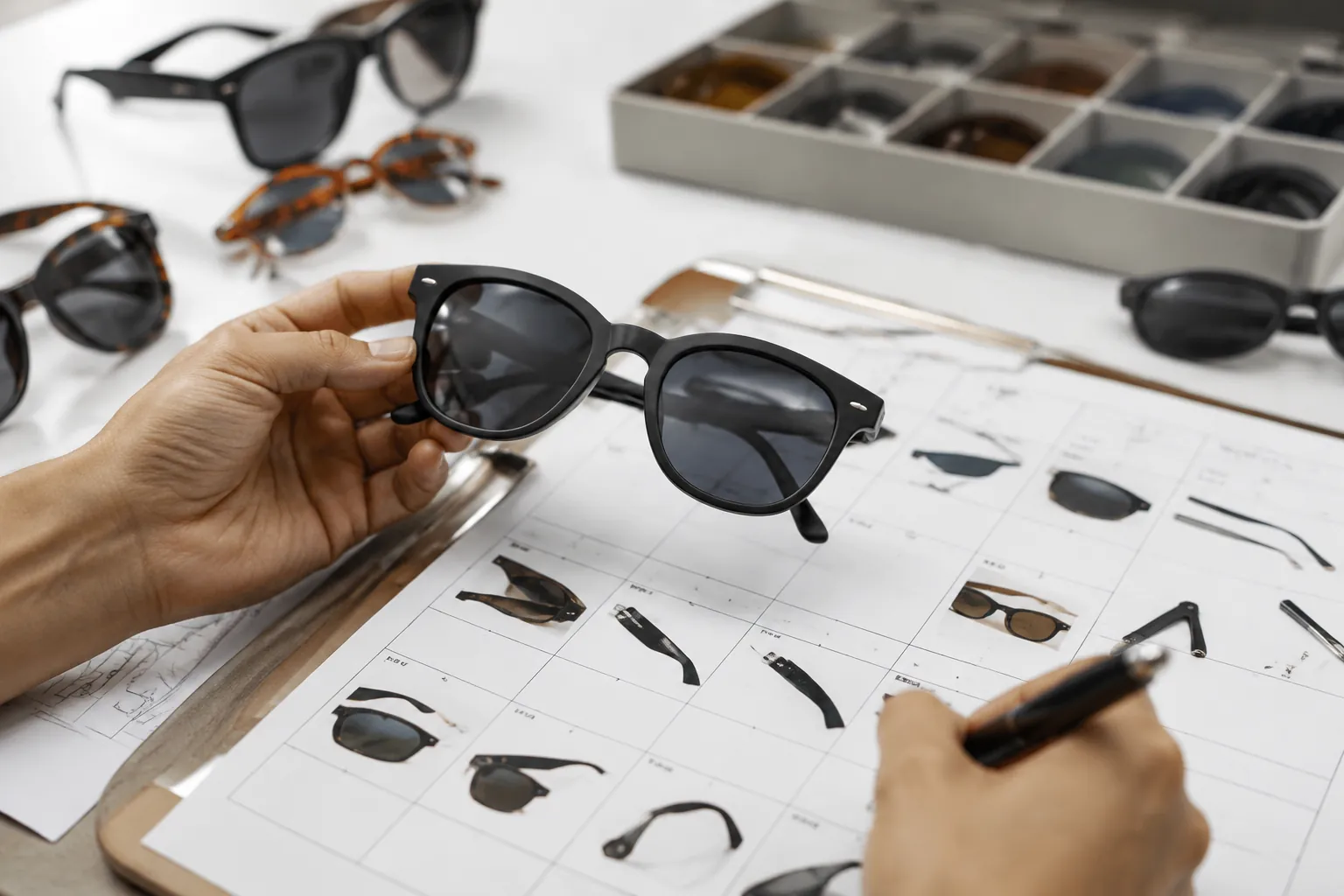
This guide is for overseas brands, importers, distributors, and retailers preparing to request OEM sunglasses samples from a factory. A clear handoff prevents wrong samples, repeat courier costs, late testing, and lost production weeks. Use it before sending files to LumiShades or another qualified eyewear manufacturer in Wenzhou.
Start With the Commercial Frame, Not the CAD File
Sampling should start with the business target, not just the drawing. A factory can make a clean prototype that still misses your margin, order quantity, compliance plan, or launch date. Before LumiShades opens tooling, cuts acetate, mixes lens tint, or prepares decoration jigs, confirm the target order quantity, destination market, target landed cost, sample purpose, and required launch date.
Volume changes the development route. LumiShades can support low-volume OEM sunglasses projects from 50 pairs per design when the style, material, and decoration method are suitable. That works for market tests, influencer drops, distributor previews, and retailer line reviews. Unit cost usually improves at higher quantities because material purchasing, mold setup, decoration fixtures, packing work, and QC time are spread across more units. The final price must be quoted against the confirmed frame material, lens category, decoration, packaging, inspection level, and production quantity.
Be honest about the volume tier. If you brief a large-volume program and later order a small trial run, the sample may be built around a cost structure that no longer works. Also define the job of the first sample. A design approval sample checks proportion, color, logo position, and fit. A sales sample needs cleaner finishing and near-final packaging. A compliance sample must use the intended lens category, coating, material, markings, and documents. A pre-production sample should match the planned bulk process, not just the look.
- 50 pairs: useful for market testing when the factory confirms the style and process are suitable.
- 300 pairs: practical for small private-label launches and retailer trials.
- 1000 pairs: often allows better material purchasing and more stable decoration setup.
- 5000+ pairs: more suitable for repeat styles, stronger price negotiation, and planned QC resources.
Build a Tech Pack a Factory Can Quote From
An eyewear tech pack is not a mood board. It tells the production team what to make, how to measure it, and what to reject. For sunglasses, include front width, lens width, bridge, temple length, lens height, frame thickness, hinge type, screw color, nose pad style, temple tip shape, lens base curve, lens category, and intended fit.
Use millimeters. Add tolerances where they matter. Avoid vague notes such as "slightly oversized," "luxury feel," or "same as photo." If the front should be 145 mm, write 145 mm and give an acceptable range. Practical visible-dimension tolerances depend on material, tooling, finishing, and measurement point, so mark the critical dimensions instead of applying one tolerance to every feature. Lens fitting, hinge alignment, temple opening angle, and frame balance matter as much as the table-top look. A frame can photograph well and still sit crooked.
For injection molded frames, confirm the material, such as PC, TR90, or another specified plastic. PC is widely used for cost-sensitive promotional and fashion styles, but feel and flexibility depend on design and grade. TR90 is commonly chosen for lighter, more flexible frames, including sports or comfort-focused designs. Acetate offers richer color options and a higher perceived value, but cutting, tumbling, and polishing remove material. Protect sharp bevels, thin rims, and layered colors in the brief.
| Spec Item | What to Send | Typical Detail Needed |
|---|---|---|
| Frame dimensions | Front, lens, bridge, temple, lens height | Measurements in mm with tolerances for critical points |
| Material | PC, TR90, acetate, metal parts, hinge type | Material grade if known, sheet thickness, screw color, spring or standard hinge |
| Lens | Category, tint, coating, UV requirement | Category 2 or 3, UV400 target, mirror, polarized, gradient, base curve |
| Fit and function | Temple angle, opening width, nose bridge feel | Head size target, wearing pressure, hinge tension, temple drop |
| Decoration | Logo size, method, location, color | Placement from hinge or temple tip in mm, Pantone or metal finish |
Send References, But Define Their Purpose
Reference samples help only when you explain what each reference controls. Do not make the factory guess whether you like the hinge tension, lens color, temple thickness, nose bridge, matte finish, or overall shape. If possible, send one physical sample and attach annotated photos. Mark the front view, side view, hinge area, nose bridge, temple tip, lens shade, and logo location.
Protect intellectual property. Do not ask a factory to copy a protected brand model. Use precise instructions instead: "match this temple stiffness," "use this matte surface feel," "keep lens height close to this sample," or "use this reference only for the brown gradient lens." LumiShades can develop original OEM frames through injection molding, acetate cutting, CNC milling, lens tinting, laser engraving, pad printing, and metal logo plate assembly, depending on the project specification. Clear reference logic cuts correction rounds.
If you send several references, rank them. Reference A may define silhouette, Reference B lens tint, Reference C packaging, and Reference D hinge feel. Label the physical samples and the digital files with the same names. A production manager may handle many sampling projects at once. Unlabeled frames and screenshot folders cause mistakes.
Blunt rule: if a feature can cause rejection, write it into the handoff before sampling starts.
Lock Color Targets Before Material Mixing
Color causes more sample disputes than almost any other item. Screens lie. Office lighting changes perception. Tinted lenses look different on a white table, on skin, and outdoors. Use Pantone targets where possible, but know their limits. Pantone on coated paper is not the same as transparent lens dye, polished acetate, rubberized coating, or injected plastic.
For frame color, provide the Pantone code, finish type, and reference photos. State whether the color is solid, translucent, tortoise, gradient, metallic, matte, glossy, or soft touch. For acetate, ask whether sheet swatches are available before full sampling when the color is custom. Lamination direction and polishing can shift the perceived shade. For injection molding, a color chip or molded plaque may be faster and cheaper to review than a complete wrong-color frame, if the factory can provide it for the chosen material.
For lenses, "black lens" is not a specification. Write smoke gray category 3, brown gradient category 2, G15-style green, blue mirror over gray base, polarized TAC, or PC lens with UV400 target. If the sunglasses will be sold in Europe, the sample specification should support CE EN ISO 12312-1. For the United States, review ANSI Z80.3 and FDA registration requirements. For Australia and New Zealand, consider AS/NZS 1067 early. Lens darkness, UV transmission, traffic signal recognition, warnings, and markings are tied to the sample specification.
- Frame color: Pantone, material, finish, gloss level, and acceptable shade range.
- Lens color: base tint, gradient position, mirror color, category, and UV requirement.
- Logo color: Pantone, foil, plating, or tone-on-tone engraving requirement.
- Packaging color: print method, paper stock, coating, barcode space, and retailer label rules.
Prepare Logo Files Like Production Files
Logo artwork should be ready for production, not copied from a website header. Send AI, EPS, or editable PDF files, plus a high-resolution PNG for visual reference. Convert fonts to outlines. Include the exact logo size in millimeters and the placement from a measurable edge, such as 18 mm from the hinge center or 35 mm from the temple tip.
Decoration method affects cost, lead time, and reject rate. Laser engraving is durable and works for many small temple marks, but contrast can be low on dark or translucent materials unless the mark is filled or designed for tone-on-tone branding. Pad printing gives color and can be used on frames, lenses, cases, and pouches, but it needs artwork separation, ink adhesion checks, and rub testing. Metal logo plates create a stronger retail impression, but require recess design, adhesive or pin decisions, plating color, alignment control, and extra assembly QC.
LumiShades can support laser engraving, pad printing, and metal logo plates when they fit the selected material and design. The buyer must define whether a small color shift is acceptable, whether the logo must survive rubbing, and whether branding appears on one temple, both temples, lens, pouch, case, box, or instruction card. List every location. Do not leave it to memory.
| Decoration Method | Best Use | Process Watch Point |
|---|---|---|
| Laser engraving | Small permanent temple branding | May be tone-on-tone with limited contrast |
| Pad printing | Colored logos on frame, lens, case, or pouch | Requires adhesion and rub checks before approval |
| Metal logo plate | Higher-value temple branding | Adds tooling, recess accuracy, plating, and alignment QC |
| Lens logo print | Retail mark or category identification | Must stay small enough to avoid visual distraction |
Treat Packaging as Part of the Sample
Packaging is often rushed after the frame is approved. That is how brands end up with good sunglasses in the wrong pouch, weak cartons, missing barcodes, or non-compliant retail labels. Include packaging in the first handoff if the sample will be shown to retailers, used for barcode setup, checked for case fit, or used for final cost confirmation.
Specify the unit pack: microfiber pouch, EVA case, hard case, cleaning cloth, instruction card, hang tag, polybag, retail box, barcode label, or anti-scratch sleeve. Give dimensions and material requirements. Thick wrap frames may not fit slim cases without bending the temples. Mirror lenses need suitable cleaning cloth material because rough fabric can scratch samples during repeated sales handling. If the case has a logo, confirm whether it is printed, debossed, embossed, rubber patched, or metal plated.
For export cartons, state inner box count, master carton count, carton marks, gross weight limits, and retailer routing-label needs. The factory needs these packaging rules before packing trials. A carton that survives the factory warehouse may still fail a retailer receiving requirement if barcode placement, carton dimensions, or mixed-SKU rules are wrong.
- Confirm unit pack contents and final print files.
- Approve barcode type, SKU code, and label location.
- Check case fit with the actual sample, not a similar frame.
- Confirm master carton quantity, carton marks, and routing label needs.
- Keep one approved packaged sample as the packing standard.
Declare Compliance Markets Before Lens Sampling
Do not wait until bulk production to discuss compliance. The destination market tells the factory which lens, markings, warnings, documents, and test approach are needed. Relevant eyewear and factory-audit references may include CE EN ISO 12312-1, FDA registration, ANSI Z80.3, AS/NZS 1067, REACH, ISO 9001, and BSCI, depending on the product, market, and buyer requirements. Do not request unrelated certificates just to fill a vendor form. It wastes time and creates document noise.
For Europe, sunglasses should be reviewed against CE EN ISO 12312-1 and applicable REACH material requirements. For the United States, ANSI Z80.3 is commonly relevant for non-prescription sunglasses, and FDA registration requirements should be handled correctly. For Australia and New Zealand, AS/NZS 1067 is the key standard to flag early. If the same style will sell in multiple markets, tell the factory before sampling. One lens category, warning text, or marking layout may not fit every market.
Give the factory the selling countries, product type, age group, lens category target, and whether the sunglasses are fashion, sports, kids, promotional, or retailer private label. Kids' eyewear and sports eyewear require tighter risk review. Also confirm whether testing must be performed by a nominated third-party lab or supported by factory-provided compliance documents. The test sample must use the same material, lens, coating, and markings intended for bulk production. Otherwise, the result may not represent the goods shipped.
Freeze the Sample Scope and Track Revisions
Once the handoff is complete, freeze the first sample scope. Changes after sampling starts are normal, but they must be tracked as revisions. Do not scatter old and new instructions across email, chat, spreadsheets, and file-sharing links. Version control keeps the factory from following yesterday's Pantone code or last month's logo size.
Ask the factory to confirm the sampling lead time in writing after reviewing the actual material, decoration, tooling, lens, packaging, and compliance requirements. Simple samples may move faster than projects involving new injection tooling, unusual acetate colors, metal logo plates, custom lens tinting, or nominated lab testing. Bulk production timing should be confirmed against the final approved sample, deposit, material availability, packaging approval, and compliance requirements. Buyer-side delays are common. Late artwork, changed Pantone targets, missing barcode files, and unclear compliance markets all move the schedule.
Send one final folder before the factory begins. Name files clearly and include the tech pack, drawings, logo files, Pantone list, packaging artwork, reference photos, compliance markets, target order quantity, and required sample purpose. Ask the factory to confirm open questions in writing. If there are ten unresolved questions, you are not ready for sampling.
- Before sampling: confirm dimensions, materials, lens category, Pantone targets, logos, packaging, order quantity, and markets.
- During sampling: track every change by revision date, item number, and responsible person.
- After review: approve, reject, or revise with photos, measurements, and clear acceptance limits.
- Before bulk: keep a signed approval sample and packaging standard at both buyer and factory sides.
Have a custom sunglasses project in mind?
Send us your styles, target market and quantities and we will return a detailed quote with MOQ, lead time and a sample plan.
Get a QuoteWhy source this from Wenzhou with LumiShades
Wenzhou in Zhejiang Province is widely regarded as China’s eyewear manufacturing capital, producing a large share of the world’s sunglasses. That concentration matters to buyers: a deep local supply chain for acetate sheet, hinges, lens blanks, plating and packaging means shorter component lead times, easier color and material matching, and a workforce with decades of eyewear-specific skill. LumiShades has manufactured in this ecosystem since 2009, and our vertical integration — in-house injection molding, acetate cutting, CNC milling, lens tinting, decoration and quality control — means no part of your order is quietly subcontracted to a workshop you cannot audit.
For international buyers, that vertical control translates into accountability. When a single factory owns every step, defects are traced and fixed at source rather than bounced between vendors, and your specifications survive intact from first sample to bulk. We back this with 15+ years of experience, shipments to 60+ countries, more than 5 million pairs produced per year and a 98.5% on-time delivery rate. Our certifications — CE EN ISO 12312-1, FDA registration, ANSI Z80.3, AS/NZS 1067, REACH, ISO 9001 and BSCI audit — mean the compliance documentation your market requires already exists. Explore our manufacturing capabilities and quality control process to see how this works in practice.
Frequently asked questions
Can I request a sunglasses sample with only photos and a logo? Yes, but it is a higher-risk brief. Photos do not define dimensions, material grade, lens category, hinge feel, color tolerance, logo placement, packaging, or compliance market. If you start with photos only, ask the factory to write down all assumptions before sampling and expect at least one correction round.
What is the minimum order quantity for OEM sunglasses at LumiShades? LumiShades can support OEM sunglasses projects from 50 pairs per design when the selected frame, material, lens, and decoration process are suitable. For quoting, give the factory your realistic first order quantity and reorder forecast. Pricing normally improves at higher quantities because setup, decoration, QC, packing, and material purchasing are spread across more units.
How long should I allow for sampling and bulk production? Ask for a confirmed timeline after the factory reviews your complete handoff. Sampling time depends on tooling, material availability, lens tinting, decoration, packaging, and compliance testing. Schedule bulk production only after sample approval, deposit, material confirmation, packaging approval, and compliance requirements are settled.
Do I need to choose the compliance standard before making a sample? Yes. Tell the factory the selling countries before lens sampling. Europe may require CE EN ISO 12312-1 and REACH review, the United States may require ANSI Z80.3 review and FDA registration handling, and Australia/New Zealand should be checked against AS/NZS 1067. The compliance sample should use the same lens, coating, material, markings, and warnings planned for bulk production.
What logo file format should I send for temple branding? Send vector artwork such as AI, EPS, or editable PDF with fonts converted to outlines, plus a PNG for visual reference. State the logo size in millimeters, placement from a measurable point, color, decoration method, and whether the logo must pass rub or adhesion checks. If branding appears on both temples, lenses, case, pouch, or box, list each location separately.
Should packaging be included in the first sample request? Include packaging if the sample will be used for retailer review, barcode setup, case-fit checks, cost confirmation, or compliance label review. Provide pouch or case dimensions, box artwork, barcode type, SKU label position, carton marks, carton quantity, and any retailer routing requirements. Keep one approved packaged sample as the packing standard for production.
Ready to start?
Explore our round sunglasses or request a quote — our sales team replies within 12 hours.
Request a Quote