
Build a Sunglasses Line by Retail Price Point
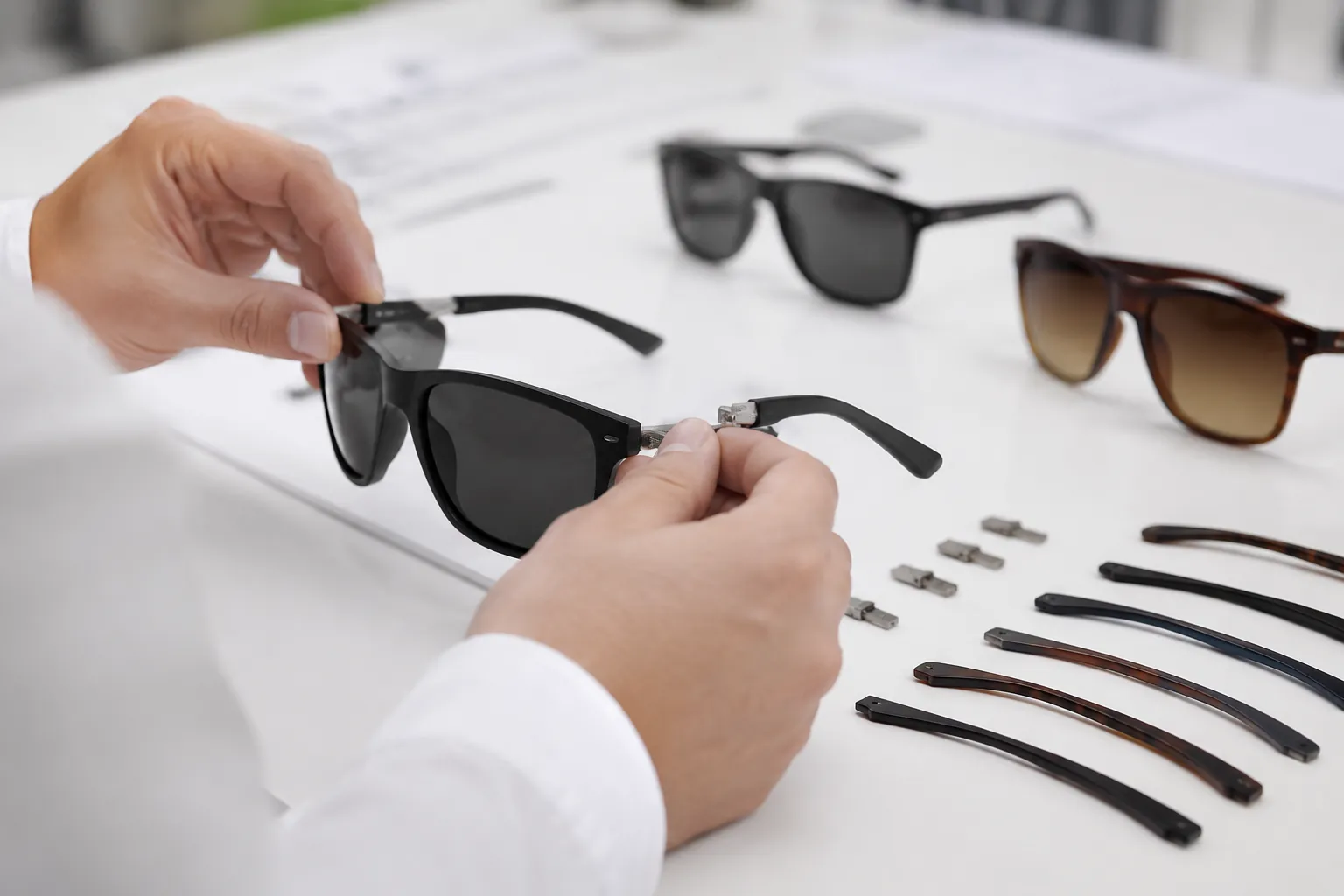
This guide is for brands, importers, distributors, and retailers building a sunglass line that has to do more than look good on a shelf. The job is to match each retail price point with the right material, build method, compliance path, and margin profile. If that balance is off, you get thin margins, slow reorders, or product that fails in the channel. If it is right, the line is easier to sell, easier to replenish, and easier to scale.
Start with the retail job, not the frame shape
Build a sunglasses line from the shelf backward. Before you talk about shapes, ask three questions: who is buying at this price, where will it be sold, and what margin does the channel need to stay healthy?
An entry SKU in a convenience store, pharmacy, travel retail outlet, or volume chain has a different job than a premium acetate frame in an independent optical store. The low-price item has to turn fast, stay simple, and survive handling with few complaints. The premium item has to justify its price in hand. That is harder.
Structure the line as a ladder, not a pile of unrelated styles:
- Entry: impulse-friendly, low unit cost, simple colors, minimal decoration, repeatable build.
- Mid: better material mix, cleaner finish, more colorways, clearer brand expression.
- Premium: acetate, metal detail, higher polish, tighter QC, better case and packaging, lower failure risk.
Do not start with a hero frame and force it into every price point. Start with the price point. Then engineer the frame to fit it. A shape that works at $12 retail can fail at $48 retail if the finish, weight, or packaging do not support the promise.
Use the price ladder to define the spec ladder
Retail price should drive material choice, lens package, decoration, and even the number of parts in the assembly. A $12 to $18 pair cannot carry the same structure as a $45 to $80 pair. The cost base, perceived value, and product risk all need to match.
Every step up in retail band should buy something visible or tangible: better surface quality, better lens behavior, more consistent hinge feel, stronger packaging, or a more distinctive logo application. If the buyer cannot see or feel the difference, the price jump will be hard to defend.
| Price band | Typical build | Buyer priority | Manufacturing note |
|---|---|---|---|
| Entry | Injection frame, basic PC lens, simple print or no logo | Low landed cost, fast replenishment | Keep tooling simple, reduce color changes, avoid extra part counts |
| Mid | Injection or mixed-material frame, UV400 lens, pad print or laser mark | Stronger shelf appeal, healthier margin | Use more colorways, but control finish standards and hinge consistency |
| Premium | Acetate or metal/acetate mix, high polish, metal logo plate, upgraded case | Perceived quality, lower return risk | Allow more finishing time and tighter inspection on alignment, polish, and symmetry |
| Fashion premium | Heavier acetate, layered lamination, specialty tint, premium packaging | Storytelling and presentation value | Expect longer lead times and more sample rounds before approval |
Buyers often make two mistakes. They over-spec the entry tier and under-spec the premium tier. Entry products should be clean, stable, and repeatable. Premium products should feel materially better in hand. Weight balance, hinge resistance, polish, lens clarity, and logo execution matter more than random features.
Check the sample stage with plain targets: narrow lens tint variation, even temple opening force, no visible sink marks in injection parts, clean edge finishing, and alignment that does not drift when the frame is opened and closed. Miss those basics and retail will expose it fast.
Build the line around margin bands
Retail price point only works if the margin band is realistic. Most buyers need room for freight, duty, packaging, claims, markdowns, and channel discounts. If gross margin is too thin, the line will not survive promotions or reorder pressure.
Start from landed cost, not factory cost. If the channel needs a 60% gross margin, landed cost has to stay around 40% of retail before local overhead. In price-sensitive channels, the buyer may need even more room to absorb freight swings and promotional allowances.
Use a ceiling-first process:
- Set target retail for each SKU tier and sales channel.
- Define target landed cost, required gross margin, and expected markdown pressure.
- Choose frame material, lens type, and decoration within that ceiling.
- Stress-test packaging, freight, duty, and failure allowance.
- Freeze the sample only after the numbers still work.
The real cost of a sunglass SKU is rarely just the factory price. Packaging can add real cost if you upgrade from a polybag to a rigid case or printed box. Air freight can erase margin on a small pilot order. A logo plate, extra polish step, or custom hinge can change whether a SKU survives in a store planogram.
LumiShades' pricing logic follows this ladder: MOQ starts at 50 pairs per design, and pricing improves at 300, 1000, and 5000+ pairs. At high volume, production can reach about $2.10 per pair depending on spec. That matters because a line should not be designed around one-off pricing. It should be designed around the reorder price the channel can actually live with for the next six to twelve months.
Quote the same SKU at three levels before approval: pilot quantity, first commercial quantity, and replenishment quantity. If the economics only work at pilot level, the style is not ready for a line.
Match material to price point and failure risk
Material choice affects more than cost. It affects surface quality, breakage behavior, consistency, lead time, and how much QC you need before shipment. It also changes the feel in hand. Buyers notice that quickly.
Injection molding is the workhorse for entry and many mid-tier sunglasses. It is efficient, repeatable, and suitable for high-volume geometries with stable dimensions. For standard production, buyers often want wall thickness in the roughly 1.2 to 2.0 mm range depending on the design, with enough structure to avoid flex without making the frame feel bulky. If the mold is clean and the process is controlled, injection gives better consistency across large runs and easier color matching from batch to batch.
Acetate behaves differently. It gives more depth, a richer surface after polishing, and a stronger premium signal, but it also demands more finishing labor and tighter control of temperature, polishing, and alignment. Small variations show up faster on acetate because the customer is paying for hand-feel as much as shape. Metal and mixed-material frames can sit in the upper middle or premium tier if welding, plating, and assembly are controlled well. Poor plating or loose temple fit will be noticed quickly.
At the lens level, separate appearance from performance. Tint, base curve, optical clarity, and coating quality all matter. A lens can look dark enough on a board sample and still perform poorly if transmission is uneven or edge distortion is obvious. For lower price points, keep lens options tight and avoid too many custom tints. For premium pairs, spend on consistency, scratch resistance, and clean color match rather than gimmicky gradients.
Good suppliers should define tolerances in plain language. Ask how much temple opening variation is acceptable, how tightly lens centering is controlled, and what visible surface defects are rejected at final inspection. You do not need a giant spec sheet to start. You do need clear acceptance criteria before production begins.
LumiShades runs injection molding, acetate cutting, CNC milling, lens tinting, decoration, and QC in-house. That matters because it reduces handoff loss. If one factory does the molding, another does the logo, and a third does final inspection, defects become harder to trace and slower to correct. One controlled production floor is usually easier to manage than a chain of subcontractors.
Plan the assortment by channel, not by ego
A product line gets messy when every decision is based on what the brand team likes. The stronger approach is channel math. A retailer needs fast movers. A distributor needs broad sell-through. An importer needs margin and replenishment stability. Each buyer uses the same frame differently.
Give each tier a role and a size limit. The goal is a line that is easy to buy, easy to restock, and easy to explain on a shelf.
- Entry SKU: one or two core shapes, a narrow color set, and a high-replenishment profile.
- Mid SKU: better finish, more color variation, and stronger seasonal appeal.
- Premium SKU: tighter editing, fewer units per color, and more presentation value.
Do not overload each tier with ten similar shapes. That ties up cash, inflates inventory risk, and creates cannibalization. Three strong shapes per price tier usually beat ten weak ones. In wholesale, give buyers enough choice to cover their shelf plan, but not so much that production becomes chaotic and forecast accuracy collapses.
Color strategy matters too. Black, tortoise, smoke, gunmetal, and classic metallic finishes usually move across channels because they are easy to merchandise and easy to reorder. Bright seasonal colors can work, but they should support the line, not replace it. If the entire assortment depends on fashion color, the program becomes fragile when the season turns or the buyer changes direction.
Set a core assortment ratio before sampling: for example, 70% core colors, 20% seasonal colors, and 10% experimental designs. That gives the line a stable base while still allowing the buyer to test response.
Treat lead time as part of the product strategy
A price point is not useful if you cannot replenish it. Lead time affects cash flow, forecast confidence, and whether a retailer keeps the SKU in stock long enough to matter. In eyewear, a good line is often the one that can be reordered without being re-engineered.
LumiShades quotes samples in 7 to 10 days and bulk production in 25 to 35 days. That is a workable planning window for many B2B programs, but only if the buyer freezes the spec on time. Late changes on lens color, decoration method, packaging, or temple print can push the schedule and trigger avoidable air freight.
Think about lead time in stages:
| Item | Typical timeline | Buyer risk if late | Best practice |
|---|---|---|---|
| Sample development | 7-10 days | Missed selling season | Approve shape, lens direction, and logo placement before asking for extras |
| Bulk production | 25-35 days | Inventory gap | Freeze color, lens, packaging, and carton marks early |
| Price break jumps | 50 / 300 / 1000 / 5000+ pairs | Wrong cost model | Forecast reorder volume before final sample approval |
| Post-production inspection | 1-3 days | Ship delay from avoidable defects | Inspect by AQL or agreed visual standard before booking freight |
Lead time is also part of channel confidence. If a buyer knows a style can be replenished quickly, they are more likely to take a deeper opening order. If the product takes too long and the factory cannot commit to a stable repeat run, the SKU may be treated as a test rather than a real line item.
For volume programs, ask where the schedule usually slips: mold correction, color matching, decoration, or packing. That answer tells you whether the supplier understands its bottlenecks.
Do not separate compliance from assortment planning
Compliance should be decided before the final line is approved, not after. Different markets and channels ask for different proof. If you sell into the wrong market with the wrong file set, the SKU may be dead on arrival even if the product itself looks good.
LumiShades lists real certifications and registrations only: CE EN ISO 12312-1, FDA registration, ANSI Z80.3, AS/NZS 1067, REACH, ISO 9001, and BSCI. Those are useful, but they do not replace buyer-side verification. You still need to confirm which test standard your customer, importer, or marketplace requires for the destination country and retail channel.
For a practical line build, think in market sets:
- EU-oriented retail: confirm CE EN ISO 12312-1 documentation and REACH-related material control.
- US-oriented retail: confirm FDA registration and verify whether the buyer wants ANSI Z80.3 references in the file set.
- Australia/NZ-oriented retail: confirm AS/NZS 1067 requirements before the first production order.
Ask for the actual test report scope, not just the certificate name. Buyers should know whether the test covers lens transmittance, UV performance, impact behavior, labeling, or material restrictions. A compliant document set that does not match destination requirements can still cause delays at import or during retailer onboarding.
If a supplier cannot answer clearly on compliance documents, stop there. Cheap product without the right paperwork is not cheap.
A workable SKU mix for a new line
If you are starting from zero, keep the line tight. Build one entry SKU, one mid SKU, and one premium SKU before you add more. That gives you enough spread to test channel response without flooding inventory or confusing the buyer.
A simple starter mix looks like this:
| Tier | Retail target | Suggested spec | Volume logic |
|---|---|---|---|
| Entry | $10-$18 | Injection frame, basic logo, controlled color set, simple packaging | Best for first orders and fast replenishment |
| Mid | $18-$35 | Better finish, UV400 lens, pad print or laser mark, stronger merchandising pack | Usually the easiest repeat-order tier |
| Premium | $35-$80+ | Acetate or mixed material, metal plate, upgraded case, tighter polish standard | Lower volume, higher margin, stronger presentation |
Do not guess the whole line on day one. Pilot one shape per tier, review sell-through, and then expand based on actual channel feedback. If the entry SKU sells but the premium does not, the issue may be shape language, finish quality, or channel fit rather than price alone. If the premium sells but the entry does not, the low-end spec may be too plain or too close to commodity product.
A good pilot also gives you a chance to test packaging economics. Sometimes a better carton, cleaner insert, or sturdier pouch increases perceived value enough to protect margin without changing the frame itself. In B2B eyewear, packaging is often the cheapest way to improve retail behavior.
The best sourcing process is boring: sample, approve, test, freeze, produce, inspect, ship, reorder. That is how a sunglasses line becomes a business instead of a pile of cartons.
Have a custom sunglasses project in mind?
Send us your styles, target market and quantities and we will return a detailed quote with MOQ, lead time and a sample plan.
Get a QuoteWhy source this from Wenzhou with LumiShades
Wenzhou in Zhejiang Province is widely regarded as China’s eyewear manufacturing capital, producing a large share of the world’s sunglasses. That concentration matters to buyers: a deep local supply chain for acetate sheet, hinges, lens blanks, plating and packaging means shorter component lead times, easier color and material matching, and a workforce with decades of eyewear-specific skill. LumiShades has manufactured in this ecosystem since 2009, and our vertical integration — in-house injection molding, acetate cutting, CNC milling, lens tinting, decoration and quality control — means no part of your order is quietly subcontracted to a workshop you cannot audit.
For international buyers, that vertical control translates into accountability. When a single factory owns every step, defects are traced and fixed at source rather than bounced between vendors, and your specifications survive intact from first sample to bulk. We back this with 15+ years of experience, shipments to 60+ countries, more than 5 million pairs produced per year and a 98.5% on-time delivery rate. Our certifications — CE EN ISO 12312-1, FDA registration, ANSI Z80.3, AS/NZS 1067, REACH, ISO 9001 and BSCI audit — mean the compliance documentation your market requires already exists. Explore our manufacturing capabilities and quality control process to see how this works in practice.
Frequently asked questions
How many SKUs should a new sunglasses line start with? Usually three to six. One entry, one or two mid-tier, and one premium is enough to test channel response without creating excess inventory. If the channel is narrower, start with three and expand only after sell-through data comes back.
What MOQ should I expect for custom sunglasses? For LumiShades, MOQ starts at 50 pairs per design. That works for pilots, but the real cost advantage usually appears at 300, 1000, and 5000+ pairs, where tooling, setup, and packing efficiency improve.
Which material is safest for a low-price retail line? Injection-molded frames are usually the easiest to control on cost and consistency. Keep the spec simple, limit decorative steps, and avoid too many moving parts or fragile finish details.
How fast can I get samples and bulk orders? LumiShades quotes samples in 7 to 10 days and bulk production in 25 to 35 days, assuming the spec is approved and does not keep changing. Late changes usually affect the finish, packaging, or color matching schedule first.
What compliance documents should I ask for first? Ask for the documents that match your market: CE EN ISO 12312-1 for EU-focused programs, FDA registration and ANSI Z80.3 for the US, AS/NZS 1067 for Australia/New Zealand, plus REACH where material control matters.
Ready to start?
Explore our rimless sunglasses or request a quote — our sales team replies within 12 hours.
Request a Quote