
How to Vet Eyewear Factory Automation Before Scaling
If you buy custom sunglasses or optical frames in volume, factory automation is not just a feature list. It affects capacity, consistency, and delivery risk. This guide shows brands, importers, distributors, and retailers how to judge whether a factory can support the next order increase without creating avoidable delays or quality drift.
1) Start With The Only Question That Matters
Do not ask a factory, "Are you automated?" That answer is usually yes. It tells you almost nothing.
Ask where automation improves repeatability, where it reduces manual labor, and where the line still depends on operator skill.
In eyewear, the higher-risk steps usually include lens finishing, frame alignment, drilling, logo decoration, and final assembly. A factory can own CNC equipment and injection machines and still bottleneck at polishing, pad printing, or hinge fitting. That bottleneck determines output. Not the machine count.
For a buyer, automation matters only if it changes three things: output per shift, defect rate, and changeover time between designs. Ask for the factory's own operating numbers by process, such as pairs per hour, defect rate, setup time, and rework rate. A serious supplier should be able to explain those figures for the product type you want to buy.
Rule: capacity claims matter only when the factory can show where the line slows down on real orders.
2) Map The Line From Raw Material To Packed Carton
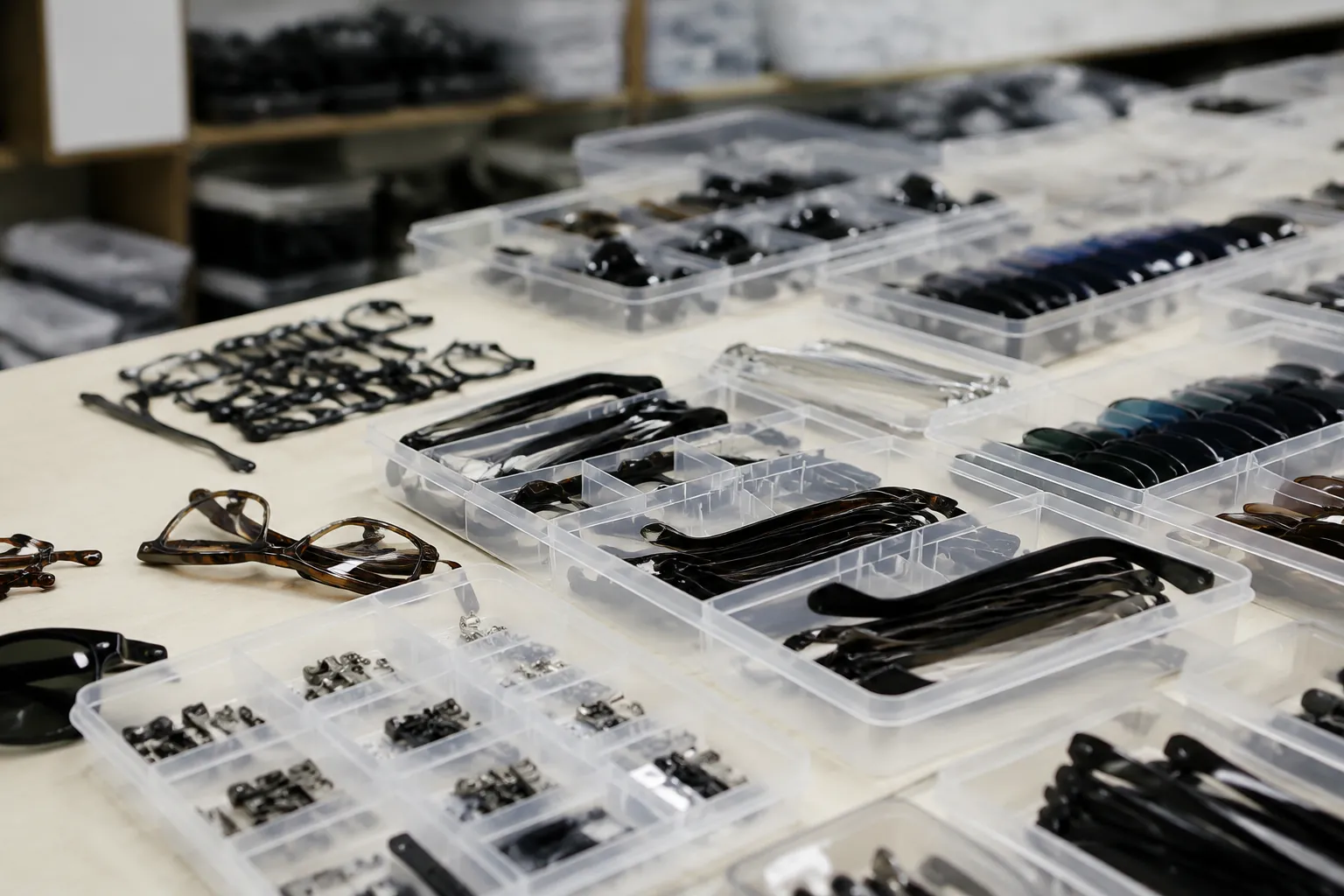
Ask for a process map, not a brochure. A capable eyewear factory should be able to walk you through the path your frame takes from raw material to finished carton. For a custom program, that may include resin drying, injection molding or CNC cutting, trimming, polishing, hinge installation, lens tinting or surfacing, logo decoration, final QC, and packing.
What you are looking for is the number of handoffs. Each handoff creates queue time. Each queue adds work in process. Work in process can hide delay until the order is close to the ship date. If a factory quotes bulk lead time, ask how much of that time is active processing and how much is waiting between stations.
For custom eyewear, the line usually includes these control points:
- Frame body is formed or cut to rough dimensions.
- Edges are trimmed, polished, and cleaned to remove flash or tool marks.
- Lens is tinted, coated, cut, or matched to the frame geometry.
- Logo decoration is applied, such as laser engraving, pad printing, hot stamping, or a metal plate.
- Assembly, hinge torque check, temple alignment, QC sampling, rework, and final pack-out.
If a factory cannot show where work in process accumulates, it probably does not control it well. That matters because work in process can make a plant look busy while one polishing booth or one decoration line quietly controls shipment speed.
Material behavior also affects throughput. Acetate can warp if polishing heat is inconsistent. Injection-molded frames can show sink marks or gate remnants if trimming is rushed. Mixed-material frames often need more fixture time because metal and plastic parts do not always seat the same way from batch to batch. Those factors affect output, reject rate, and repeat-order consistency.
3) Judge Line Balance, Not Machine Count
Many factories show a room full of machines. That is not the same as balanced capacity. One CNC line, three pad printers, and ten packers can still miss ship dates if one polishing station feeds everything else. Real capacity is the output of the slowest constrained step, not the busiest room.
Ask for the slowest operation in each product family. For acetate frames, that is often cutting, polishing, or hinge setting. For injected sunglasses, it is often trimming, alignment, or decoration. For decorated fashion sunglasses, printing and curing can become the bottleneck before molding does.
Useful questions for pressure-testing the answer:
- How many pairs per hour does each key station output at normal staffing?
- What happens when a design changes lens tint, temple length, or logo method?
- How many operators can move across stations during peak season without retraining delays?
- Which step creates rework most often, and what is the rework rate by SKU?
- How much time is lost in changeover when moving from one colorway to another?
If a factory needs substantial setup time for a small cosmetic change on a repeat program, that is a sign of hidden inefficiency. On high-volume custom eyewear, even small setup delays can affect whether a shipment makes the planned booking window.
If the factory cannot answer with a number or a clear operating rule, the line is probably managed by habit rather than by capacity planning.
4) Compare Automation Levels By Product Type
Different eyewear products need different automation. A factory may be highly automated for one frame type and weak on another. That is normal. The key is whether the process matches your product and the tolerances your market requires.
Injected sunglasses can usually hold consistent geometry with well-maintained molds and jigs, but decoration is often the weak link. Acetate sunglasses often benefit from CNC shaping and controlled polishing, but surface finish still depends heavily on operator skill. Mixed-material frames need fixture-based assembly and tighter QC because metal and polymer parts do not always seat the same way from batch to batch.
| Product type | Good automation | Typical tolerance focus | Common bottleneck | Buyer risk |
|---|---|---|---|---|
| Injected sunglasses | Injection molding, automated trimming support, alignment jigs | Temple symmetry within about ±0.5 mm, lens seat consistency, hinge alignment | Logo decoration, lens fit, final alignment | Fast output but inconsistent finish if decoration is manual |
| Acetate sunglasses | CNC cutting, precision shaping, controlled polishing workflow | Edge finish, front curve uniformity, hinge depth and screw seat quality | Hand polishing, hinge setting, surface defects | Color and finish variation can rise at higher volume |
| Mixed-material frames | CNC milling, fixture-based assembly, QC gauges | Part fit-up, screw torque, frame-to-temple angle, cosmetic matching | Parts matching, fit-up, manual rework | Lead time slips if parts are not staged well |
| Optical frames with precision fit | Gauge-based assembly, drilling support, controlled inspection | Bridge width, lens groove depth, pantoscopic angle, hinge parallelism | Final adjustment and inspection | Minor drift creates returns after delivery |
Use this table during factory review. If the machine set does not match the product mix you plan to buy, the factory may be fine for samples and weaker on bulk. Also ask what percentage of the line is dedicated to your category versus shared with unrelated products. Shared lines can be flexible, but they can also add changeover delays.
5) Read The Bottleneck From The Outside In
You do not need access to the production floor to spot trouble. The evidence often shows up in quoting behavior, sample timing, and how the factory handles revisions. Strong factories tend to be specific because their capacity is visible. Weaker factories are often vague because they are estimating.
A factory with good flow should give clear answers on sample lead time, bulk lead time, and changeover cost. For custom sunglasses, sample timing depends on how much needs to change. A standard sample can often be faster than a sample that requires new tooling, unusual plating, or a special lens tint. Bulk lead time depends on whether the order is repeatable, whether materials are in stock, and whether the decoration method is stable.
Watch for these warning signs:
- Sample dates keep moving after artwork approval or color sign-off.
- MOQ changes every time you request a small cosmetic tweak.
- Color matching needs repeated follow-up or multiple reprints.
- Bulk lead time is quoted before the factory asks about decoration method.
- The supplier cannot distinguish tooling lead time from production lead time.
Those signs usually mean the bottleneck is not machine capacity alone. It may be coordination, scheduling, or unclear process ownership. A factory that understands its own line will tell you whether the delay comes from mold scheduling, polishing, curing, decoration, or packing. If it cannot identify the step, it may not control it well.
One useful outside-in check is to compare the sample path to the bulk path. If a sample is quick but a similar bulk order is much slower, ask what additional process gates were added. Sometimes the answer is normal quality control. Sometimes it shows the sample came from a separate team that does not reflect normal production flow.
6) Tie Automation To MOQ, Price, And Changeover
Automation only helps if it lowers setup burden across repeated orders. For custom sunglasses, the key question is not whether one pair is inexpensive at volume. It is how volume changes setup burden and how much of that burden the factory can automate. Buyers often focus on unit price and underweight batch economics, which is where late shipments start.
A pricing ladder can help you read the production model. For example, a factory may quote one price at 50 pairs for a pilot or small launch, a better price at 300 pairs, another step at 1,000 pairs, and its most efficient pricing at 5,000+ pairs. That structure suggests fixed setup work is being spread across more units as volume rises. If the price drops smoothly, the factory may have repeatable tooling, stable decoration, and manageable QC. If the price falls only at very high volume, the plant may still be fragile in mid-size runs.
To evaluate whether the economics make sense, ask what changes at each tier:
- At 50 pairs: is the order treated as a pilot run, and how much manual labor is allowed?
- At 300 pairs: does the factory dedicate a fixture, color batch, or decoration setup?
- At 1,000 pairs: does it shift to a dedicated schedule slot or second-shift support?
- At 5,000+ pairs: what becomes the limiting factor: materials, decoration, labor, or packing capacity?
If a factory has weak automation, the cost curve often becomes less stable. Small runs can be expensive, mid-size runs can slow down on changeovers, and large runs can create overtime instead of true throughput. That is how missed ship dates happen, especially when a repeat colorway needs a new logo method, a different lens tint, or a packaging change.
Use this logic before you scale: confirm which steps are machine-driven and which are manual; ask what changes at 300, 1,000, and 5,000 pairs; check whether decoration or lens tinting adds separate queue time; and compare quoted lead time against the factory's actual changeover pattern. A lower unit price is only useful if the schedule still holds.
7) Verify Compliance And QC Sit Inside The Line
Compliance should be built into production, not handled as an afterthought by one person at the end of the process. For overseas buyers, the relevant certifications and standards are not optional extras. They help define whether goods can meet market requirements and customer audit expectations.
A credible eyewear factory should know which checks belong to which market and where those checks sit in the process. For example, lens transmittance and category checks belong near incoming inspection or batch QC, not after cartons are sealed. Frame dimensions, hinge torque, and screw retention should be verified during assembly and before final pack-out. Decoration should also be checked before packing because logo placement errors become costly once cartons are closed.
Look for process discipline behind the documents. Valid items may include CE EN ISO 12312-1, ANSI Z80.3, AS/NZS 1067, REACH, FDA registration, ISO 9001, and BSCI, depending on the product and market. The key is not the logo on a certificate; it is whether the factory can explain how those requirements affect incoming checks, in-process control, final inspection, and release.
A useful audit question is this: if 3 out of 200 pairs fail final inspection, what happens next? A disciplined factory will describe quarantine, rework, retest, and release procedures. A weak one will say "we fix it" without explaining where failed units go or how the issue affects ship date.
Good automation plus weak QC still gives you rejects. Good QC plus weak automation still gives you late orders. You need both.
8) Use A Simple Audit Before You Scale
Before placing a larger repeat order, run a focused factory audit. Do not try to inspect everything. Inspect the parts that best predict throughput, consistency, and on-time shipment.
Start with the exact SKU you plan to scale. A factory may look strong on a generic sample but behave differently on your actual lens tint, logo method, or material blend. Ask for evidence on the exact configuration you will reorder, not on a best-case demo product.
- Ask for a process flow chart for your exact SKU and decoration method.
- Review the slowest station, its hourly output, and its realistic daily capacity.
- Request sample and bulk lead times by decoration method, not only by model name.
- Confirm how the factory handles rush orders without skipping QC or changing tolerances.
- Check whether the same line can handle acetate, injected, or mixed-material designs without a new setup.
- Ask what rework rate is normal and who signs off on release after rework.
If the factory can answer those points clearly, you are probably dealing with a real production system. If not, the risk is hidden in plain sight. You may receive the sample on time and still miss the bulk ship date.
That is why overseas buyers should treat automation as a forecasting tool, not a sales topic. A factory that can explain line balance usually understands capacity. A factory that only talks about machines usually does not. When you know the bottleneck, you can decide whether to scale, split the order, or add more lead time before the season turns against you.
Have a custom sunglasses project in mind?
Send us your styles, target market and quantities and we will return a detailed quote with MOQ, lead time and a sample plan.
Get a QuoteWhy source this from Wenzhou with LumiShades
Wenzhou in Zhejiang Province is widely regarded as China’s eyewear manufacturing capital, producing a large share of the world’s sunglasses. That concentration matters to buyers: a deep local supply chain for acetate sheet, hinges, lens blanks, plating and packaging means shorter component lead times, easier color and material matching, and a workforce with decades of eyewear-specific skill. LumiShades has manufactured in this ecosystem since 2009, and our vertical integration — in-house injection molding, acetate cutting, CNC milling, lens tinting, decoration and quality control — means no part of your order is quietly subcontracted to a workshop you cannot audit.
For international buyers, that vertical control translates into accountability. When a single factory owns every step, defects are traced and fixed at source rather than bounced between vendors, and your specifications survive intact from first sample to bulk. We back this with 15+ years of experience, shipments to 60+ countries, more than 5 million pairs produced per year and a 98.5% on-time delivery rate. Our certifications — CE EN ISO 12312-1, FDA registration, ANSI Z80.3, AS/NZS 1067, REACH, ISO 9001 and BSCI audit — mean the compliance documentation your market requires already exists. Explore our manufacturing capabilities and quality control process to see how this works in practice.
Frequently asked questions
What is the most important sign that an eyewear factory can scale my order? The best sign is that the factory can name the slowest station in your product flow and explain its hourly output, tolerance checks, and changeover impact. Ask for the answer on your exact SKU, not a generic product. If the factory cannot quantify the bottleneck, scaling risk is higher.
Is a fully automated line always better for sunglasses? No. Eyewear usually needs a mix of machines, fixtures, manual adjustment, and QC checkpoints. Steps such as polishing, alignment, hinge fitting, and final inspection often still rely on skilled operators. The right setup is the one that matches your product and tolerance needs.
How do MOQ and price tiers relate to automation? Automation usually helps a factory spread setup work across more units, which can make pricing more stable as volume increases. Ask what changes at 50, 300, 1,000, and 5,000+ pairs. That tells you whether the factory is scaling through real process control or simply through more labor and overtime.
What lead time should I expect for custom sunglasses samples and bulk? There is no universal lead time, but you should ask the factory to separate sample time from bulk time and to explain what changes the schedule. A sample with standard decoration is often faster than one that needs new tooling, unusual plating, or special lens tinting. For bulk, ask how materials, decoration, and QC affect the date, then compare that answer with the line's capacity.
Which certifications should I verify for export eyewear? Verify only the documents that apply to your market and product, such as CE EN ISO 12312-1, ANSI Z80.3, AS/NZS 1067, REACH, FDA registration, ISO 9001, and BSCI. Ask to see the actual documents and check that they match the product category, test scope, and factory name. The certificate alone is not enough; the factory should explain how it is used in production and QC.
Ready to start?
Explore our square sunglasses or request a quote — our sales team replies within 12 hours.
Request a Quote