
How to Audit a Sunglasses Factory's Tools and Machines
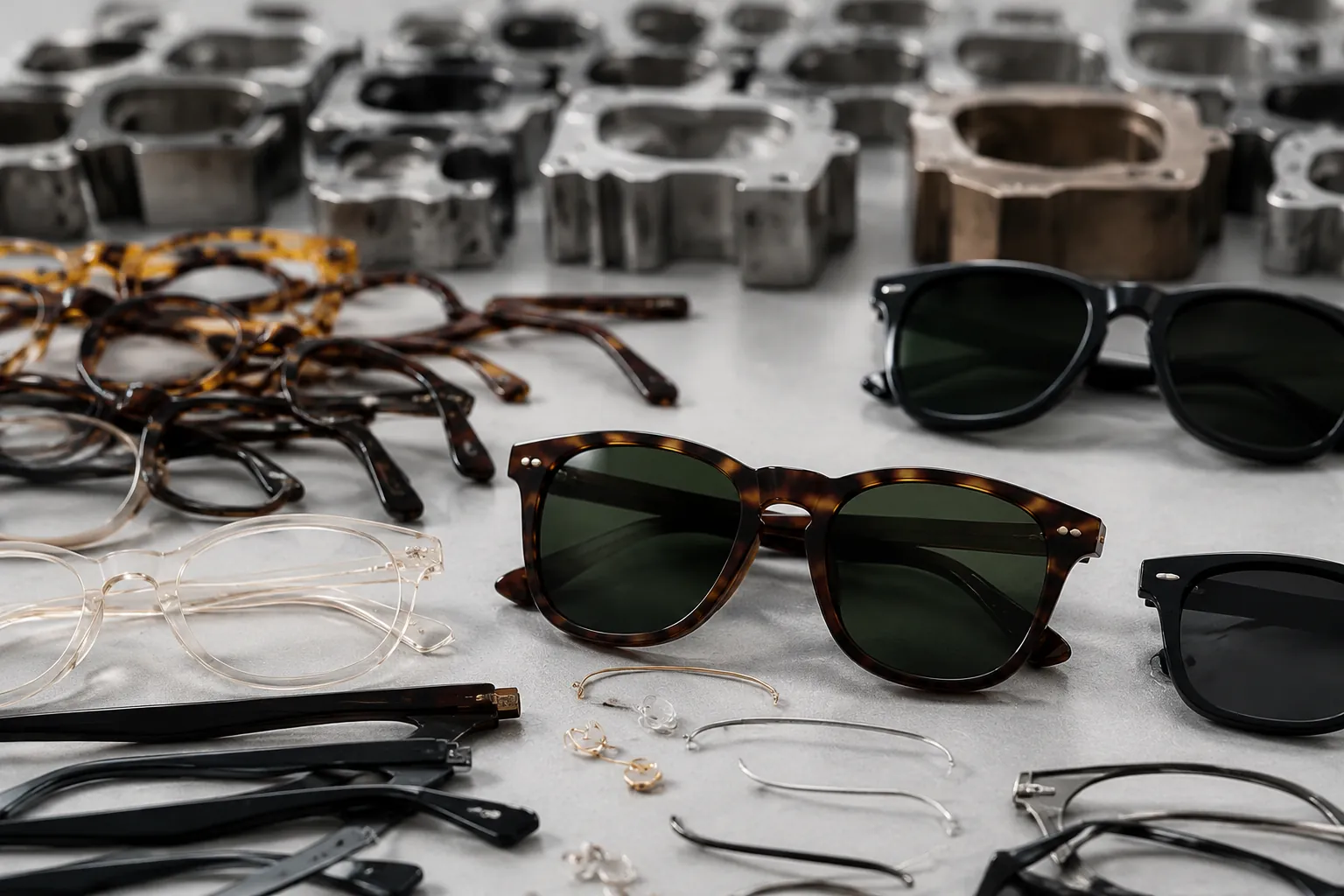
If you buy custom sunglasses for a brand, import business, distributor, or retail program, you need to know whether a factory truly controls production or only coordinates it. Tooling and machine capability affect lead time, color consistency, fit, logo quality, and repeatability. This guide shows what to check, what to ask for, and what the answers should look like before you place an OEM or ODM order.
1) Start with process ownership, not sales talk
First question: which steps are actually done in-house, and which are outsourced? A factory that controls injection molding, acetate cutting, CNC milling, lens tinting, decoration, assembly, and QC can fix problems faster and hold more variables in one place. That matters on custom orders. Every handoff adds delay, cost, and variation. It also affects whether the factory can hold tolerances from sample approval through bulk production.
For sunglasses, process ownership usually shows up in three places: the tool room, the finishing line, and the inspection room. If the supplier can only show finished samples and a sales office, you are not seeing the production system. Ask for the machine list, workshop layout, and the person responsible for each major step. A serious factory should be able to name the equipment behind each process, explain how work is queued, and show where quality is checked.
That is the answer you want. Then verify it. Ask to see machine plates, mold storage, the workshop layout, and the process owner for each department. If the factory answers only in general terms, assume they are using outside vendors or borrowed capacity.
Buyer test: ask, "Which steps are done in-house, which are outsourced, and which step creates the longest queue?" A real factory can answer that without hesitation.
For volume buyers, process ownership affects more than quality. It affects schedule and cost. If a factory controls molding, tinting, and decoration internally, the order is easier to sequence and more predictable to manage. If those steps move between subcontractors, each transfer adds delay, and rush orders often get pushed behind someone else's queue.
2) Inspect the tooling setup before you inspect samples
Tooling is where many eyewear projects go wrong. A good-looking sample can hide weak mold control, poor maintenance, or a tool that only works at low volume. Ask how the molds are designed, where they are stored, how cavities are numbered, and who handles preventive maintenance. For multi-cavity injection tools, you want cavity-by-cavity consistency and key dimensions checked against a drawing, not by eye.
For injection frames, the supplier should understand gate position, cooling layout, and ejection behavior. These details show up later as sink marks, warpage, flash, or stress whitening around the hinge zone. The target is simple: stable repeatability on critical dimensions such as temple length, hinge spacing, and front width. If the mold is not maintained, you may see flash at the parting line, uneven gloss, or a hinge area that fails in use.
For acetate frames, ask about block cutting accuracy, polishing sequence, and how the factory checks lens groove consistency. Acetate is forgiving in appearance. It is less forgiving in fit. If the groove depth drifts, lens seating becomes uneven and can cause rattle or edge lift. If hinge alignment is off, the frame may still look fine in the sample room but fail in packing or on a fit check. Ask how they control temple-to-front symmetry, hinge insertion depth, and left-right balance after polishing.
- Ask for tool life, maintenance, and cleaning records.
- Check whether spare inserts, cores, ejector pins, and jigs are on site.
- Confirm whether first-article parts are measured against a drawing, not just approved by eye.
- Request cavity-by-cavity sampling for multi-cavity molds and ask for the measured delta between cavities.
A practical factory should be able to explain how a mold is set up, how often it is cleaned, what the maintenance interval is, and what happens when a cavity starts drifting. If they cannot describe that, the tool room is probably not under control.
3) Match the machine range to the frame material
Not every machine range suits every product. A factory that makes both injection and acetate eyewear should not treat them the same. Different materials need different temperatures, cutter settings, polishing sequences, and finishing steps. This is where buyer audits often fail: the supplier has machines, but not the right mix for the SKU you want, or not the process discipline to use those machines consistently.
Injection-molded frames need stable cycle control, correct melt temperature, and consistent cooling so the part does not warp after ejection. Acetate frames need precise cutting, careful edge finishing, and polishing that preserves geometry instead of rounding away the fit. CNC matters in both categories because it controls symmetry, hinge seats, and logo pockets. In production, a good factory knows where tolerance matters most: temple length, front width, bridge alignment, lens groove depth, hinge position, and logo placement.
| Process | What it should handle | Buyer should verify | Common failure if weak |
|---|---|---|---|
| Injection molding | Repeatable plastic frames, consistent wall thickness, stable hinge area | Machine tonnage, cycle control, mold cooling, scrap rate, part weight variation | Warping, flash, brittle hinge zones, sink marks |
| Acetate cutting | Block acetate shaping, front and temple accuracy, groove prep | CNC cut precision, edge finishing, polishing consistency, groove depth control | Uneven lens fit, rough edges, visible glue lines, lens pop-out |
| CNC milling | Detail shaping, logo pockets, hinge seats, precision profiles | Spindle condition, fixture quality, repeatability between runs, program control | Off-center logos, crooked hinge mounts, poor symmetry |
| Lens tinting | Color depth control, fade consistency, batch matching | Tint bath control, retained samples, color check method, drying time | Shade drift, batch mismatch, rejection at inspection |
Do not let a supplier hide behind "we have many machines." Ask for the fit between machine and product. If you need a polarized fashion frame with consistent temple thickness, clean logo work, and repeatable fit across 1,000 pairs, a factory with proper CNC, stable fixtures, and disciplined finishing matters more than a factory with a larger machine count. The question is not how many machines they own. It is whether the machines are sized, maintained, and arranged for your frame material.
4) Check the tinting room like a chemist, not a shopper
Lens tinting is one of the easiest places to fake competence. A decent sample can come from a careful operator working one lens at a time. A real production line needs batch control. Ask how shades are matched, how bath temperature is monitored, how immersion time is controlled, and whether the factory keeps a retained sample for each color lot. Without that, a reorder may look close under showroom light and still miss under retail or outdoor conditions.
In production, tint depth is usually controlled by time, temperature, concentration, and post-rinse handling. A small change in bath temperature or dwell time can shift color noticeably, especially on lighter tints or gradient styles. Buyers should ask for the target shade tolerance, not just the color name. A practical factory should be able to explain whether it controls color by visual standard, instrument, or both, and how often the bath is checked and adjusted. If the factory cannot explain lot-to-lot matching, it is unlikely to hold a reorder within a consistent visual band.
You also need to know how the factory handles market-specific compliance. Ask which of the following it can support for your destination market: CE EN ISO 12312-1, ANSI Z80.3, AS/NZS 1067, REACH, FDA registration context, ISO 9001, and BSCI. Keep the distinction clear: product standards and material compliance are not the same thing, and FDA registration is not a substitute for product test results. Ask what is tested in-house and what goes to an external lab.
- Request the tint process flow, from raw lens to final color check.
- Ask whether each color has a master sample and batch record.
- Confirm whether tint drift is checked by visual standard, instrument, or both.
- Ask how the factory controls haze, edge burn, and coating damage after tinting.
- Verify drying and curing time before packing so lenses do not mar or stain in carton.
For buyers, the real issue is not whether a lens looks dark enough under office light. It is whether the production batch stays consistent across 300, 1,000, or 5,000 pairs and whether the optics remain stable after handling, cleaning, and packing. If the factory cannot explain that control, expect color complaints later.
5) Decoration equipment is where brand damage shows up first
Decoration sounds minor until your logo lands crooked or wears off after a short retail cycle. Ask what decoration methods are actually in house: laser engraving, pad printing, metal logo plates, hot stamping, heat transfer, or UV printing. Then ask how placement is fixed. The key is not the decoration method alone. It is registration control, repeatability, and surface preparation. A logo can fail because the jig is loose, the ink is wrong, the substrate was not cleaned, or the curing time was too short.
Laser engraving should be clean and repeatable, especially on metal or acetate where depth matters. A controlled laser mark needs consistent engraving depth and a repeatable focus height so the mark looks the same from the first pair to the last pair in the batch. Pad printing needs ink viscosity control, drying control, and a stable jig. If the print pad is not aligned to a fixed datum point, logo drift will show up immediately in a side-by-side comparison. Metal logo plates need adhesive or mechanical attachment that survives handling, humidity, and carton pressure. Hot stamping and heat transfer require temperature and dwell-time control; too hot and the substrate distorts, too cool and the mark flakes.
Ask to see rejection examples. Real factories keep them. You want to know the tolerance band for logo placement, how they measure alignment, whether the same jig is used during sample approval and mass production, and what the pass/fail standard is for smudging, edge lift, or uneven depth. If the answer changes between sales and production, stop and recheck.
Blunt rule: if the logo position is not jigged, it is not controlled.
For branded programs, ask for a first-article approval sheet that includes logo position, mark depth or print density, and a photo of the approved reference. That document should travel with the order so the factory can compare bulk output against the same standard.
6) Put the QC room under a microscope
Good eyewear factories do not rely on final inspection alone. They inspect incoming material, in-process parts, and finished goods. Ask what gets checked at each stage. For sunglasses, that should include frame symmetry, lens seating, hinge function, surface defects, coating issues, and packing correctness. For volume orders, you also want a documented sampling method and clear rejection criteria. If the supplier cannot state the sampling plan, the rejection criteria, or who has authority to hold a lot, QC is probably informal.
Practical QC for sunglasses should include measurement against a drawing or golden sample, not general visual approval. Common checkpoints include temple opening force, hinge feel, lens inset level, bridge symmetry, and surface finish. The factory should also be able to explain whether it checks by lot, by carton, or by critical station. A strong line may do incoming lens checks, in-process frame checks at defined intervals, and a final audit against the customer's acceptance criteria. The exact standard may vary by order, but the discipline should be visible.
Ask to see a typical inspection sheet. It should show defect categories, photo standards, hold/release responsibility, and whether the inspector can stop the line. You should also ask how nonconforming units are segregated so they do not get mixed back into production. If the factory has ISO 9001, ask how that system shows up in day-to-day records rather than on a certificate on the wall.
- Check whether QC uses standard gauges for temple angle, lens fit, and hinge opening force.
- Ask how samples are labeled versus bulk pieces and whether retained samples are stored by color and lot.
- Confirm whether rework is documented or simply mixed back into production.
- Request carton-level traceability for large orders, including lot number and inspection date.
Do not accept "we check carefully" as an answer. That is not a process. It is a slogan.
7) Convert capability into price, MOQ, and lead time
Tooling and machine control should show up in the commercial terms. If a factory has tight process control, its pricing should reflect setup cost, labor efficiency, and scrap rate rather than guesswork. A realistic supplier will explain how price changes with order size, complexity, and finishing requirements. If the unit price drops with volume, ask what process changes make that possible: lower setup overhead per pair, fewer changeovers, or better line balance.
Think about order size in plain terms. A small order is usually for market testing, a prototype launch, or a niche retail trial. The factory can run it, but you are paying for setup, design checks, and a higher share of manual handling. At a moderate order size, the line starts to benefit from fewer changeovers and lower decoration waste. At a larger order size, you should see real unit cost improvement if the tooling is stable and the batch can run with minimal interruption.
| Order size | Typical buyer use | Commercial effect | What to verify |
|---|---|---|---|
| 50 pairs/design | Market test, sample launch, niche retail trial | Highest unit cost because setup is spread across few pieces | Can the factory hold color, fit, and logo quality at low volume? |
| 300 pairs | Initial program or regional rollout | Lower waste and better machine utilization | Does the factory keep the same tool and QC standard? |
| 1,000 pairs | Core sell-through line | Meaningful price drop if tooling and line balancing are real | Can they preserve consistency across multiple cartons? |
| 5,000+ pairs | National chain or distributor replenishment | Best unit pricing, depending on spec and finishing load | Can they sustain output without changing materials or shortcuts? |
Check lead time logic too. Samples in about 7–10 days and bulk in about 25–35 days can be reasonable for an organized eyewear operation, but only if mold work, tinting, decoration, and QC are under one roof or tightly controlled. If the factory promises faster than that without explaining capacity, question it. Fast lead time is credible only when the factory can show how it protects bottlenecks: mold changeovers, tint batch timing, decoration queues, and final QC capacity.
8) Use a factory audit checklist before you place the PO
Walk the floor with a checklist. Do not rely on the sample room. A polished sample room can hide a weak workshop, and a strong salesperson can hide a weak production system. The goal of the audit is to verify that the machines, the tools, the people, and the records all match the claims.
Start with basics: confirm the factory address and whether the workshop is at the same site as sales. Ask for machine photos with serial plates, not just marketing shots. Review one current mold and one current production line for your product type. Compare sample parts to bulk-ready parts and check whether dimensions stay consistent after finishing. Verify certifications that matter to your market: CE EN ISO 12312-1, ANSI Z80.3, AS/NZS 1067, REACH, FDA registration context, ISO 9001, and BSCI. Ask for inspection records from the last production lot of a similar item, plus the packing spec and carton mark standard.
- Confirm the workshop address and the role of each building.
- Ask for actual machine photos with model numbers and serial plates.
- Check one mold, one line, and one finished lot from a comparable product.
- Compare first article, in-process sample, and bulk-ready parts.
- Review compliance documents that match the destination market.
- Ask for the last lot's inspection summary and defect breakdown.
- Confirm packaging, carton marks, spare parts, and accessory handling before approval.
If the factory can show real tooling, real machines, real QC, and real compliance documents, you can move forward with fewer surprises. If they cannot, do not buy on sample beauty alone.
Have a custom sunglasses project in mind?
Send us your styles, target market and quantities and we will return a detailed quote with MOQ, lead time and a sample plan.
Get a QuoteWhy source this from Wenzhou with LumiShades
Wenzhou in Zhejiang Province is widely regarded as China’s eyewear manufacturing capital, producing a large share of the world’s sunglasses. That concentration matters to buyers: a deep local supply chain for acetate sheet, hinges, lens blanks, plating and packaging means shorter component lead times, easier color and material matching, and a workforce with decades of eyewear-specific skill. LumiShades has manufactured in this ecosystem since 2009, and our vertical integration — in-house injection molding, acetate cutting, CNC milling, lens tinting, decoration and quality control — means no part of your order is quietly subcontracted to a workshop you cannot audit.
For international buyers, that vertical control translates into accountability. When a single factory owns every step, defects are traced and fixed at source rather than bounced between vendors, and your specifications survive intact from first sample to bulk. We back this with 15+ years of experience, shipments to 60+ countries, more than 5 million pairs produced per year and a 98.5% on-time delivery rate. Our certifications — CE EN ISO 12312-1, FDA registration, ANSI Z80.3, AS/NZS 1067, REACH, ISO 9001 and BSCI audit — mean the compliance documentation your market requires already exists. Explore our manufacturing capabilities and quality control process to see how this works in practice.
Frequently asked questions
What is the fastest way to tell if a sunglasses factory really controls its tooling? Ask to see the tool room, mold storage, maintenance records, and the person responsible for mold changes. Then request one current mold number, the cavity count, and the last maintenance date. A real factory can show those details quickly and consistently, not just finished samples.
Why does in-house CNC matter for custom eyewear? CNC control affects symmetry, hinge seating, logo pockets, and repeatability. If CNC is outsourced, the factory has less control over fixture quality, turnaround time, and part consistency. Ask to see the program owner, fixture method, and a measured sample from a current run.
How should I judge tinting capability for a volume order? Ask for batch records, retained color samples, bath temperature control, and the method used to control shade drift. Also ask whether the factory can show you the same color repeated across more than one batch. One perfect sample means little if the bulk order does not match it.
Which certifications should I ask for on sunglasses orders? Ask only for certifications and compliance evidence that match the destination market: CE EN ISO 12312-1, ANSI Z80.3, AS/NZS 1067, REACH, FDA registration context, ISO 9001, and BSCI. Then ask which tests were done, by whom, and for which SKU. Do not accept unrelated certificates as proof of product compliance.
What MOQ is normal for custom sunglasses from a real factory? MOQ depends on the style, materials, and decoration method, but a small test order can be workable if the factory has the right setup. Ask the supplier to quote 50, 300, 1,000, and 5,000 pairs so you can see how price changes with scale. The key is whether quality, fit, and branding stay consistent at each level.
How do I protect my logo quality on a branded eyewear order? Require a fixed jig, an approved placement drawing, a retained first article, and a clear rejection standard for misalignment, depth, smudging, or plate detachment. Ask the factory to show the same setup used for sample approval and mass production. If the jig or reference changes, the logo standard has changed too.
Ready to start?
Explore our square sunglasses or request a quote — our sales team replies within 12 hours.
Request a Quote