
How to Vet a Sunglasses Factory for OEM/ODM
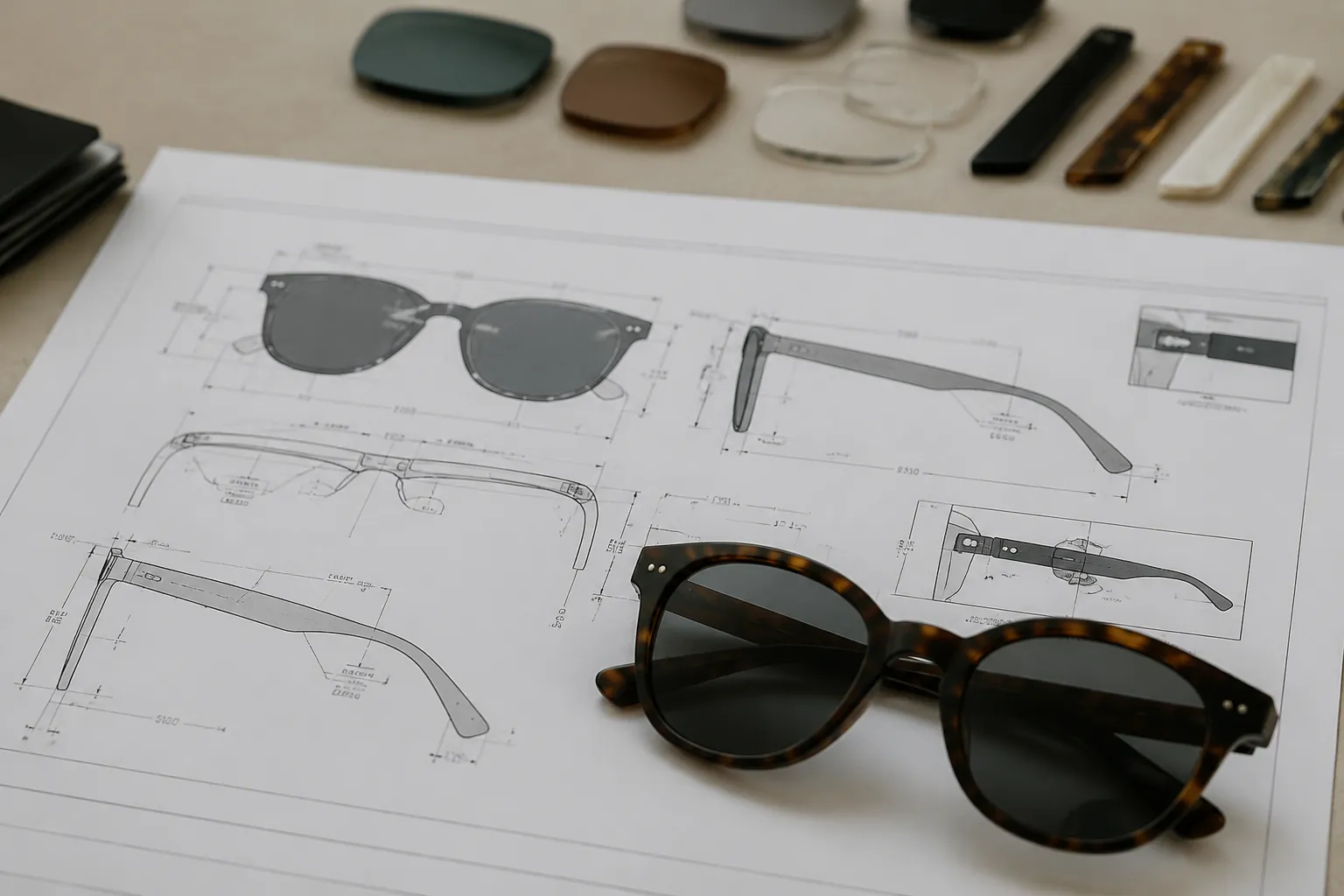
This guide is for brands, importers, distributors, and retailers buying custom sunglasses at volume. The job is simple: separate a real factory from a trader, and separate a true development partner from a plant that can only copy a sample. Qualify the supplier properly up front. You cut sample churn, avoid tooling surprises, and improve the odds that repeat production matches the approved golden sample.
Start With the Factory's Real Scope
Before you ask about price, ask what the supplier does in-house and what it outsources. A real OEM/ODM sunglasses factory should map its process clearly: raw material receiving, frame forming or injection, lens tinting, CNC or trimming, hinge assembly, decoration, quality control, and packing. If those steps are split across outside vendors, your lead time, defect risk, and color consistency can change from order to order.
That matters most on the steps that create variation. Injection frames depend on mold condition, temperature control, and cooling time. Acetate frames depend on cutting accuracy, polishing, and assembly quality. Metal and mixed-material frames depend on CNC tolerance, soldering consistency, and alignment during assembly. If a supplier cannot explain which machines are on site, which processes are external, and who signs off at each stage, treat it as a trading company until proven otherwise.
A serious factory can usually answer practical questions without hesitation: how many injection machines they run, whether acetate is cut and polished in-house, what lens tinting methods they use, how they verify hinge function, and whether final inspection is done by line QC or a separate team. You are not looking for polished language. You are looking for process ownership.
Buyer rule: if the supplier cannot trace the product from raw material to packed carton, it is not ready for serious OEM work.
If a factory states that it controls core steps such as injection molding, acetate cutting, CNC milling, lens tinting, decoration, and QC, that is a useful sign. Even then, verify each claim with machine photos, process records, and the sample you receive.
Check Development Capability, Not Just Samples
Real OEM starts before tooling. A capable factory should be able to turn a sketch, reference photo, or existing sample into a buildable technical package. That means discussing frame thickness, temple curvature, hinge type, lens base curve, bridge fit, pantoscopic angle, and decoration limits. It also means identifying what can change without a new mold and what requires a tooling change.
Ask blunt questions. Can they adjust temple length in small increments? Can they modify nose bridge width without changing the front mold? Can they hold logo engraving depth within a repeatable range? Can they provide CAD or a dimensioned drawing for approval? If they only answer "yes, no problem," push for specifics. Good factories can explain the tradeoff between design freedom, tooling cost, and lead time.
Development teams usually work from a defined sequence: inquiry, feasibility review, structure confirmation, sample build, correction, approval, and production release. If the design is complex, expect at least one technical review before the first sample is made. That review should cover material choice, wall thickness, hinge reinforcement, lens specification, decoration method, and compliance target. A temple that looks fine on paper can still flex badly in production if the structure is too thin at the hinge area.
- Ask for a development workflow: inquiry, spec review, sampling, correction, approval, production.
- Ask who signs off on structure, color, and artwork.
- Ask whether first samples are made by the same team that runs bulk production.
- Ask how many revision rounds are normal before tool release.
If the factory can explain how it decides between a cosmetic tweak, a tooling insert, and a full mold change, you are talking to a development partner. If it can only repeat your design back to you, it may still be useful, but it is not doing full ODM-level development.
Use the Sample Stage to Expose Weaknesses
Sample timing tells you a lot. A realistic sunglasses supplier usually needs several days for a simple sample and longer for a new mold or a multi-material frame. Bulk production takes longer than sampling once the specification is frozen. Those ranges matter because they show whether the factory has a controlled sample path and a realistic production process. A supplier who promises a finished complex sample in a very short time is often skipping steps or sending a hand-finished mockup that will not match production.
Make the sample order specific. Lock the lens color, frame color, logo method, packaging, and target-market compliance before you pay for samples. Ask for at least one production-intent sample, not only a display piece. If possible, request a pre-production sample made with final materials and final decoration methods. That is the sample most likely to predict bulk reality.
When you check the sample, inspect it like production would. Compare frame symmetry, hinge function, lens seating, and logo position. Under daylight, watch for color shift, especially in transparent or translucent acetate. On painted or plated parts, check for edge buildup, overspray, or plating dullness. A practical target is simple: left and right should look balanced, and the critical dimensions should stay within your drawing tolerance.
- Approve a written sample spec.
- Request sample photos before shipment.
- Check the sample against your target market standard.
- Freeze the approved sample as the golden reference.
- Do not change artwork or color after tooling release unless you accept delay and extra cost.
Pay attention to what changes between sample one and sample two. If the factory can repeat the same lens tint, temple finish, and logo placement after revision, that is a stronger signal than a beautiful first sample made by hand finishing.
Separate Tooling Claims From Real Tooling Control
Tooling is where many "OEM factories" fall apart. Ask who owns the molds, where they are stored, who maintains them, and what happens when a cavity wears out. For sunglasses, tooling quality shows up in temple symmetry, lens fit, frame warpage, flash lines, and stability around the hinge area. Small defects become recurring defects if the mold is sloppy or poorly maintained.
For injection frames, ask about mold steel, cooling layout, gate location, and how they monitor wear. For acetate frames, ask how they control cutting angle, polishing steps, and edge finish. Uneven polishing can leave one side smooth and the other side sharp. For metal or mixed-material frames, ask how they hold CNC tolerances across batches and how they control soldering or bonding at stress points.
Do not worry if the supplier cannot give a lecture on tooling metallurgy. Worry if it cannot explain which defect comes from design, which from tooling, and which from operator setup. That distinction matters. A lens that sits unevenly may point to a front frame tolerance issue; a temple that twists after opening may point to a hinge or assembly problem; repeated flash lines may point to a worn mold parting surface.
| Production Area | What Good Looks Like | Common Failure | Buyer Check |
|---|---|---|---|
| Injection molding | Stable frame shape, low flash, repeatable hinge alignment | Warping, sink marks, rough parting lines | Inspect symmetry and fit across 10+ samples |
| Acetate cutting | Clean edges, controlled thickness, consistent polish | Edge chips, uneven temple thickness | Check edge finish and temple straightness |
| CNC milling | Repeatable geometry, clean logo recesses, tight fit | Tool chatter, dimension drift | Measure critical points against drawing |
| Decoration | Logo placement consistent, no bleed or flake | Misaligned prints, weak engraving | Approve artwork on actual substrate |
If the factory can tell you its critical dimensions and how it verifies them, you are ahead of most buyers. You do not need the exact machine model. You need confidence that mold and tool control are part of the system, not an afterthought.
Make Compliance a Market-Specific Test
Do not accept vague claims of "international standard." Ask for the exact certification, test basis, or compliance file that matches your destination market and product type. Sunglasses compliance is not one universal document. It changes by region, lens type, and whether the product is fashion eyewear, sun protection eyewear, or a special-purpose item with added claims.
Keep the compliance discussion tied to the documents that matter for your market: CE EN ISO 12312-1, ANSI Z80.3, AS/NZS 1067, REACH, FDA registration, ISO 9001, and BSCI. CE EN ISO 12312-1 is relevant for sunglasses in the EU. ANSI Z80.3 is commonly used for the U.S. fashion sunglass market. AS/NZS 1067 applies in Australia and New Zealand. REACH covers restricted substances in the EU supply chain. ISO 9001 is a quality management system standard, not a product safety certificate. BSCI is an audit framework for social compliance. FDA registration is not the same as product certification.
Ask whether the documents are tied to the exact model, lens material family, or product line you are buying. A factory may have test reports for one frame family and not another. If you are buying polarized lenses, mirrored coatings, or impact-related claims, ask for the supporting evidence for that specific construction. If you are buying children's sunglasses or anything that could trigger stricter scrutiny, review compliance before production, not after shipment.
- Match the compliance file to the destination country before production starts.
- Confirm lens category, UV claim, and any impact-related claim in writing.
- Ask whether the factory can keep compliant materials consistent across future reorders.
- Do not mix decorative and protective claims casually. Customs and regulators read labels.
A good supplier can tell you which documents are current, which are model-specific, and which should be refreshed after a material change. If it cannot do that, your risk is not just delay; it is a compliance failure on arrival.
Let Pricing Show the Volume Breaks
For custom sunglasses, pricing should move with tooling amortization, material yield, decoration complexity, and packaging. A useful quote should show where cost changes as volume increases. More important than the unit number is whether the supplier can explain what drives the price and what changes the reorder cost.
Do not compare quotes on unit price alone. Compare the full landed setup: tooling, sampling, packaging, compliance testing, freight, and defect risk. A low price can be a false economy if the supplier cannot hold color, lens tint, or logo position. On the other hand, if your design is simple, the factory already has a platform mold, and the decoration is standard pad print or laser engraving, volume can reduce cost sharply.
Watch the pricing logic. At low quantities, the supplier is usually charging for setup, sampling, and manual labor. As volume increases, amortization improves and the quote should reflect better efficiency. At higher quantities, the lowest unit price only makes sense if the spec is locked and the process is repeatable. Any change to lens color, hinge finish, or packaging can add scrap or reset the setup cost.
| Order Level | Typical Buyer Use | Cost Behavior | What to Watch |
|---|---|---|---|
| 50 pairs/design | Market test, small launch, VIP or limited run | Highest unit cost | Tooling and setup dominate |
| 300 pairs | Small wholesale order | Better amortization | Ask for stable color and packing consistency |
| 1000 pairs | Core seasonal buy | Cost improves further | Check defect rate and replenishment speed |
| 5000+ pairs | Program supply | Lowest quoted unit cost | Lock specs tightly; small changes add delay |
Ask for a quote that separates frame cost, lens cost, decoration, packaging, and any one-time mold charge. If the factory can show how price changes with better yield or simpler decoration, you are getting a useful sourcing partner rather than a flat number.
Audit QC Like a Production Manager
Quality control is not a final glance in a warehouse. It should be staged. A serious factory checks incoming raw material, in-process parts, and finished goods before packing. For sunglasses, that means checking frame dimensions, hinge function, lens fit, surface finish, logo placement, carton count, and label accuracy. If the supplier only talks about final inspection, it may be catching problems too late.
Ask how it defines acceptable defect levels. Ask whether it uses AQL or another internal standard. Ask what happens if a batch misses the target. A good answer includes rework, sorting, hold points, and photo records. A weak answer is "we check carefully." That is not a process. You want a factory that can tell you how many pieces are pulled for inspection, which points are checked on each lot, and which defects trigger a line stop.
For sunglasses, useful checks include hinge opening force, temple alignment, lens seating depth, coating consistency, and packaging correctness. If you can, ask for a batch inspection photo set that shows the actual product, the carton label, and the accessory count. This matters most for private label programs where the same frame may be shipped with different logos or packaging across customers.
- Confirm whether critical measurements are checked per batch or per shift.
- Ask for photo evidence of cartons, inserts, and label placement.
- Verify hinge function, lens seating, and surface marks before shipment.
- Ask how the factory handles mixed color runs and artwork changes.
If the factory can explain how it prevents mix-ups between similar SKUs, how it isolates defects, and how it documents rework, you are looking at an operation that understands volume production rather than just sample making.
Use a Simple Factory-Qualification Scorecard
Here is the practical test. Score the factory on five points: development, tooling control, sample accuracy, compliance, and repeat production. If one of those is weak, keep your order small until it improves. If two are weak, the supplier is not ready for OEM or ODM. Trading companies often look good on communication and weak on process. Small workshops may make nice samples and fail at repeatability. You want both technical understanding and production discipline.
A strong factory should be able to repeat the same frame, same tint, same logo, and same carton spec across multiple orders with minimal drift. The best sign is not a showroom or a polished deck. It is consistency between what it says, what it shows, and what arrives on your dock. Look for stable reorders, matching approval records, and a clear way to lock the golden sample, artwork, and BOM.
For an overseas buyer, the safest operating model is to verify everything on your own terms: drawings, samples, labels, test reports, packing list, and shipment history for the exact product family you plan to buy. A factory that can explain its in-house processes, show clear compliance documentation, and give practical MOQ and lead-time guidance gives you a workable sourcing baseline. You still need to verify the details, but the structure is there.
Final check: if the factory can repeat the same frame, same tint, same logo, and same carton spec across repeated orders, you have a real production partner.
FAQ
How do I tell a factory from a trader?
Ask for the production flow, machine list, QC checkpoints, and ownership of tooling. A trader usually answers in broad terms. A factory can name the process steps, the in-house machines, and where each defect is caught. If possible, ask for live video from the workshop and compare the answer with the sample and documents you receive.
Is 50 pairs enough for OEM?
Yes, if your goal is a test run, niche launch, or market validation. At that level, setup and sampling costs are still heavy, so the unit price will be higher. Use the run to confirm fit, color, lens tint, and packaging before scaling to a larger order.
What is the biggest cause of sample-to-bulk mismatch?
Color, lens tint, and decoration are the most common problems. Samples are sometimes hand-finished, while bulk production follows machine settings and batch materials. To reduce mismatch, freeze the approved sample in writing, match materials as closely as possible, and keep the artwork and packaging spec unchanged after approval.
Which compliance documents should I ask for first?
Ask for the documents that match your market and product claim: CE EN ISO 12312-1 for the EU, ANSI Z80.3 for the U.S. fashion sunglass market, AS/NZS 1067 for Australia and New Zealand, and REACH where relevant. Also ask whether the factory's ISO 9001 and BSCI records are current. FDA registration is not a product certificate, so do not treat it as one.
How do I keep pricing from jumping on reorder?
Lock the BOM, packaging, logo method, and lens spec. If you change any of those, the factory may need a new setup or may incur extra scrap. Reorders stay more stable when the design, materials, and packing are unchanged and the same mold or tooling is used again.
What tolerances should I expect on custom sunglasses?
Ask the factory to state its own tolerances for critical dimensions such as lens pocket depth, temple length, and hinge alignment. Cosmetic alignment may be held within a narrow band, but the exact target should be written on the drawing or approval sheet. The key is not a universal number; it is whether the supplier can measure consistently and keep the same result across batches.