
Mixed-SKU Sunglasses Orders Without MOQ Pain
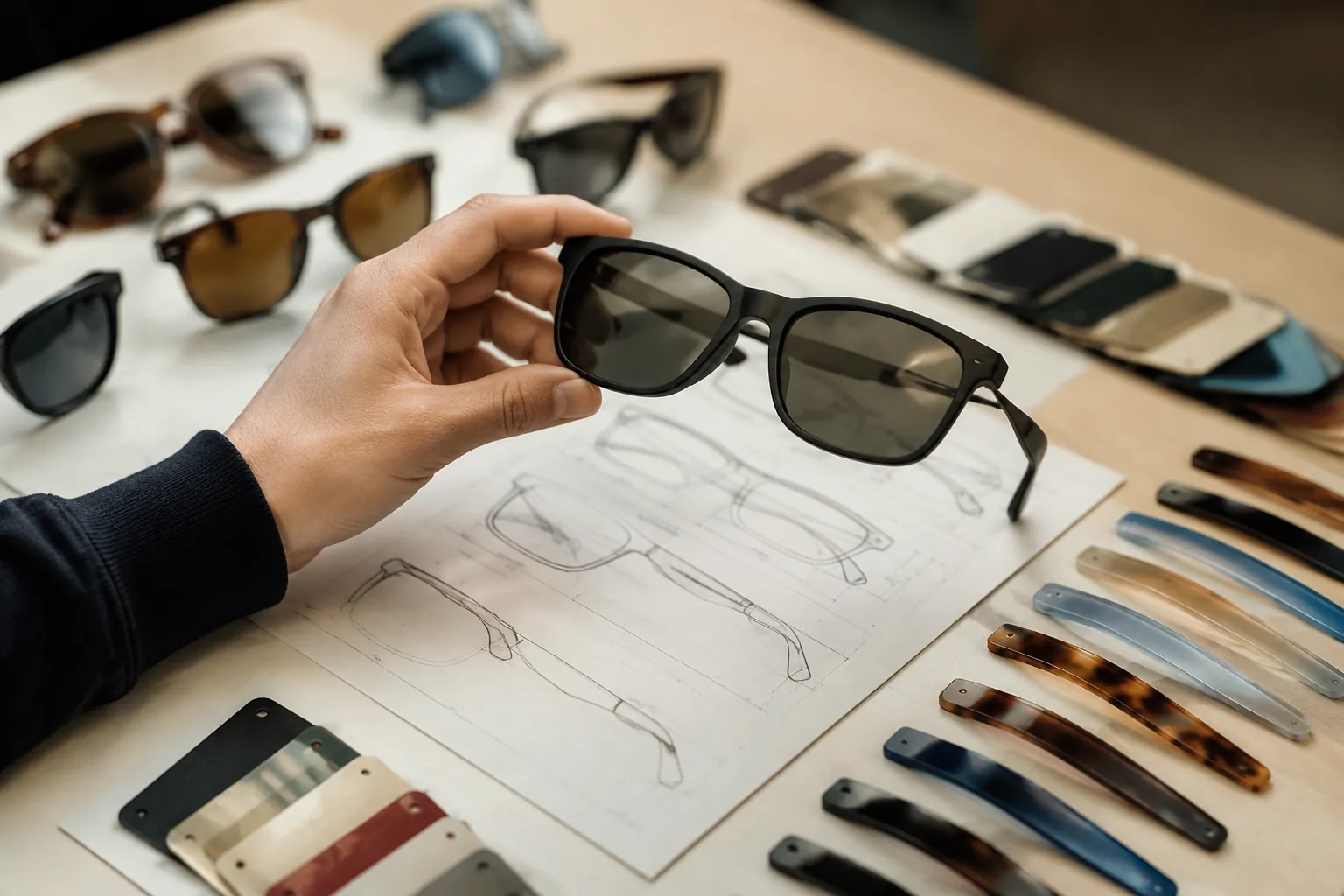
If you buy sunglasses for a brand, chain, import program, or distributor network, mixed-SKU orders can protect margin only when the production plan is built like a factory schedule, not a retail wish list. The common failure is easy to spot: too many variants, weak component sharing, and a purchase order that looks efficient on paper but turns into line stoppages, extra QC, and higher freight cost on the floor. This guide shows how to combine styles, colors, lens options, and decoration methods in one order without blowing up MOQ, lead time, compliance, or landed cost.
Start With the SKU Map, Not the PO
Mixed-SKU buying only works when the assortment is mapped before pricing starts. Build the order around three layers: frame style, frame color, and lens option. Add a fourth layer only if it truly changes production: decoration method. Buyers think in retail terms. Factories think in mold, material, coating, print, assembly, and pack-out. Every extra option adds changeover time, handling, and QC.
For a sunglass program, separate true sell-through SKUs from display or test variations. If a style cannot realistically sell 50 pairs in its first run, do not treat it like a production SKU. A 50-pair MOQ per design is manageable, but only if each design family is treated as a real production unit. A 12-SKU buy is usually healthier as 4 styles x 3 colorways than 12 styles x 1 color each. One front shape. One hinge spec. One lens blank. That is easier to run.
That matters even more in a vertically integrated setup like LumiShades in Wenzhou, where injection molding, acetate cutting, CNC milling, lens tinting, and decoration are handled within one supply chain. Internal coordination helps. It does not remove the need for a clean matrix. The best buyers send a SKU map with target market, material, color code, lens type, logo method, packing unit, and expected volume before asking for a quote.
- Group SKUs by shared mold, lens shape, or temple platform.
- Keep frame fronts fixed and vary color within a design family.
- Separate test SKUs from replenishment SKUs before quoting.
- Flag any color that needs new resin, spray, plating, or coating.
How MOQ Really Works Across Multiple Styles
MOQ is rarely one number for an entire mixed order. In practice, it is usually a per-design threshold, then production logic around colors, lenses, decoration, and packaging. A factory can often combine several colors inside one style if the mold, lens shape, and packing spec stay unchanged. Once you change temples, hinges, lens tint, logo method, or pack format, you have created another process node. Another risk point.
For mixed-SKU sunglasses, the cleanest buying unit is often the design family: one front shape, one temple structure, one hardware spec, and multiple approved color and lens combinations. That lets you allocate volume across variants without forcing the supplier to re-quote every small change. Ask for five styles at 20 pairs each, and you are under the stated minimum in practical terms. Ask for one style at 250 pairs split into five colors, and you are much more likely to get a workable production schedule and a better unit price.
The factory cares about line efficiency, not retail assortment theory. If the line has to stop for every 30-pair color change, the quote will rise fast. Even a small setup change can add disproportionate labor because crews must clean tools, confirm shade consistency, and recheck assembly fit. Batch the work. On a 300-pair style, it is usually better to run 120 black, 100 tortoise, and 80 green than to split the same volume across six colors.
Think about MOQ in terms of component reuse. A style that shares 80% of its parts with another style behaves like a lower-risk extension. A style that changes the front, hinge, and lens at once behaves like a new product. Ask the supplier where the real break point is. In eyewear, the number is often driven less by the stated MOQ and more by how many production steps actually change.
| Order pattern | Factory impact | Typical risk | Buyer result |
|---|---|---|---|
| 1 style, 3 colors, shared lens | Low setup load, repeatable assembly | Low | Best for early volume and fast replenishment |
| 4 styles, 2 colors each | Moderate setup load, manageable QC | Medium | Works if each style clears its own design minimum |
| 8 styles, 1 color each | High setup load, fragmented packing | High | Quote weakens and lead time usually stretches |
| 1 style, 5 lens tints, 2 logo methods | High QC and packing complexity | Medium to high | Needs strict control of artwork, labeling, and carton split |
Keep the design family stable enough that the factory can run it without constant interruption. That is the difference between a mixed order that saves money and a mixed order that burns it.
Price Breaks: Where Margin Is Won or Lost
The price ladder matters more than the headline unit price. In a practical China sourcing setup, a sunglasses program often sees meaningful breakpoints around 50 pairs per design, then 300, 1000, and 5000+ total units. Setup, tooling wear, color matching, scrap, labor, and packing all get amortized differently as the run gets larger. A line that spends the same hour on setup for 60 units versus 600 units will price those two orders very differently.
On a mixed-SKU order, the real question is not "What is the cheapest style?" It is "Which mix gets the order into the next volume bracket without creating dead stock?" Sometimes adding 200 pairs to a core black style is the right move because it pushes the family into a better price tier. Sometimes the better choice is to keep the run smaller if the added inventory sits too long in channel. The best mix protects both gross margin and sell-through.
Build landed cost from the start. Include ex-factory price, packaging, freight, duty, inspection, and local warehouse handling. A carton that is 15% larger because of rigid cases or oversized inserts can erase a unit-price gain quickly, especially on air freight or low-density cartons. In eyewear, a $0.12 packaging upgrade may be cheaper than a 9% increase in carton volume. Ignore that tradeoff, and the math gets ugly.
Ask for pricing by style block, not only by SKU line. That lets the supplier quote on shared components and shared process steps. If one style uses the same front mold, same lens blank, and same hinge as another style, it should not be priced as if it were fully separate. The same logic applies to mixed cartons: if packing is consistent, you can often reduce handling by consolidating more units into fewer master cartons.
- Set a target retail margin first.
- Back out freight, duty, and handling to find max ex-factory cost.
- Push volume into the highest-selling style blocks first.
- Use lower-volume variants only where they protect channel coverage.
- Ask the factory to quote by design family, not just by SKU line.
Design Choices That Multiply Variants
Most mixed-SKU problems start with design decisions that look small during development. Frame color is not always just a color decision. In acetate, marble, transparent, and layered sheet effects can cut and polish differently, which affects edge clarity and polish time. A dense black acetate frame may behave very differently from a translucent amber sheet when it reaches the polishing wheel. In injection molding, pigment shift, gloss level, and wall thickness can change between runs, especially if the tool temperature or resin lot moves.
Decoration is another multiplier. Laser engraving is usually clean and durable, but it needs controlled depth, often around 0.05-0.15 mm for fine branding, so the mark stays readable without biting too deeply into the surface. Pad printing is flexible for logos and icons, but curved temples and glossy surfaces can reduce ink transfer and edge sharpness. Hot stamping can look premium, yet it is sensitive to heat, pressure, and surface texture. Metal logo plates and epoxy domes add perceived value, but they also add alignment and adhesive checks.
Lens selection can be equally expensive in disguise. Standard smoke lenses are simple. Mirror, gradient, polarised, and flash-coated lenses each introduce another layer of process control, from base tint and coating uniformity to optical inspection and scratch protection. If you mix UV400 fashion lenses with compliance-driven SKUs, the product file must show exactly which model uses which lens build and which market it is destined for. Otherwise, the sample may pass visually but fail in documentation or testing.
Hardware is the last place to get creative. Hinges, screws, temple tips, and nose pads may seem small, but they drive assembly stability and field complaints. If the goal is a profitable mixed order, freeze the front shape and hinge system, then vary the color, lens tint, and decoration. That gives assortment without turning the order into a parts puzzle.
Buyer rule: Keep the front structure fixed, then vary color, lens tint, and decoration inside that framework. Assortment should change the look, not the build.
Build the PO Around Shared Components
The strongest mixed-SKU plan uses shared components wherever possible. One front mold should support several colorways. One lens shape should cover multiple finishes. One carton size should work across the family if the packing spec is stable. This lowers purchasing complexity and keeps one low-volume item from holding the whole order hostage.
Shared components also improve QC. If the same lens blank, same hinge, same screw length, and same cleaning standard are used across a group, inspectors can spot drift faster. In a factory that runs many styles at once, that consistency is what keeps defect rates under control. It also makes replacement parts easier to track if a retailer reports a fit issue after launch.
Before sample approval, ask for a production matrix. At minimum it should show SKU, color, lens type, decoration method, carton count, packing unit, and target market. If the supplier cannot map the order cleanly, the assortment is too fragmented. A fragmented BOM usually means more changeover, more paperwork, and more chances for the wrong lens or logo method to land in the wrong carton.
Define tolerances early. Temple length should be locked before quoting, and if a design family uses a 140 mm temple, do not allow casual drift from one variant to another. Likewise, lens width, bridge size, and front height should be stable enough that the same case and insert set still fit all variants. That is how you keep the supply chain efficient while still offering choice to the market.
- Keep one master spec per design family.
- Lock lens width, bridge, and temple length before quoting.
- Use one packing standard unless a channel clearly requires more.
- Reserve special decoration only for top-selling SKUs.
Sample Plan and Lead-Time Reality
Sample timing is usually 7-10 days for standard development and 25-35 days for bulk production, but only if the file stays frozen. Mixed-SKU programs often slip because the buyer asks for too many permutations at once. The faster route is to confirm the structure and artwork, approve one base sample, then freeze the variation list. Sample the core style first, then test the two or three variants that will carry the program. Do not sample every fringe color unless there is a clear sales reason.
A good sample plan separates structural approval from cosmetic approval. For example, approve frame fit, hinge tension, and lens clarity on the base sample, then check color chips, logo placement, and packaging on a follow-up round. This reduces rework because the supplier is not trying to solve ten variables at once. If multiple lens tints or logo methods are required, stage them in one controlled sample round instead of three. Each extra round adds calendar time and consumes attention on both sides.
Lead time usually stretches when approval is ambiguous. If the lens curve is acceptable but the logo position is not locked, the supplier may hesitate to start bulk. If the packaging spec is still changing, carton allocation can stall. Even small issues matter: a 1 mm logo shift can move the print out of the safe zone on a curved temple, and a slightly too-thick insert can increase carton height enough to change freight rates.
Use a strict sign-off list. Size, hinge feel, lens clarity, print sharpness, engraving depth, color tolerance, and packaging all need approval. For most buyers, the practical color tolerance on fashion eyewear is tighter than they expect; if the first batch and the approved sample differ visibly under daylight, the market will notice. Catch those problems before bulk, not after the deposit is spent.
| Stage | What to freeze | Typical timing | Common mistake |
|---|---|---|---|
| Concept | Style count and market use | 1-3 days | Adding too many SKUs before volume is defined |
| Sample | Frame, lens, logo, pack | 7-10 days | Changing artwork after approval |
| Bulk | Final BOM, carton spec, and pack split | 25-35 days | Mixing new colors or pack formats mid-run |
Compliance: Match the Claim to the Market
Do not let assortment create a compliance mess. A mixed order can include fashion-only styles, UV-protection styles, and market-specific SKUs, but each one needs a clear file. LumiShades can support certifications and standards including CE EN ISO 12312-1, FDA registration, ANSI Z80.3, AS/NZS 1067, REACH, ISO 9001, and BSCI. The key is to match the claim to the destination and keep each style tied to the right test set.
For Europe, CE-related eyewear testing and REACH material control are not optional paperwork. For the U.S., the product file should align with FDA registration and the lens or impact standard your customer requires. For Australia and New Zealand, AS/NZS 1067 matters. For impact-related positioning in some channels, ANSI Z80.3 may be requested. The same frame may be sold in multiple markets, but the paperwork should not be copied blindly from one destination to another.
Mixed-SKU orders get cleaner when each style is tagged by market before purchase order release. One SKU can be EU-bound, another U.S.-bound, and another for general fashion retail. That reduces mistakes in labeling, carton markings, and compliance documents. It also helps if a later market change requires you to re-route stock rather than relabel everything.
Ask the factory to keep test reports tied to the exact construction: frame material, lens type, decoration method, and coating stack. If a style changes from mirrored to plain smoke lenses, or from pad print to laser mark, the certificate set may no longer match. REACH declarations should also cover coatings, inks, and additives, not only the base plastic. That detail matters when an importer needs to answer a retailer audit quickly.
- Assign one compliance profile per SKU.
- Keep reports tied to the exact lens and frame spec.
- Verify material declarations for coatings, inks, and additives.
- Do not reuse a certificate file after construction changes.
A Practical Buying Template for Mixed Orders
If you want a clean mixed-SKU order, use a template the factory can actually run. Start with a core group of two to four styles. Each style should have one shared frame structure, two to three colors, and one or two lens options. Keep decoration methods limited. Then forecast volume by channel, not by hope.
A workable first order might look like this: 500 pairs total, split across three styles; 200 pairs on the main retail driver, 150 on the second style, and 150 across the test style; colors limited to black, tortoise, and one seasonal tone; lens options limited to smoke and brown. That structure gives you enough market coverage to test demand without turning the factory into a custom lab.
Before release, confirm three things in writing: the approved sample, the final SKU matrix, and the shipment split by style. If you need mixed cartons, say so explicitly. If you need retail-ready packing, define it. If you need barcodes, polybag inserts, or country-specific labeling, list them. The fewer assumptions, the fewer chargebacks later.
When the order is built this way, the economics are easier to control. The factory can run shared components, the buyer can protect MOQ, and the freight team can keep carton count under control. Mixed-SKU sourcing is not about making every item unique. It is about controlling variation so the order stays profitable. Good buyers treat assortment like a production problem. That is how they keep MOQ intact and land a decent margin.
Have a custom sunglasses project in mind?
Send us your styles, target market and quantities and we will return a detailed quote with MOQ, lead time and a sample plan.
Get a QuoteWhy source this from Wenzhou with LumiShades
Wenzhou in Zhejiang Province is widely regarded as China’s eyewear manufacturing capital, producing a large share of the world’s sunglasses. That concentration matters to buyers: a deep local supply chain for acetate sheet, hinges, lens blanks, plating and packaging means shorter component lead times, easier color and material matching, and a workforce with decades of eyewear-specific skill. LumiShades has manufactured in this ecosystem since 2009, and our vertical integration — in-house injection molding, acetate cutting, CNC milling, lens tinting, decoration and quality control — means no part of your order is quietly subcontracted to a workshop you cannot audit.
For international buyers, that vertical control translates into accountability. When a single factory owns every step, defects are traced and fixed at source rather than bounced between vendors, and your specifications survive intact from first sample to bulk. We back this with 15+ years of experience, shipments to 60+ countries, more than 5 million pairs produced per year and a 98.5% on-time delivery rate. Our certifications — CE EN ISO 12312-1, FDA registration, ANSI Z80.3, AS/NZS 1067, REACH, ISO 9001 and BSCI audit — mean the compliance documentation your market requires already exists. Explore our manufacturing capabilities and quality control process to see how this works in practice.
Frequently asked questions
Can I mix multiple sunglasses styles in one order and still meet MOQ? Yes, if each design family clears the factory minimum. With a 50-pair MOQ per design, a 10-style order only works when the style-level allocation is real and production-ready, not just theoretical on the spreadsheet.
What is the fastest way to improve price on a mixed order? Push volume into fewer shared styles and shared components. Moving a style from 50 to 300 units usually matters more than adding another low-volume color, because the setup cost gets spread across more pairs.
How should I split colors and lens options? Keep the frame structure fixed and vary colors and lens tints inside that structure. That reduces setup changes, keeps assembly simpler, and makes QC more consistent across the batch.
What documents should I ask for on compliant eyewear? Match the file to the destination: CE EN ISO 12312-1 and REACH for Europe, FDA registration for the U.S., ANSI Z80.3 when required, and AS/NZS 1067 for Australia and New Zealand.
How do I avoid sample delays on a mixed-SKU program? Freeze the base design first, then sample only the key variants. If you keep changing lens tint, decoration, or packing after approval, the 7-10 day sample window will slip quickly.
What should I share with the factory before asking for a quote? Send a SKU matrix with style, color, lens, decoration, carton pack, target market, expected volume per line, and any required tolerances. A vague list gets a vague price and a riskier production plan.
Ready to start?
Explore our aviator sunglasses or request a quote — our sales team replies within 12 hours.
Request a Quote