
ODM vs OEM Sunglasses: First Runs of 300-3,000 Pairs
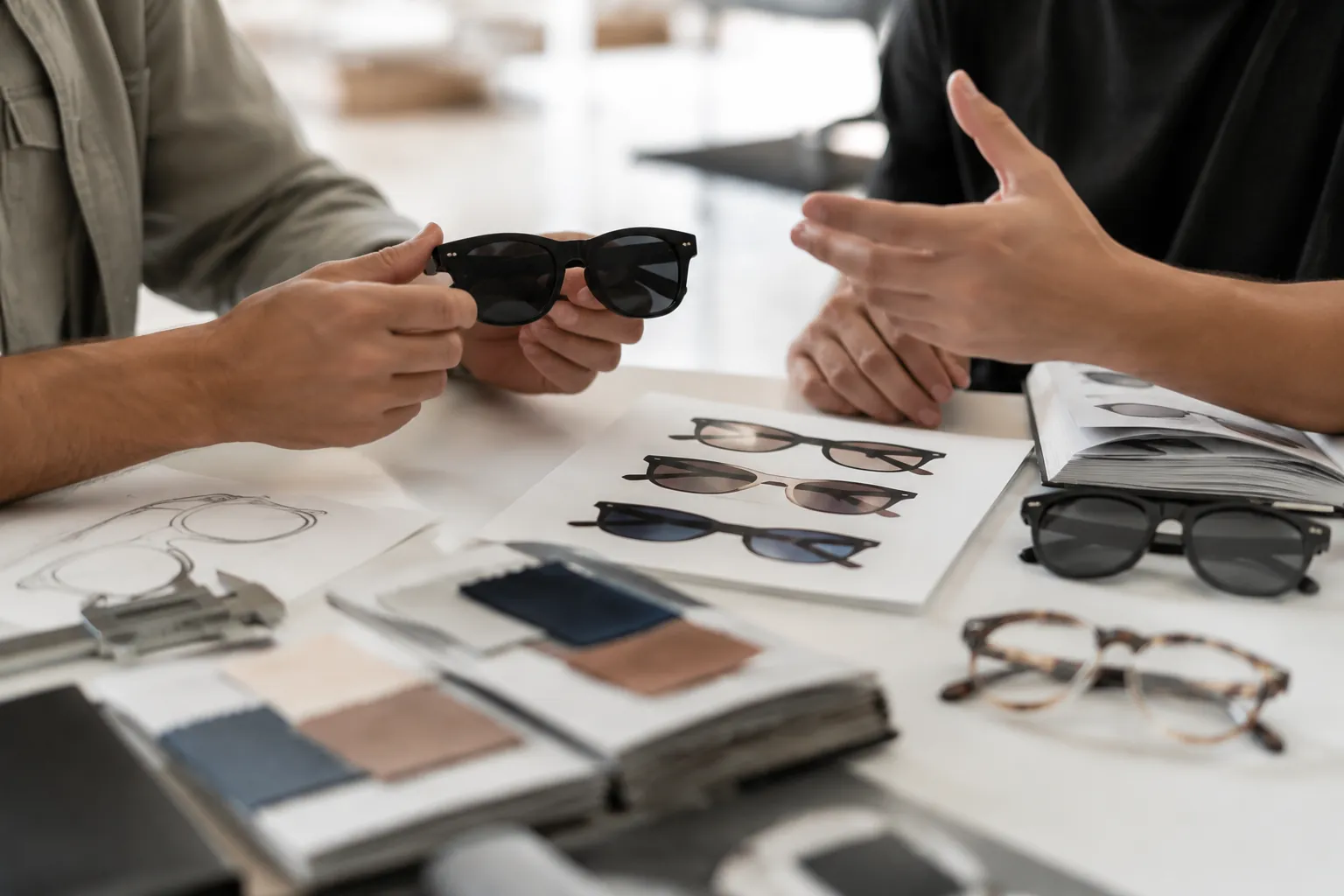
This guide is for brand owners, importers, distributors, and retailers planning a first sunglasses order of 300 to 3,000 pairs. At this size, the ODM-versus-OEM choice is not mainly about how custom the product feels. It is about risk. How much cash will you put into development before sales are proven? How fast can samples and bulk goods move? How predictable will fit, lens assembly, and quality be? And how much unsold inventory can you carry if one style misses? The framework below focuses on factory steps, MOQ breakpoints, approval risks, and compliance checks so buyers can choose the lower-risk route for a first launch.
Start with the risk you can carry
Buyers often treat ODM versus OEM as a branding question. For first orders of 300 to 3,000 pairs, it is usually an execution question first.
ODM starts from an existing factory frame or proven base style. Common changes include frame color, lens tint, logo print, laser marking, metal logo plates, pouch, box, barcode label, and carton details. Some factories also allow small trim changes without treating the job as full development.
OEM starts from your sketch, reference sample, CAD file, or 3D model. Depending on the construction, the work may include injection molds, CNC programming for acetate, hardware selection, prototype rounds, fit corrections, and repeated approvals before bulk production can begin.
For a first launch, ODM usually carries less technical and commercial risk. The base geometry has already been made. Lens fit, hinge position, temple balance, front curve, and closing alignment are known production issues, not theories.
OEM makes more sense when one of three conditions applies:
- Your product strategy depends on a frame shape that buyers cannot easily source from catalog options.
- Your customer has a fit need that standard frames do not solve, such as a specific bridge shape, wrap profile, or temple geometry.
- You expect enough repeat business in the same shape to spread development cost and approval time across more than one order.
If demand is still unproven, full custom development can trap budget before you know which size, lens color, or silhouette will actually reorder.
ODM vs OEM at a glance
| Factor | ODM from existing frame | OEM new development |
|---|---|---|
| Starting MOQ | Often more accessible for first orders because the base frame already exists. Some factories support smaller branded runs, but MOQ still depends on material, decoration, and packaging. | The quoted MOQ may look similar, but the real commitment is higher once samples, tooling, and approval rounds are included. |
| Typical price logic | Better suited to market testing because you are paying mainly for customization, not new product development. | First-order cost is usually higher because development expense is spread across a smaller initial volume. |
| Sample time | Usually shorter. The frame exists, so color, lens, logo, and packaging details carry most of the approval work. | Usually longer. Frame structure, fit, and component details may need one or more prototype rounds. |
| Bulk lead time | More predictable once the pre-production sample is approved. | Bulk production may be similar after final approval, but development adds time before production starts. |
| Technical risk | Lower. Lens curve, hinge setting, and assembly sequence are already familiar to the factory. | Higher. New geometry can create fit, lens retention, alignment, or comfort issues that only appear after sampling. |
| Brand differentiation | Moderate. Differentiation comes from color, lens tint, logo execution, packaging, and channel control. | High. You can control front shape, thickness, hardware, details, and the overall product language. |
| Compliance path | Usually simpler if the build stays close to proven lens categories, materials, and constructions. | Needs closer review when design changes affect lens performance, coverage, wrap, materials, or labeling. |
The difference is plain. ODM shortens the path to market. OEM gives more control, but it adds approval steps and more places for the project to stall.
What buyers underestimate
Most first-time OEM buyers focus on the shape. Factories focus on whether that shape can be produced consistently and pass inspection.
- Lens seating tolerance: Lens fit depends on the lens edge, groove, bevel, and front opening. If the relationship is wrong, lenses may sit loose, feel stressed during insertion, or become hard to assemble consistently.
- Temple closing alignment: A frame can look symmetrical from the front and still close unevenly because of hinge drilling, warpage, hardware position, or inconsistent heat adjustment.
- Bridge fit and wearing balance: Two frames with similar listed measurements can fit differently. Bridge form, front curve, and temple geometry all change how the frame sits on the face.
- Material behavior: Injection, acetate, metal, and mixed constructions behave differently in production. Surface finish, dimensional stability, polishing, and repairability all depend on material and process.
- Decoration limits: Pad printing, laser marking, and attached metal logos do not perform the same way on every surface. Curvature, texture, coating, and finish can change the result.
- Compliance drift: Late changes to lens tint, mirror finish, material, or labeling can change what must be checked for the destination market.
This is why ODM is often the safer first step. The structural work has already been proven. Your team is customizing a known base, not validating a new frame architecture from zero.
Use total launch cost, not unit price
Do not compare ODM and OEM only by quoted unit price. Compare total launch cost per sellable pair.
For ODM, cost usually sits in the product itself plus branding details: lens tint, logo method, pouch, box, labels, and cartons. MOQ and pricing still vary by frame material, lens specification, decoration, and packaging complexity. But the project usually avoids heavy upfront engineering work.
For OEM, the first order includes more than the ex-factory piece price. Build in development time, prototype rounds, tooling or mold charges, engineering corrections, and a longer approval cycle. Repeat-order economics may look good. The first run can still be weak if sell-through is uncertain or the launch window is tight.
Use this decision filter:
- If customers are buying mainly for branding, color story, or channel exclusivity, start with ODM.
- If the launch is seasonal and a late shipment would damage the program, start with ODM.
- If you already have retailer commitments, reorder confidence, or a long-term core shape strategy, OEM becomes more rational.
- If lens color, eye size, bridge fit, or temple length are still open questions, do not fund full OEM yet.
Many brands overestimate how much shape originality the market needs on a first order. A disciplined ODM program can test demand with clear colors, strong logo placement, and consistent packaging. That is often enough.
How lead time really breaks down
Published sample and production lead times matter. But only after approvals are complete. In eyewear projects, delays often come from vague specifications, not factory capacity alone.
For ODM, the workflow is normally:
- Select the base frame and confirm material, color, lens tint, and logo method.
- Submit vector artwork with dimensions and placement measured from a fixed reference point.
- Review a pre-production sample.
- Approve frame details, packaging, carton marks, barcode or SKU logic, and labels.
- Move into bulk production and final packing.
For OEM, add development loops before bulk production: CAD review, prototype machining or mold evaluation, fit revision, hardware confirmation, and second-sample approval if needed. Each revision round adds calendar time.
Factories move faster when the approval package is complete. That usually means:
- Exact color reference by Pantone, approved swatch, or physical sample
- Lens tint target and intended market requirement
- Logo artwork, size, and placement
- Packaging artwork and print approvals
- Destination-market labeling requirements
- Master carton rules and shipping marks
Instructions such as "make the logo smaller" or "darken the lens slightly" are not production specifications. Be precise. Fewer guesses mean fewer stops.
Compliance needs early attention
Sunglasses compliance affects import readiness, retailer acceptance, marketplace listing, and product liability risk. Treat it as an early requirement, not final paperwork.
Buyers commonly ask suppliers about CE EN ISO 12312-1, ANSI Z80.3, AS/NZS 1067, REACH, FDA registration, ISO 9001, and BSCI. These do not mean the same thing. Product standards such as CE EN ISO 12312-1, ANSI Z80.3, and AS/NZS 1067 relate to sunglasses performance in relevant markets. REACH concerns chemical compliance. FDA registration is a separate regulatory matter. ISO 9001 and BSCI relate to management systems or social compliance, not whether a specific sunglass model meets a product-performance standard.
ODM usually lowers compliance risk because the construction is familiar to the factory. If you stay close to proven materials, lens categories, and labeling logic, the path is more predictable. OEM needs closer review when you change coverage, wrap, transmittance, materials, or other elements that affect testing, marking, or documentation.
Ask these questions before approving the sample:
- Which product standard applies to the destination market?
- Does the selected lens tint or finish affect the required performance classification?
- What information must appear on the product, packaging, or accompanying documents?
- Are material declarations or supporting compliance records required for import or retail listing?
Fixing a label file is usually manageable. Reworking finished goods because the lens specification or compliance record is wrong is expensive.
Best-fit scenarios from 300 to 3,000 pairs
300 pairs, first market test: ODM is usually the safer choice. Keep the program simple, limit colorways, and focus on packaging, photography, and channel fit.
Retailer trial or distributor program: ODM is still often lower risk unless the account requires a proprietary shape. Use an existing frame and differentiate through color, lens treatment, logo execution, and packaging.
Higher-confidence repeat business in one shape: This is where OEM starts to make more commercial sense, especially if your team already has clear requirements for fit, styling, and construction.
Seasonal launch with a hard ship date: ODM is generally the better route unless a unique silhouette is the main reason the product will sell. Missing the selling window can cost more than giving up some design exclusivity.
Clear fit gap in the market: Consider OEM earlier if catalog frames do not solve a repeat customer problem, such as bridge fit, wrap profile, or wearing comfort. In that case, custom development solves a real product issue.
Practical rule: use ODM to test demand, then move proven winners into OEM when reorder data supports deeper investment.
Buyer checklist before you commit
- Define whether the order is a market test, retailer program, or long-term core style.
- State quantity honestly from the start because MOQ and price logic change with volume, material, and packaging.
- Choose material based on finish, production repeatability, durability, and price position.
- Lock the lens brief early: tint, intended use, target market, and required documentation.
- Specify decoration with measurable instructions: artwork format, size, color, and placement.
- Ask what is truly custom and what is a modified catalog frame.
- Review the pre-production sample physically where possible, including hinge feel, folding symmetry, surface finish, logo clarity, and lens cleanliness.
- Approve packaging and labels before bulk production because these often delay shipment.
- For OEM, confirm how many prototype rounds are included and what changes create extra time or cost.
- Store approved specifications in a clear tech pack so reorders are controlled and comparable.
For most first-time buyers, the safer path is the one that gets a sellable product to market with controlled MOQ, realistic timing, and manageable compliance work. In many first-order cases, that means ODM first and OEM later.
Have a custom sunglasses project in mind?
Send us your styles, target market and quantities and we will return a detailed quote with MOQ, lead time and a sample plan.
Get a QuoteWhy source this from Wenzhou with LumiShades
Wenzhou in Zhejiang Province is widely regarded as China’s eyewear manufacturing capital, producing a large share of the world’s sunglasses. That concentration matters to buyers: a deep local supply chain for acetate sheet, hinges, lens blanks, plating and packaging means shorter component lead times, easier color and material matching, and a workforce with decades of eyewear-specific skill. LumiShades has manufactured in this ecosystem since 2009, and our vertical integration — in-house injection molding, acetate cutting, CNC milling, lens tinting, decoration and quality control — means no part of your order is quietly subcontracted to a workshop you cannot audit.
For international buyers, that vertical control translates into accountability. When a single factory owns every step, defects are traced and fixed at source rather than bounced between vendors, and your specifications survive intact from first sample to bulk. We back this with 15+ years of experience, shipments to 60+ countries, more than 5 million pairs produced per year and a 98.5% on-time delivery rate. Our certifications — CE EN ISO 12312-1, FDA registration, ANSI Z80.3, AS/NZS 1067, REACH, ISO 9001 and BSCI audit — mean the compliance documentation your market requires already exists. Explore our manufacturing capabilities and quality control process to see how this works in practice.
Frequently asked questions
At what order size should I seriously consider OEM instead of ODM? Consider OEM when the order is more than a one-off test: repeat demand in the same shape, a retailer program that needs a proprietary frame, or a clear fit requirement that standard frames do not solve. Quantity matters, but reorder confidence matters more. Before approving OEM, ask the factory for the development timeline, number of prototype rounds, tooling implications, and which changes after first sampling will add cost or delay.
Can I still make an ODM frame look exclusive to my market? Yes. Most programs can customize frame color, lens tint, logo application, inside temple print, packaging, labels, and sometimes trim details. Ask the supplier to separate standard options, minor modifications, and changes that would move the project into new development. For a first launch, review a sample that shows the exact logo method, lens color, and packaging finish you plan to sell.
How fast can I get from approved sample to shipment on an ODM order? It depends on factory schedule, quantity, materials, packaging complexity, and whether approvals are complete. After sample approval, ask for a written production timeline covering bulk production, packing, and ex-factory readiness. To keep the project moving, finalize logo artwork, packaging files, barcode logic, carton marks, and destination-market labeling before issuing the bulk order.
Does FDA registration mean the sunglasses are automatically approved for every market? No. FDA registration does not replace market-specific product requirements. You still need to confirm which standards and documents apply where you will sell. Buyers commonly ask about CE EN ISO 12312-1, ANSI Z80.3, AS/NZS 1067, and REACH-related requirements. Ask the supplier which records they can provide for the exact model and lens configuration, then verify that those records match your destination market and sales channel.
What is the biggest hidden cost in OEM sunglasses development? Usually revision time, not just the visible sample fee or tooling charge. A new frame may need extra rounds to correct fit, lens seating, hinge alignment, cosmetic finish, or wearing balance. To control that risk, submit one consolidated markup file per review round, define acceptance criteria before sampling starts, and ask the factory which changes count as minor corrections versus a new development step.
If my MOQ is only 300 pairs, should I split into multiple colorways? Only if each colorway still meets the supplier's practical production minimum and you have a clear sales plan for each version. Small runs spread across too many colors can create slow stock and make results harder to read. Ask the factory for the minimum quantity per color, whether packaging or labeling changes by color add cost, and whether repeat orders can be mixed the same way.
Ready to start?
Explore our square sunglasses or request a quote — our sales team replies within 12 hours.
Request a Quote