
ODM vs OEM Sunglasses: Which Launches Faster?
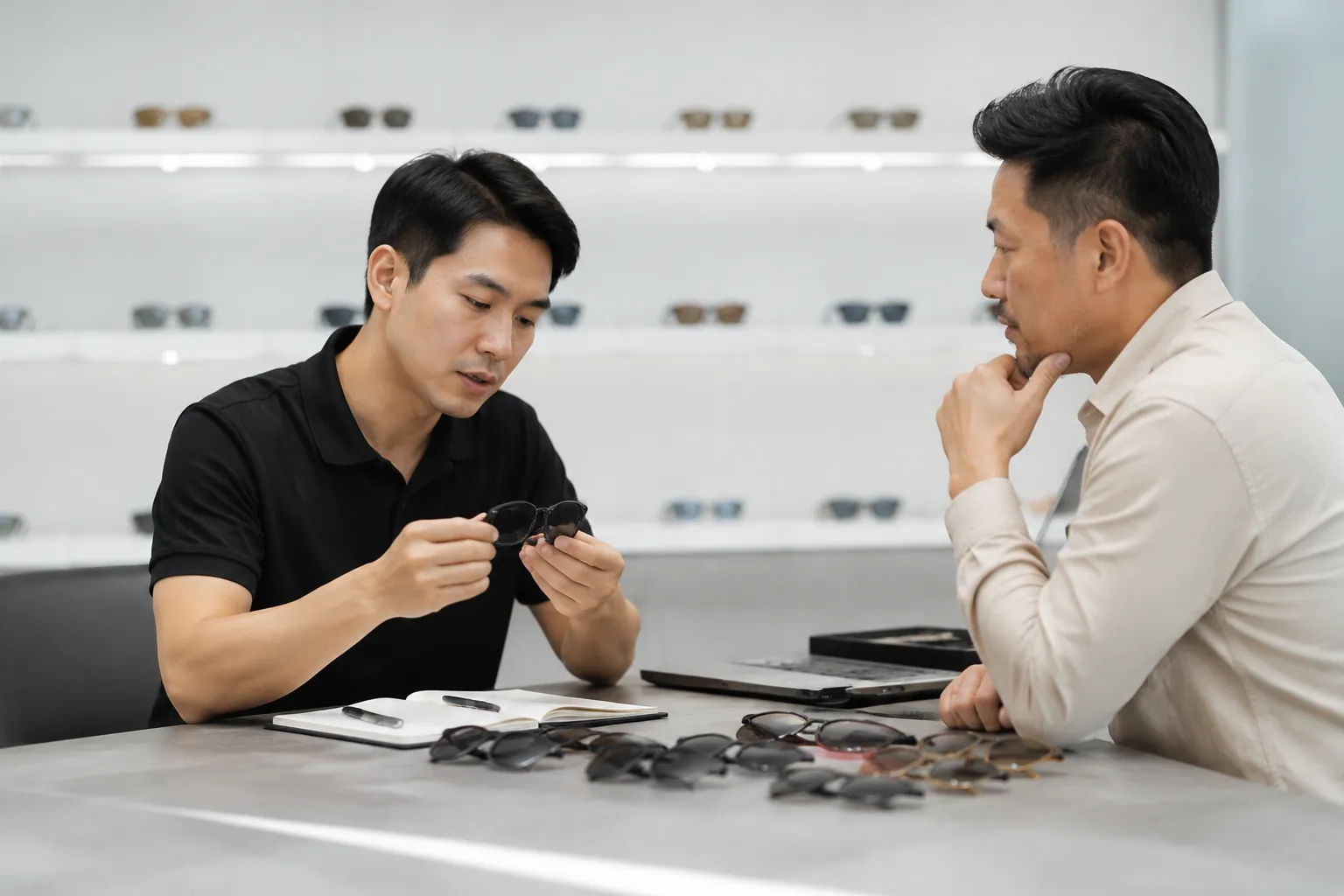
This guide is for brand owners, importers, distributors, and retail buyers sourcing sunglasses at commercial volume. If you are choosing between an ODM frame you can customize quickly and an OEM project built from scratch, the wrong path can add weeks, extra sample freight, tooling cost, and margin pressure. The right choice depends on how much structural change you need, how fast you must launch, and whether expected reorder volume can absorb development expense. Use the framework below to compare lead time, MOQ, unit economics, process risk, and compliance before you commit.
Start with the buying model, not the reference image
Many buyers start with a photo, a target FOB price, and a deadline. That order causes problems. First decide whether the project is actually ODM or OEM.
ODM means you choose an existing frame platform from the factory and customize brand-facing details such as frame color, lens tint, logo application, packaging, and sometimes small hardware or finish changes. The mold already exists. The hinge position is already set. The factory already knows how the frame behaves in production. That removes the biggest source of delay.
OEM means the frame is developed for your brand from a new drawing, physical sample, or concept. You may change eye shape, bridge width, front curvature, temple cross-section, end-piece geometry, logo construction, metal trim integration, or material structure. That usually means new tooling, more sample rounds, tolerance correction, and extra testing or verification.
For most commercial buyers, the split is simple:
- Choose ODM if your priority is speed, lower opening cash exposure, and a launch built on a frame structure that already runs reliably.
- Choose OEM if your priority is a frame architecture that cannot be achieved by recoloring, decorating, or slightly modifying an existing platform.
- Do not choose OEM just because you want the product to feel original. Many private label sunglass programs stand apart through color, lens category, finish, logo hardware, and packaging without changing the underlying frame structure.
This matters even more when a factory handles multiple processes in-house. A supplier with internal injection molding, acetate cutting, CNC milling, lens tinting, decoration, and QC can usually move faster because fewer teams and subcontractors need to coordinate each sample revision.
ODM and OEM compared on lead time, cost, and risk
The clearest comparison is not on the tech pack. It is inside the factory schedule. What changes, and how many steps get added?
| Factor | ODM sunglasses | OEM sunglasses |
|---|---|---|
| Base structure | Existing mold and established frame design | New frame design, usually with new tooling |
| Sample lead time | Typically shorter because the frame platform already exists; timing depends on color, logo, lens, and packaging changes | Typically longer because development may include tooling, fit correction, and finish revisions |
| Bulk lead time | Usually more predictable after final approval because the production process is already proven | Usually less predictable at launch because tooling validation and pre-production approval add steps |
| MOQ logic | Often workable at lower opening quantities, depending on the factory and customization level | Usually makes more sense when projected repeat volume can absorb development and tooling cost |
| Unit price | Usually lower at launch because tooling cost is not being introduced into the project | Usually higher at launch because engineering, tooling, and extra sampling are spread across fewer units |
| Development risk | Lower because molding behavior, hinge position, and basic fit have already been validated in production | Higher because distortion, tolerance mismatch, assembly issues, and finish defects can appear during development |
| Brand differentiation | Moderate to high visually, but limited structurally | Higher when frame architecture itself is part of the brand value |
That is why ODM is common for first orders, seasonal programs, promotions, test launches, and distributors building a line fast. OEM makes more sense when the frame itself is the statement product and the buyer expects enough reorder volume to recover upfront spend over time.
When ODM is the smarter commercial choice
ODM gets dismissed too easily. That is a mistake. For many first launches and time-sensitive programs, it is the better buying decision.
- You need speed. If you are targeting a trade show, summer shelf date, campaign launch, or distributor deadline, an existing frame platform removes the tooling stage. Sample and bulk timing still vary by factory, but ODM usually shortens the path because the structure does not need to be engineered from zero.
- Your opening order is small or mid-size. Lower starting MOQs help when you are testing a market, building a capsule collection, or launching several SKUs without carrying excess stock. Price often improves at higher volume because decoration setup, packaging labor, and material purchasing spread more efficiently.
- Your brand difference is mostly visual. If your customer is more likely to notice crystal gray, olive green, smoke gradient, mirror flash, a foil logo box, or a metal logo plate than a slight temple-profile change, ODM may already meet the commercial brief.
- You want lower technical risk. Existing molds have known production behavior. That lowers the chance of issues such as sink marks around thick logo zones, temple warpage after cooling, or lens mismatch during assembly.
Typical ODM custom points are still substantial:
- Injection frame color matching to approved references or physical swatches
- Acetate sheet pattern selection and lamination direction
- Lens options such as smoke, brown, green, gradient, mirror, or polarized
- Finish choices including matte, gloss polish, or translucent crystal effects
- Logo application by pad print, silk print, hot foil, laser engraving, or inset metal plate
- Custom barcode labels, microfiber pouch, folding case, hangtag, and gift box pack-out
These are the changes customers actually see. They do not require a new mold. That is why ODM usually wins on speed and opening capital efficiency.
Use OEM only when frame geometry truly must change
OEM is worth the extra time and money only when the structure itself creates brand value. Good reasons include a non-standard lens silhouette, a custom bridge fit for a specific facial profile, a signature temple profile, a laminated acetate construction that does not exist in the catalog, or metal decoration designed into the frame component rather than applied afterward.
But be clear about what OEM is. It is not just a more customized purchase order. It is a product development project. Problems happen.
- Tooling review: A shape that looks good in CAD may not release cleanly from the mold. Draft angle, gate position, wall thickness, and resin shrinkage all affect whether the part ejects without stress marks.
- Tolerance correction: Small dimensional changes matter. A bridge-width shift or temple opening-angle change can alter fit significantly. Left-right temple symmetry, hinge seating, and lens groove consistency need physical validation.
- Material behavior: Injection materials can warp if sections are uneven, acetate can move slightly after CNC and tumbling, and metal trim can affect assembly alignment if recess depth is inconsistent.
- Finish correction: Paint edge cleanliness, milling marks near the bevel, logo recess depth, and temple-tip polish often require more than one sample round to finalize.
Commercially, OEM usually works only when forecasted repeat volume is strong enough to amortize development. If the first order is near MOQ and the style direction is still unproven, the economics are often poor. Treat OEM as an investment. Not a mood.
Run the cost model before you approve the design path
Many sourcing mistakes start with a narrow comparison: unit price only. That is not enough. Compare total launch cost, including development, sample freight, packaging, compliance work, and the cost of delay.
With ODM, the factory already owns the mold base and understands the production cycle. Your incremental cost usually sits in color matching, lens treatment, custom logo hardware, upgraded packaging, and inspection requirements. Opening cash stays lower, and you can test several styles in parallel without funding tooling.
With OEM, the first order usually carries more hidden weight: tooling or mold charges, more engineering time, more sample freight, a longer approval cycle, and the chance of correction samples. Even if long-run unit cost improves later, launch economics are usually less favorable.
A practical rule is to request pricing at several quantity breaks before you lock the design path. The logic often looks like this:
| Order quantity | Typical buying implication | Best-fit model |
|---|---|---|
| 50 pairs | Market test, capsule launch, or promotional program with low risk tolerance | ODM |
| 300 pairs | Small commercial run with better decoration and packaging efficiency | Mainly ODM |
| 1000 pairs | More repeatable style with stronger unit-cost logic | ODM or OEM depending on tooling needs |
| 5000+ pairs | Volume program where development cost is easier to amortize across reorders | OEM becomes more viable |
Do not compare a headline price alone. Acetate construction, polarized lenses, metal logo plates, special hinges, and rigid gift packaging can all change cost materially. Compare the full delivered specification, not just the frame body.
Compliance still needs line-by-line confirmation
Some buyers assume an existing ODM style is automatically compliant because the frame shape already exists. It is not that simple. Compliance follows the final sold configuration, including lens material, tint category, coating, labeling, and destination market.
For sunglasses, the usual checkpoints include lens performance, labeling accuracy, chemical compliance, and factory documentation. Common references buyers may ask about include CE EN ISO 12312-1, ANSI Z80.3, AS/NZS 1067, REACH, FDA registration where relevant to the company and product category, ISO 9001, and social compliance records such as BSCI. Useful, yes. Interchangeable, no.
- CE EN ISO 12312-1: A product performance standard commonly used for general-use sunglasses in many markets.
- ANSI Z80.3: A recognized performance standard for non-prescription sunglasses in the US market.
- AS/NZS 1067: A key reference for Australia and New Zealand programs.
- REACH: Relevant where chemical substance restrictions apply to materials, coatings, and finishes.
- FDA registration: Buyers should confirm whether the supplier's registration status is relevant to the specific product category and market-entry process.
- ISO 9001: A quality-management certification for the factory system, not a product-performance certificate.
- BSCI: A social compliance audit framework, not a technical product-compliance standard.
The operational question is straightforward: does the factory have test reports or compliance documents that cover your exact configuration, or will your custom tint, polarized lens, mirror coating, or material change require fresh verification? Ask before deposit. It saves time later.
Factory process changes the timeline more than buyers expect
Buyers often ask for faster shipment without checking where time is actually lost. The bottleneck is usually not final packing. It is approval speed and coordination between development steps.
When a factory handles injection molding, acetate cutting, CNC milling, lens tinting, decoration, assembly, and QC in-house, ODM usually moves faster because logo artwork, color chips, lens tone, and pack-out can be synchronized without multiple subcontractors. Less waiting. Fewer handoffs.
For OEM, in-house capability matters even more because one engineering change can affect several departments at once. A front-curve revision can alter mold flow, lens edging, polishing, and hinge alignment. If those steps are split across vendors, even a small correction can add real delay.
A disciplined approval flow usually follows this sequence:
- Confirm frame model selection or approve the OEM design brief with key dimensions and material callouts.
- Approve frame color, lens specification, logo method, and packaging details.
- Review the first sample for fit, finish, logo position, and lens appearance.
- Issue correction notes with measurements where needed, not just visual comments.
- Approve a pre-production sample if the project complexity requires it.
- Start bulk production with in-line QC and final QC before shipment.
In practice, slow artwork approval, unclear color references, missing barcode files, and late packaging signoff often waste more time than molding itself. Buyers who manage approvals tightly usually launch faster, regardless of factory size.
A blunt decision framework for buyers
If you are still deciding, use this filter.
- Pick ODM if you need to launch in weeks rather than months, your order is modest, your margin is tight, and your product difference is mainly visual or branding-led.
- Pick ODM if this is your first order for a new market, a new channel, or an unproven style direction and you want to limit cash tied up in development.
- Pick OEM if frame shape, fit, material architecture, or integrated decoration is central to your brand promise and cannot be matched from an existing platform.
- Pick OEM if you have development budget, tolerance for extra sample rounds, and forecasted repeat volume strong enough to justify tooling.
The short answer is blunt: ODM is usually the faster route to market in commercial sunglass programs because it removes the slowest and riskiest part of development. OEM earns its place when structural product difference creates measurable brand value and the volume forecast is strong enough to justify the added cost and time.
Have a custom sunglasses project in mind?
Send us your styles, target market and quantities and we will return a detailed quote with MOQ, lead time and a sample plan.
Get a QuoteWhy source this from Wenzhou with LumiShades
Wenzhou in Zhejiang Province is widely regarded as China’s eyewear manufacturing capital, producing a large share of the world’s sunglasses. That concentration matters to buyers: a deep local supply chain for acetate sheet, hinges, lens blanks, plating and packaging means shorter component lead times, easier color and material matching, and a workforce with decades of eyewear-specific skill. LumiShades has manufactured in this ecosystem since 2009, and our vertical integration — in-house injection molding, acetate cutting, CNC milling, lens tinting, decoration and quality control — means no part of your order is quietly subcontracted to a workshop you cannot audit.
For international buyers, that vertical control translates into accountability. When a single factory owns every step, defects are traced and fixed at source rather than bounced between vendors, and your specifications survive intact from first sample to bulk. We back this with 15+ years of experience, shipments to 60+ countries, more than 5 million pairs produced per year and a 98.5% on-time delivery rate. Our certifications — CE EN ISO 12312-1, FDA registration, ANSI Z80.3, AS/NZS 1067, REACH, ISO 9001 and BSCI audit — mean the compliance documentation your market requires already exists. Explore our manufacturing capabilities and quality control process to see how this works in practice.
Frequently asked questions
Can I make an ODM sunglass look exclusive enough for a brand launch? Usually yes, if the base shape is already close to your target. Ask the factory which elements can be customized without new tooling: frame color, acetate pattern, lens tint, polarized or mirror options, logo method, metal logo plates, pouch, case, hangtag, and box finish. Then request a fully itemized sample specification so you can see exactly how the product will differ from the catalog version before approval.
What order size usually justifies OEM development? There is no universal cutoff because tooling cost, material, and complexity vary by factory. A practical approach is to ask for two comparisons: an ODM version and an OEM version of the closest design, each quoted at your opening quantity and at your expected reorder quantity. If projected repeat volume does not clearly absorb tooling, extra sampling, and longer development time, ODM is usually the safer commercial choice.
Does a short sample lead time apply to OEM too? Usually not. Shorter sample timing is more common for ODM because the frame platform already exists and changes are limited to color, lens, logo, or packaging. OEM samples often take longer because the factory may need to review drawings, build or adjust tooling, validate fit, and correct finish issues. Ask the supplier to break the timeline into design review, tooling, first sample, correction sample, and pre-production sample so you can see where time is being spent.
How should I compare prices fairly between factories? Compare a like-for-like specification sheet, not just the unit price. Confirm frame material, lens material, tint or polarized requirement, hinge type, logo method, packaging, defect standard, inspection level, and which compliance documents are included. Then request quotes at the same quantity breaks and ask whether tooling, sample charges, test costs, and freight are included or separate. A lower quote on a lighter specification is not a true comparison.
What compliance documents should I ask for first? Start with the requirements of your destination market and your exact product configuration. For sunglasses, buyers commonly ask about CE EN ISO 12312-1, ANSI Z80.3, AS/NZS 1067, REACH, FDA registration where relevant, ISO 9001, and BSCI. Then verify whether the supplier's existing reports match your actual lens type, tint, coating, and materials. If they do not, ask whether fresh testing or updated documentation will be needed before shipment.
Ready to start?
Explore our cat-eye sunglasses or request a quote — our sales team replies within 12 hours.
Request a Quote