
ODM Sunglasses Sourcing with Existing Molds
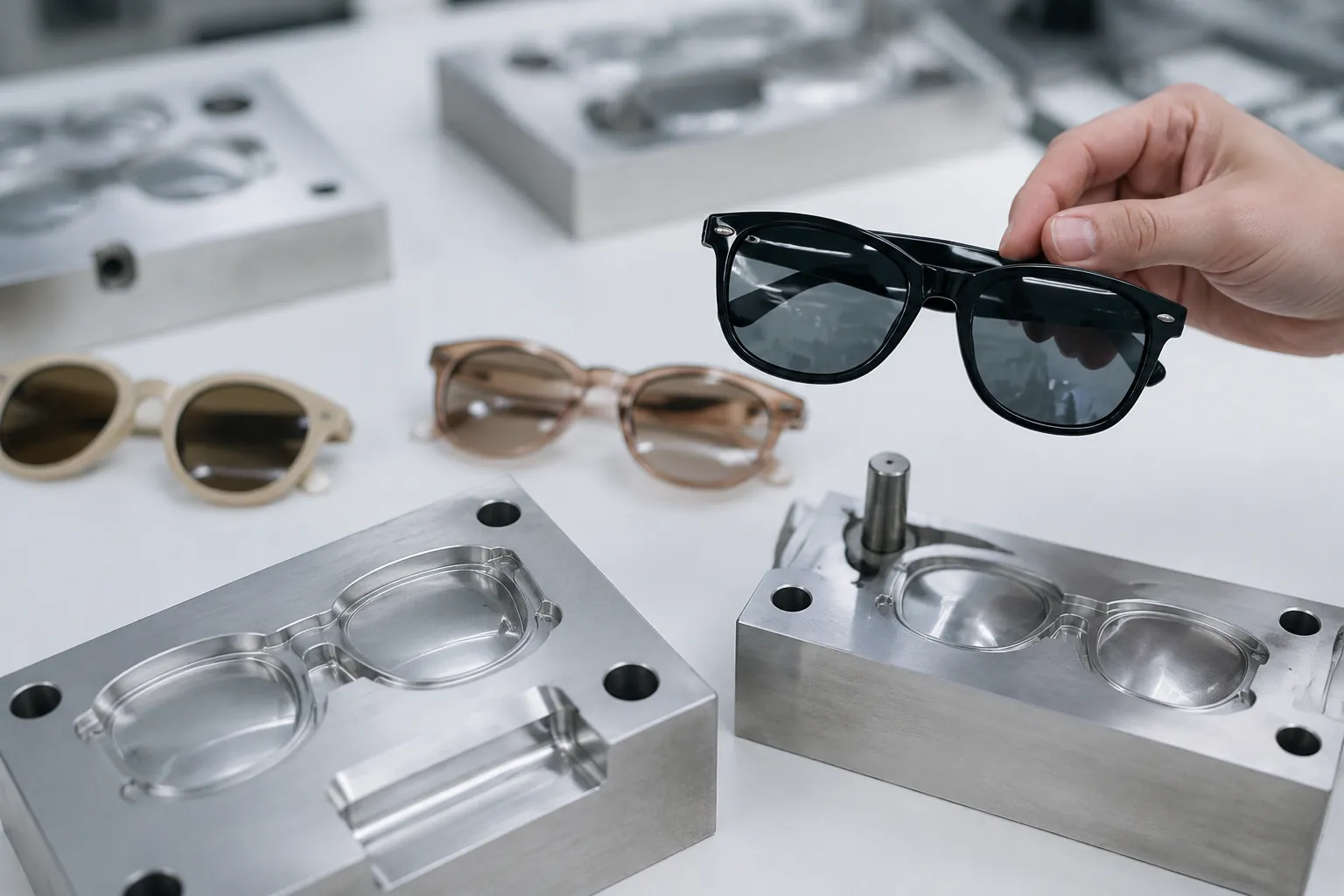
This guide is for brands, importers, distributors, and retailers that need new sunglass SKUs without paying for a new frame mold upfront. ODM catalog sourcing starts with factory-ready frame molds. You then specify color, lenses, logo placement, packaging, and compliance documents around the chosen design. The gain is practical: lower tooling risk, faster samples for standard combinations, and a safer way to test demand before investing in private tooling.
The ODM catalog decision: speed first, ownership later
ODM catalog sourcing means you start from an existing factory frame mold instead of cutting a new one. The frame geometry has already been used in production. Details such as hinge seat depth, bridge thickness, lens groove, temple length, screw boss, injection gate position, cooling behavior, and shrinkage are already known. That lowers technical uncertainty. It does not remove the need for sampling and inspection.
This route fits three common buying situations. You need a seasonal launch and cannot wait for new tooling, mold trials, and revisions. You want to test several shapes before choosing one for private investment. Or your first order is small, so a mold charge would push the landed cost too high.
At LumiShades in Wenzhou, ODM sunglasses can be quoted from 50 pairs per design for test orders, buyer samples, influencer kits, or small distributor launches. Availability depends on the selected frame, lens, logo method, and packaging. Pricing usually improves at 300, 1000, and 5000+ pairs because material purchasing, color setup, lens cutting, decoration setup, and inspection time are spread over more units. Confirm final pricing against a written specification. Not a catalog photo.
Blunt sourcing rule: if the frame shape is not the main reason customers will buy, do not start with new tooling. Use a catalog mold. Put the budget into lens quality, color execution, branding, packaging, compliance, and sell-through testing.
What you can customize without opening a new mold
Existing molds do not mean generic product. Most visible brand choices can still be controlled if the change does not alter the steel or aluminum tooling. Separate cosmetic customization from geometry changes before you brief the factory.
- Frame color and finish: injection frames may be made in solid, translucent, matte, gloss, frosted, crystal, or two-tone effects, depending on resin, pigment, and process. For translucent colors, approve both hue and density. Small pigment changes can change the retail look.
- Frame material: PC is common for economical impact-resistant frames. TR90 or TR-type materials are often used for lighter, more flexible active styles. Acetate gives richer color depth and polished surfaces, but it needs cutting, tumbling, polishing, and more labor. Confirm which materials the selected mold can run before sampling.
- Lens type: standard tinted, gradient, mirrored, polarized, UV400, category-specific, TAC, PC, nylon, or CR39 lenses may be available, depending on the frame and target market. The lens base curve must match the frame. Forcing the wrong curve can cause stress, lens popping, optical distortion, or poor assembly consistency.
- Logo decoration: laser engraving on the lens or temple, pad printing, hot stamping, foil stamping, metal logo plates, and small inlaid badges are common options. Confirm the method, logo size, placement, durability target, and whether the frame has enough flat or prepared surface area.
- Hardware and small parts: hinge type, screw color, temple core style, nose pad color, and spring hinge options may be adjustable if the catalog design was built for those components. Do not assume parts are interchangeable across models.
- Packaging: polybag, microfiber pouch, cleaning cloth, paper box, retail carton, hang tag, barcode label, warning insert, and outer carton marks can usually be customized. Packaging must also meet the labeling rules of the sales market.
What normally cannot change without tooling? Frame silhouette, lens opening, bridge width, molded nose shape, hinge seat geometry, temple cross-section, lens groove position, and molded logo recesses. You can often add a printed mark or attached logo component. You cannot turn a square frame into a cat-eye frame without cutting or modifying tooling.
Cost and lead-time comparison: ODM mold vs new mold
The main value of ODM catalog frames is not only the missing frame tooling charge. It is the shorter decision cycle. With an existing mold, the factory already knows the injection temperature range, cooling time, demolding behavior, lens size, and hinge assembly settings. With a new frame, the first trial may expose shrinkage, warpage, hinge misalignment, bridge deformation, or lens fitting problems. Those issues are normal in eyewear development. They still cost time.
| Option | Best use case | Typical upfront cost | Sample lead time | Bulk lead time | Main risk |
|---|---|---|---|---|---|
| ODM catalog mold | Fast launch, SKU testing, distributor range expansion | No new frame mold charge; decoration setup may apply | Often 7-10 days for standard colors and lenses after complete specification approval | Often 25-35 days after pre-production sample approval, depending on quantity and materials | Same base shape may be available to other buyers |
| ODM mold plus private-label decoration | Brand color, lens, logo, and retail packaging program | Logo plate, pad-print screen, packaging die-line, barcode, or label setup may apply | Often 7-12 days if artwork, color references, and lens details are final | Often 25-35 days after approval, subject to material availability and inspection requirements | Artwork, label, or compliance approval delays |
| Modified existing design | Adjusted temple detail, special logo seat, small component change | Partial tooling, insert change, fixture, or engineering cost may apply | Often 15-25 days, depending on the modification | Often 30-45 days after approval | Modification may affect fit, strength, or lens seating |
| Fully custom mold | Owned shape, brand signature, patent-sensitive collection | New tooling required; cost depends on frame complexity, material, and cavity plan | Often 30-60+ days including mold trial and corrections | Often 35-50+ days after final approval | Multiple mold trials may be needed before stable mass production |
For small and mid-size buyers, the logic is simple. Use ODM to find the winners. Move a proven top seller into private tooling when repeat volume supports the investment. A stable 5000+ pair program is a better point to discuss exclusivity, mold inserts, or a fully owned frame than an untested first launch.
How to choose catalog frames that will not create production problems
Do not choose catalog frames from a polished PDF alone. Ask how often the mold has run, which material it runs best in, whether the lens has special fitting requirements, and whether the frame needs manual correction after assembly. A good-looking frame that needs constant hand adjustment can create inconsistent QC results in bulk.
Use this buyer-side screening method before ordering samples:
- Define the wearer and channel. Fashion boutique, surf shop, petrol station, pharmacy, optical retailer, souvenir shop, and promotional distributor do not need the same frame weight, hinge strength, lens category, or packaging.
- Check fit numbers. Request lens width, bridge width, temple length, frame front width, lens height, and base curve. Small bridge or temple differences can change comfort, especially across regional fit preferences.
- Confirm process control points. Ask which dimensions are critical on the selected model, such as lens groove, hinge seat, bridge alignment, and temple opening angle. Also ask how those dimensions are checked during production and final inspection.
- Ask for real sample photos. Renderings hide sink marks, parting lines, gate marks, orange peel, uneven polish, and hinge finish problems. Real front, side, temple, lens, and close-up photos show actual condition.
- Limit first-round colors. Start with two or three frame colors and two lens colors. Too many combinations split MOQ, slow approval, and raise color-matching risk.
On injection frames, watch the bridge, brow, and hinge areas. Thick sections can show sink marks. Thin temples can warp after demolding if cooling is not stable. On acetate frames, check polishing around the nose bridge, end pieces, and temple tips. Poor finishing is easy for retailers to see and hard for a brand to defend.
Spec-sheet items to lock before sampling
A sample request that says "black sunglasses with logo" is not enough. It forces the factory to guess. Guesses create second and third sample rounds. That is how a fast sample plan turns into a multi-week delay.
Before LumiShades or any Wenzhou factory starts the sample, lock these items:
- Frame code: exact catalog model, size, material, and any hinge or nose pad option.
- Frame color: Pantone reference, physical chip, approved factory swatch, or previous production sample. For translucent colors, approve density and light transmission appearance, not only hue.
- Lens specification: material, thickness target, tint color, gradient or solid, mirror coating, polarized or non-polarized, UV400 requirement, filter category, and base curve.
- Logo method: laser engraving, pad print, hot stamp, metal logo plate, or a combination. Provide vector artwork, logo size, placement distance from hinge or lens edge, and color reference.
- Hardware: standard hinge or spring hinge, screw color, screw head style, torque expectation if applicable, and whether thread-locking is required.
- Packaging: pouch, cloth, hang tag, retail box, barcode, carton marks, inner pack quantity, master carton quantity, and country-specific inserts.
- Compliance target: CE EN ISO 12312-1, ANSI Z80.3, AS/NZS 1067, FDA registration, REACH, or a combination based on the sales market.
Good factories can move fast. They cannot read minds. A precise spec sheet is still the cheapest way to cut lead time, reduce sample revisions, and prevent disputes at final inspection.
Compliance and lens claims: keep performance specific
Compliance is not decoration. It affects lenses, markings, test reports, warnings, packaging artwork, and customs documents. For sunglasses sold in Europe, CE EN ISO 12312-1 is commonly used for general-purpose sunglasses. For the United States, buyers often reference ANSI Z80.3 and FDA registration requirements. For Australia and New Zealand, AS/NZS 1067 applies. REACH may matter for restricted chemicals in plastics, coatings, paints, and metal parts.
LumiShades can work with certification frameworks buyers commonly request, including CE EN ISO 12312-1, FDA registration, ANSI Z80.3, AS/NZS 1067, REACH, ISO 9001, and BSCI. But do not ask a factory to "add all certificates" if the product specification and sales market do not match. Define the market, product category, lens type, labeling requirement, and test standard before sampling.
Be exact with lens performance. UV400 is not the same as polarization. Polarized lenses reduce glare from horizontal reflective surfaces, but polarization does not define visible light transmission category. A very dark lens without proper UV protection is unsafe because the pupil may open wider while UV still reaches the eye. Serious buyers should approve lens test data, tint category, polarization orientation if applicable, and required markings before bulk packing.
Check label language early. Some markets require filter category information, warnings against direct sun observation, and limits for driving use on certain categories. Put this into packaging artwork before cartons are printed. Correcting labels after packing can take longer than the original sample.
A practical launch path from 50 pairs to 5000+ pairs
ODM sourcing works best when buyers use volume stages instead of betting everything on one large first order. A test order is not just inventory. It is data: which shape sells, which lens color photographs well, which packaging survives shipping, and which SKU earns repeat orders.
| Stage | Order size | Purpose | What to measure | Buyer decision |
|---|---|---|---|---|
| Sample set | 1-3 pcs per style | Approve fit, finish, logo, lens color, and packaging direction | Wear comfort, hinge feel, lens appearance, logo position | Drop weak styles before MOQ |
| Test order | 50-300 pairs per design | Retail test, distributor samples, online photos, influencer kits | Sell-through, returns, customer comments, damage rate | Keep, modify, or cancel each SKU |
| Commercial order | 1000+ pairs per design | Build stock for proven styles and improve unit economics | Margin, reorder speed, QC pass rate, packaging performance | Negotiate better unit price and carton plan |
| Scale order | 5000+ pairs | Stable seasonal replenishment or distributor program | Color consistency, delivery timing, defect trend, market feedback | Discuss exclusivity, insert changes, or private tooling |
The buyer still has work at every stage. Approve samples quickly. Freeze artwork. Confirm compliance labels. Do not change lens colors after materials are ordered. Late buyer changes are one of the most common reasons a simple ODM order becomes messy.
Factory-floor checks before bulk production
Before paying the bulk deposit or releasing mass production, ask for a pre-production sample made with the agreed frame material, lens, logo method, hardware, and packaging. Not a close substitute. The actual combination. This sample becomes the control reference for production and final inspection.
For injection molded frames, QC should check flash at the parting line, sink marks, gate trimming, warpage, hinge alignment, screw tightness, temple opening angle, lens seating, and frame balance on a flat surface. For acetate frames, check sheet defects, lamination lines, CNC edge accuracy, polishing marks, rivet placement, temple balance, and heat-adjustment consistency. Lens QC should cover scratches, tint consistency, coating defects, optical distortion, polarization orientation if applicable, and UV performance documentation.
Buyers should define AQL level, inspection method, critical defects, major defects, and minor defects before production starts. A useful inspection checklist states what fails the order, what can be reworked, and what can be accepted within tolerance. If a third-party inspection company will be used, share the inspection protocol with the factory before production. Not after goods are packed.
Pack testing is basic. It is also often skipped. Shake the retail box. Check whether the lens rubs against a zipper, hang tag, staple, or rough cardboard edge. Confirm carton strength, carton marks, barcode readability, and inner pack count. A perfect pair of sunglasses can arrive unsellable if packaging scratches the lens during a long shipment.
Have a custom sunglasses project in mind?
Send us your styles, target market and quantities and we will return a detailed quote with MOQ, lead time and a sample plan.
Get a QuoteWhy source this from Wenzhou with LumiShades
Wenzhou in Zhejiang Province is widely regarded as China’s eyewear manufacturing capital, producing a large share of the world’s sunglasses. That concentration matters to buyers: a deep local supply chain for acetate sheet, hinges, lens blanks, plating and packaging means shorter component lead times, easier color and material matching, and a workforce with decades of eyewear-specific skill. LumiShades has manufactured in this ecosystem since 2009, and our vertical integration — in-house injection molding, acetate cutting, CNC milling, lens tinting, decoration and quality control — means no part of your order is quietly subcontracted to a workshop you cannot audit.
For international buyers, that vertical control translates into accountability. When a single factory owns every step, defects are traced and fixed at source rather than bounced between vendors, and your specifications survive intact from first sample to bulk. We back this with 15+ years of experience, shipments to 60+ countries, more than 5 million pairs produced per year and a 98.5% on-time delivery rate. Our certifications — CE EN ISO 12312-1, FDA registration, ANSI Z80.3, AS/NZS 1067, REACH, ISO 9001 and BSCI audit — mean the compliance documentation your market requires already exists. Explore our manufacturing capabilities and quality control process to see how this works in practice.
Frequently asked questions
Can I get exclusivity on an existing ODM sunglasses mold? Sometimes, but do not assume it. Existing molds are usually shared factory assets. If exclusivity matters, ask for written terms covering model code, sales territory, sales channel, exclusivity period, annual purchase quantity, and what happens if the volume target is missed. For stronger control, discuss a modified insert, private logo component, or fully custom mold.
Is 50 pairs enough for a real production order? It can be enough for a test order, buyer trial, influencer kit, or small launch if the selected model and decoration method allow it. It is not the most efficient tier for unit cost. For better pricing, material planning, and production efficiency, ask for quotations at 50, 300, 1000, and 5000+ pairs per design. Compare landed cost, not only ex-factory price.
Will ODM frames pass CE, ANSI, or AS/NZS testing automatically? No. A proven mold does not guarantee the final SKU will pass the target standard. The finished product includes the lens material, tint, coating, visible light transmission, UV performance, markings, warnings, and packaging. Tell the factory the sales market before sampling and specify the relevant standard, such as CE EN ISO 12312-1, ANSI Z80.3, AS/NZS 1067, REACH, or FDA registration requirements.
What artwork files are needed for logo decoration? Send vector artwork such as AI, EPS, PDF, or SVG, plus the preferred logo size, color reference, exact placement, and decoration method. For pad printing, confirm print color and whether a screen or plate setup is needed. For laser engraving, approve the position and contrast on the actual material. For metal logo plates, confirm plate finish, size, attachment position, and whether the selected frame can accept the plate without tooling changes.
When should I move from ODM to a fully custom mold? Consider a fully custom mold after a style proves repeat demand or when the frame shape itself becomes a brand asset. A practical trigger is a stable 5000+ pair program, a distributor commitment, or a product strategy that requires shape ownership. Before paying for tooling, confirm the target fit, lens curve, material, compliance market, estimated annual volume, and any patent or trade-dress risk.
What usually delays an ODM sunglasses order? The most common delays are incomplete specs, late artwork, unclear lens requirements, color changes after sample approval, missing compliance labels, slow pre-production sample sign-off, and packaging revisions. To avoid them, submit a complete spec sheet, approve physical color and lens samples, finalize barcodes and warnings before printing, and freeze order details before materials are purchased.
Ready to start?
Explore our wayfarer sunglasses or request a quote — our sales team replies within 12 hours.
Request a Quote