
Mirrored Sunglasses: Specs, QC, and Defect Limits
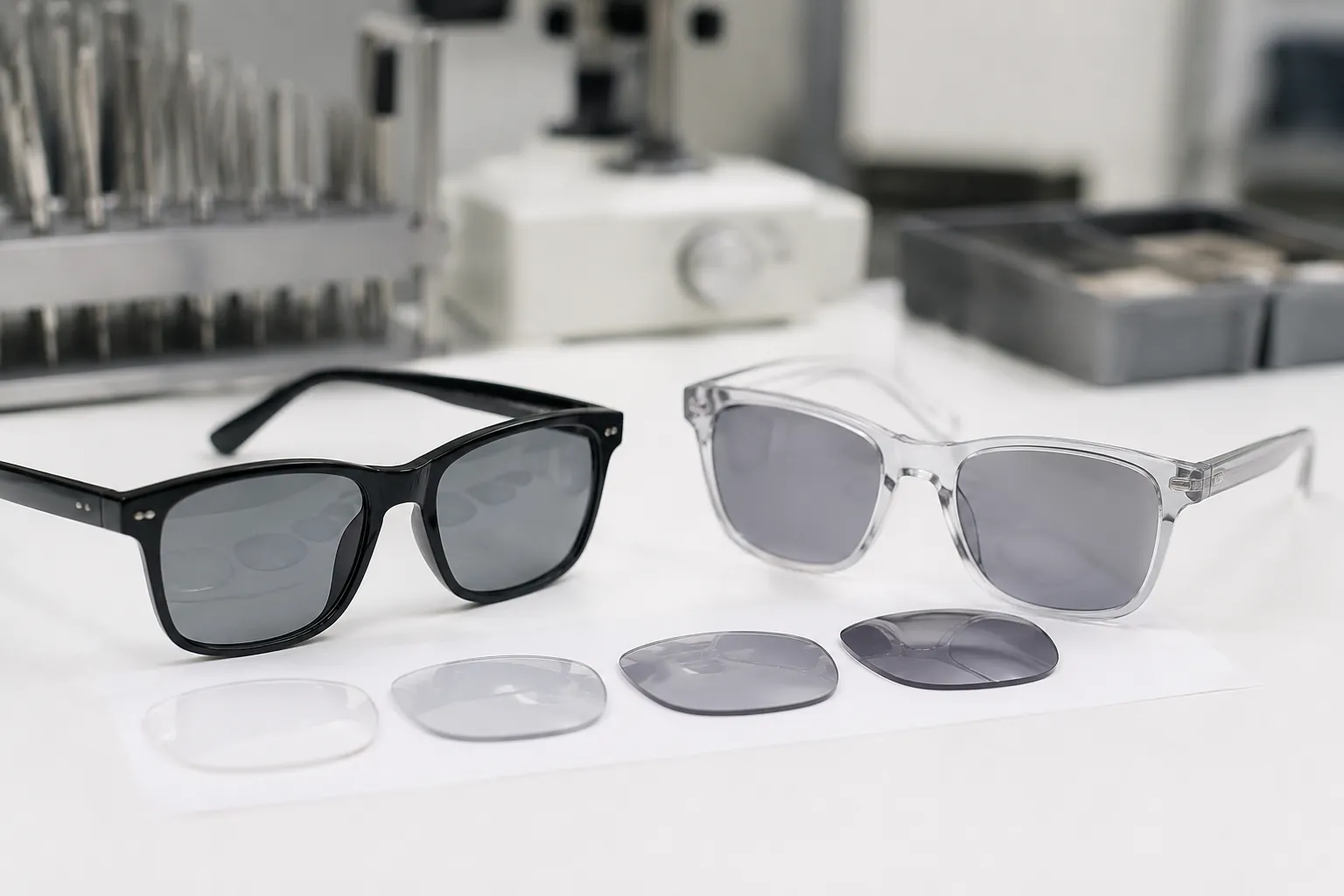
This guide is for brands, importers, distributors, and retail buyers sourcing mirrored sunglasses in volume. It explains how to specify mirror color, base tint, durability, inspection limits, and compliance requirements before production starts. The aim is simple: fewer shade disputes, fewer rejected cartons, and a specification sheet your supplier can actually manufacture and inspect against.
Start With the Lens Stack, Not the Color Name
Most mirror-lens disputes start with vague names: silver mirror, blue mirror, fire mirror, green revo, rainbow mirror. These names help sales teams. They do not control production.
A mirrored sunglass lens is a stack. It may include lens material, base tint, polarizing film, hard coat, mirror coating, and a protective top coat. Change one layer and the final appearance can change. So can light transmission, adhesion, and durability.
For production orders, specify the full lens construction. Do not approve a color name only. Mirror consistency depends on tint batch control, lens curve, coating process, fixture angle, coating thickness, handling, and inspection light. Put these decisions in the purchase order, technical file, or approved sample record.
| Lens decision | What to specify | Why it matters |
|---|---|---|
| Lens material | PC, TAC polarized, nylon, CR-39, or another approved material | Different materials have different impact performance, optical properties, flexibility, and coating adhesion behavior |
| Base tint | Grey, brown, green, smoke, gradient, or custom tint with an approved physical sample | The same mirror coating can look different over different base tints |
| Visible light category | Required filter category or visible light transmission range, confirmed by test where applicable | Category claims must match the destination-market standard and the final lens construction |
| Polarization | Yes or no, with axis direction and performance requirement if relevant | Polarized TAC or other polarized constructions add cost and can affect mirror shade, lens edge appearance, and inspection criteria |
| Coating face | Usually front-side mirror unless a different construction is approved | Back-side reflective effects can increase internal reflections and may affect wearer comfort |
Do not approve a mirror lens from a loose lens sample and assume it will look the same after assembly. Rim pressure, base curve, bevel design, lens thickness, and frame color can all change the reflected color at the edge. For a new mirror color or a new frame curve, approve the lens in the actual frame whenever possible.
Control Color With a Golden Sample and Tolerance
Mirror color is angle-sensitive. A blue mirror viewed straight on may shift toward purple or cyan from the side. Some color travel is normal. A mismatched left and right lens is not.
The most practical control tool is a signed golden sample: one approved finished pair, sealed and labeled with the approval date, style number, lens code, coating code, frame color, and buyer approval reference. For repeat orders, the buyer and factory should each retain a controlled sample.
Approve a new golden sample if the lens supplier, coating process, base tint, frame curve, or frame color changes. Do not rely on memory. Do not rely on phone photos.
For stricter programs, add instrumental color control. Visual approval is common in fashion eyewear, but larger retailers and controlled brand programs may require color readings using a defined instrument, measurement geometry, angle, and tolerance. A Delta E value without measurement conditions is weak. Mirrored surfaces change with viewing angle and illumination.
- Basic retail program: approve by golden sample under a defined light source such as D65 or agreed white inspection light, with no obvious left-right mismatch at normal inspection distance.
- Brand-controlled program: add center-lens color readings and require both lenses in one pair to remain within the agreed tolerance.
- Repeat seasonal program: retain coated lens swatches or finished pairs from each approved production lot for future comparison.
- Mixed-frame program: approve the mirror appearance separately for each frame curve, lens size, and frame color that may affect reflection.
For custom mirror shades, allow time to adjust the base tint and mirror coating together. A lens described as "blue mirror" may still be wrong if it misses the approved hue, reflectivity, or darkness. Physical sample approval is more reliable than filtered photos or informal chat approval.
Put Durability Specs in Writing
Mirror coating is a thin optical and cosmetic layer. It is not scratch-proof. It is not indestructible. The job is to define the abrasion, adhesion, sweat resistance, and handling level required for the product's price point and sales channel.
For low-cost promotional sunglasses, a basic mirror coating may be acceptable if the buyer understands the care limits and packaging risk. For retail eyewear, sport eyewear, beach programs, and private-label repeat orders, ask about hard coat, protective top coat, lens cleaning instructions, and the factory's internal coating tests.
Match the coating specification to the way the product will be sold and used.
| Durability item | Practical requirement | Buyer note |
|---|---|---|
| Adhesion | No peeling, flaking, or coating lift after the agreed tape-pull or internal adhesion method | Important on high-wrap frames and tight rims where the lens may flex during assembly |
| Abrasion resistance | Define the test method, load, cycles, material used, and acceptable visual result | Do not accept "anti-scratch" as a standalone claim without a test method or sample comparison |
| Salt or sweat exposure | No visible spotting, staining, or edge creep after the agreed exposure method and time | Important for beach, resort, fishing, sport, and outdoor programs |
| Cleaning resistance | No visible stain, haze, or color loss after wiping with the approved lens cloth and cleaner | Include care instructions if the coating requires microfiber cleaning and mild cleaner only |
| Assembly resistance | No scratches, pressure marks, coating lift, or edge damage after lens insertion | Inspect finished frames, not only loose lenses, because assembly can create defects |
Ask for realistic testing, not broad promises. A promotional sunglass and a premium sport sunglass may need different coating constructions. Both can be controlled if the acceptance criteria are written. Before placing the order, request the supplier's proposed test method, reference sample, and pass/fail standard for the exact lens construction being purchased.
Set Defect Limits Before QC Starts
Mirror-coating defects are easy to argue about. Many appear only at certain angles or under strong light. Set the rules before bulk production starts. Put them in the purchase order, inspection checklist, or quality agreement.
Do not wait until cartons are packed to decide whether a spot, scratch, or shade shift is acceptable.
Use a defined inspection distance, lighting condition, and lens zone. A practical factory method is to inspect finished frames at an agreed distance, under strong white light, while rotating the frame to reveal reflective defects. The central vision zone should be stricter than the peripheral zone because the wearer looks through the center of the lens. The outer rim area may allow smaller cosmetic marks if they are not visible when worn and do not suggest coating failure.
- Critical defects: wrong lens category, wrong lens type, wrong mirror color against approved sample, coating peeling, cracked lens, blocked vision, unsafe sharp edge, or any failure that may affect safety or compliance.
- Major defects: visible mirror spots in the central zone, obvious left-right shade mismatch, scratch visible at the agreed inspection distance, oil stain under coating, blister, cloudy patch, coating lift, or unacceptable edge creep.
- Minor defects: very small peripheral speck outside the main vision area, tiny handling mark not visible when worn, or slight edge color shift on a high-wrap frame if allowed by the buyer's written standard.
Set size and location limits. For example: no visible spots in the central vision zone; no continuous edge peeling; no scratch visible at the agreed inspection distance under agreed lighting; and no more than the agreed number of tiny peripheral specks below the agreed diameter.
The limits can be strict or moderate. They must be measurable enough for inspectors to apply consistently.
For larger orders, use AQL inspection with mirror-specific checkpoints added to normal frame checks such as hinge function, frame alignment, lens fit, decoration, packing, and barcode labels. The supplier's QC team can only enforce the approved standard. If the order says only "black frame, blue mirror," inspection becomes subjective.
Compliance: Test the Final Lens Construction
A mirror lens can look dark and still fail visible light transmission, filter category, traffic signal recognition, or labeling requirements. Compliance depends on the complete lens system, not the mirror coating alone. Base tint, coating, polarization, lens material, and final thickness can all affect test results.
For the EU, sunglasses are commonly assessed against CE requirements using EN ISO 12312-1. For the United States, ANSI Z80.3 is commonly used for non-prescription sunglasses, and FDA registration may be relevant for eyewear suppliers and import compliance. For Australia and New Zealand, AS/NZS 1067 applies. REACH is relevant for restricted substances in materials, coatings, and surface finishes sold into the EU. Supplier management and factory audit references may include ISO 9001 and BSCI where the supplier holds valid documentation.
Do not write "UV400" as the only lens requirement. Specify UVA and UVB protection, visible light transmission or filter category, claimed standard, and destination market. If the lens is polarized, specify polarization efficiency and axis where relevant. If the mirror coating, base tint, or lens supplier changes after sample approval, retest or reconfirm the final lens construction before shipment.
Buyer rule: approve mirror color only after confirming that the final lens construction still meets the required standard and claim for the sales market. A good-looking mirror lens that fails the required optical or labeling criteria is not an acceptable shipment.
Children's sunglasses, novelty shapes, very light fashion tints, and unusual lens colors need extra attention. They can create compliance or labeling risk if the lens does not meet the claimed category or use condition. Keep reports tied to the exact lens code, frame style, production batch, and standard version wherever possible.
Cost and Lead Time: What Mirror Coating Changes
Mirror coating can affect cost in three areas: the coating process, yield loss, and inspection time. Reflective surfaces make dust, fingerprints, edge chips, coating stains, and shade variation easier to see than on a plain smoke lens. Tighter color targets usually mean more sampling and process control.
Lead time depends on whether the buyer chooses an existing mirror color or a custom target. Standard lens bases and common mirror colors are usually faster to sample than custom mirror shades, polarized mirror lenses, special gradients, or lenses requiring a new test report.
Packaging artwork, barcode labels, retailer carton rules, and third-party inspection can also add time. Plan for them.
| Order type | Typical risk | Planning advice |
|---|---|---|
| Small custom run | Higher unit cost and limited room for multiple coating trials | Use existing mirror colors, standard lens bases, and a clear golden sample |
| Repeat private-label style | Risk of shade drift between seasons or batches | Retain approved samples and confirm whether any lens, tint, or coating process changed |
| Retail program with strict QC | More rejects if the defect standard is not aligned before production | Add mirror-specific checkpoints to the inspection plan and define lens zones |
| Large-volume program | Greater financial impact if the specification is vague | Lock lens code, coating code, defect limits, packaging rules, and compliance tests before bulk production |
Ask the supplier to quote mirror lenses with the exact frame, lens material, base tint, polarization requirement, coating standard, packaging, and inspection requirement. A low unit price based on a generic mirror lens may not include the durability, shade tolerance, compliance testing, or packaging control that a retailer expects.
Factory Checklist Before Production Approval
Before bulk production starts, ask for a production file that a line leader, lens technician, inspector, and packing team can follow without guessing. Many sourcing problems start when a buyer approves a photo informally and the factory later has no controlled reference for color, coating, defect limits, or packaging.
- Frame model, material, color code, size, and approved frame finish.
- Lens material, base tint, mirror color, lens code, visible light category or transmission target, and polarization requirement.
- Approved golden sample reference number, approval date, and signed sample status.
- Compliance target: CE EN ISO 12312-1, ANSI Z80.3, AS/NZS 1067, REACH, FDA registration relevance, or other applicable requirement for the real sales market.
- Decoration details: laser engraving, pad printing, metal logo plate, temple logo position, logo color, and artwork version.
- Inspection method: lighting, distance, lens zones, critical, major, and minor defect definitions.
- Packing method: pouch, case, polybag, lens protection film, carton quantity, warning labels, retailer labels, and barcode requirements.
- Retained samples: pre-production sample, first-off production sample, and final shipment sample where required.
If the supplier has in-house processes such as injection molding, acetate cutting, CNC milling, lens tinting, decoration, assembly, or QC, that can reduce handoff risk. It does not replace a written specification. The approved production file is the anchor for manufacturing and inspection.
One practical rule: do not approve mass production from filtered photos. Request short videos under fixed light, finished pairs assembled in the actual frame, and at least one physical sample for any new mirror color or new lens construction. The cost and time of sample approval are usually lower than sorting or replacing a shipment with the wrong mirror appearance.
Have a custom sunglasses project in mind?
Send us your styles, target market and quantities and we will return a detailed quote with MOQ, lead time and a sample plan.
Get a QuoteWhy source this from Wenzhou with LumiShades
Wenzhou in Zhejiang Province is widely regarded as China’s eyewear manufacturing capital, producing a large share of the world’s sunglasses. That concentration matters to buyers: a deep local supply chain for acetate sheet, hinges, lens blanks, plating and packaging means shorter component lead times, easier color and material matching, and a workforce with decades of eyewear-specific skill. LumiShades has manufactured in this ecosystem since 2009, and our vertical integration — in-house injection molding, acetate cutting, CNC milling, lens tinting, decoration and quality control — means no part of your order is quietly subcontracted to a workshop you cannot audit.
For international buyers, that vertical control translates into accountability. When a single factory owns every step, defects are traced and fixed at source rather than bounced between vendors, and your specifications survive intact from first sample to bulk. We back this with 15+ years of experience, shipments to 60+ countries, more than 5 million pairs produced per year and a 98.5% on-time delivery rate. Our certifications — CE EN ISO 12312-1, FDA registration, ANSI Z80.3, AS/NZS 1067, REACH, ISO 9001 and BSCI audit — mean the compliance documentation your market requires already exists. Explore our manufacturing capabilities and quality control process to see how this works in practice.
Frequently asked questions
Can I use the same mirror lens color on different frame shapes? Yes, but approve it in each important frame shape before bulk production. Lens curve, frame pressure, bevel design, lens size, and frame color can change how the mirror reflects light. High-wrap frames, oversized lenses, rimless designs, and very light frame colors are higher risk. Ask for finished-pair samples, not only loose lenses, and keep a golden sample for each approved frame and lens combination.
What is the safest mirror color for repeat production? Standard silver, smoke silver, and common blue mirror colors are usually easier to repeat than multi-color fire, rainbow, purple-green shift, or highly customized shades. For repeat programs, choose a standard lens base and mirror formula where possible, label the approved lens and coating codes, and keep retained samples from each lot. If the buyer needs a special mirror color, agree on the viewing light, viewing angle, and tolerance before production.
Should mirrored sunglasses always use polarized lenses? No. Polarization reduces glare from horizontal reflective surfaces, so it is useful for fishing, boating, driving, beach, snow, and outdoor sport programs. It also adds cost and can affect lens appearance, edge look, and inspection criteria. Fashion programs may use non-polarized mirror lenses if they still meet the required UV, visible light transmission, labeling, and destination-market standards. If polarization is claimed, test the final lens construction for polarization efficiency and axis.
How should I handle mirror coating scratches found during inspection? Classify scratches by location, visibility, and severity. A scratch in the central vision zone that is visible at the agreed inspection distance should normally be treated as a major defect. Peeling, coating lift, or scratches that affect vision should be critical or major depending on the inspection standard. Tiny peripheral marks may be minor only if the buyer's written standard allows them. The inspection plan should define lighting, distance, lens zones, and acceptable size limits before QC starts.
Do mirror coatings affect CE or ANSI compliance? Yes. Mirror coatings can change visible light transmission, filter category, and in some cases other optical performance results. Test or verify the final lens construction, including base tint, mirror coating, lens material, and polarization if used. For EU programs, confirm CE requirements using EN ISO 12312-1. For U.S. non-prescription sunglasses, ANSI Z80.3 is commonly used and FDA registration may be relevant. For Australia and New Zealand, check AS/NZS 1067. Keep test reports linked to the exact lens code and frame style.
Ready to start?
Explore our wayfarer sunglasses or request a quote — our sales team replies within 12 hours.
Request a Quote