
Sunglass Lens Specs: Thickness, Weight & Comfort
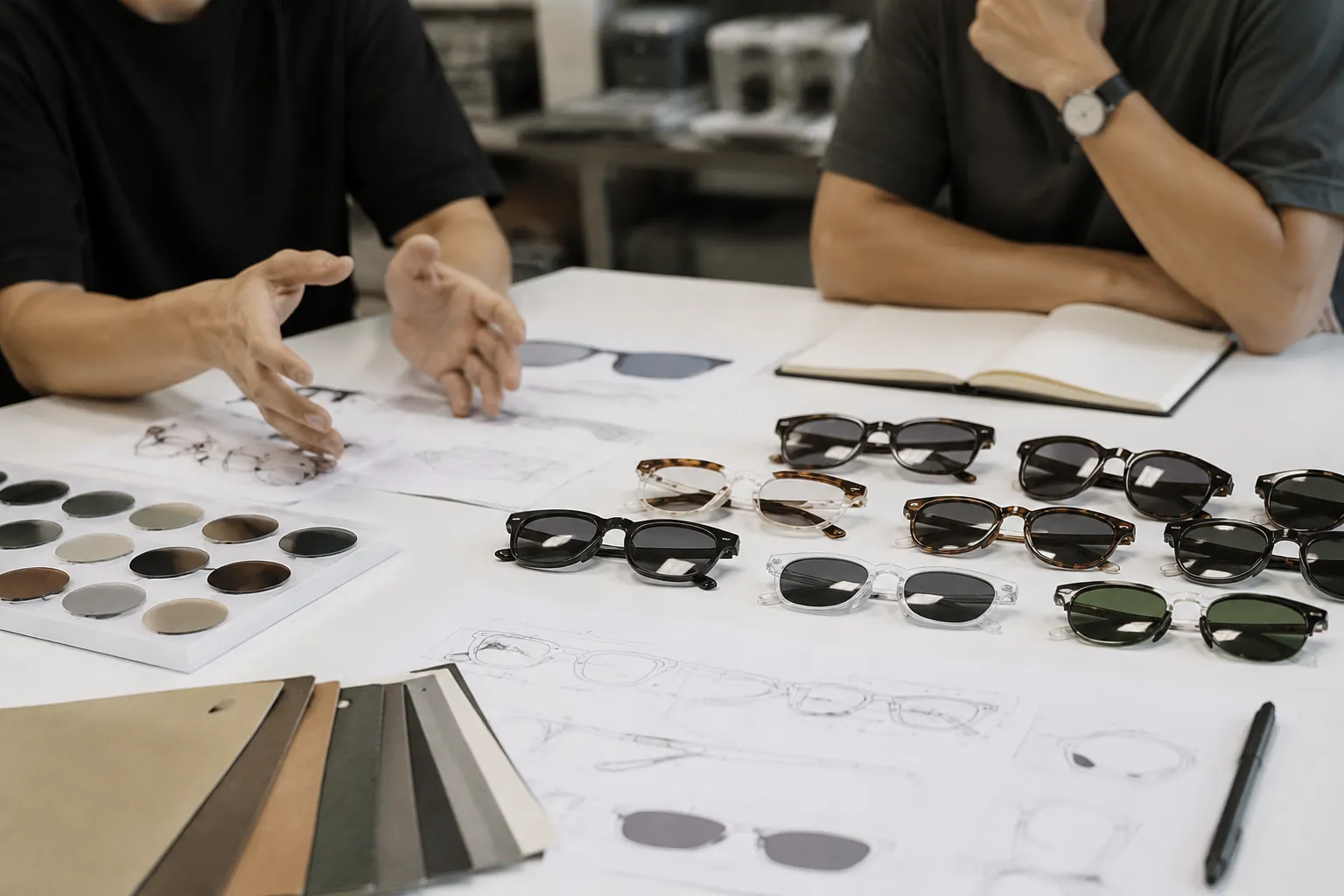
In custom sunglasses, lens build is not a cosmetic detail. Material, thickness, base curve, and edge finish affect weight, balance, fit, and production consistency. If those points are vague, problems show up later: front-heavy wear, poor lens seating, visible asymmetry, or QC rework. A clear lens spec keeps sourcing, sampling, compliance review, and bulk production aligned.
Why lens build changes the buyer outcome
Many buyers start with frame material, color, finish, or logo placement. Those matter. But lens construction has a direct effect on how the finished pair feels and how reliably it can be produced.
Two sunglasses can look almost identical in a photo and wear very differently. The lens changes front weight, seating depth, curvature, and visual finish. Small shifts in thickness or curve can change how the lens sits in the groove and how the frame balances on the face.
For commercial programs, lens build affects three buyer outcomes:
- Perceived quality: Clean edge finishing, even tint, and consistent curvature make the product look properly made.
- Wearability: Lens mass and geometry affect balance, nose pressure, slip, and overall comfort.
- Returns and complaints: Poor seating, asymmetry, excess front weight, or visible distortion can trigger after-sales issues.
Problems usually appear when the lens is reviewed separately from the frame. A style can look acceptable on the table and still feel unstable in wear if lens thickness, bridge fit, and temple tension were never checked together. Treat lens spec as a structural requirement. Not a finish choice.
The three specs buyers should ask for
Do not approve sunglasses on appearance alone. Ask for these three lens details on every style sheet and include them in the approved sample record.
- Lens material — commonly polycarbonate (PC), TAC, or glass. Material affects weight, impact behavior, and the practical thickness range.
- Center thickness and edge thickness — these affect lens mass, edge appearance, and groove fit.
- Base curve / lens curvature — this affects wrap, lens seating, and edge visual performance.
For most fashion sunglasses, PC and TAC are the main options. PC is widely used where impact resistance and broad commercial usability matter. TAC is common in polarized fashion sunglasses because it is lightweight and widely available. Glass is heavier and more fragile in handling, so it is usually limited to selected premium or heritage-style builds.
Avoid vague instructions such as "lightweight" or "premium feel." Those are design goals, not production specs. A factory can control material, thickness, curvature, and tolerance. It cannot manufacture to subjective wording.
A workable spec line should state measurable targets: center thickness, edge thickness, base curve, and finished pair weight if weight control matters to the program. Confirm the final values against frame size, lens shape, and material.
Material comparison: what changes weight, clarity, and cost
| Lens material | Weight | Impact / wear behavior | Typical buyer use | Commercial note |
|---|---|---|---|---|
| PC (polycarbonate) | Light | High impact resistance; widely used in commercial sunglasses programs | Mass market, active styles, programs where impact performance matters | Often used in styles intended to meet standards such as CE EN ISO 12312-1, ANSI Z80.3, or AS/NZS 1067 when the complete product is designed and tested accordingly |
| TAC | Light | Common in polarized lenses; comfort-focused but construction quality matters | Polarized fashion sunglasses, lightweight retail assortments | Buyers should verify edge quality, lamination quality, and fit in the frame groove |
| Glass | Heavy | Good scratch resistance and optical clarity; less suitable where impact handling is a concern | Selected premium or heritage-style sunglasses | Usually not the first choice where low weight, break resistance, or mail-order durability is important |
| Acetate frame with separate tinted lenses | Depends on lens spec | Wear behavior depends on the actual lens material, cut quality, and seating | Fashion acetate frames | Evaluate frame weight and lens weight together, because a heavy front can be missed until wear testing |
Material alone does not set cost. Polarization, mirror coating, tint matching, custom shapes, anti-scratch coatings, and packaging also affect price and process complexity. Standard colors and existing tooling are usually easier to quote and approve than custom tint development or special curvature.
Lead time follows the same pattern. Standard lens colors and proven frame-lens combinations usually move faster than custom tint matching, special curvature, or multi-step decoration. If the lens spec changes during sampling, timelines usually slip because fit, appearance, and compliance assumptions may need review again.
Thickness targets by style, not by guesswork
There is no single correct lens thickness for all sunglasses. The right target depends on frame construction, lens size, curvature, material, and intended use.
Use style logic and define a measurable target:
- Flat or low-wrap fashion frames: usually suit a visually slim lens, provided it still seats securely and meets the product's performance needs.
- Medium-wrap lifestyle frames: often need closer control of both center and edge build, especially on larger eye sizes.
- High-wrap sports-inspired styles: need tighter control of curvature, edge shaping, and optical quality across the lens surface.
Do not focus on center thickness alone. Edge thickness often determines how heavy the lens looks from the front and whether it seats cleanly in the rim groove. On curved lenses, edge build can increase fast and affect both appearance and fit.
Ask the supplier to state both target dimensions and allowable tolerances. The tolerance should match the style and manufacturing method. Also require left-right symmetry review and a lens seating check against the approved sample. A lens can pass a dimensional check and still sit proud or uneven in the frame.
Before bulk approval, review a production-intent sample, not just an early development mockup. That is the stage to check balance, groove fit, edge appearance, and tint consistency together.
Weight, balance, and the nose-pressure problem
Comfort complaints describe the result, not the cause. The wearer says the frame feels heavy, slides on the nose, or pinches at the temples. Often the real issue is balance: lens weight, bridge geometry, frame front design, and temple tension all working together.
That is why buyers should evaluate total pair weight, not lens weight alone. A lens that seems acceptable by itself can still make the finished frame feel front-heavy once installed.
Practical checks during sampling:
- Wear the pair for at least 10 minutes rather than doing only a quick try-on.
- Check whether the frame slides when the wearer looks down or moves quickly.
- Press lightly at the temples to see whether the front tips or lifts unexpectedly.
- Compare left and right lens seating for equal depth and no visible twist.
- Check nose contact after a few minutes of wear, because some comfort issues appear only once the frame warms on the face.
If weight control matters, include a finished pair weight target in the approved sample record and confirm whether the supplier will check it during final QC. Review weight after all finishing steps are complete, because decoration, metal trim, hinge choices, and packaging configuration can affect the final result or the perceived balance in hand.
How lens build affects compliance and testing
Lens thickness is not only a comfort issue. It can also affect whether a style performs as intended in testing and inspection. A lens that is too thin, poorly seated, or mismatched to the frame can cause failure even if the raw lens material is acceptable.
For B2B buyers, relevant references may include CE EN ISO 12312-1, ANSI Z80.3, AS/NZS 1067, REACH, FDA registration, ISO 9001, and BSCI. These are not interchangeable. Product standards such as EN ISO 12312-1, ANSI Z80.3, and AS/NZS 1067 relate to sunglasses performance requirements in their target markets. REACH covers chemical compliance. FDA registration may matter to the company and market pathway in the US, but it is not a substitute for product performance testing. ISO 9001 and BSCI relate to management systems and social compliance, not proof that a sunglass style meets a lens performance standard.
Do not ask whether a lens by itself is "certified" unless the request matches a real test scope. Ask what the complete style has been designed and tested to meet, and request documentation that matches the target market and product configuration.
Tint alone does not make a style compliant. The full assembly matters: lens material, thickness, optical category, frame construction, seating, markings, and final build.
For regulated or retail programs, keep the approval pack consistent:
- Lens material
- Thickness target and tolerance
- Color / tint standard
- Base curve
- Lens shape reference and groove fit
- Marking and logo location
- Required compliance market: EU, US, Australia, or multiple
If lens cutting, frame making, tinting, decoration, and QC are managed in one coordinated process, final fit is usually easier to control. If those steps are split across multiple suppliers, mismatch risk goes up and approvals need tighter documentation.
Decoration methods and where weight creeps in
Decoration changes more than branding. It can alter the finished pair after the initial fit sample has already been approved.
Common decoration methods include laser engraving, pad printing, hot stamping, foil transfer, applied metal badges, and mirror coating on lenses. These processes differ in appearance, durability, and production risk. Laser engraving usually adds little mass. Applied metal parts can shift weight distribution. Lens coatings and decorative layers can make the process more sensitive and raise rejection risk if surface preparation or handling is inconsistent.
For lens decoration, ask when the decoration is applied, how it is protected during assembly, and what visual standard is used for inspection. For polarized lenses, it is also reasonable to ask about the construction method and edge quality expectations, because those affect appearance and consistency.
A simple rule: approve decoration only after fit is stable. If branding, badges, or coatings are added later, recheck balance, surface appearance, and lens seating on the updated pre-production sample. Do not assume the first sample still represents the final product.
To reduce disputes, ask the supplier to define the final visual inspection condition in advance, including viewing distance, lighting condition, and which defects are acceptable or rejectable.
What to lock in before you place a bulk order
If you are sourcing at commercial volume, send a proper specification sheet that includes lens data. A short marketing description is not enough to control quality or support a clear quotation.
- Define the target market and required compliance path.
- Choose lens material based on use case, not price alone.
- Set center thickness, edge target, and allowable tolerance.
- Confirm base curve and wrap relationship with the frame.
- Request a production-intent sample and wear test it.
- Approve the pre-production sample only after checking tint, fit, and finished weight if weight is part of the target.
- Lock packaging, marking, and decoration so the approved build can be repeated in bulk.
Lead times should follow this approval process. Sampling and bulk timing vary by factory capacity, material availability, decoration method, and how stable the specification remains. Many delays come from unresolved approvals, not from manufacturing itself.
The best buying practice is simple: approve one master sample, freeze the lens specification in writing, and require final QC records that show the shipped product matches the approved build. That protects comfort, consistency, and claim handling later.
Have a custom sunglasses project in mind?
Send us your styles, target market and quantities and we will return a detailed quote with MOQ, lead time and a sample plan.
Get a QuoteWhy source this from Wenzhou with LumiShades
Wenzhou in Zhejiang Province is widely regarded as China’s eyewear manufacturing capital, producing a large share of the world’s sunglasses. That concentration matters to buyers: a deep local supply chain for acetate sheet, hinges, lens blanks, plating and packaging means shorter component lead times, easier color and material matching, and a workforce with decades of eyewear-specific skill. LumiShades has manufactured in this ecosystem since 2009, and our vertical integration — in-house injection molding, acetate cutting, CNC milling, lens tinting, decoration and quality control — means no part of your order is quietly subcontracted to a workshop you cannot audit.
For international buyers, that vertical control translates into accountability. When a single factory owns every step, defects are traced and fixed at source rather than bounced between vendors, and your specifications survive intact from first sample to bulk. We back this with 15+ years of experience, shipments to 60+ countries, more than 5 million pairs produced per year and a 98.5% on-time delivery rate. Our certifications — CE EN ISO 12312-1, FDA registration, ANSI Z80.3, AS/NZS 1067, REACH, ISO 9001 and BSCI audit — mean the compliance documentation your market requires already exists. Explore our manufacturing capabilities and quality control process to see how this works in practice.
Frequently asked questions
What lens material should I choose for lightweight fashion sunglasses? Start with the use case. Choose <strong>TAC</strong> if the program is fashion-led, lightweight, and commonly sold with polarized lenses. Choose <strong>PC</strong> if you need broader impact resistance, stronger general durability, or expect the style to go through stricter product review. Ask the supplier to confirm the exact lens construction, not just the material name, and review the finished sample in the actual frame before approval.
Should I specify lens thickness in my PO? Yes. The PO and the approved sample record should state at minimum: <strong>lens material, center thickness target, edge thickness target, base curve, and tolerance</strong>. Also reference the approved sample or drawing revision. If the supplier controls by internal work order rather than PO text alone, make sure the same values appear on the signed spec sheet so there is no ambiguity during production or QC.
How does lens thickness affect returns? If the lens is too thick for the style, the pair may feel front-heavy, look bulky, or create poor balance on the nose. If it is too thin, the lens may seat poorly, look unstable at the edge, or feel lower in perceived quality. Returns usually come from the visible or wearable result, so buyers should review thickness together with groove fit, edge appearance, and total pair balance, not as an isolated number.
Do decorations change comfort? They can. Metal badges, extra trim, hinge upgrades, and some lens coatings can change weight distribution or affect how the finished product feels in hand and on face. Recheck the <strong>final decorated pre-production sample</strong> for weight, balance, and visual quality before bulk release. Do not rely only on an undecorated fit sample.
How should I test comfort before bulk order? Use a repeatable check. Wear the sample for at least 10 minutes, test whether it slides when looking down, compare left-right lens seating, inspect bridge contact and temple pressure, and weigh the finished pair if weight is a control point for the program. Then compare the pre-production sample back to the approved master sample to confirm the build has not changed before bulk production starts.
Ready to start?
Explore our square sunglasses or request a quote — our sales team replies within 12 hours.
Request a Quote