
Pad Printing vs Laser Engraving vs Metal Logo Plates
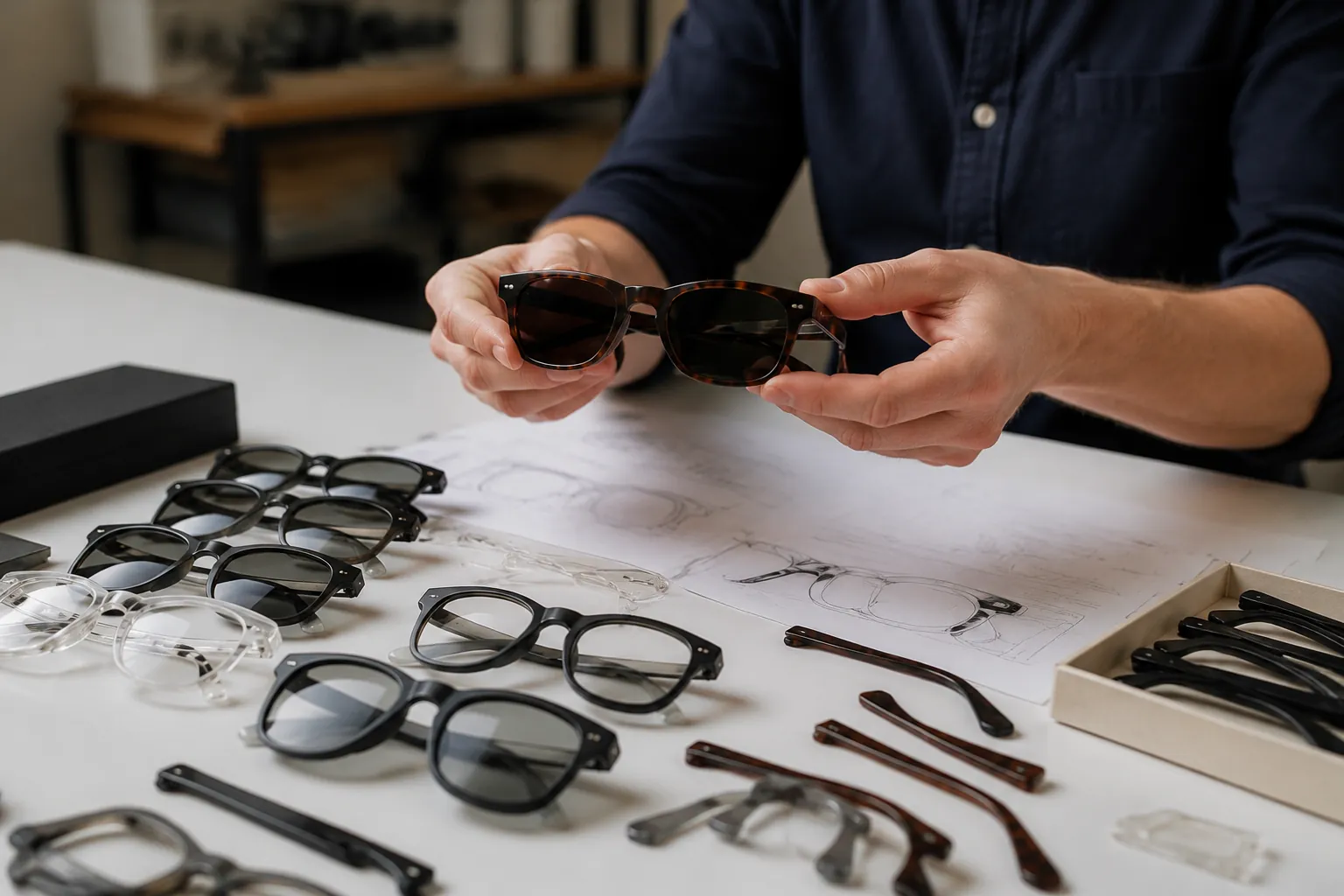
This guide is for brand owners, importers, distributors, and retailers sourcing custom sunglasses in volume and deciding how logo decoration affects both product perception and production risk. On eyewear, decoration is not just a styling choice. It affects sampling, tooling, assembly complexity, quality control, and complaint exposure after shipment. A logo treatment that looks strong on a sample can fail in bulk if print adhesion is weak, plate alignment drifts, or engraving contrast changes by material and finish. The comparison below stays practical. It focuses on what buyers can check during quotation, sampling, and purchase-order review when comparing pad printing, laser engraving, and metal logo plates for sunglasses.
Start with price position and risk tolerance
Many buyers start by asking which logo method looks most premium. Start somewhere else. Ask what price position the sunglasses need to support and how much added process risk the program can absorb.
Decoration is rarely the biggest cost driver in a sunglasses project. Frame material, lens spec, hinge construction, packaging, and freight usually matter more. But decoration is highly visible, so it has an outsized effect on perceived value. A clean, well-placed logo supports the product. A blurred, crooked, or poorly attached logo hurts it fast.
Order profile matters too. Small trial orders usually favor lower setup burden and faster revision cycles. Repeat programs with stable artwork and predictable volume can justify methods that need more setup or tighter control.
- If the priority is low setup complexity and broad material compatibility, start with pad printing.
- If the brand wants a subtle logo with no surface ink layer, evaluate laser engraving on the final production material.
- If the line needs a visible and tactile premium cue, evaluate metal logo plates only after confirming temple geometry and assembly control.
- If the order is small, do not assume a more complex logo treatment will automatically create better value.
In practice, serious buyers should compare at least two decoration options during quotation and sampling. Looks matter, but consistency matters more. The right choice is the one that holds up on the real material, real finish, and real production volume.
Head-to-head: value, durability, MOQ fit, and process logic
These three methods do different jobs on the frame. Pad printing adds ink to the surface. Laser engraving changes the surface by removing or altering material. Metal logo plates add a separate part that must be positioned and fixed to the temple. Different process logic means different control points and different failure risks.
| Method | Perceived value | Typical MOQ fit | Lead-time effect | Typical tolerance concern | Main failure risk |
|---|---|---|---|---|---|
| Pad printing | Entry to mid-premium; can look clean with disciplined artwork and process control | Often suitable for low to mid-volume orders | Usually limited, but depends on artwork approval and curing | Logo placement consistency on curved or glossy surfaces | Wear, edge blur, weak adhesion, off-position print |
| Laser engraving | Subtle, technical, and premium when the substrate gives clear contrast | Often more suitable once artwork and material are stable | May require added setup for fixtures and parameter testing | Contrast repeatability and jig positioning | Low contrast, haze, burn marks, inconsistent appearance |
| Metal logo plates | Often the strongest premium signal when alignment and finish are well controlled | Usually better suited to programs that can absorb added component and assembly control | Often the longest because both the plate and receiving area must be validated | Alignment, flushness, edge feel, and attachment consistency | Loose plates, crooked placement, visible adhesive, scratches |
Commercially, pad printing usually creates the lightest front-end burden. Artwork can be revised fairly quickly, and the process is common across eyewear categories. Laser engraving depends much more on the exact material, color, and finish because contrast and surface response vary. Metal plates add a second part and an attachment step. That means more variables to control.
For buyers moving upmarket, metal plates can create the strongest first impression. But only if temple design, plate finish, and assembly quality stay under control. Engraving fits brands that want quieter branding and better resistance to rub-off than surface printing. Pad printing still has a place on better-positioned products if the artwork is scaled well and the finish is clean.
What happens on the factory floor
Decoration problems usually come from process control, not design intent. Buyers get better results when they review the production sequence instead of approving only a showroom sample.
- Pad printing: the part is cleaned, artwork is prepared on a printing plate, ink is mixed to the approved standard, and a silicone pad transfers the image to the frame. The printed part is then dried or cured before handling. Small text, very fine strokes, and highly curved surfaces raise the risk of fill-in, blur, or uneven transfer. Adhesion also depends on the substrate and surface condition.
- Laser engraving: artwork is converted to a machine path, parts are positioned in a fixture, and the operator adjusts settings such as power, speed, and frequency to suit the material. The target is usually a consistent visible mark, not maximum depth. On some plastics and coated metals, too much heat can create whitening, haze, edge roughness, or coating damage. Fixture repeatability matters. Even a small shift can show up clearly on a short temple logo.
- Metal logo plates: the logo component is produced separately, then finished by polishing, brushing, plating, painting, filling, or a combination of these. The temple must have an appropriate flat area, pocket, slot, or attachment feature. The plate is then fixed by adhesive, mechanical retention, embedding, or a combined method, followed by checks for alignment, flushness, edge condition, and attachment security.
The key issue is integration. Decoration quality depends on how well the substrate, fixture, logo component, and inspection standard are controlled together. If those variables sit with different suppliers and there is no clear final standard, risk goes up.
Material behavior changes the result
The same logo method can perform very differently depending on substrate, surface finish, color, and coating. Buyers should approve decoration on the final production material and final colorway, not on a substitute sample.
Acetate: often supports premium decoration because it machines cleanly and can take understated engraving or carefully fitted metal plates. Laser engraving can look refined on darker or lower-gloss acetates, but too much heat may cause whitening or rough edges. Metal plates can work well if the temple section provides enough material for stable attachment.
Injected plastic: commonly uses pad printing because it is cost-effective and broadly applicable. Results depend on resin type, surface energy, mold-release residue, texture, and gloss level. Laser marking may work on some plastics, but contrast is not equally reliable across all materials and colors. Metal plates are possible only if the temple design supports them without weakening the part.
Metal temples: often suit laser engraving for small logos or subtle side branding. Pad printing on coated metal can also work, but the wear environment matters. Adding a second metal part to a metal temple can look strong, but it is not always the lowest-risk option if the goal is simply clear branding.
Color and finish matter just as much. Darker materials often make subtle engraving easier to read, while very light, transparent, or highly reflective surfaces can reduce consistency. High-contrast pad printing can look sharp, but edge quality becomes more obvious. With metal plates, polished finishes grab attention quickly, while brushed or satin finishes usually look more controlled and may hide handling marks better.
Cost, MOQ, and lead-time points to compare
Decoration should be quoted as part of the full program, not treated as a minor per-piece add-on. Buyers should account for artwork preparation, fixtures, sampling rounds, added inspection time, and likely reject points.
As a sourcing rule, pad printing is usually the easiest method to trial because it is widely available and simpler to revise. Laser engraving becomes easier to assess once the artwork, material, and finish are fixed. Metal logo plates make the most sense when the style has a stable forecast and the buyer is ready to validate both the plate and the receiving area on the frame.
Lead time depends on the supply chain structure and the amount of sampling required. A pad print sample may move quickly once artwork and ink standard are approved. Laser usually needs material-specific testing and fixture confirmation. Metal plates often need the most front-end validation because the brand is approving a separate component, its finish, and its attachment to the frame.
- Low-volume or launch orders: prioritize methods with lower setup complexity and easier revision cycles.
- Repeat programs: compare whether engraving or metal plates improve long-term consistency or reduce complaint risk.
- Complex logos: confirm whether fine lines, small text, or multi-finish details are realistic for the chosen process.
- Reorders: ask whether approved fixtures, artwork settings, and component sources will be locked for repeat production.
A practical approach is to quote two branding paths side by side. For example, a buyer might launch with pad printing, then review engraving or metal plates for a reorder after demand, margin, and acceptable defect levels are clearer.
Failure modes that show up after shipment
Most decoration complaints are predictable. The problem is usually not awareness. It is missing control points in the tech pack, sample approval, and purchase order.
Pad printing failure modes: rubbing off in frequent contact areas, weak adhesion after exposure to sweat, sunscreen, or cleaning agents, fuzzy edges on small text, and inconsistent opacity on dark substrates. Buyers should define minimum stroke width, approved logo location, curing method if disclosed by the supplier, and an agreed adhesion or abrasion check.
Laser engraving failure modes: low visibility, overheating marks, haze on some plastics, and left-right inconsistency caused by poor fixture repeatability. Buyers should approve the mark on the final production substrate and request first-off review from both sides of the frame, not one side only.
Metal plate failure modes: crooked placement, visible adhesive, sharp edges, scratches after assembly, and lifting under handling or temperature exposure. Buyers should define the attachment method, visual alignment standard, acceptable edge feel, and whether the plate must sit fully flush or only look flush.
On premium programs, QC should go beyond a single visual check. Inspect centering, left-right symmetry, finger feel on plate edges, scratch condition after packing, and whether the logo still looks acceptable after repeated opening and closing of the temples. A logo can pass assembly and still be damaged during packing and transport if protection is weak.
Compliance and documentation for decorated frames
Decoration does not replace compliance. Sometimes it adds more material-control questions. The finished sunglasses still need to meet the destination market requirements that apply to the product category and target market. Depending on the market and product, buyers may need CE EN ISO 12312-1 documentation for Europe, ANSI Z80.3 as a US market reference, AS/NZS 1067 for Australia and New Zealand, REACH declarations for restricted substances, and FDA registration or related entry documentation where applicable. ISO 9001 and BSCI are supplier-management credentials, not substitutes for product-performance compliance.
For decorated parts, buyers should ask specifically about inputs that are often missed: printing inks, adhesion promoters, clear coats, adhesives, metal plating chemicals, and paint fills used in logo plates. A compliant lens or frame material does not automatically confirm that every decorative input has been documented to the same level.
Request a document pack tied to the final approved specification, not a generic certificate set. If the supplier changes coating, ink, adhesive, plating finish, or plate source after sample approval, ask whether any supporting declarations need to be refreshed before shipment.
A practical decision framework
If the goal is to raise perceived brand value without adding avoidable production risk, make decoration decisions in order. Do not choose by appearance alone.
- Set the product position. Decide whether the line is promotional, mid-market, or premium, and confirm that the expected retail and wholesale economics support the decoration method.
- Match the method to the substrate. Do not assume the same logo treatment will work equally well across acetate, injected plastic, coated metal, and different colorways.
- Check order profile. Review launch volume, reorder probability, and whether the program can absorb extra sampling, separate components, or more intensive QC.
- Approve the exact decoration stack. Sample the final frame material, final finish, final logo size, and final plate finish or attachment method where relevant.
- Write measurable QC points into the PO. Include logo position reference, appearance standard, left-right consistency, edge quality, and the agreed adhesion, abrasion, or attachment checks.
If you need one simple rule, use this: choose metal logo plates when the product truly benefits from a visible premium component and the construction can support it, choose laser engraving when the brand wants subtle and more wear-resistant marking, and choose pad printing when flexibility, lower setup complexity, and cost control matter most. Then verify that choice with material-specific samples and written QC standards before bulk production.
Have a custom sunglasses project in mind?
Send us your styles, target market and quantities and we will return a detailed quote with MOQ, lead time and a sample plan.
Get a QuoteWhy source this from Wenzhou with LumiShades
Wenzhou in Zhejiang Province is widely regarded as China’s eyewear manufacturing capital, producing a large share of the world’s sunglasses. That concentration matters to buyers: a deep local supply chain for acetate sheet, hinges, lens blanks, plating and packaging means shorter component lead times, easier color and material matching, and a workforce with decades of eyewear-specific skill. LumiShades has manufactured in this ecosystem since 2009, and our vertical integration — in-house injection molding, acetate cutting, CNC milling, lens tinting, decoration and quality control — means no part of your order is quietly subcontracted to a workshop you cannot audit.
For international buyers, that vertical control translates into accountability. When a single factory owns every step, defects are traced and fixed at source rather than bounced between vendors, and your specifications survive intact from first sample to bulk. We back this with 15+ years of experience, shipments to 60+ countries, more than 5 million pairs produced per year and a 98.5% on-time delivery rate. Our certifications — CE EN ISO 12312-1, FDA registration, ANSI Z80.3, AS/NZS 1067, REACH, ISO 9001 and BSCI audit — mean the compliance documentation your market requires already exists. Explore our manufacturing capabilities and quality control process to see how this works in practice.
Frequently asked questions
Which logo method is best for a new brand launching only 100 to 200 pairs? Usually start by comparing pad printing and laser engraving on the actual frame material. Pad printing is often easier to sample, revise, and control at lower volume. Laser engraving can be a good option if the material gives clear contrast and the brand wants a more understated mark. Metal logo plates make sense only if the temple construction supports them and the brand accepts the added component, sampling, and QC burden. Action step: ask the supplier for two pre-production samples on the final material and compare appearance, durability checks, and likely defect risks before approving one method.
Do metal logo plates always justify a higher selling price? No. A metal plate adds perceived value only when fit, finish, alignment, and edge condition are well controlled. If the plate is too thick for the temple, sits unevenly, shows visible adhesive, or scratches easily, it can lower perceived quality. Action step: require approval samples that show the exact plate finish, placement, and attachment method, and write a visible-alignment and edge-quality standard into the purchase order.
How should I write decoration requirements in my tech pack? Specify the logo artwork version, logo size, exact location reference point, orientation, color or finish, and the final substrate and surface finish. Add measurable QC points such as left-right consistency, acceptable edge quality, and the inspection method for adhesion, abrasion, scratches, or attachment security. For metal plates, also state whether the plate must be flush, what attachment method is approved, and whether visible adhesive is acceptable. Action step: attach a marked-up temple drawing or photo with dimensions and approval notes so the supplier and QC team inspect against the same reference.
Is laser engraving more durable than pad printing? Often yes, because engraving does not rely on a surface ink layer that can wear away through rubbing. But durability and appearance still depend on the substrate, coating, and process settings. On some materials, engraving may be durable but too low in contrast to read clearly. Action step: ask for both a visual approval sample and a simple wear-check sample on the final material so you can judge contrast and resistance together instead of assuming one from the other.
Can decorated sunglasses still meet CE EN ISO 12312-1 or ANSI Z80.3 requirements? Yes, if the finished product is built and documented to meet the applicable standard. Decoration does not replace lens and product compliance, and decorative inputs such as inks, adhesives, plating materials, and coatings may require their own supporting documentation, especially for REACH-related material controls. Action step: request compliance documents for the finished product plus any available declarations covering decorative materials used in the approved production specification.
Ready to start?
Explore our rimless sunglasses or request a quote — our sales team replies within 12 hours.
Request a Quote